
High net worth estate planning in 2026 isn't about picking one clever document. It's about matching the right legal tools to an estate over $1 million and making sure they talk to each other. Below is the ranked breakdown: what wins for which situation, what's overrated, and what a fee-only fiduciary adds that a $99 online will generator can't.
- A coordinated fee-only fiduciary relationship ranks best overall for high net worth estate planning in 2026.
- Revocable living trusts win on probate avoidance; ILITs win on keeping insurance proceeds out of the taxable estate.
- The 2026 federal estate tax exemption is $15 million per individual and $30 million for married couples.
- DIY estate planning software handles simple estates, not portfolios over $1 million with multiple entities.
- GRATs and dynasty trusts only pay off when paired with active tax and investment coordination.
Why this matters
The federal estate tax exemption sits at $15 million per individual in 2026, doubled for married couples. That sounds like most families are safe, but state estate taxes, business interests, and appreciating assets can push a $3-5 million estate into planning problems the exemption number alone doesn't solve.
The families who get this wrong usually don't lack documents. They have a trust from 2015, a will that's never been updated, and no one checking whether any of it still lines up with their investment accounts. Vital Investment Management works through exactly this gap for New England families managing $1 million or more, and the estate planning strategies for high net worth families breakdown covers how the pieces are supposed to fit.
What makes the best estate planning tool
- Legal control: who holds title, and who can change the plan later
- Tax efficiency: how the tool performs against the 2026 federal exemption and any state estate tax
- Coordination: whether it talks to your investment accounts, retirement plans, and business interests
- Flexibility: can it be amended when tax law or family circumstances change
- Fiduciary oversight: is a professional legally required to act in your interest, or are you guessing alone
- Cost relative to estate size: complexity that's cheap for a $20 million estate can be overkill for a $2 million one
Estate planning tools at a glance
| Tool | Best for | Standout feature | Key limitation |
|---|---|---|---|
| Fee-only fiduciary advisory relationship | Coordinating every other tool on this list | One ongoing plan across investments, taxes, and estate documents | Requires an ongoing advisory relationship, not a one-time purchase |
| Revocable living trust | Avoiding probate while keeping control | Assets stay under your control and can be changed anytime | No estate tax protection on its own |
| Irrevocable life insurance trust (ILIT) | Keeping insurance proceeds out of the taxable estate | Removes policy proceeds from the estate entirely | Can't be changed or unwound once funded |
| Grantor retained annuity trust (GRAT) | Transferring appreciating assets at reduced gift tax cost | Locks in today's value, passes future growth tax-free | Only works if the asset outperforms the IRS hurdle rate |
| Dynasty trust | Multi-generational wealth transfer | Spans multiple generations without repeated estate tax | Complex and expensive to draft and administer |
| Donor-advised fund (DAF) | Charitable giving with flexible timing | Immediate tax deduction, grants paid out over years | Money is irrevocably committed to charity |
| DIY online estate planning software | Simple estates under $1 million | Fast, low-cost will and basic trust documents | Not built for tax planning or multi-entity estates |
1. Fee-only fiduciary advisory relationship: best estate planning tool for coordinating everything else
A fee-only fiduciary advisor doesn't replace an estate attorney or a CPA. The advisor sits above the individual tools, checking that a funded trust actually holds the right assets, that an ILIT premium gets paid on schedule, and that the estate plan reflects this year's tax return rather than one from a decade ago. Vital Investment Management builds this coordination into an ongoing advisory relationship rather than a one-off engagement, working with families and business owners across New England who have $1 million or more to manage.
Fee-only fiduciary advisory relationship pros:
- Legally required to act in your interest, not a commission on a product sold
- Catches gaps between the trust document and the actual account titling
- Adjusts the plan as tax law changes, including the 2026 exemption levels
- One point of contact instead of three professionals who never talk to each other
Fee-only fiduciary advisory relationship cons:
- Requires an ongoing fee, not a flat one-time cost
- Doesn't draft legal documents directly; still needs an estate attorney
- Overkill for a simple estate with no business interests or appreciating assets
Check the fee-only fiduciary advisor qualities breakdown before hiring one. Best for: families and business owners with $1 million-plus who need every tool below coordinated, not just purchased. Verdict: Buy.
2. Revocable living trust: best estate planning tool for avoiding probate
A revocable living trust holds title to your assets while you're alive and lets a successor trustee step in without a probate court involved. You can change or dissolve it anytime, which is exactly why it offers no estate tax benefit on its own.
Revocable living trust pros:
- Avoids probate, which keeps the estate private and usually faster to settle
- Fully changeable while you're alive and competent
- Works alongside almost every other tool on this list
Revocable living trust cons:
- Provides zero estate tax protection because the assets are still legally yours
- Only works if you actually retitle assets into it, a step many people skip
Best for: anyone who wants to skip probate and keep flexibility. Verdict: Buy as the base layer, not the whole plan.
3. Irrevocable life insurance trust (ILIT): best estate planning tool for shielding insurance proceeds
An ILIT owns a life insurance policy so the death benefit lands outside your taxable estate. Once funded, you give up the ability to change or cancel it, which is the tradeoff for the tax removal.
ILIT pros:
- Removes life insurance proceeds from the taxable estate entirely
- Provides liquidity to heirs without forcing a sale of other assets
ILIT cons:
- Irrevocable — no changing your mind once it's funded
- Requires ongoing premium funding through Crummey notices or similar mechanics
Best for: estates where life insurance is a meaningful chunk of net worth. Verdict: Buy if the policy is large enough to matter against the exemption.
4. Grantor retained annuity trust (GRAT): best estate planning tool for transferring appreciating assets
A GRAT lets you move an asset expected to grow fast — concentrated stock, a pre-IPO stake, real estate — into a trust, take annuity payments back, and pass the remaining growth to heirs largely gift-tax-free.
GRAT pros:
- Passes future appreciation to heirs with minimal gift tax use
- Works well for a single concentrated, high-growth asset
GRAT cons:
- Only pays off if the asset outperforms the IRS Section 7520 rate
- If the grantor dies during the term, the strategy can fail entirely
Best for: an owner sitting on one asset expected to appreciate faster than the IRS hurdle rate. Verdict: Hold until you have a specific asset and a tax advisor confirm the math.
5. Dynasty trust: best estate planning tool for multi-generational transfer
A dynasty trust is built to hold assets across multiple generations without triggering estate tax at each death, using the generation-skipping transfer tax exemption alongside the standard estate exemption.
Dynasty trust pros:
- Assets can compound across generations without repeated estate tax hits
- Can include creditor and divorce protection provisions for heirs
Dynasty trust cons:
- Expensive and complex to draft, fund, and administer correctly
- Rules vary by state, and not every state allows long-term dynasty trusts
Best for: families with assets well above the 2026 exemption planning three-plus generations out. Verdict: Hold for anyone below roughly $10-15 million in net worth.
6. Donor-advised fund (DAF): best estate planning tool for charitable giving
A DAF takes an irrevocable charitable contribution today, gives you the tax deduction now, and lets you recommend grants to specific charities over years.
DAF pros:
- Immediate tax deduction in the year you fund it
- Flexible timing on which charities actually receive the money
DAF cons:
- Contribution is irrevocable — the money can never come back to you
- Doesn't reduce estate tax on assets that stay outside the fund
Best for: anyone already planning to give significantly to charity. Verdict: Buy if charitable giving is already part of the plan.
7. DIY online estate planning software: best estate planning tool for simple estates under $1 million
Online platforms generate a basic will and a simple revocable trust in an afternoon. They work fine for a single homeowner with no business interests and a modest 401(k).
DIY software pros:
- Fast and inexpensive for a basic will or simple trust
- Better than having no documents at all
DIY software cons:
- No tax planning, no ILIT or GRAT structuring, no fiduciary review
- Falls apart fast once a business, multiple properties, or appreciating assets enter the picture
Best for: a straightforward estate well under $1 million with no complex assets. Verdict: Skip once your net worth crosses seven figures.
A plan only works when the pieces are checked against each other every year, not filed away after signing.
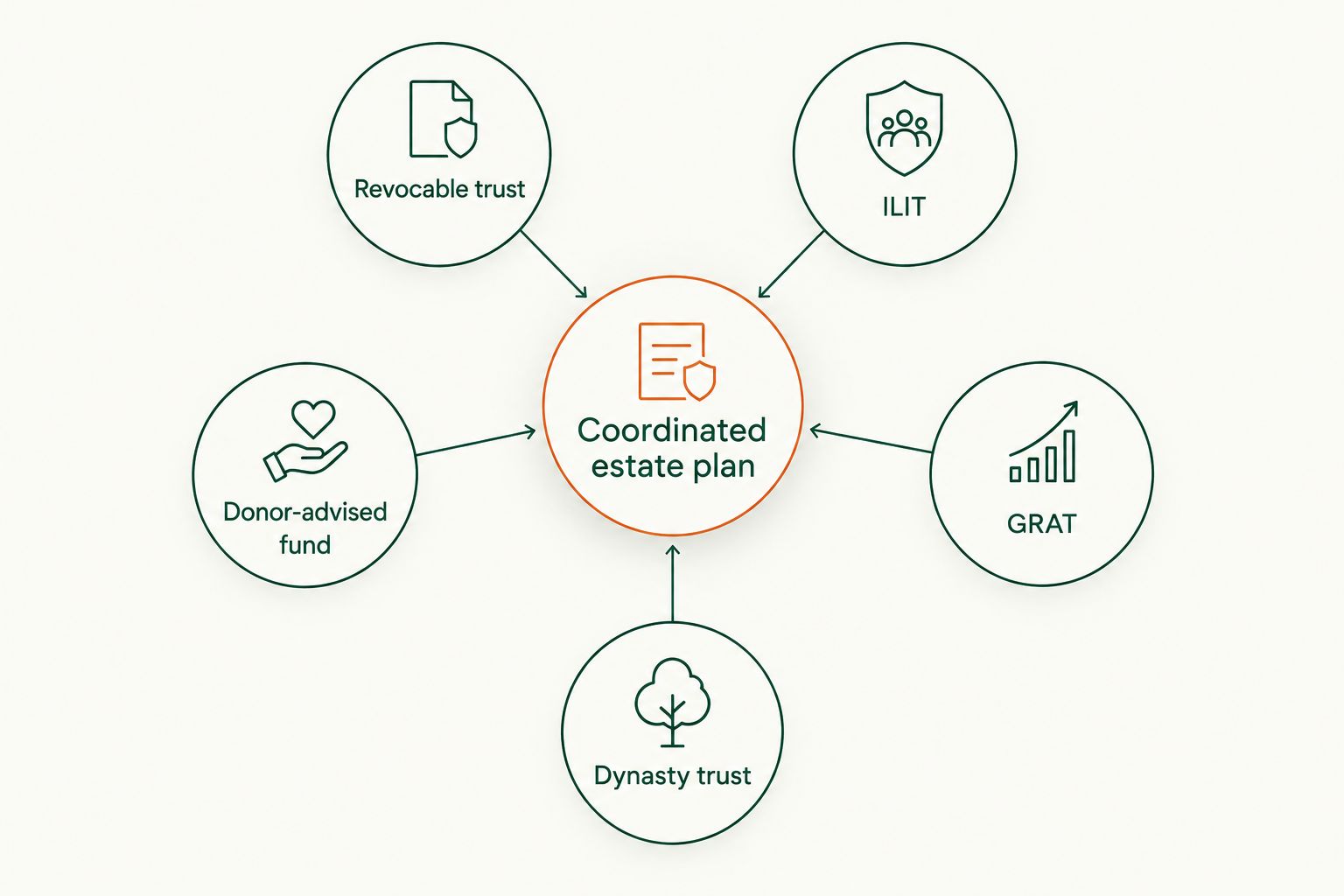
“The tool that fails a high net worth estate is rarely the trust itself, it's the missing coordination between the trust, the tax return, and the investment account.”
How we ranked these
The order above weighs coordination and tax efficiency first, since a document that isn't checked against the rest of the balance sheet drifts out of date within a few years. Cost and complexity come last, because a $2 million estate and a $15 million estate need genuinely different tools, not the same trust in different sizes.
Get one coordinated estate plan
Fee-only fiduciary planning for New England families with $1 million or more to manage.
Which estate planning tool should you choose in 2026?
If your estate is under $1 million with no business or multiple properties, a revocable living trust plus DIY software covers the basics. If you're above $1 million with a business, appreciating assets, or life insurance in the mix, the default move in 2026 is a fee-only fiduciary advisory relationship that coordinates a revocable trust, an ILIT where insurance is significant, and a GRAT or dynasty trust only once the math is confirmed. Anything less leaves tools sitting in a folder, unchecked against each other.
FAQ
What is the best estate planning tool for high net worth individuals in 2026?
A coordinated fee-only fiduciary advisory relationship ranks best overall for high net worth estates in 2026, since it checks trusts, insurance structures, and tax filings against each other rather than treating them as separate documents.
What is the federal estate tax exemption in 2026?
The federal estate tax exemption is $15 million per individual in 2026, and $30 million for a married couple filing jointly.
Is a revocable living trust enough for a high net worth estate?
A revocable living trust avoids probate but provides no estate tax protection on its own, since the assets remain legally yours while you're alive.
When does an ILIT make sense?
An irrevocable life insurance trust makes sense once a life insurance policy is large enough that its death benefit would meaningfully affect the taxable estate.
Is a GRAT better than a dynasty trust for high net worth families?
A GRAT works best for one concentrated asset expected to appreciate fast, while a dynasty trust is built for multi-generational transfer well above the 2026 exemption threshold; they solve different problems, not competing ones.
Can online estate planning software replace an estate attorney for high net worth estates?
No. Online estate planning software works for simple estates under $1 million but doesn't structure ILITs, GRATs, or dynasty trusts, and provides no fiduciary review of how the pieces fit together.
How often should a high net worth estate plan be reviewed?
An estate plan should be reviewed at least annually, and immediately after any change in tax law, a business sale, or a significant shift in net worth.
Does a donor-advised fund reduce estate tax?
A donor-advised fund removes contributed assets from your estate once funded, but only the amount actually contributed; it does not reduce estate tax on assets that stay outside the fund.
One last thing
The families who run into trouble in 2026 aren't the ones without a trust. They're the ones whose trust was drafted in 2015, funded once, and never checked against a business sale, a new grandchild, or the current $15 million exemption. The document isn't the risk — the review cadence is.