
Best overall for high net worth retirees in 2026: Roth conversion bracket-filling during the gap years before Required Minimum Distributions begin at age 73. Best for charitably inclined retirees: Qualified Charitable Distributions made directly from an IRA. Best for taxable brokerage accounts: tax-loss and gain harvesting paired with disciplined asset location. Best for legacy and estate tax exposure: irrevocable trust structures and lifetime gifting.
- Roth conversion bracket-filling ranks as the best tax planning strategy for high net worth retirees in the years before RMDs start at 73.
- Qualified Charitable Distributions let retirees satisfy RMDs without raising adjusted gross income.
- Tax-loss harvesting and asset location work together inside taxable brokerage accounts, not in isolation.
- Irrevocable trusts and lifetime gifting matter most for retirees with estates likely to exceed federal exemption levels.
- IRMAA surcharges are based on income from two years earlier, so 2026 decisions shape 2028 Medicare premiums.
Why this matters
A retiree with $1,000,000 or more spread across taxable, tax-deferred, and Roth accounts doesn't have one tax bill to manage — they have three account types, each taxed on a different schedule. The strategy that lowers this year's return can raise next year's Medicare premium or shrink an heir's inheritance. Vital Investment Management builds tax planning into the same conversation as retirement income and estate planning, rather than treating it as a once-a-year filing exercise.
The strategies below aren't ranked by popularity. They're ranked by how much lifetime tax exposure they actually remove for a retiree with meaningful assets, and who each one fits.
What makes the best tax planning strategy for high net worth retirees
- Reduces lifetime tax, not just this year's bill — a strategy that saves $2,000 now but triggers a bigger RMD-driven bracket jump at 73 isn't a win.
- Coordinates with RMD and IRMAA timing — income decisions in one year echo into Medicare premiums two years later.
- Works across account types — taxable, tax-deferred, and Roth accounts each need a different tax approach, not one blanket rule.
- Fits the estate plan — a tax move that conflicts with how assets pass to heirs isn't a net gain.
- Survives tax law changes — strategies built entirely around one provision expiring in a few years carry more risk than they save.
- Doesn't add complexity the household can't monitor — a strategy nobody reviews after year one usually stops working by year three.
At a glance: tax strategies for high net worth retirees in 2026
| Strategy | Best for | Standout feature | Key limitation |
|---|---|---|---|
| Roth conversion bracket-filling | The gap years before RMDs begin | Locks in today's bracket instead of a future unknown one | Requires cash outside the IRA to pay the conversion tax |
| Qualified Charitable Distributions | Charitably inclined IRA holders | Satisfies RMDs without raising AGI | Only works from IRAs, not 401(k)s directly |
| Tax-loss and gain harvesting | Taxable brokerage accounts | Offsets gains dollar-for-dollar in the same tax year | Needs ongoing monitoring, not a one-time fix |
| Asset location | Retirees with mixed account types | Places tax-inefficient assets where they cost less | Only matters once accounts reach meaningful size |
| Donor-advised fund bunching | Consistent annual givers | Converts several years of giving into one deduction year | Funds are irrevocable once contributed |
| Irrevocable trust and lifetime gifting | Estates near or above exemption levels | Moves future appreciation out of the taxable estate | Gifted assets are no longer accessible to the retiree |
1. Roth conversion bracket-filling: best for the years before RMDs start
This strategy converts a slice of a traditional IRA or 401(k) to a Roth account each year during retirement's lower-income window, usually between the retirement date and age 73 when RMDs begin. The goal is filling up the current tax bracket without spilling into the next one, paying tax now at a known rate instead of later at an unknown one.
Roth conversion pros:
- Shrinks future RMDs, which lowers the income that drives IRMAA surcharges
- Converted funds grow tax-free for the retiree and, often, for heirs
- Gives more control over which year the tax hit lands
Roth conversion cons:
- Requires paying conversion tax from funds outside the IRA to preserve the benefit
- Done in the wrong year, it can push income into a higher bracket or trigger IRMAA
Best for: retirees with a multi-year gap between stopping work and turning 73. A tax-efficient retirement account structure makes this conversion math far easier to run correctly.
Verdict: Priority for 2026.
2. Qualified Charitable Distributions: best for charitably inclined IRA holders
A QCD sends IRA funds directly to a qualified charity instead of to the retiree's bank account, and the amount counts toward the RMD without ever showing up as taxable income. It's one of the few moves in the tax code that reduces both the RMD obligation and the AGI in the same transaction.
QCD pros:
- Satisfies part or all of the RMD without raising AGI
- Lower AGI can mean lower Medicare IRMAA tier and less Social Security taxed
- Simple to execute through most custodians
QCD cons:
- Only available from IRAs, not workplace 401(k) or 403(b) plans directly
- Retirees under 70½ can't use it yet, so timing matters
Best for: retirees already giving to charity who currently write checks instead of routing gifts from the IRA.
Verdict: Priority for charitable retirees.
3. Tax-loss and gain harvesting: best for taxable brokerage accounts
Harvesting means selling positions at a loss to offset realized gains elsewhere in the same tax year, and sometimes selling winners deliberately in a low-income year to reset cost basis at the 0% or 15% capital gains rate instead of the top 20% rate. It's an ongoing discipline, not a once-a-year cleanup.
Harvesting pros:
- Offsets gains dollar-for-dollar in the same tax year
- Unused losses carry forward indefinitely
- Works alongside asset location for compounding effect
Harvesting cons:
- Wash-sale rules limit repurchasing the same or a substantially identical security for 30 days
- Needs regular portfolio review, which many DIY investors skip
Best for: retirees with taxable brokerage accounts holding both gains and losses across multiple positions.
Verdict: Priority, run continuously.
4. Asset location: best for retirees with mixed account types
Asset location places each investment type in the account where it's taxed least, rather than mirroring the same portfolio across every account. Bonds and REITs, which throw off ordinary income, typically sit better in tax-deferred accounts; high-growth equities often make more sense in Roth or taxable accounts where future gains face capital gains rates instead of ordinary income rates.
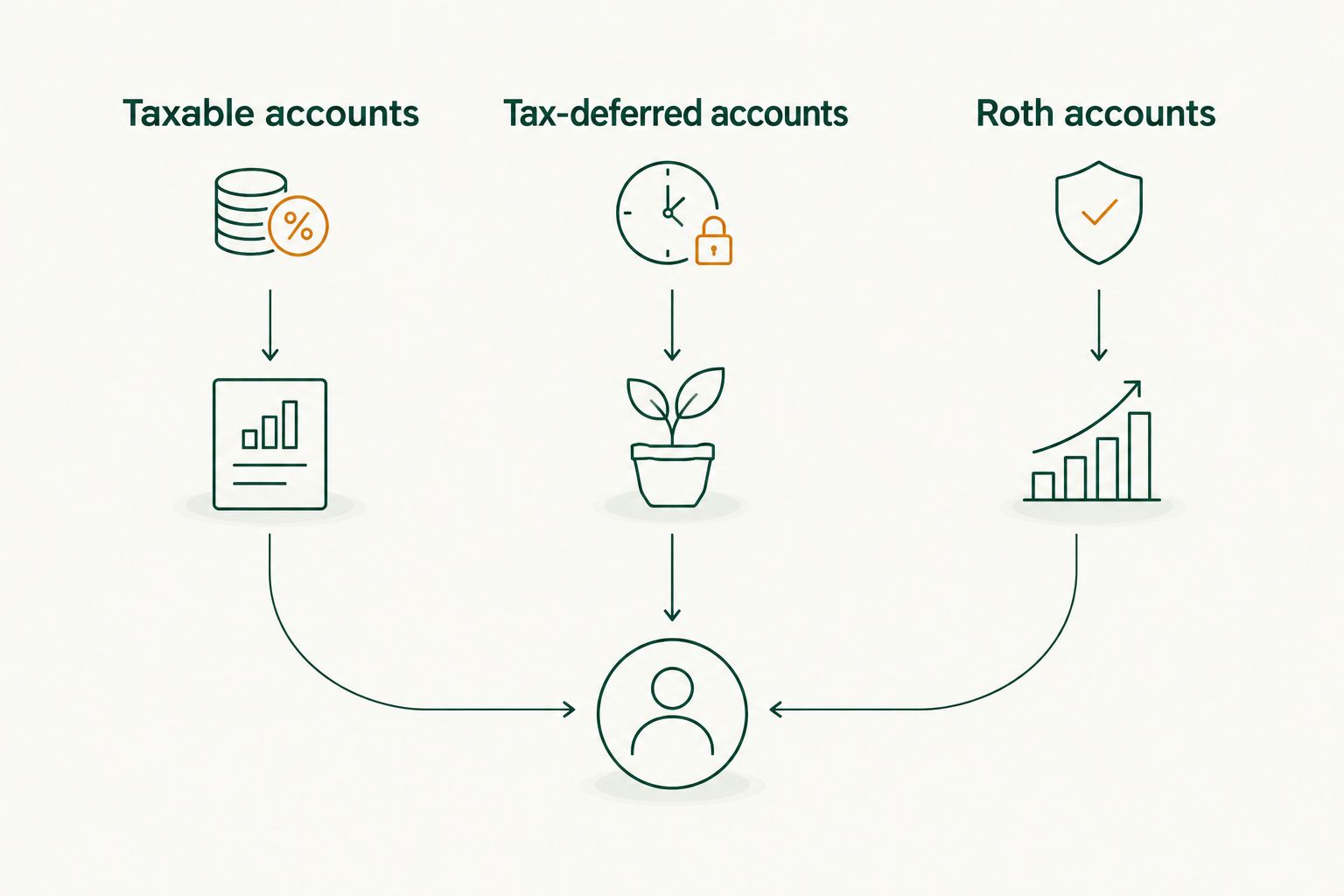
Asset location pros:
- Lowers the ongoing tax drag on investment income without changing the underlying allocation
- Complements harvesting instead of competing with it
- No transaction needed beyond a one-time restructuring
Asset location cons:
- Benefit is proportional to account size — small accounts see little difference
- Requires coordinating across every account a household holds, which gets harder with more accounts
Best for: retirees holding taxable, traditional, and Roth accounts simultaneously.
Verdict: Priority once accounts reach meaningful size.
5. Donor-advised fund bunching: best for consistent annual givers
Bunching combines several years of planned charitable giving into a single contribution to a donor-advised fund, taking one large itemized deduction in that year while distributing the money to charities over time. It's most useful for retirees whose annual giving alone wouldn't clear the standard deduction.
DAF bunching pros:
- Converts scattered giving into one deduction year that actually itemizes
- Appreciated securities can be donated directly, avoiding capital gains tax on the gift
- Grants to charities can still be paced out over several years
DAF bunching cons:
- Funds are irrevocable once contributed to the DAF
- Doesn't help retirees who give small, inconsistent amounts each year
Best for: retirees who give a similar amount to charity every year and want that giving to actually reduce taxes.
Verdict: Situational — depends on giving pattern.
6. Irrevocable trust and lifetime gifting: best for larger taxable estates
This strategy moves assets out of a retiree's taxable estate during their lifetime, either through direct gifting or through an irrevocable trust, so future appreciation on those assets happens outside the estate. It matters most for households whose net worth is approaching or above federal estate tax exemption levels.
Trust and gifting pros:
- Removes future growth on gifted assets from the taxable estate
- Can be structured to still benefit the retiree's spouse or descendants during their lifetime
- Reduces estate settlement complexity for heirs
Trust and gifting cons:
- Assets placed in an irrevocable trust are generally no longer accessible to the retiree
- Requires legal drafting and ongoing administration, not a form filled out once
Best for: retirees with estates likely to exceed exemption thresholds or who want more control over how wealth transfers. An estate planning strategy built for high net worth families usually pairs this move with a broader gifting schedule.
Verdict: Priority for larger estates, skip for smaller ones.
How we ranked these strategies
Each strategy above is scored against the six criteria listed earlier: lifetime tax reduction, RMD and IRMAA coordination, cross-account fit, estate alignment, durability against tax law changes, and manageable complexity. Roth conversion bracket-filling and QCDs rank highest because they hit nearly all six for most retirees with $1,000,000 or more in assets. Trust and gifting strategies rank as situational because they only apply meaningfully once an estate approaches exemption thresholds.
Which tax strategy should you choose in 2026?
For most high net worth retirees, the default move is Roth conversion bracket-filling paired with Qualified Charitable Distributions once RMDs begin — together they manage AGI on both ends of retirement. Layer in tax-loss harvesting and asset location inside taxable accounts, and add trust or gifting strategies only once the estate picture calls for it. None of these strategies work well pulled apart from the rest of the plan; a retirement strategy built for high net worth individuals treats tax planning as one piece of the same decision, not a separate project.
Talk through your 2026 tax plan
See how Roth conversions, QCDs, and estate moves fit your accounts.
FAQ
What are the best tax planning strategies for high net worth retirees in 2026?
Roth conversion bracket-filling before RMDs start at 73, Qualified Charitable Distributions after RMDs begin, and tax-loss harvesting inside taxable accounts cover the most ground for most retirees. Trust and gifting strategies matter more once the estate approaches exemption levels.
Is a Roth conversion worth it for retirees with $1,000,000 or more in assets?
Often yes, especially in the years between retirement and age 73 when income is temporarily lower. The conversion tax needs to come from funds outside the IRA for the strategy to actually pay off.
How do Qualified Charitable Distributions reduce taxes for retirees?
A QCD sends IRA funds directly to a charity, and that amount counts toward the RMD without appearing as taxable income. This keeps AGI lower, which can also help avoid a higher IRMAA tier.
What is asset location and why does it matter for tax planning?
Asset location means placing each investment type in the account taxed least for that asset, such as bonds in tax-deferred accounts and growth stocks in Roth or taxable accounts. It lowers ongoing tax drag without changing the overall portfolio allocation.
Do irrevocable trusts help retirees reduce estate taxes?
Yes, assets moved into an irrevocable trust generally leave the taxable estate, so future growth on them happens outside estate tax exposure. The tradeoff is that the retiree usually gives up direct access to those assets.
How does IRMAA affect retirement tax planning?
IRMAA surcharges on Medicare premiums are based on income reported two years earlier, so a large Roth conversion or capital gain in 2026 can raise Medicare costs in 2028. Timing income across years is part of managing IRMAA exposure.
Should high net worth retirees use municipal bonds?
Municipal bonds can make sense for retirees in high tax brackets who want income that isn't federally taxed, but the after-tax yield needs to be compared against taxable alternatives rather than assumed. It works best as part of a broader asset location plan, not a standalone move.
When should a retiree hire a fee-only fiduciary for tax planning?
Once RMDs, Roth conversions, and estate decisions start interacting with each other, a fee-only fiduciary who coordinates all of it in one plan tends to catch conflicts a single-issue tax preparer misses. This matters most for households with $1,000,000 or more across multiple account types.
One last thing
Most retirees plan Roth conversions and RMDs around this year's tax bracket and stop there. The IRMAA look-back means a conversion done in 2026 doesn't show up as a Medicare premium surcharge until 2028 — by the time the bill arrives, the decision is two years old and impossible to undo. Anyone converting a meaningful amount in 2026 should already know what their 2028 Medicare premium is projected to look like before filing the return.