
The best investment strategies for high net worth individuals in 2026 don't start with a fund pick — they start with coordinating tax location, concentration risk, and estate transfer under one plan.
- Best overall: coordinated asset location across every account, not fund-picking, drives the biggest after-tax gain in 2026.
- Concentrated stock from equity comp or a sale needs a diversification plan before a liquidity event, not after.
- Tax-loss harvesting and direct indexing cut the most from a seven-figure taxable account's annual tax bill.
- Multi-generational transfer strategies only pay off when built alongside the investment plan, not bolted on later.
- A fee-only fiduciary who sees the whole balance sheet outperforms strategy-hopping without a coordinated plan.
Why this matters
A $1 million portfolio and a $10 million portfolio don't need different funds. They need different plumbing: which account holds which asset, how a concentrated position gets unwound without a six-figure tax bill, and whether the estate plan and the investment plan are actually talking to each other.
Most "best strategy" roundups for high net worth individuals are really lists of products. The strategies below are decisions — the ones that move after-tax outcomes the most in 2026, regardless of which market index does what this year. Vital Investment Management builds these decisions around an advisor who sees the full balance sheet, not one account at a time.
What makes the best investment strategy for high net worth individuals
- Coordinates every account you hold — taxable, retirement, trust — instead of optimizing one in isolation
- Treats concentration risk from equity comp, a business sale, or inherited stock as a solvable problem, not a footnote
- Manages tax brackets across multiple years, not just tax-deferral in a single year
- Builds estate and gifting moves into the plan before a liquidity event, not after
- Comes from a fiduciary who sees the full balance sheet, not just one brokerage statement
- Rebalances around after-tax, after-fee return, not headline return
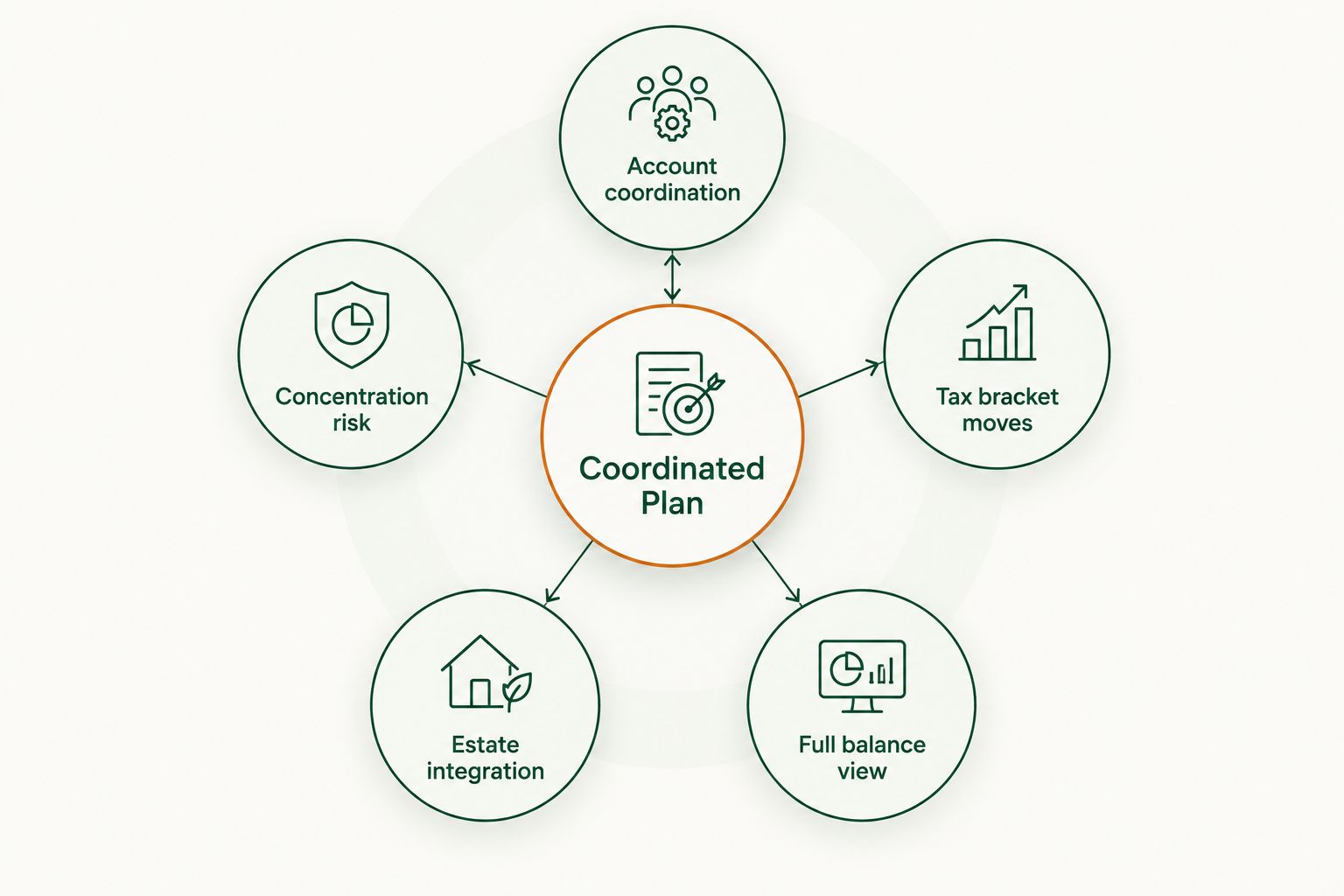
Investment strategies for high net worth individuals at a glance
| Strategy | Best for | Standout feature | Key limitation |
|---|---|---|---|
| Coordinated asset location | Anyone with more than one account type | Cuts tax drag without changing what you own | Needs a full-picture advisor, not fund-picking alone |
| Diversifying concentrated stock | Executives, founders, equity-comp holders | Exchange funds and 10b5-1 plans cut single-stock risk without an immediate tax bill | Exchange funds lock up capital for years |
| Tax-loss harvesting + direct indexing | Large taxable brokerage accounts | Harvests losses at the individual stock level, not just the fund level | Only pays off with meaningful account size and volatility |
| Backdoor and mega backdoor Roth conversions | High earners phased out of direct Roth contributions | Moves after-tax dollars into tax-free growth | Pro-rata rule complicates the math with existing pre-tax IRA balances |
| Donor-advised funds and charitable trusts | Charitably inclined families with appreciated assets | Deducts the gift now, decides the charity later | Contribution is irrevocable once made |
| Alternative and private market allocation | Accredited investors wanting exposure beyond public markets | Adds return sources uncorrelated with stocks and bonds | Illiquid, higher fees, harder to exit early |
| Irrevocable trusts and lifetime gifting | Multi-generational wealth transfer | Moves future appreciation out of a taxable estate | Irreversible once assets move into most trust structures |
1. Coordinated asset location: best investment strategy for high net worth individuals overall
Asset location decides which account holds bonds, which holds growth stocks, and which holds alternative assets, based on how each account is taxed. Paired with ongoing tax-bracket management, it changes a portfolio's after-tax return without touching the underlying holdings. For someone with a taxable brokerage account, a 401(k) or SEP-IRA, and maybe a trust, random placement versus coordinated placement compounds every single year.
Coordinated asset location pros:
- Lowers a portfolio's tax drag without adding risk
- Works across every account type at once, not fund by fund
- Pairs naturally with ongoing tax-bracket planning
Coordinated asset location cons:
- Requires visibility into every account, including ones outside a single custodian
- Shows up as "tax saved," not a headline return, so it's easy to underrate
- Needs rebalancing discipline or the benefit erodes within a year or two
Verdict: Adopt as the baseline for any portfolio over $1 million in 2026. This is table stakes, not an optional add-on.
2. Diversifying a concentrated stock position: best investment strategy for high net worth individuals with equity comp or a recent liquidity event
Exchange funds pool concentrated stock from multiple holders into a diversified basket without an immediate sale. 10b5-1 trading plans set a systematic, pre-scheduled sale schedule for insiders. Both cut single-stock risk on different timelines, and business owners face the same problem in a private company after a sale — covered in wealth management strategies for business owners.
Pros:
- Reduces single-stock risk without dumping shares at a bad moment
- 10b5-1 plans remove emotion and timing decisions from insider selling
- Exchange funds can defer a tax event for years
Cons:
- Exchange funds typically lock up capital for a multi-year holding period
- 10b5-1 plans still require compliant setup timing
- Not available or practical for every equity-comp structure
Verdict: Adopt before the position doubles, not after it drops.
3. Tax-loss harvesting with direct indexing: best investment strategy for high net worth individuals with a large taxable account
Direct indexing holds the individual stocks in an index rather than a fund, so losses in specific names get harvested even when the index itself is up for the year. It separates the tax lot from the index lot, generating offsets a pooled fund can't.
Pros:
- Harvests losses at the stock level, not just the fund level
- Losses offset gains elsewhere in the portfolio, including from a concentrated stock sale
- Customizable to exclude sectors or single stocks
Cons:
- Only pays off with meaningful account size and enough position count for dispersion
- Adds tracking error versus the benchmark index
- Ongoing trading generates more tax lots to manage
Verdict: Adopt for taxable accounts with real size and volatility; skip for small accounts where trading costs outweigh the benefit.
“A strategy that can't survive a rebalance in a taxable account isn't actually tax-efficient.”
4. Backdoor and mega backdoor Roth conversions: best investment strategy for high net worth individuals phased out of direct Roth contributions
A backdoor Roth conversion moves after-tax dollars from a traditional IRA into a Roth IRA. A mega backdoor Roth does the same at much larger scale through an after-tax 401(k) contribution, when the employer plan allows it.
Pros:
- Gets tax-free growth for high earners locked out of direct Roth contributions
- Mega backdoor version can move far more per year than a standard backdoor
- No income limit on the conversion step itself
Cons:
- The pro-rata rule complicates the math if you already hold pre-tax IRA balances
- Not every 401(k) plan allows after-tax contributions or in-plan conversions
- Conversion creates a taxable event in the year it happens
Verdict: Adopt if your plan supports it and the pro-rata math checks out; wait if it doesn't.
5. Donor-advised funds and charitable trusts: best investment strategy for high net worth individuals who give to charity
A donor-advised fund takes an irrevocable contribution now — often appreciated stock — and lets the donor recommend grants to specific charities over time, decoupling the tax deduction from the giving decision. Charitable remainder and lead trusts add income or estate benefits on top.
Pros:
- Deduction happens in the contribution year; charity choice happens later
- Appreciated stock goes in without triggering the capital gain first
- Trust versions can generate income or reduce estate size at the same time
Cons:
- Contributions are irrevocable — the money is out of your estate for good
- Trust structures carry setup and ongoing administration
- Doesn't help if you're not already charitably inclined
Verdict: Adopt for appreciated-stock giving; skip if cash giving is simpler for your situation.
6. Alternative and private market allocation: best investment strategy for high net worth individuals seeking return sources outside public markets
Private equity, private credit, and real estate allocations add return drivers that don't move in lockstep with public stocks and bonds, typically available to accredited investors through funds or direct deals.
Pros:
- Return sources less correlated with daily stock and bond swings
- Access to deal flow not available in a public brokerage account
- Can smooth reported volatility versus a public-only portfolio
Cons:
- Illiquid — capital can be locked up for years with no early exit
- Fees run higher than public market funds
- Requires real due diligence; not every fund or sponsor performs
Verdict: Consider a modest allocation once the liquid portfolio and estate plan are already in order; skip as a first move.
7. Irrevocable trusts and lifetime gifting: best investment strategy for high net worth individuals planning a multi-generational transfer
Irrevocable trusts and structured gifting move assets — and their future appreciation — out of a taxable estate while the person is still alive, ahead of estate tax exposure. The right structure depends on family goals as much as account balances, detailed in estate planning strategies for high net worth families.
Pros:
- Future growth on gifted assets happens outside the taxable estate
- Structured gifting can happen over years, spreading out the transfer
- Can be paired with life insurance or a GRAT for larger estates
Cons:
- Irreversible once assets move into most trust structures
- Requires legal drafting coordinated with the investment plan, not a DIY move
- Only relevant once total assets are large enough to face real estate tax exposure
Verdict: Adopt early for multi-generational wealth; waiting until later in life narrows the options.
Get a coordinated wealth plan
See how these strategies fit your specific accounts.
How we ranked these strategies
Each strategy above is scored against the six criteria listed earlier: account coordination, concentration-risk handling, multi-year tax management, estate integration, fiduciary visibility, and after-tax return. Coordinated asset location ranks first because it applies to every high net worth portfolio in 2026 regardless of what else is going on; the rest solve a specific problem that not everyone has yet.
Which investment strategy should you choose in 2026?
If you only do one thing this year, coordinate asset location across every account you hold — it's the one strategy with no downside and no prerequisite. Layer in concentration-risk management if equity comp or a business sale left you overweight one stock, and bring estate and gifting moves into the plan well before a major liquidity event, not after one.
For someone with more than $1 million in investable assets across New England, the harder part usually isn't picking a strategy — it's finding one advisor who coordinates all of them under a single fee-only relationship instead of handing pieces to separate specialists.
FAQ
What's the best investment strategy for high net worth individuals in 2026?
Coordinated asset location across every account ranks best overall in 2026 because it applies regardless of portfolio size or market conditions. Strategies like concentrated stock diversification or trust planning matter more once a specific risk, like equity comp or a large estate, is actually present.
Is direct indexing better than a total market index fund for a large taxable account?
Direct indexing beats a fund for tax-loss harvesting because it holds individual stocks, not a single fund share. A traditional index fund is simpler and cheaper to run when tax-loss harvesting isn't the priority.
How does asset location differ from asset allocation?
Asset allocation decides what percentage goes into stocks, bonds, and alternatives; asset location decides which account holds each of those assets based on how the account is taxed. Both matter, but location is the piece most portfolios get wrong.
When should a concentrated stock position get diversified?
Diversify a concentrated position before it grows large enough to dominate the portfolio, not after a drop forces the issue. Exchange funds and 10b5-1 plans both work best when set up ahead of a known liquidity event.
Do high net worth individuals need alternative investments?
Alternative investments aren't required, but they add return sources uncorrelated with public stocks and bonds once the core liquid portfolio and estate plan are already in order. They're a later addition, not a starting point.
How does a fee-only fiduciary differ from a commission-based advisor?
A fee-only fiduciary is paid directly by the client and has no incentive to sell a specific product, while a commission-based advisor earns from the products they recommend. That structural difference is why fee-only fiduciary status matters for coordinating strategies across accounts.
What estate planning strategies matter most for high net worth families?
Irrevocable trusts and structured lifetime gifting matter most once total assets are large enough to face real estate tax exposure. The earlier these move into the plan, the more options a family keeps.
How often should a high net worth investment strategy be reviewed?
A coordinated wealth strategy needs at least an annual review to rebalance asset location and check tax-bracket moves, with additional reviews after any liquidity event, sale, or inheritance. Waiting until year-end alone misses mid-year tax-loss harvesting opportunities.
One last thing
The single biggest driver of after-tax return for a $1 million-plus portfolio in 2026 isn't security selection — it's whether every account is coordinated by one fiduciary who can see the whole balance sheet. Vital Investment Management, working with advisor Rusty Tredwel across New England and Colorado, builds that coordination into one relationship instead of splitting it across a broker, a CPA, and an estate attorney who never talk to each other.