
Losing a spouse rewrites your financial life overnight, and the advisor you choose next either steadies that transition or adds to the chaos. This guide ranks the six qualities that actually protect a widow's assets and decision-making in 2026, not the credentials that just look good on a business card.
- Best overall quality: fee-only fiduciary status, because it removes commission-driven advice at the exact moment you're least equipped to spot it.
- Best for emotional readiness: documented experience guiding widows through the first 12-18 months after a loss.
- Best for avoiding fragmented advice: one advisor who handles investments, taxes, and estate planning together instead of three disconnected specialists.
- The best financial advisor qualities for widows in 2026 combine fiduciary duty, grief-aware communication, and integrated planning under one roof.
- Vital Investment Management, an SEC-registered RIA based in Marblehead, Massachusetts, is structured around this exact combination for New England households.
Why this matters
A widow managing $1 million or more in assets is often approached by more advisors in the first year after a loss than at any other point in her life. Some of that outreach is well-intentioned. A lot of it is sales activity dressed up as sympathy.
The qualities on this list exist to filter that noise. Start with fiduciary financial advisor qualities as the baseline screen, then layer in the widow-specific criteria below before you sign anything in 2026.
What makes the best financial advisor qualities for widows
- Fiduciary duty, not fiduciary claims — a legal obligation to act in your interest, verifiable through Form ADV, not a marketing line
- Grief-literate communication — an advisor who slows down, repeats things, and doesn't push decisions in the first few meetings
- Integrated planning — investments, taxes, and estate work handled as one plan, not handed to three separate firms
- Verifiable credentials — CFP or CFA designation plus a clean disclosure record on BrokerCheck or IAPD
- Local access — in-person meetings available for the decisions that shouldn't happen over a screen
- Fee transparency — a flat or asset-based fee stated plainly, with no commission products layered on top
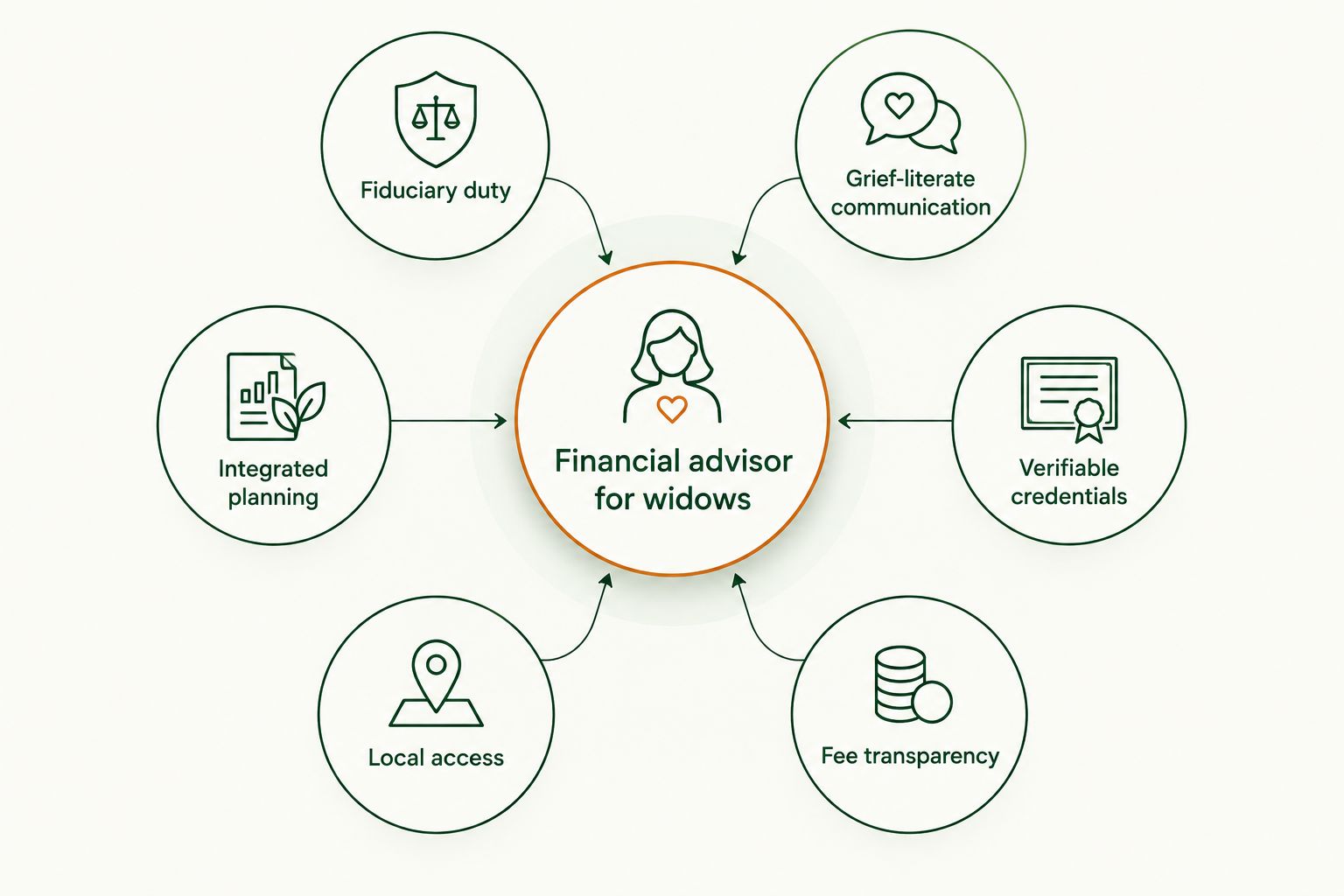
At a glance: the qualities compared
| Quality | Best for | Standout feature | Key limitation |
|---|---|---|---|
| Fee-only fiduciary status | Avoiding conflicts of interest | No commission on products sold | Doesn't guarantee bedside manner |
| Widow transition experience | Emotional readiness in year one | Pace matches your capacity, not a sales calendar | Hard to verify without asking directly |
| Integrated planning | Avoiding fragmented advice | One advisor sees the whole balance sheet | Fewer specialists means more depends on one relationship |
| Verifiable credentials | Technical competence | CFP/CFA training plus a public disclosure record | A clean record doesn't confirm communication style |
| Local, in-person access | Ongoing comfort with big decisions | Face-to-face meetings for the calls that matter | Less useful if you relocate frequently |
| Plain-language communication | Confidence in your own decisions | Explanations without jargon | Can't fix a plan that's poorly built underneath |
1. Fee-only fiduciary status: best for avoiding conflicts of interest
A fee-only fiduciary is paid directly by you, not by commissions on the products they recommend. That single structural fact removes the incentive to steer a widow toward an annuity or insurance product that pays the advisor more than it helps her.
Fee-only fiduciary pros:
- Legal duty to act in your interest, not just a suitability standard
- No commission products muddying the recommendation
- Fee structure is disclosed and easy to check against Form ADV
Fee-only fiduciary cons:
- Still requires you to verify the fee-only claim independently
- Doesn't by itself guarantee grief-aware communication
Read the specifics on fee-only financial advisor qualifications before your first meeting. Best for: widows who want the conflict-of-interest question settled before discussing anything else. Verdict: non-negotiable.
2. Widow transition experience: best for emotional readiness support
This is the advisor who has sat across from a widow in the first six months after a loss and knows the difference between a decision that needs to happen now and one that can wait a year. That patience is not a soft skill — it prevents rushed asset moves that create tax problems or lock in losses.
Transition experience pros:
- Fewer decisions forced in the first months after a loss
- Meeting pace adjusts to what you can actually process
- Recognizes when a decision (like selling a home) can wait
Transition experience cons:
- Hard to verify from a website or brochure alone — ask for specifics
- A slower pace can frustrate widows who prefer to move fast
Best for: the first 12 to 18 months after a spouse's death, when every decision feels urgent but few actually are. Verdict: must-have.
3. Integrated planning: best for avoiding fragmented advice
An integrated advisor manages investments, tax planning, and estate documents as one coordinated plan instead of routing you to three separate professionals who never talk to each other. For a widow settling an estate, that coordination matters more in 2026 than at almost any other point in the relationship.
Integrated planning pros:
- One advisor sees the full financial picture, not a slice of it
- Tax and estate decisions get made with investment strategy in view
- Fewer handoffs, fewer things that fall through the cracks
Integrated planning cons:
- Puts more weight on one relationship rather than spreading it across specialists
- Requires the advisor to be genuinely competent across disciplines, not just claiming to be
See how this plays out for larger estates in estate planning strategies for high-net-worth families. Best for: widows settling an estate with investment accounts, tax exposure, and legal documents all in motion at once. Verdict: must-have.
4. Verifiable credentials: best for confirming technical competence
A CFP or CFA designation signals a baseline level of technical training, but the credential alone doesn't tell you how someone will treat you during a hard year. Pair the designation check with a look at their disclosure history on BrokerCheck or IAPD.
Credentials pros:
- Objective, checkable signal of technical training
- Disclosure history flags past complaints or regulatory action
- Easy to verify in minutes before a first call
Credentials cons:
- Says nothing about bedside manner or communication style
- A clean record doesn't mean the advisor is the right personal fit
Best for: the five-minute background check every widow should run before a first meeting, in 2026 or any year. Verdict: confirm directly.
5. Local, in-person access: best for ongoing comfort with big decisions
Some decisions — selling a house, retitling accounts, meeting with an estate attorney — go better face-to-face than over a screen. Advisors based in the region you live in, whether that's coastal New England or elsewhere, can meet for those moments without adding a time zone or a flight to an already hard day.
Local access pros:
- In-person meetings for decisions that carry emotional weight
- Familiarity with regional estate and tax rules where you live
- Easier to build a relationship that feels personal, not transactional
Local access cons:
- Less relevant if you split time between multiple states
- Doesn't replace the need for fiduciary status or fee transparency
Best for: widows who want a financial life managed by someone they can sit across from, not just email. Verdict: nice-to-have, valuable when available.
6. Plain-language communication: best for confidence in your own decisions
An advisor who explains a required minimum distribution or a trust provision in plain English gives you something more valuable than the explanation itself: the ability to make the next decision without calling back three times to ask what it meant.
Plain-language communication pros:
- You leave meetings understanding the decision, not just agreeing to it
- Reduces the anxiety of managing money you didn't build the plan for
- Makes it easier to catch a recommendation that doesn't sit right
Plain-language communication cons:
- Communication style alone can't fix a poorly built underlying plan
- Subjective — what feels clear to one widow may not to another
Best for: widows who were not the primary financial decision-maker in the marriage and are building that muscle now. Verdict: must-have.
Talk through your situation directly
A fee-only fiduciary conversation, no product pitch.
How we ranked these qualities
Each quality was weighted against the six criteria above: fiduciary duty, grief-literate communication, integrated planning, verifiable credentials, local access, and fee transparency. Fiduciary status and integrated planning rank highest because they're structural — they hold regardless of who's sitting across the table. Local access and communication style rank as valuable but secondary, since they matter more once the structural questions are already answered.
Which quality should you prioritize first in 2026?
Start with fee-only fiduciary status — it's the fastest disqualifier and takes minutes to verify. From there, prioritize an advisor with real transition experience and an integrated approach to investments, taxes, and estate planning, since fragmented advice is where widows lose the most ground in the first two years. The best financial advisor qualities for widows in 2026 are fiduciary duty and integrated planning first, with local access and communication style as the tiebreakers between two otherwise qualified advisors.
FAQ
What is the most important quality in a financial advisor for widows?
Fee-only fiduciary status is the most important quality because it legally requires the advisor to act in your interest rather than earn commissions on products they recommend. Verify it through the advisor's Form ADV before your first meeting.
Is a fee-only advisor better than a commission-based advisor for a widow?
Yes, for widows managing a lump sum after a loss, a fee-only advisor removes the incentive to sell annuities or insurance products that pay higher commissions. Commission-based advisors aren't required to put your interest ahead of their own.
How soon after a spouse's death should a widow meet with a financial advisor?
Most major financial decisions can wait several months, but an initial conversation with a fee-only fiduciary in the first 60 to 90 days helps identify anything truly time-sensitive, like beneficiary updates. A grief-literate advisor will not push decisions before you're ready.
What credentials should a widow look for in a financial advisor?
A CFP (Certified Financial Planner) or CFA designation signals technical training, and both credentials are checkable through public databases. Pair that with a disclosure history search on BrokerCheck or IAPD before signing an agreement.
Should a widow use one advisor for investments, taxes, and estate planning?
Integrated planning with one advisor reduces the risk of decisions made in isolation, such as a tax move that conflicts with an estate strategy. It works best when that advisor genuinely has competence across all three areas, not just one.
How can a widow verify an advisor is actually a fiduciary?
Ask directly whether the advisor is a fee-only fiduciary at all times, then confirm it against their Form ADV filing, which is public. An advisor who hesitates to answer directly is a warning sign.
Does local access matter when choosing a financial advisor?
Local access matters most for decisions that benefit from meeting in person, like reviewing estate documents or discussing a home sale. It matters less for widows who split time across multiple states or prefer remote meetings.
What red flags should a widow watch for in a financial advisor?
Pressure to make quick decisions, vague answers about fee structure, and recommendations toward annuities or insurance products early in the relationship are all warning signs. A fiduciary advisor should welcome questions about how they're paid.
One last thing
The advisor conversation that reveals the most in 2026 isn't about performance numbers — it's asking directly how they're paid and watching how quickly and plainly they answer. A fee-only fiduciary answers in one sentence; anyone who hedges is telling you something worth hearing.