
Executives who get paid in RSUs, ISOs, or NSOs face a different planning problem than salaried employees: most of their net worth sits in one stock, and every decision about selling it carries a tax consequence. The best financial planning strategies for equity compensation executives in 2026 rank concentration risk management first, followed by tax-timed option exercises, insider trading compliance, and estate coordination.
- Concentration risk diversification is the best overall strategy for equity comp executives holding RSU-heavy positions in 2026.
- ISO and NSO exercise timing controls AMT exposure and belongs on a multi-year tax calendar, not a single trade.
- 10b5-1 trading plans are the standard tool for company insiders who need to sell on a schedule set before they hold material information.
- QSBS and 83(b) elections only work inside strict deadlines - the 83(b) window closes 30 days after grant with no extensions.
- A fee-only fiduciary who coordinates tax, trading rules, and estate planning outperforms a single-issue tax preparer for equity comp executives.
Why this matters
Equity compensation stops being a bonus and starts being a balance sheet problem once it grows past a small slice of net worth. An executive holding $2 million in vested RSUs at one Boston-area biotech, or a founder sitting on ISOs ahead of an exit, is not diversified no matter how the rest of the portfolio looks.
A fee-only fiduciary has to weigh the tax bill against the concentration risk every year, not just at exercise or vesting. That coordination - tax, trading compliance, and long-term planning under one roof - is what separates a real strategy from a spreadsheet full of guesses. 2026 brackets, 2026 AMT exemption amounts, and 2026 blackout calendars all move the math, so a plan built in 2024 is already stale.
What makes the best equity comp strategy for executives
- Addresses concentration risk directly instead of treating diversification as a someday task
- Fits the executive's actual tax bracket and AMT exposure, not a generic online calculator's output
- Coordinates trading windows and insider restrictions with the compensation plan itself
- Ties equity decisions to the full retirement and estate plan, not just the stock price
- Comes from a fiduciary legally bound to the client's outcome, not a commission on the trade
- Gets monitored year over year as brackets, vesting schedules, and company events change
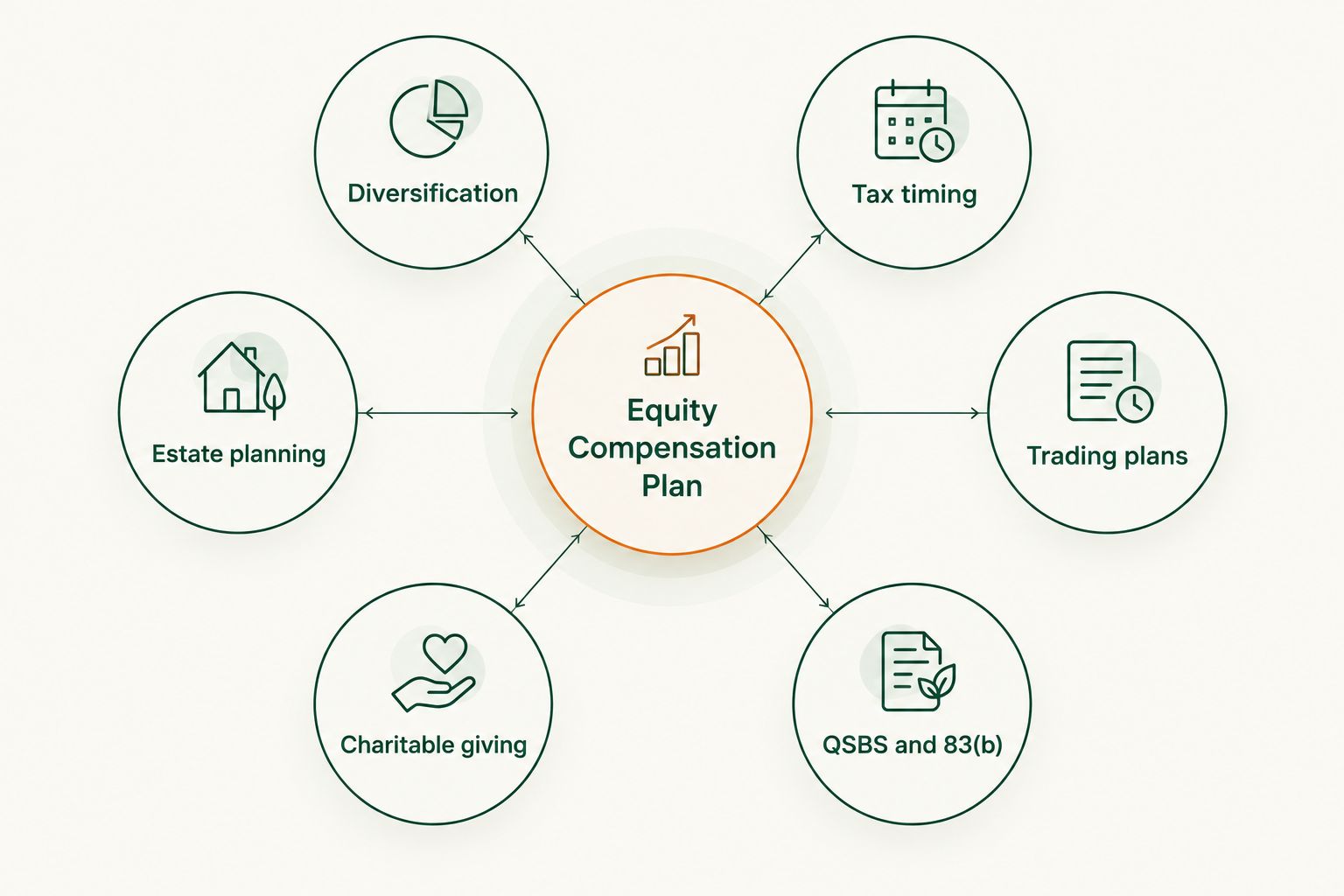
Equity comp strategies at a glance
| Strategy | Best for | Key benefit | Key limitation |
|---|---|---|---|
| Concentration risk diversification | RSU-heavy executives with one stock over-weighted | Cuts single-stock risk without dumping the whole position at once | Selling still triggers a capital gains bill in the year of the trade |
| ISO/NSO and AMT tax planning | Optionholders at pre-IPO or newly public companies | Times exercises to control AMT and ordinary income exposure | Needs exercise cash up front and multi-year projections |
| 10b5-1 trading plans | Company insiders with blackout window restrictions | Lets insiders sell on a pre-set schedule, clear of material information | Terms lock in at adoption and can't react to news |
| QSBS and 83(b) elections | Early-stage and pre-IPO equity holders | Can exclude up to $10 million of gain under Section 1202 | 83(b) election must be filed within 30 days of grant or it's gone |
| Charitable giving with appreciated stock | High earners near the 37% top bracket | Avoids capital gains tax and generates a deduction in one move | Only makes sense with real philanthropic intent |
| Estate planning integration | High-net-worth families with concentrated equity wealth | Moves appreciated shares out of the taxable estate before more gains build up | Requires the advisor, attorney, and CPA to actually coordinate |
1. Concentration risk diversification: best for RSU-heavy portfolios
This is the strategy every equity comp executive needs first, before tax optimization or estate work matters at all. It sets a target ceiling - often below 10% of net worth in one stock - and sells down toward it on a schedule instead of all at once.
Concentration risk diversification pros:
- Removes the single biggest threat to long-term net worth: one company's stock price
- Can be paired with tax-loss harvesting elsewhere in the portfolio to offset gains
- Works whether the stock is RSUs, ISOs already exercised, or founder shares
Concentration risk diversification cons:
- Selling appreciated shares still creates a tax bill the same year
- Executives with real conviction in their own company sometimes resist the discipline
Verdict: Act now. Every other strategy on this list assumes concentration risk is already being managed - start here.
2. ISO/NSO and AMT tax planning: best for pre-IPO optionholders
Incentive stock options create phantom income for AMT purposes the moment they're exercised and held, even before a sale. This strategy models exercise timing across multiple tax years to avoid stacking a large AMT hit in one filing season.
ISO/NSO tax planning pros:
- Can spread option exercises across years to smooth AMT exposure
- Coordinates with the qualifying disposition holding period for favorable long-term rates
- Catches cases where an 83(b) election on early-exercised ISOs makes sense
ISO/NSO tax planning cons:
- Requires cash on hand to exercise before a liquidity event exists
- Projections go stale fast if the company's valuation or IPO timeline shifts
Verdict: Plan with an advisor. This is not a strategy to run from a tax software estimate the week before year-end.
3. 10b5-1 trading plans: best for company insiders
Executives and directors classified as insiders can't trade freely around earnings or material nonpublic information. A 10b5-1 plan, adopted during an open window, sets predetermined trade instructions that execute later regardless of what the insider knows at that point.
10b5-1 plan pros:
- Provides an affirmative defense against insider trading claims when structured correctly
- Lets insiders diversify out of concentrated stock on autopilot
- Removes the emotional decision of when to sell
10b5-1 plan cons:
- Once adopted, trade instructions are locked - no reacting to news
- SEC rules impose a cooling-off period before trades under a new plan can begin
Verdict: Situational, but high-value for insiders. If a blackout calendar governs your trading, this belongs in the plan.
4. QSBS and Section 83(b) elections: best for early-stage equity holders
Qualified Small Business Stock under Section 1202 can exclude up to $10 million of gain (or 10 times basis, if greater) for stock held more than five years in a qualifying C-corp. The 83(b) election, filed within 30 days of an early exercise or restricted stock grant, locks in ordinary income tax at today's low valuation instead of a future, higher one.
QSBS/83(b) pros:
- The $10 million QSBS exclusion is one of the largest tax breaks available to founders and early employees
- An 83(b) election on unvested shares can convert future gain into long-term capital gains treatment
- Both strategies reward early planning at grant, not after the fact
QSBS/83(b) cons:
- The 83(b) election window is exactly 30 days - miss it and the opportunity is gone permanently
- QSBS eligibility depends on the company structure and gross assets at issuance, which the executive doesn't control
Verdict: Act now if eligible, skip if the window has closed. There is no retroactive fix for a missed 83(b) filing.
5. Charitable giving with appreciated stock: best for high tax brackets
Donating appreciated shares directly to a donor-advised fund or qualified charity avoids the capital gains tax that a sale-then-donate approach would trigger, while still producing a deduction at fair market value.
Charitable giving pros:
- Avoids the 23.8% top capital gains and NIIT rate on the donated shares entirely
- Deduction value is based on fair market value, not the lower cost basis
- Reduces concentration risk and taxable income in the same transaction
Charitable giving cons:
- Only makes financial sense alongside genuine giving intent, not as a standalone tax play
- Deduction limits apply as a percentage of adjusted gross income in a given year
Verdict: Use when it fits the goal. This is a tool for executives already planning to give, not a reason to start.
6. Estate planning integration: best for concentrated family wealth
Once equity compensation has built real wealth, moving appreciated shares into trusts or gifting structures before further appreciation accrues keeps future growth out of the taxable estate. This strategy only works when the advisor, estate attorney, and CPA are actually coordinating on the same numbers.
Estate planning integration pros:
- Shifts future appreciation out of the estate while current value is still lower
- Can combine with charitable and diversification strategies in the same plan
- Protects a concentrated position from being a single point of failure for heirs
Estate planning integration cons:
- Requires legal documents and ongoing coordination, not a one-time transaction
- Poorly timed transfers can trigger gift tax reporting the family didn't expect
Verdict: Plan with an advisor, ideally years before a liquidity event.
“A single stock position over 10% of net worth is concentration risk, not conviction.”
How this list was ranked
Each strategy was scored against the six criteria above: does it reduce concentration risk, does it account for actual tax bracket and AMT exposure, does it respect insider trading rules, does it connect to retirement and estate goals, does it come from a fiduciary standard, and can it be monitored year after year. Strategies that only pass one or two of those tests rank lower even when they save money in isolation.
Which equity comp strategy should you choose in 2026?
Start with concentration risk diversification if a single stock is over 10% of net worth - it's the strategy every other item on this list assumes is already in motion. Optionholders at pre-IPO companies should move next to ISO/NSO tax timing before an exercise deadline forces a decision. Insiders need a 10b5-1 plan in place before the next blackout window closes, and anyone with QSBS-eligible stock or an unvested grant needs to check the 83(b) clock immediately - it does not wait.
Get a plan for your equity compensation
Coordinated tax, trading, and estate planning under one fiduciary relationship.
FAQ
What is the best financial planning strategy for equity compensation executives in 2026?
Concentration risk diversification ranks first for most equity comp executives in 2026 because it addresses the single biggest threat - too much net worth tied to one stock - before tax optimization matters. ISO/NSO timing and 10b5-1 plans follow depending on the executive's role and holdings.
Should I exercise my ISOs before an IPO?
It depends on AMT exposure, available cash, and how confident the exercise-and-hold period is worth the risk of the company's valuation dropping. This decision should be modeled across multiple tax years, not decided the week of a liquidity event.
How does a 10b5-1 plan work for company insiders?
A 10b5-1 plan sets trade instructions in advance, during an open trading window, that execute later regardless of what the insider knows at that point. SEC rules require a cooling-off period before trades under a new plan begin.
What is the QSBS exclusion and who qualifies?
Qualified Small Business Stock under Section 1202 can exclude up to $10 million of gain, or 10 times basis if greater, for stock in a qualifying C-corp held more than five years. Eligibility depends on the company's structure and assets at the time the stock was issued.
How much RSU stock should I hold versus sell?
Most concentration risk frameworks target keeping any single stock position under 10% of total net worth. Executives well above that threshold typically sell down on a schedule rather than all at once, to manage the tax hit.
When is the 83(b) election deadline?
The 83(b) election must be filed with the IRS within 30 days of the grant or early exercise date. There is no extension and no retroactive fix once the window closes.
Is donating appreciated stock better than selling and donating cash?
Donating appreciated stock directly avoids the capital gains tax a sale would trigger while still producing a fair-market-value deduction. Selling first and donating cash pays that tax before the charity ever sees the money.
Do I need a fiduciary advisor for equity compensation planning?
A fee-only fiduciary is legally required to act in the client's interest rather than earn a commission on trades or product sales, which matters most when the decisions involve six or seven figures of concentrated stock. Coordinating tax, trading compliance, and estate planning under one advisor also avoids the gaps that happen when three separate professionals never talk to each other.
One last thing
The most common failure among equity comp executives isn't a bad diversification decision - it's the 83(b) election that never gets filed because nobody flagged the 30-day window. That single missed deadline can cost more than every other strategy on this list combined.