
Federal employees’ retirement planning is the coordination of pension eligibility, Thrift Savings Plan savings, health coverage, taxes, and survivor choices to support income after federal service. In 2026, the central task is to make those decisions as one plan rather than treating your retirement date as the only decision.
- Retirement planning for federal employees starts with confirmed pension eligibility, not a target date alone.
- Coordinate FERS income, TSP withdrawals, health coverage, and taxes before choosing when to leave service.
- Vital Investment Management is best for federal employees seeking integrated, fee-only planning in New England or Colorado.
- Confirm benefit rules and personal eligibility with your federal benefits office and official plan records.
Why retirement planning matters for federal employees
Federal retirement has moving parts that do not start on the same day. A pension can begin when you retire, Social Security can begin later, and Medicare eligibility introduces another coverage decision. Your Thrift Savings Plan, or TSP, must help cover the periods between those dates without ignoring later needs.
For employees covered by the Federal Employees Retirement System, or FERS, the core retirement resources are the FERS annuity, Social Security, and the TSP. Employees covered by the Civil Service Retirement System, or CSRS, have different benefit rules. Confirm your retirement system before applying a pension formula or eligibility rule to your own record.
Vital Investment Management provides fee-only financial planning and investment management for individuals, families, and business owners in New England and Colorado. Its integrated approach fits a household that needs retirement, investment, tax, and estate decisions considered together; your agency benefits office remains the source for confirming federal benefit eligibility.
How to build your 2026 federal retirement plan
Confirm your retirement eligibility
Start with your federal service history, not a date circled on a calendar. Ask your agency benefits office for your retirement coverage, credited service, and available retirement estimates. Check whether prior service, deposits, redeposits, or periods away from federal employment affect what appears in your record. Do this before you commit to a departure date.
Under standard FERS immediate-retirement rules, eligibility includes age 62 with at least 5 years of service, age 60 with at least 20 years, or minimum retirement age with at least 30 years. Other pathways, including minimum retirement age with 10 years and certain special-provision retirements, carry different consequences. In 2026, the right question is not simply whether you can retire; it is which benefit starts when, under your specific eligibility path.
- Request a current service history and identify gaps or discrepancies.
- Confirm whether you are covered by FERS, CSRS, or another applicable retirement provision.
- Ask for estimates using the retirement dates you are actually considering.
- Record the start date and conditions for each projected benefit.
Calculate your pension income
Use the official estimate from your agency as the working figure. For a standard FERS annuity, the basic calculation generally uses your high-3 average salary, years of creditable service, and a 1% multiplier. The multiplier is generally 1.1% if you retire at age 62 or later with at least 20 years of service. Special provisions and individual records require their own calculations.
A gross annuity estimate is not a household spending plan. Survivor elections, taxes, and applicable benefit deductions change what reaches your account. If you are married, discuss the survivor decision together before treating an estimate without deductions as spendable income. Keep the calculation separate from your assumptions about future raises, investment returns, or Social Security.
- Get pension estimates for each proposed retirement date.
- Distinguish gross annuity amounts from estimated income after deductions.
- Review how a survivor election changes household income.
- List income that begins later, including Social Security and any applicable supplement.
Review your TSP decisions
The TSP connects your working years to the income plan you will use after federal service. In 2026, check your account balance, contribution elections, investment allocation, beneficiary designation, and traditional versus Roth holdings. Your retirement date should not automatically become the date you withdraw or move the entire account.
For eligible FERS employees, agency automatic and matching contributions are part of the TSP picture; contributing 5% of basic pay generally captures the full available agency match. Confirm the rules that apply to your employment and contribution history in your TSP records. Before changing investments or arranging withdrawals, write down the job each part of the account must do. That makes decisions easier to assess against your pension and other resources.
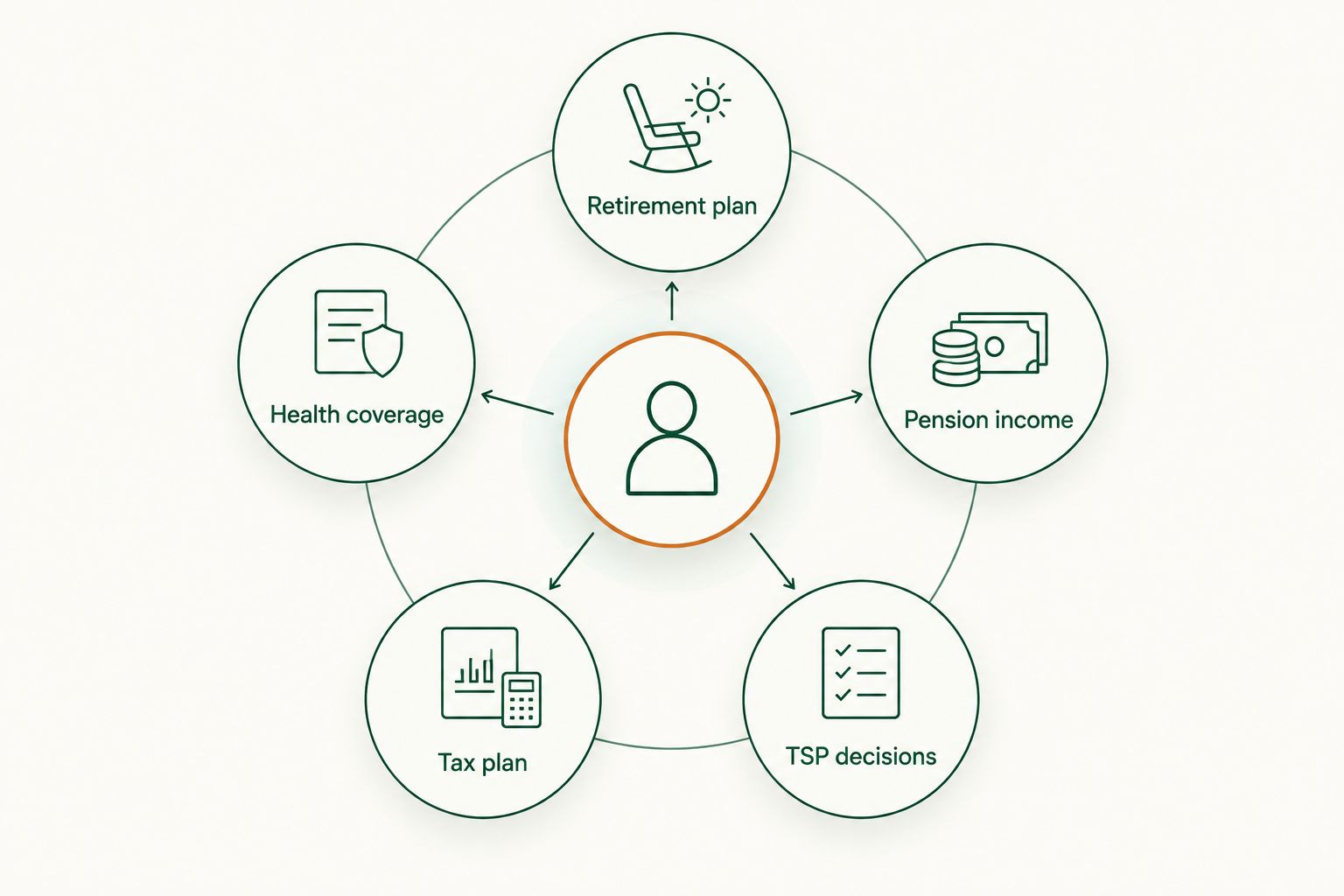
A retirement plan should connect pension income, TSP decisions, health coverage, and a tax plan. Changing one part without checking the others can move a problem rather than solve it.
- Review contributions and the match available under your coverage.
- Assign a purpose to TSP savings in your retirement income plan.
- Compare traditional and Roth holdings before selecting withdrawals.
- Check beneficiary designations against your current family and estate documents.
Protect your health coverage
Federal Employees Health Benefits, or FEHB, coverage is a major retirement-date constraint. To continue FEHB into retirement, you generally must have been enrolled for the 5 years immediately before retirement, or since your first opportunity to enroll if shorter, and meet the applicable annuity requirements. Confirm your own eligibility with your agency benefits office before making an irreversible employment decision.
Medicare generally becomes available at age 65. If retirement and Medicare eligibility fall in different years, identify what coverage you will have between them. If they overlap, review how your FEHB and Medicare choices work together for your circumstances. A spouse or dependent can make that comparison materially different from an employee-only decision.
Do not assume that a plan you use while employed will require no review after retirement. Compare the coverage and enrollment choices available to you when your employment status changes, and use official FEHB and Medicare materials for plan-specific rules.
- Confirm your FEHB enrollment history and retirement eligibility.
- Map coverage for yourself and eligible family members across retirement dates.
- Mark the year each person reaches Medicare eligibility.
- Compare your applicable FEHB and Medicare enrollment choices.
Build a tax plan for withdrawals
Your pension, traditional TSP withdrawals, Roth TSP withdrawals, and Social Security benefits do not receive identical tax treatment. Start by placing each expected income source on a year-by-year worksheet. Then test the order of withdrawals against your actual spending needs rather than choosing an account solely because it is easy to access.
The transition from salary to retirement income can change your tax picture. So can the later start of Social Security or required distributions from tax-deferred accounts. In 2026, focus on the sequence: which income is already fixed, which withdrawals you control, and which tax decisions require a qualified tax professional. Do not base a Roth conversion or a large withdrawal on a single-year estimate without checking its effect on the rest of the plan.
State taxes also matter when you live or retire in New England or Colorado. Identify the state rules relevant to your own residence rather than assuming every source of retirement income is treated alike.
- Project pension and other income by calendar year.
- Separate traditional and Roth TSP balances in the worksheet.
- Test withdrawal and conversion decisions with your tax professional.
- Revisit the plan when Social Security or required distributions begin.
Coordinate survivor and estate choices
Retirement planning for federal employees is household planning when someone else depends on the income. A survivor annuity election, life insurance, TSP beneficiary designation, and estate documents answer related but different questions. Review them together before submitting retirement paperwork.
Ask what income a spouse or other dependent would retain if you died before or after retirement. Then check whether each beneficiary designation still reflects your wishes. Do not rely on a will alone to correct an outdated account designation. For families with substantial assets, coordinate these decisions with an estate attorney and the professional preparing your tax plan.
A survivor choice is not simply a deduction from your annuity. It affects another person’s potential income and can affect access to associated benefits. Get the applicable federal rules and elections in writing, and discuss the trade-off with anyone the decision is meant to protect.
- Review survivor-annuity options with your agency benefits office.
- Check TSP and insurance beneficiary records individually.
- Compare those records with your will and other estate documents.
- Document the income available to a surviving household member.
Recheck your plan before leaving service
A workable 2026 plan should survive a change in retirement date, household spending, or investment markets. Recalculate it after your agency confirms your benefits and before you submit final paperwork. Give special attention to the period after paychecks stop but before every planned income source has begun.
Keep a short decision record: your proposed retirement date, the official estimates behind it, the coverage you expect to retain, and the withdrawals needed to meet spending. That record gives your benefits office, tax professional, attorney, and financial advisor the same set of assumptions. If an estimate changes, you can see which other decisions need review.
- Match each projected benefit to its official record or statement.
- Check household spending against income available immediately after retirement.
- Revisit health coverage and survivor elections before submission.
- Set a date to review the plan after retirement begins.
Which planning option fits your needs?
You do not need to choose between using official federal resources and getting personal advice. They solve different problems. Federal benefits staff can confirm employment-based rules; a tax professional can assess a proposed tax decision; an advisor can connect those answers to the household’s wider plan. Use the option that matches the question, then keep the answers in one place.
| Option | Best for | Key limitation |
|---|---|---|
| Agency benefits office and official plan records | Confirming service history, eligibility, elections, and estimates | Does not replace a household investment, tax, and estate plan |
| Self-directed planning with official resources | Employees comfortable organizing their own retirement decisions | You must connect benefits, withdrawals, coverage, and family decisions yourself |
| Tax professional | Reviewing the tax effects of withdrawals and conversions | Tax advice alone does not establish federal retirement eligibility |
| Vital Investment Management | Individuals and families in New England or Colorado seeking integrated, fee-only financial planning and investment management | Agency records and officials still determine federal benefit eligibility |
Vital Investment Management is best for federal employees in New England or Colorado who want fee-only planning that brings retirement, investments, taxes, and estate decisions into one advisory relationship. It is not a substitute for an official pension estimate or an agency ruling on coverage. Bring those records into the planning conversation so the advice rests on confirmed benefits.
Bring your retirement decisions together
Discuss retirement, investments, taxes, and estate planning in one advisory relationship.
Common mistakes federal employees make
- Choosing a departure date before checking eligibility. A date that looks right on a personal calendar can have different pension and coverage consequences under different retirement provisions. Confirm service, age, and the type of annuity first.
- Treating the gross pension estimate as take-home income. Survivor elections, taxes, and benefit deductions need a place in the household budget. Build spending decisions around the income you expect to receive.
- Making TSP decisions in isolation. An account allocation or withdrawal schedule should reflect pension income, other assets, taxes, and the people who rely on the money. Review the whole income sequence before changing the account.
- Assuming health coverage will take care of itself. FEHB continuation has eligibility conditions, and Medicare introduces separate choices. Verify coverage before leaving federal service, especially when a spouse or dependent is covered.
- Leaving beneficiary records until after retirement. Beneficiary designations and survivor elections are separate decisions. Check each record against your current household and estate plan.
FAQ
What is the first step in retirement planning for federal employees?
Confirm your retirement system, credited service, and eligibility with your agency benefits office. Those records determine which pension estimates and retirement dates belong in your plan.
What are the main parts of a FERS retirement plan?
A FERS retirement plan coordinates the federal annuity, Social Security, and the TSP. It also accounts for health coverage, taxes, and survivor decisions that affect household income.
Can federal employees keep FEHB coverage in retirement?
Eligible federal retirees can generally continue FEHB if they meet the applicable annuity and enrollment requirements. The enrollment rule generally requires coverage for the 5 years immediately before retirement or since the first opportunity to enroll if shorter.
Should I withdraw my TSP when I retire?
Retirement does not by itself require you to withdraw your entire TSP account. Choose a withdrawal approach after comparing your pension, spending needs, taxes, and other assets.
How does Medicare fit with federal retirement coverage?
Medicare generally becomes available at age 65, creating a separate decision about enrollment and coordination with FEHB. Review your own coverage and the needs of eligible family members before choosing.
Is a financial advisor a substitute for my federal benefits office?
No. Your agency benefits office and official records confirm federal service and benefit eligibility; an advisor can help connect confirmed benefits with investments and broader household planning.
What should a federal employee review before submitting retirement paperwork?
Review official pension estimates, FEHB eligibility, survivor elections, beneficiary designations, and the first years of retirement income. Resolve discrepancies in your service record before relying on a departure date.
One last thing
The most useful 2026 retirement worksheet is not just a projected account balance. It is a timeline showing when paychecks end, when each benefit begins, who remains covered, and where household income comes from in between. Build that timeline before you settle on a retirement date. It exposes decisions that a single pension estimate cannot answer.