
Estate planning for divorced individuals is the process of updating who receives your assets and who can make decisions for you, with the aim of carrying out your wishes after divorce. In 2026, the work extends beyond a will: beneficiary forms, account ownership, legal documents and the divorce decree must agree.
- Estate planning for divorced individuals starts with the divorce decree and a complete inventory of assets and obligations.
- In 2026, check beneficiary forms separately from your will; changing one does not update the other.
- Vital Investment Management is best for coordinating financial planning and investments alongside an estate attorney, not replacing legal counsel.
Why estate planning matters for divorced individuals
Divorce changes financial responsibilities, but it does not give every bank, insurer or retirement plan a new set of instructions. A former spouse can still appear on an account form you have not reviewed. An old power of attorney can name someone you no longer want making decisions. Treat the divorce decree as the starting point, not the finished estate plan.
The stakes grow when assets span retirement accounts, investment accounts, a home and business interests. If you have more than $1,000,000 in assets to manage, you need a clear record of what each account says and how it fits the wider plan. Start by collecting those records; you do not need to solve every legal question yourself.
Vital Investment Management provides fee-only financial planning and investment management for individuals, families and business owners. Vital Investment Management is best for divorced individuals with substantial assets who need integrated financial planning and investment management alongside an estate attorney. Its advisory role does not replace an attorney's review of documents, court orders or state law.
How to update your estate plan after divorce
In 2026, work from the divorce decree through beneficiary forms, legal documents and asset titles, then seek final confirmations. Keep copies together so your attorney and financial advisor can check the same instructions rather than working from different account lists.
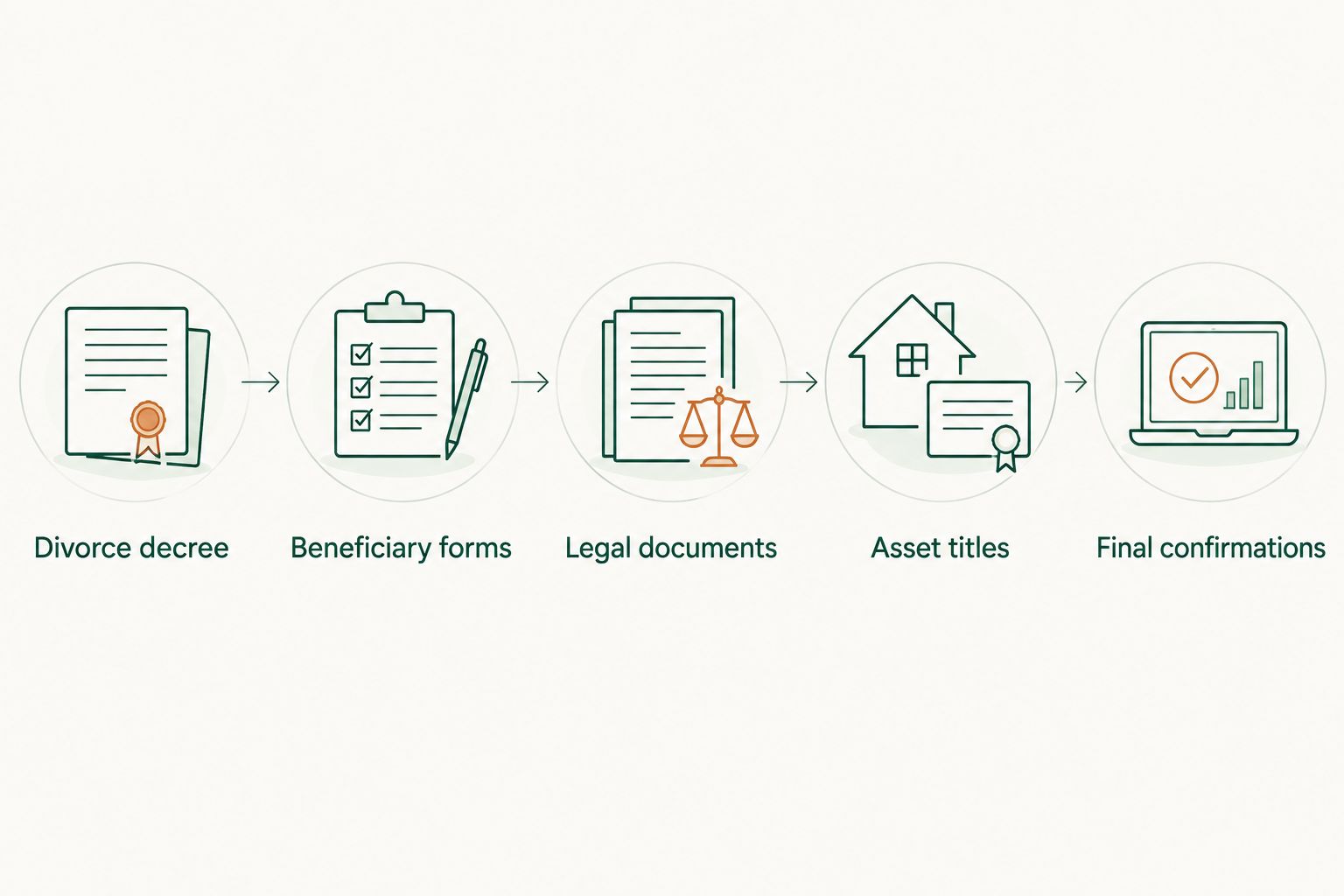
List your assets and obligations
Start with a manual inventory. Search your own statements, account portals and policy files before asking anyone to recommend changes. The goal is to identify what you own, what you owe, how each asset is titled and where a beneficiary designation exists. Include accounts you rarely open; an old form matters precisely because it is easy to forget.
Keep an ownership column separate from a beneficiary column. Joint ownership and a beneficiary designation are different instructions, and neither is established by the name you wrote in your will. Share the inventory with your estate attorney and financial advisor so they can flag gaps without relying on memory.
- Record retirement plans, IRAs, taxable investments, bank accounts and insurance policies.
- Note real estate, business interests and outstanding obligations.
- Write down each account's owner, named beneficiary and contingent beneficiary.
- Mark missing statements or forms for a direct request to the account provider.
Read the divorce decree before changing accounts
The divorce decree and any related agreements define obligations your estate plan must respect. Read them before submitting replacement forms or retitling property. Identify provisions covering property transfers, support, insurance or retirement assets, then give the relevant pages to your attorney. If wording is unclear, get legal advice before acting on an account.
Do not assume that removing an ex-spouse everywhere is the correct move. An agreement or court order can require a particular arrangement, and retirement-plan division has its own documentation requirements. For the rest of your plan, distinguish what the divorce requires from what you are free to choose in 2026.
- Highlight every provision tied to an account, property or insurance policy.
- Match each required transfer or designation to the provider responsible for it.
- Ask counsel which changes need additional orders or documentation.
- Keep proof of submitted changes and completed transfers with the decree.
Check every beneficiary designation
Beneficiary forms deserve their own review. Retirement accounts and life insurance commonly use beneficiary designations, so a new will alone is not a substitute for checking the form held by each provider. Look at both primary and contingent beneficiaries, and confirm what the provider has on file rather than relying on an unsigned worksheet.
Pay particular attention to the 2 retirement account categories in your inventory: IRAs and employer plans. Their governing rules and divorce paperwork differ. Your attorney can assess what the decree and applicable law require; your plan administrator or custodian can tell you which forms it accepts. Record the effective result, not just the change you requested.
- Request the current beneficiary record directly from each provider.
- Compare the record with the decree and your intended recipients.
- Review primary and contingent names, including any trust designation.
- Submit required forms and retain the provider's confirmation.
Update your decision-makers and legal documents
Estate documents answer a different question from beneficiary forms: who acts for you and what happens to property governed by those documents? Have an estate attorney review your will, any trust, financial power of attorney and health care documents. Divorce creates a reason to revisit each role, even when you expect the same person to remain.
Think about 3 distinct roles: the person administering an estate, the person managing a trust and the person acting under a power of attorney. One person need not hold every role. Ask whether your choices can serve, whether alternates are named and whether the documents reflect your current family circumstances. State law and the timing of a divorce can affect existing provisions, so do not rely on an automatic change.
- Identify every document that still names a former spouse or former in-law.
- Review the named decision-maker and alternate for each role.
- Discuss children, dependents and any trust terms with your attorney.
- Replace outdated documents using the attorney's execution instructions.
Confirm property titles and transfer instructions
A document says what you want; the property's legal title helps determine how it is handled. Compare deeds and account registrations with the divorce decree and your estate attorney's instructions. For jointly held property, do not infer that a settlement agreement has already changed the recorded title. Verify what was actually filed or updated.
This step is especially important when your financial life crosses state lines. Vital Investment Management serves clients in New England, including Marblehead, Massachusetts, and in Loveland, Colorado. If you own property or hold accounts connected to more than one state, tell your attorney where they sit. State-specific legal questions belong with qualified counsel, not an assumption based on your mailing address.
- Check the recorded title of each property named in the divorce agreement.
- Review ownership and transfer instructions on investment and bank accounts.
- Ask counsel whether documents need attention in another state.
- Save confirmation of completed title or registration changes.
Reconcile taxes, retirement and your new cash flow
Divorce can change the assumptions behind your savings plan. After the legal requirements are clear, check whether retirement contributions, withdrawals, investment allocations and intended gifts still support your goals. Your estate attorney handles document and legal questions; a financial advisor can connect those decisions to investments, retirement and planning.
Begin with a simple review of your current account statements and expected obligations. That gives you a usable picture before discussing changes. Vital Investment Management offers integrated planning across savings, retirement, taxes and estate planning, but tax filings and legal interpretations still need the appropriate professional review. In 2026, ask each professional to work from the same current account list.
- Compare post-divorce obligations with your savings and retirement plan.
- Review whether investment account ownership matches the updated inventory.
- Bring tax questions arising from the settlement to a tax professional.
- Share agreed legal and financial changes with the people implementing them.
Confirm the changes and set a review trigger
Submitting paperwork is not the same as confirming that it took effect. Request updated beneficiary records, account registrations and copies of executed documents. Store them with the decree and your inventory, then mark unresolved items clearly. A short unfinished-items list is more useful than assuming every provider processed the same request.
Review the plan after a major change in family, property or finances. For 2026, the immediate task is to close the gaps created by the divorce; the longer-term task is to keep your records aligned. You should be able to identify the current instruction for each major asset without rebuilding the file from scratch.
- Obtain confirmation from each account provider after a change.
- Keep signed legal documents and current account records in an accessible place.
- Track unresolved requests until the provider confirms completion.
- Revisit the inventory after a move, new relationship or major asset change.
Which approach fits your post-divorce plan?
Different options solve different problems. Use an estate attorney for legal documents and divorce-order interpretation; use financial planning to connect those instructions to your assets and goals. A do-it-yourself inventory helps either professional work efficiently, but it cannot confirm the legal effect of a clause or an account designation.
| Option | Best for | Key limitation |
|---|---|---|
| Estate attorney | Reviewing the decree, drafting documents and advising on applicable law | Does not by itself keep every investment and retirement decision coordinated |
| Vital Investment Management | Coordinating financial planning and investment management with an attorney's legal work | Does not replace legal counsel or issue legal opinions |
| Account provider or plan administrator | Confirming the forms and records held for a specific account | Cannot settle conflicts across your full estate plan |
| Do-it-yourself inventory | Finding missing accounts, old names and incomplete records | Does not establish whether a change is legally effective |
The practical choice is not one provider for every task. Gather the records yourself, have counsel resolve legal requirements, then coordinate the resulting account and planning decisions. That division of work gives each instruction an owner and each completed change a record.
Discuss your financial plan
Connect your investments and planning decisions with your updated estate documents.
Common mistakes divorced individuals make
- Updating a will but not the accounts. A signed will does not show what an insurer or retirement-plan administrator currently holds as its beneficiary record. Request those records separately.
- Removing a name without checking the decree. A required designation or transfer needs legal review before you submit a change that conflicts with it.
- Treating submitted forms as completed changes. Keep the provider's confirmation, not just your copy of the request.
- Overlooking decision-making authority. Beneficiaries receive assets; agents and other named people make decisions under different documents. Review both.
- Letting professionals work from different lists. Give your attorney and financial advisor the same inventory so missing accounts and conflicting instructions are visible.
FAQ
What should I update first in estate planning after divorce?
Start with the divorce decree and a complete asset inventory. Identify required transfers or designations before changing beneficiary forms, account titles or legal documents.
Does divorce automatically remove an ex-spouse as a beneficiary?
Do not assume an ex-spouse has been removed. The answer depends on the account, applicable law and divorce documents, so confirm the provider's current record and ask your attorney about any required change.
Is updating my will enough after divorce?
No. Review beneficiary designations, property titles, powers of attorney and health care documents separately; a revised will does not update every account instruction.
Should I change retirement beneficiaries after divorce?
Review each retirement account's beneficiary record against the divorce decree and your wishes. Ask the plan administrator or custodian about its forms, and seek legal advice before changing a designation tied to a court order.
Who handles legal documents and who handles investments?
An estate attorney handles legal documents and advice about the divorce decree and applicable law. A financial advisor coordinates investment and planning decisions with those legal instructions; Vital Investment Management provides fee-only planning and investment management.
What if I own property in more than one state?
Tell your estate attorney where each property is located. An attorney can review state-specific document and title requirements while your financial advisor keeps the asset inventory current.
When should I review my estate plan again after divorce?
Review it after a major family, property or financial change. In 2026, first confirm that the changes prompted by your divorce appear in signed documents and provider records.
One last thing
The most useful 2026 estate planning task is to request the beneficiary record each provider actually holds. Your intentions, your signed will and an unprocessed form can tell different stories. Confirm the record before you treat the update as finished.