
Best overall: annual exclusion gifting for families transferring wealth steadily; best for business owners: a grantor retained annuity trust (GRAT); best for estate liquidity: an irrevocable life insurance trust (ILIT). Vital Investment Management is a fee-only advisor for New England families who want wealth transfer coordinated with investment management and financial planning in 2026.
- The best wealth transfer strategies for family wealth in 2026 start with annual gifts, then address control, liquidity and taxes.
- Annual exclusion gifting is the default for steady transfers; a GRAT fits business equity expected to appreciate.
- An ILIT addresses estate liquidity, while a revocable trust organizes inheritance without reducing estate tax.
- Vital Investment Management coordinates wealth transfer with financial planning and investment management for New England families.
Why this matters
A wealth transfer plan answers more than who receives an asset. It determines when that person receives it, who controls it in the meantime and whether the transfer creates a tax or cash-flow problem. A trust that solves one issue can make another harder.
In 2026, the federal estate and gift tax exemption is $15 million per person. Massachusetts has a separate $2 million estate tax threshold. A family whose estate falls below the federal exemption still needs to consider state tax, beneficiary designations and whether heirs can manage an inheritance. The Vital Investment Management website describes financial planning and investment management as one advisory relationship; that coordination matters when an estate decision also changes the investment plan.
For families around Marblehead and elsewhere in New England, start with the assets you own and the people who will receive them. Then select the legal tools with an estate attorney and tax professional. Do not create a trust before you can state the problem it must solve.
What makes the best wealth transfer strategy
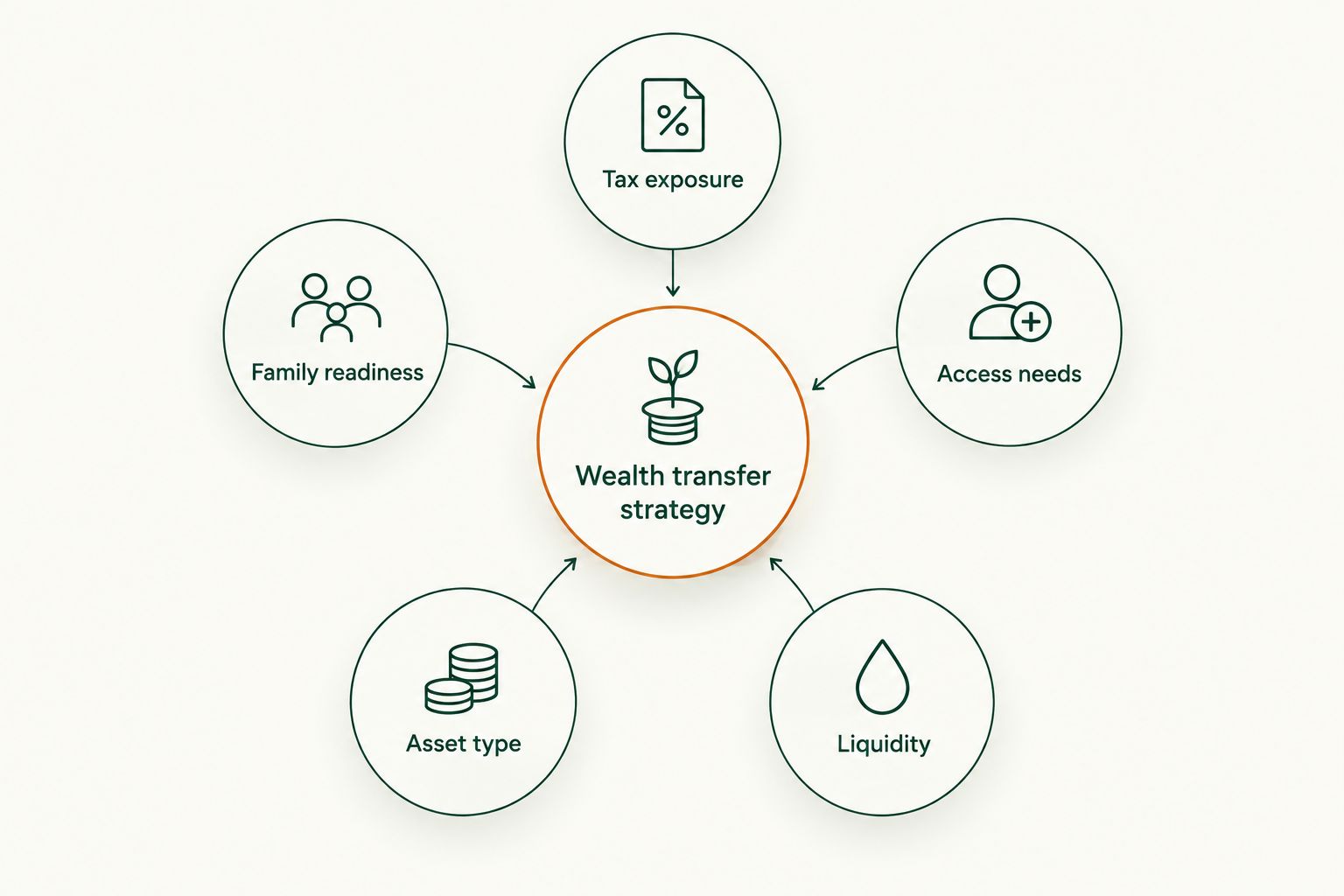
Use these criteria before comparing documents or asking an advisor for a recommendation:
- Tax exposure: Check federal and applicable state estate taxes, gift taxes and the income tax consequences for heirs. A gift that reduces an estate can also give up a potential basis adjustment at death.
- Access needs: Decide how much you can transfer without relying on the assets later. An irrevocable gift is not an emergency fund.
- Liquidity: Identify expenses your estate must pay and whether heirs would need to sell a business, property or investments to cover them.
- Asset type: Publicly traded investments, retirement accounts, insurance policies and private businesses follow different transfer rules.
- Family readiness: Set a plan for beneficiaries who need time, guidance or ongoing trustee oversight before receiving control.
These criteria overlap. For example, transferring an appreciated asset can reduce the size of an estate while increasing an heir's eventual capital gains exposure. Have the advisor, attorney and tax professional examine the same asset list before making an irrevocable transfer.
Wealth transfer strategies at a glance
| Strategy | Best for | Standout feature | Key limitation |
|---|---|---|---|
| Annual exclusion gifting | Steady lifetime transfers | Moves assets to heirs without using the lifetime exemption when gifts stay within annual limits | You give up the transferred assets |
| Revocable trust and beneficiary review | Orderly inheritance | Coordinates instructions for assets held in the trust and checks direct transfers | Does not remove assets from the taxable estate |
| GRAT | Appreciating business interests | Passes growth above the trust's required return to beneficiaries | Little benefit if the asset fails to outperform |
| ILIT | Estate liquidity | Holds insurance outside the insured person's estate when properly structured | The insured gives up control of the policy |
| SLAT | Married couples seeking indirect access | Allows distributions to a beneficiary spouse | Access can disappear after divorce or the spouse's death |
| Dynasty trust | Multigenerational transfers | Keeps assets under trust terms across generations | Long-term administration and limited flexibility |
1. Annual exclusion gifting: best for steady family transfers
Annual exclusion gifting is the default place to start because it works without placing every family asset in a trust. In 2026, you can give up to $19,000 to each recipient under the federal annual gift tax exclusion. Two spouses making their own qualifying gifts can give $38,000 to the same recipient without using either spouse's lifetime exemption.
Education funding offers another version of this approach. A contributor can elect to spread a 529 plan contribution over five years for gift tax purposes. At the 2026 annual exclusion amount, that permits a $95,000 contribution for one beneficiary, provided the election and other gifts to that beneficiary are handled correctly. The five-year election requires a gift tax return even when no gift tax is due.
Annual exclusion gifting pros:
- Starts transferring assets without waiting for a major estate restructuring.
- Can repeat across recipients and years as your cash needs allow.
- Can direct education gifts into a 529 plan rather than handing a child unrestricted cash.
Annual exclusion gifting cons:
- Completed gifts are no longer available for your own spending.
- Annual limits make this a slow method for transferring a large business interest or estate.
- Giving appreciated investments can pass your tax basis to the recipient, unlike an asset that qualifies for a basis adjustment at death.
Best for: families who can comfortably part with assets and want a repeatable plan. Verdict: Buy the approach only after confirming which assets you can afford to give away.
2. Revocable trust and beneficiary review: best for orderly inheritance
A revocable living trust provides instructions for assets transferred into it and lets a successor trustee manage those assets when the original trustee can no longer do so. Beneficiary designations on retirement accounts and insurance policies need a separate review: those assets generally transfer according to their designations, not instructions in a will.
This is an inheritance tool, not a federal estate tax escape hatch. Assets you control through a revocable trust generally remain part of your taxable estate. Its value lies in clearer administration and continuity, provided you actually fund the trust and keep designations aligned with the plan.
Revocable trust and beneficiary review pros:
- Gives a successor trustee instructions for assets held in the trust.
- Can keep properly funded trust assets out of probate.
- Exposes conflicts between a will, a trust and account beneficiary forms before heirs discover them.
Revocable trust and beneficiary review cons:
- Does not, by itself, reduce federal or state estate tax.
- An unfunded trust cannot direct an asset that never entered it.
- Requires attention after account changes, marriage, divorce or a death in the family.
Best for: families whose main concern is an orderly handoff rather than an estate tax reduction. Verdict: Buy when the documents and beneficiary forms need to work as one plan.
3. GRAT: best for appreciating business interests
A grantor retained annuity trust places an asset in an irrevocable trust while returning scheduled annuity payments to the grantor. If the asset grows faster than the rate used to calculate those payments, the excess can pass to beneficiaries with a limited taxable gift. That makes a GRAT relevant to an owner considering the transfer of a business interest before a potential increase in value.
Timing and valuation matter. An owner cannot assume a future sale or growth rate, and the trust must meet its annuity obligations. Review whether the business interest can be transferred under its governing agreements before choosing this strategy.
GRAT pros:
- Targets future appreciation rather than requiring an outright gift of the full asset value.
- Lets the grantor receive annuity payments during the trust term.
- Creates a defined transfer process for an asset expected to grow.
GRAT cons:
- Produces little transfer benefit if the asset fails to outperform the calculation rate.
- Death during the trust term can cause estate inclusion.
- Adds legal drafting, valuation and administration work.
Best for: business owners with a transferable interest expected to appreciate. Verdict: Hold until an estate attorney and valuation specialist confirm that the asset and timing fit.
4. ILIT: best for estate liquidity
An irrevocable life insurance trust owns a policy and directs how the proceeds are used after the insured person's death. When structured and maintained correctly, the policy proceeds can stay outside the insured person's taxable estate. The proceeds can give heirs cash without requiring an immediate sale of a business or other illiquid asset.
The distinction between a new policy owned by the trust and an existing policy transferred into it matters. A transfer of an existing policy can trigger a three-year estate inclusion rule if the insured dies within that period. The trustee also needs to handle policy funding and required notices correctly.
ILIT pros:
- Addresses a specific cash need at death.
- Can keep qualifying insurance proceeds outside the insured person's estate.
- Gives the trustee instructions for using proceeds for beneficiaries.
ILIT cons:
- The insured person cannot retain the policy control that would cause estate inclusion.
- Premium funding and trust administration require ongoing attention.
- Does not fix an estate plan whose underlying insurance coverage is unsuitable.
Best for: families with a documented estate liquidity need. Verdict: Buy only when the policy and trust terms solve that identified need.
5. SLAT: best for married couples seeking indirect access
A spousal lifetime access trust is an irrevocable trust created by one spouse for the benefit of the other. The gift can remove assets and future growth from the donor spouse's estate, while the beneficiary spouse can receive distributions under the trust terms. It offers indirect family access, not a promise that the donor can reclaim the assets.
That distinction becomes critical if the couple divorces or the beneficiary spouse dies. Couples considering a trust created by each spouse also need legal advice on the reciprocal trust doctrine; mirror-image arrangements can defeat the intended tax result.
SLAT pros:
- Combines a completed gift with potential distributions to the beneficiary spouse.
- Can move future asset growth outside the donor's estate.
- Lets an attorney set distribution rules that reflect the family's goals.
SLAT cons:
- Divorce or the beneficiary spouse's death can end the family's expected access.
- The donor gives up direct ownership and control.
- Poorly differentiated trusts for each spouse create tax risk.
Best for: married couples with assets they can transfer but some concern about future access. Verdict: Hold until both spouses understand how the plan works if the marriage or beneficiary changes.
6. Dynasty trust: best for multigenerational transfers
A dynasty trust holds assets under terms intended to benefit more than one generation. Proper planning can use the federal generation-skipping transfer tax exemption to limit transfer taxes as wealth passes to later generations. How long the trust can operate depends on the law governing it.
This is the most demanding strategy on the list. A family needs workable distribution standards, trustee succession and a reason to keep assets in trust over time. Tax savings alone do not answer how future beneficiaries should use the money.
Dynasty trust pros:
- Sets instructions for assets intended to benefit later generations.
- Can reduce repeated transfer tax exposure when structured and funded correctly.
- Keeps trustee oversight in place for beneficiaries who are not ready to manage assets directly.
Dynasty trust cons:
- Requires long-term administration and trustee decisions.
- Future generations must live with terms set before their circumstances are known.
- State trust law affects duration and other planning choices.
Best for: families who have a clear multigenerational goal and assets they do not need to retain. Verdict: Wait if the immediate inheritance plan is still unsettled.
How these strategies were ranked
The order favors an approach families can assess first, then moves toward tools that solve narrower problems and require more administration. It is a decision sequence, not a claim that every family should use every strategy. A GRAT addresses appreciation; an ILIT addresses liquidity. Neither replaces a current beneficiary review.
Vital Investment Management's integrated approach to savings, retirement, taxes, estate planning and investments fits that decision sequence. The advisor's role is to coordinate the financial consequences while the estate attorney drafts legal documents and a tax professional reviews tax treatment.
Which wealth transfer strategy should you choose?
Choose annual exclusion gifting as your first 2026 review if you can part with assets now. Check beneficiary forms and any revocable trust at the same time; a gift plan cannot correct an account set to pass to the wrong person. If you own a business, examine a GRAT before making an irreversible transfer or completing a sale. If heirs would need cash at death, assess an ILIT against that specific need.
Massachusetts families should not use the $15 million federal exemption as their only tax test: the state's estate tax threshold is $2 million. Colorado does not impose a state estate tax, but federal tax and inheritance decisions still require attention. Residence, asset ownership and the applicable documents belong in the same review, particularly when a family has ties to more than one state.
For a New England household with more than $1 million in assets to manage, the next move is a meeting built around a complete asset list, current beneficiary forms and existing estate documents. Vital Investment Management serves individuals, families and business owners through fee-only financial planning and investment management. Rusty Tredwel's New England roots give the conversation a local starting point; the recommendation still needs to fit your own balance sheet.
Review your wealth transfer plan
Bring your asset list and estate documents into one financial planning conversation.
FAQ
What are the best wealth transfer strategies for family wealth in 2026?
Start with annual exclusion gifting and a review of beneficiary designations in 2026. Consider a GRAT for appreciating business interests, an ILIT for estate liquidity or a SLAT when a married couple needs indirect access.
How much can I give someone in 2026 without using my lifetime gift tax exemption?
The federal annual gift tax exclusion is $19,000 per recipient in 2026. Two spouses can each make qualifying gifts to the same person, for a combined $38,000.
Does a revocable trust reduce estate taxes?
No, assets you control through a revocable trust generally remain in your taxable estate. The trust can instead provide instructions and continuity for assets properly transferred into it.
Is a GRAT better than an ILIT for a business owner?
A GRAT targets future appreciation in a transferable asset; an ILIT addresses a need for cash at death. A business owner can need one, both or neither depending on the asset and estate plan.
What is the federal estate tax exemption in 2026?
The federal estate and gift tax exemption is $15 million per person in 2026. State estate tax rules can apply at a lower estate value.
Does Massachusetts have an estate tax below the federal exemption?
Yes. Massachusetts has a $2 million estate tax threshold, below the $15 million federal exemption in 2026. Review state exposure separately from federal exposure.
Can a 529 contribution count as five years of gifts?
Yes. A contributor can elect to spread a qualifying 529 contribution over five years for federal gift tax purposes. At the 2026 annual exclusion amount, that is $95,000 for one beneficiary, and the election requires a gift tax return.
One last thing
Before transferring an appreciated investment, compare a lifetime gift with leaving that asset to an heir at death. Gift recipients generally take the donor's tax basis, while inherited assets generally receive a basis adjustment. The transfer that cuts an estate tax bill is not automatically the transfer that leaves the family with the best after-tax result.