
Self-employed professionals don't get a default 401(k) with an employer match sitting in a drawer. You pick the plan, you fund it, and the choice you make in 2026 determines how much of this year's income actually compounds for retirement instead of getting taxed away. Best overall for solo operators: the Solo 401(k). Best for professionals 50 or older chasing maximum tax deferral: a cash balance plan layered on top of a Solo 401(k). Best for simplicity with variable 1099 income: the SEP IRA. Best low-cost option once you hire staff: the SIMPLE IRA.
- Solo 401(k) is the best retirement planning tool for self-employed professionals with no employees in 2026.
- Cash balance plans let high-earning professionals 50 and older defer far more than a Solo 401(k) alone allows.
- SEP IRAs fit variable 1099 income; SIMPLE IRAs fit owners with a handful of employees.
- Backdoor Roth IRAs and HSAs work best as add-ons, not stand-alone retirement plans.
- Pairing any of these with a fee-only fiduciary keeps contribution strategy tied to your full financial picture.
Why this matters
A W-2 employee has HR picking the plan and running the enrollment. A self-employed professional has to research plan types, open the account, calculate contribution limits against a fluctuating income, and file the paperwork correctly every single year. Get the vehicle wrong and you either underfund a high-earning year or lock yourself into an administrative cost you didn't need.
This is exactly the kind of decision that benefits from a second set of eyes. Vital Investment Management works with self-employed professionals and business owners across New England on exactly this question, folding retirement account selection into one integrated plan rather than treating it as a form to fill out once a year.
What makes the best retirement planning tools for self-employed professionals
- Contribution ceiling relative to income — how much of a high-earning year can actually go in
- Administrative complexity — filing requirements, actuarial reports, third-party administrator costs
- Flexibility for variable income — can you skip or lower a contribution in a lean year
- Tax treatment — pre-tax deferral now versus tax-free growth later
- Employee cost exposure — what you owe staff if you've hired anyone
- Fit with the rest of the plan — how easily it coordinates with taxable accounts, estate planning, and other savings
Retirement tools for self-employed professionals: at a glance
| Retirement Tool | Best For | Standout Feature | Key Limitation |
|---|---|---|---|
| Solo 401(k) | Solopreneurs with no employees | Stacks employee deferral and employer contribution in one plan | Extra IRS filing (Form 5500-EZ) once plan assets grow large |
| SEP IRA | Variable or seasonal 1099 income | Contribution set as a percentage of net earnings, decided year to year | Must contribute the same percentage for any employees you have |
| Cash Balance / Defined Benefit Plan | High earners 50+ chasing maximum deferral | Actuarially calculated contributions well beyond Solo 401(k) limits | Requires ongoing actuarial administration and a fixed annual commitment |
| SIMPLE IRA | Owners with a handful of employees | Low-cost setup with a mandatory employer match or contribution | Lower contribution ceiling than a Solo 401(k) |
| Backdoor Roth IRA | High earners over the direct Roth income limit | Tax-free growth with no lifetime required minimum distributions | Pro-rata rule complicates things if you hold other pre-tax IRAs |
| HSA | Anyone on a qualifying high-deductible health plan | Triple tax advantage: deductible in, tax-free growth, tax-free qualified withdrawals | Contribution room is modest next to the other vehicles on this list |
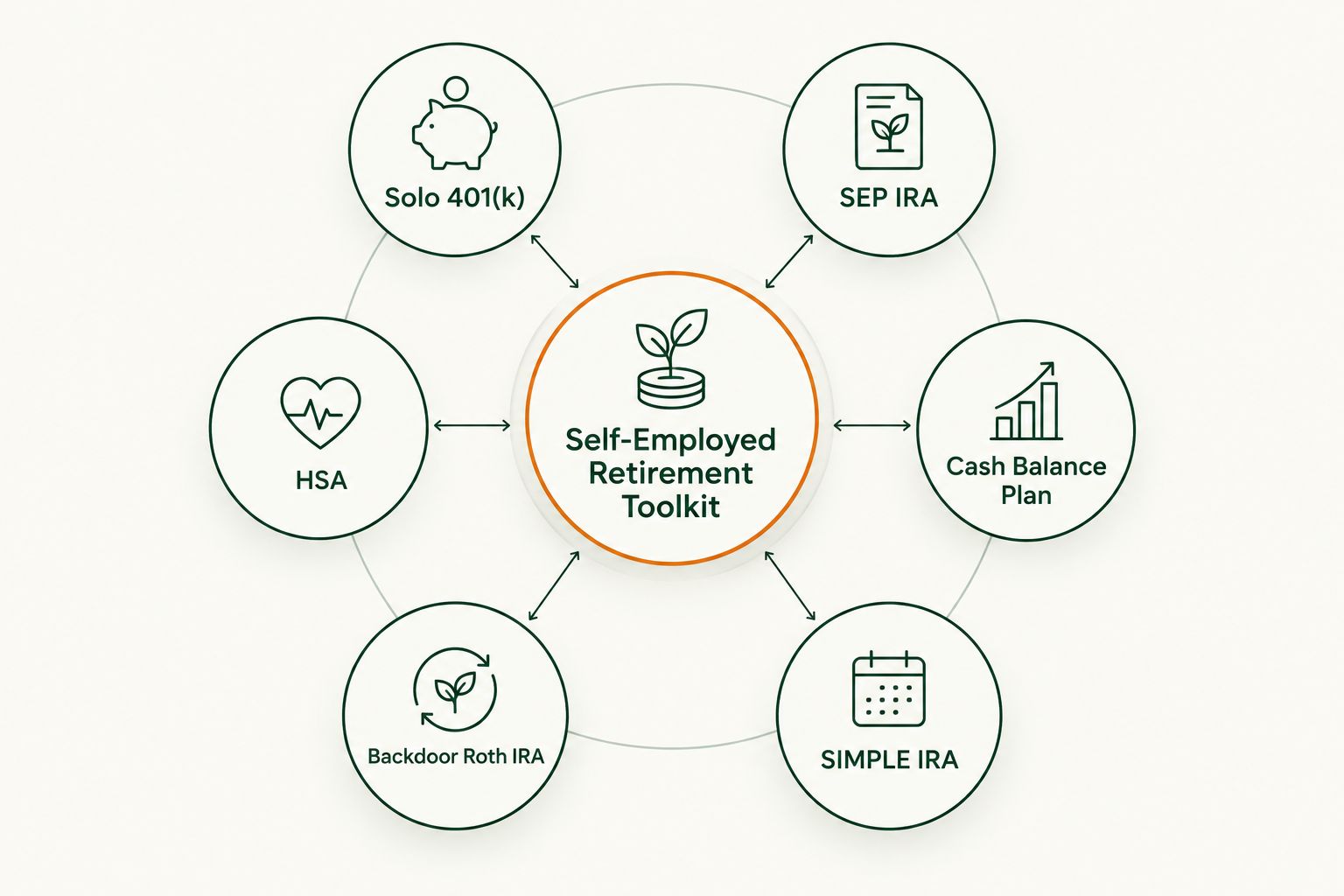
1. Solo 401(k): best retirement tool for self-employed professionals with no employees
A Solo 401(k) lets you contribute as both the employee and the employer of your own business, which is why it holds the highest ceiling of any option on this list for a one-person operation. You defer a portion of income as the employee, then add an employer profit-sharing contribution of up to 25% of net compensation on top.
Solo 401(k) pros:
- Highest combined contribution ceiling for a business with no employees
- Roth and pre-tax options in the same plan at most custodians
- Loan provisions available at many providers if you ever need short-term liquidity
Solo 401(k) cons:
- Requires a separate Form 5500-EZ filing once plan assets pass the IRS threshold
- Not usable once you hire full-time, non-owner employees
- Setup has to happen before year-end to fund that tax year
Best for: self-employed professionals and single-member LLCs with no full-time staff. Verdict: open one.
2. SEP IRA: best retirement tool for variable 1099 income
A SEP IRA is the simplest plan on this list to set up and administer. Contributions are calculated as a flat percentage of net self-employment earnings, up to 25% of compensation, and you decide that percentage fresh every year — including contributing nothing in a slow one.
SEP IRA pros:
- Minimal paperwork, no annual filing requirement
- Contribution percentage can flex up or down year to year
- Works well for freelancers and consultants with unpredictable income
SEP IRA cons:
- No Roth option
- If you hire employees, you must contribute the same percentage for them
- Lower ceiling than a Solo 401(k) for the same income level because there's no separate employee deferral
Best for: freelancers and consultants whose income swings meaningfully year to year. Verdict: open one if simplicity matters more than maximizing the ceiling.
3. Cash Balance / Defined Benefit Plan: best retirement tool for high earners 50 and older
A cash balance plan is a defined benefit structure dressed up to look like an account balance. An actuary sets your annual contribution based on age, income, and a target retirement benefit, and for professionals in their 50s and 60s that contribution can run well past what a Solo 401(k) allows on its own.
Cash balance plan pros:
- The single largest deferral ceiling available to a self-employed professional
- Contributions scale up with age, favoring those closer to retirement
- Can be layered on top of a Solo 401(k) for an even bigger combined deduction
Cash balance plan cons:
- Requires an actuary and a third-party administrator, adding annual cost
- Contribution amounts are largely fixed once set, which cuts against flexibility in a down year
- Underperforms for professionals under 45 relative to the setup cost
Best for: high-earning professionals 50 or older with several consecutive strong-income years ahead of them. Verdict: worth pricing out with an advisor before you commit.
4. SIMPLE IRA: best retirement tool for owners with a few employees
A SIMPLE IRA exists for the self-employed professional who has crossed from solo practice into having a small staff. Setup and ongoing administration cost less than a 401(k), but the plan requires either a matching or a fixed employer contribution for every eligible employee.
SIMPLE IRA pros:
- Cheapest plan to administer once employees are involved
- Mandatory employer contribution structure is predictable to budget
- Easy to explain to a small team
SIMPLE IRA cons:
- Lower contribution ceiling than a Solo 401(k) or SEP IRA
- Employer contribution is mandatory, not discretionary
- Early withdrawal penalties are steeper in the first two years of participation
Best for: self-employed professionals who've hired a handful of staff and want low administrative overhead. Verdict: open one once payroll starts, not before.
5. Backdoor Roth IRA: best retirement tool for high earners over the Roth limit
A backdoor Roth IRA is a two-step maneuver: contribute to a non-deductible traditional IRA, then convert it to a Roth. It exists because direct Roth IRA contributions phase out at higher income levels, and self-employed professionals often clear that threshold quickly.
Backdoor Roth IRA pros:
- Tax-free growth and tax-free qualified withdrawals
- No required minimum distributions during your lifetime
- Adds Roth diversification alongside pre-tax Solo 401(k) or SEP dollars
Backdoor Roth IRA cons:
- The pro-rata rule can create an unexpected tax bill if you already hold other pre-tax IRA balances
- Contribution room is small relative to the other tools on this list
- Not a stand-alone retirement plan — it's a supplement
Best for: high earners who've maxed a Solo 401(k) or SEP IRA and want tax-free growth on top. Verdict: add it, don't lead with it.
6. HSA: best retirement tool for a triple tax-advantaged supplement
A Health Savings Account isn't marketed as a retirement account, but for a self-employed professional on a qualifying high-deductible health plan, it functions like one. Contributions are deductible going in, growth is tax-free, and qualified medical withdrawals come out tax-free — after age 65, non-medical withdrawals are simply taxed like a traditional IRA instead of penalized.
HSA pros:
- The only account with a triple tax advantage
- No required minimum distributions
- Doubles as a medical expense fund before retirement
HSA cons:
- Contribution room is modest compared to a Solo 401(k) or cash balance plan
- Requires a qualifying high-deductible health plan to contribute
- Best treated as a supplement, not a core retirement vehicle
Best for: self-employed professionals already funding a primary plan who want one more tax-advantaged bucket. Verdict: add it if you qualify.
How we ranked these
Each tool was weighed against the six criteria above: contribution ceiling, administrative complexity, flexibility for variable income, tax treatment, employee cost exposure, and how well it coordinates with the rest of a financial plan. The Solo 401(k) wins the top spot because it clears every criterion for a one-person operation; the cash balance plan and SIMPLE IRA rank where they do because they solve a narrower problem well rather than solving every problem adequately.
Which retirement tool should you choose?
If you're a solo consultant or freelancer with no employees, open a Solo 401(k) first — it gives you the most room with the least ongoing cost. If you're 50 or older and having a strong income run, get a cash balance plan quote alongside it; the combined contribution can meaningfully outpace a Solo 401(k) alone. If your income swings hard year to year, the SEP IRA's flexibility beats the Solo 401(k)'s fixed structure. Once you've got employees, the SIMPLE IRA is usually the right low-cost fit.
None of these decisions happens in isolation from the rest of your financial life — taxes, estate planning, and how these accounts interact with a taxable brokerage all matter for someone with $1,000,000 or more in investable assets. A tax-efficient retirement account strategy for high earners coordinated across all of these vehicles usually outperforms picking one tool and hoping it's enough.
Talk through your retirement plan options
Personalized guidance for self-employed professionals in New England.
FAQ
What's the best retirement planning tool for self-employed professionals in 2026?
For most self-employed professionals with no employees, the Solo 401(k) is the best retirement planning tool in 2026 because it allows both employee and employer contributions in one plan. Professionals 50 or older with high income often pair it with a cash balance plan for an even larger deferral.
Is a Solo 401(k) better than a SEP IRA?
A Solo 401(k) usually allows a higher total contribution than a SEP IRA at the same income level because it adds an employee deferral on top of the employer contribution. A SEP IRA is simpler to administer and better suited to sharply variable income.
How much can a self-employed professional contribute to a Solo 401(k)?
The total combines an employee deferral with an employer contribution of up to 25% of net compensation, and the exact dollar caps adjust annually with inflation. Check current IRS limits before finalizing a contribution for the year.
When should a self-employed professional consider a cash balance plan?
A cash balance plan makes sense once you're 50 or older, have several consecutive years of strong income ahead, and want to defer well beyond what a Solo 401(k) alone allows. The actuarial and administrative cost only pays off at that income and age level.
Can I have a SEP IRA and a Solo 401(k) at the same time?
You generally can't fully fund both for the same self-employment income in the same year without running into overlapping contribution limits, so most professionals pick one as their primary plan. An advisor can model which one nets a larger deduction for your specific income.
Do I need an employee if I use a SIMPLE IRA?
No, but a SIMPLE IRA is designed for businesses with employees since it requires a mandatory employer match or contribution for everyone eligible. Solo operators with no staff are usually better served by a Solo 401(k) or SEP IRA.
Is a backdoor Roth IRA worth it for self-employed professionals?
Yes, once you've maxed a primary plan like a Solo 401(k) or SEP IRA and your income is above the direct Roth contribution limit. It adds tax-free growth and removes required minimum distributions, but the pro-rata rule needs checking first if you hold other pre-tax IRA balances.
At what age do required minimum distributions start in 2026?
Required minimum distributions start at age 73 under current law. This applies to pre-tax retirement accounts like a Solo 401(k), SEP IRA, or SIMPLE IRA, but not to Roth IRA balances during your lifetime.
One last thing
The biggest mistake self-employed professionals make isn't picking the wrong account — it's picking one and never revisiting it as income changes. A SEP IRA that made sense during a lean startup year can leave real money on the table five years later once income has tripled and a cash balance plan or Solo 401(k) fits better.