
Wealth management for airline pilots is the coordination of pay, benefits, investments, taxes and retirement decisions with the aim of turning a demanding flying career into a sustainable financial plan. Pilots need to account for career-specific benefits and the FAA age-65 rule for Part 121 operations without assuming every airline offers the same retirement package. If you are considering Vital Investment Management, start by documenting what your own employer provides and what your household needs.
- Wealth management for airline pilots starts with your actual benefits and a retirement plan built around the age-65 rule.
- Vital Investment Management is best for New England pilots seeking fee-only, integrated planning and investment management.
- Compare self-management, employer resources and independent advice by what each can coordinate—not by investment selection alone.
Why wealth management matters for airline pilots
An airline pilot's financial plan cannot rest on an assumed retirement date. The FAA age-65 rule applies to pilots in Part 121 operations, so a plan that depends on continuing in that role past 65 needs to change. Other flying work has different rules; your plan should identify the work you actually expect to do, not treat all pilot jobs as interchangeable.
Benefits require the same care. Review your airline's current plan documents before counting on a pension, employer contribution, disability benefit or retiree health coverage. What matters is the benefit you can document, the conditions for receiving it and the income your household needs if work ends earlier than planned.
For a pilot with substantial assets, these decisions also affect taxes, investment withdrawals and what a spouse would need to manage alone. The goal in 2026 is one plan that still makes sense when you change employers, stop flying or lose the ability to work.
Build your airline pilot wealth plan
Map every source of pay and benefits
Start with records, not estimates from a colleague's plan. Gather pay statements, retirement account statements, benefit elections and the documents that govern any pension or deferred compensation arrangement. Write down which benefits are already yours and which depend on continued employment or another condition.
Put irregular pay beside recurring household expenses. A high-income month does not tell you what spending the household can sustain after flying ends. If you share finances with a spouse or partner, make the record usable by both of you rather than keeping the plan in one person's head.
- List base pay and other compensation separately.
- Identify each employer retirement account and its current elections.
- Check pension provisions only if your employer provides a pension.
- Record disability, life and health coverage from current documents.
- Note benefit decisions tied to a job change or retirement.
Set your retirement runway against age 65
Build the first version yourself: put your intended final flying date beside the age-65 limit for Part 121 pilots, then estimate annual spending after that date. Treat continued flying in a different role as a separate scenario, not guaranteed income. Do the same for an earlier stop caused by a health or family change.
A useful planning exercise is to map the first 12 months without airline pay. Identify which expenses continue, which benefits change and which accounts would supply cash. Extend that map across 3 years to see whether early withdrawals or a change in tax bracket require closer review. These are planning windows, not predictions about when you will retire.
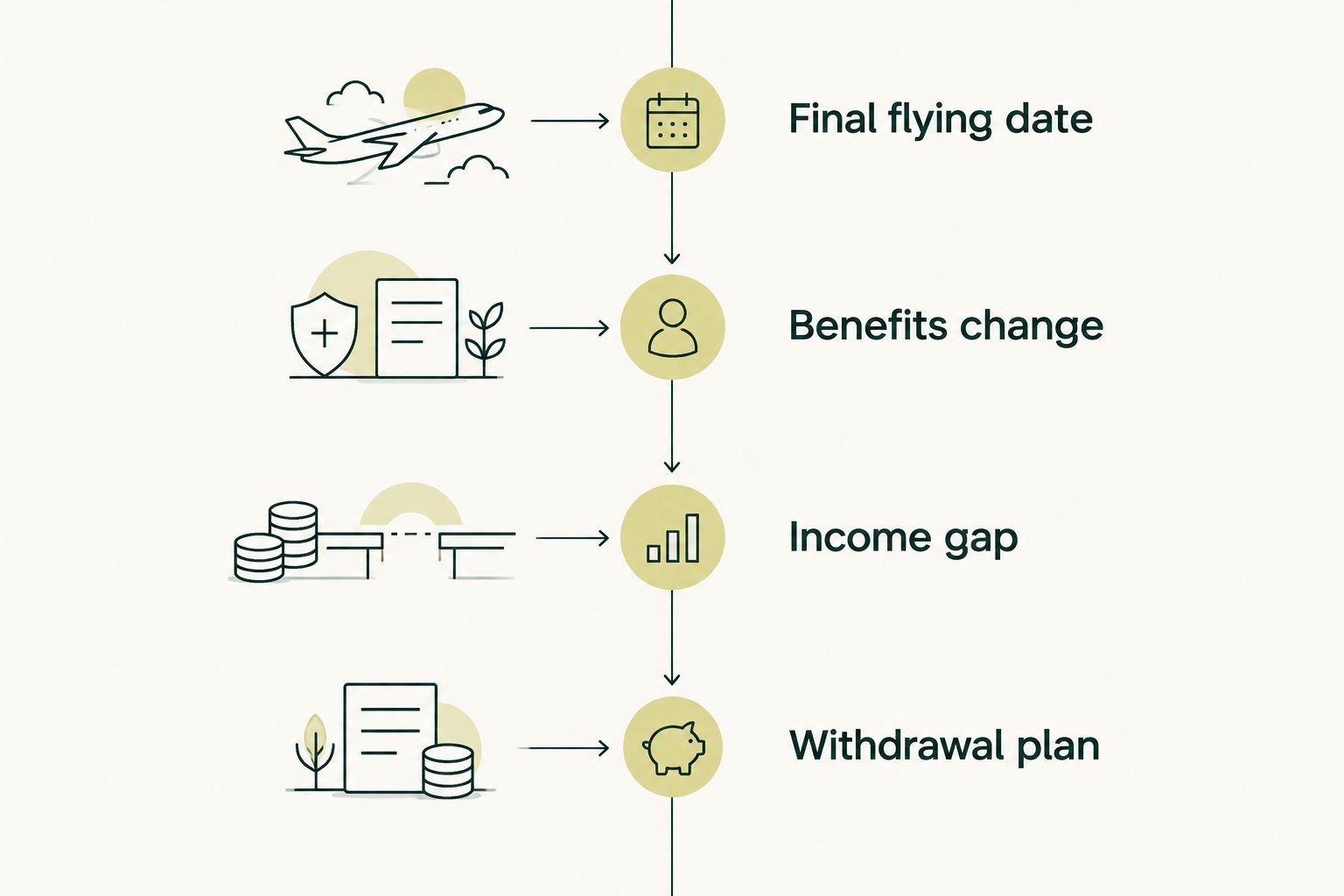
- Mark the expected end of Part 121 flying.
- Model an earlier exit without assigning it a probability.
- List spending that continues when pay stops.
- Match each income gap to a documented source of funds.
- Revisit the timeline when work or family plans change.
Choose an account contribution order
Review the retirement accounts available through your employer and any accounts you already own. Check current plan rules and contribution limits before changing elections; do not assume an option described by another pilot is available in your plan. Then decide whether your next dollar belongs in an employer plan, an individual retirement account, a taxable investment account or cash reserves.
The order depends on your tax situation, employer benefits and when you expect to use the money. An account with a tax advantage is not automatically the right source for spending before other income begins. Keep an accessible reserve for near-term needs rather than asking a long-term investment portfolio to cover every unexpected expense.
- Read your current plan's contribution and distribution rules.
- Identify any employer contribution and its conditions.
- Compare tax treatment before choosing account types.
- Separate near-term spending money from long-term investments.
- Record why each contribution receives priority.
Plan taxes across career changes
A tax plan should cover earning years and withdrawal years together. Review what happens when airline pay ends, when retirement income begins and when you start drawing from different account types. An accountant can check the tax treatment; an adviser can help place those decisions within the wider retirement plan.
State residence deserves its own line in that review. A pilot who moves between New England and Colorado should confirm the facts of residency with a qualified tax professional rather than assume that an address change settles state tax questions. Vital Investment Management provides integrated planning across taxes, retirement and investments; that coordination is useful only when the underlying employer and tax records are accurate.
- Gather recent tax returns and current pay records.
- Identify income sources likely to change at retirement.
- Review withdrawal order before making account elections.
- Ask a tax professional to assess any residency change.
- Recheck the plan after a major compensation change.
Build investments around income risk
Choose an allocation based on when you will need the money and how much of a decline your plan can absorb. Do not set it solely by your current salary. A pilot nearing the end of Part 121 flying faces a different withdrawal problem from a pilot with many working years left, even if both hold the same investments today.
Write a rule for replenishing near-term spending funds and a separate rule for rebalancing long-term investments. Then test the plan against lower investment values and an earlier end to work. The point is not to forecast a market return. It is to identify which expenses and withdrawals would change if your assumptions fail.
- Assign a purpose and time horizon to each account.
- Keep planned near-term withdrawals distinct from long-term holdings.
- Set a written rebalancing rule.
- Test a lower-asset scenario without assuming a recovery date.
- Update the allocation when your retirement runway changes.
Coordinate protection and estate documents
Check whether your household can follow the plan if you cannot make decisions. Employer coverage, personal policies, beneficiary designations and estate documents solve different problems. A will does not replace the beneficiary instructions on an account, and a beneficiary designation does not explain how someone should manage the household's finances.
Start with a simple inventory your spouse or chosen decision-maker can find. Review coverage and legal documents with the appropriate insurance and legal professionals; do not treat an investment review as a substitute for either. In 2026, the useful test is practical: can the person taking over identify the accounts, contacts and next decisions?
- Check beneficiaries on every applicable account and policy.
- Review employer coverage before relying on it.
- Locate wills, powers of attorney and other existing documents.
- Record key professional contacts and account locations.
- Revisit the inventory after a family or job change.
Test the plan with a fee-only fiduciary
Do the manual review first. Bring your benefit documents, account statements, tax records and retirement scenarios to a prospective adviser, then ask them to explain where the plan is incomplete. A good discussion covers withdrawal timing and household responsibilities as well as investments.
Vital Investment Management is a fee-only, SEC-registered RIA serving individuals and families in New England and Colorado. Its integrated advisory relationship fits a pilot who wants financial planning and investment management considered together. Its scope is also a limitation: confirm adviser fit, fees and the services covered before deciding that an ongoing relationship is right for you. SEC registration is not a performance endorsement.
- Ask for the adviser's Form ADV and current fee disclosures.
- Confirm which retirement, tax and estate questions the adviser coordinates.
- Identify work that still requires an accountant or attorney.
- Ask how often assumptions and benefit changes are reviewed.
- Choose a relationship only after the responsibilities are clear.
Compare your planning options
The best option is the one that keeps your benefit decisions, investments and retirement income plan connected. You can do the first inventory yourself. Outside help becomes more useful when decisions cross accounts, tax years or professional specialties.
| Option | Best for | Fee check | Key limitation |
|---|---|---|---|
| Self-managed planning | Pilots willing to maintain their own records, scenarios and investment rules | Check account and investment costs | You must coordinate benefits, taxes and estate work yourself |
| Employer benefits resources | Pilots checking what their own airline plan provides | Confirm what is included with your employer | Resources tied to an employer plan do not replace a whole-household plan |
| Vital Investment Management | New England or Colorado pilots seeking an ongoing, fee-only advisory relationship | Request current disclosures and confirm scope | An ongoing adviser relationship is not necessary for every pilot |
Employer resources are the right place to verify employer benefits, but they cannot decide how those benefits fit every other account in your household. Self-management gives you control, but it also gives you responsibility for keeping the pieces current. In 2026, compare the work each option will actually do before choosing one.
Review your financial plan
Discuss retirement timing, investments and planning needs in one advisory conversation.
Common mistakes airline pilots make
- Counting an unverified benefit as retirement income. A colleague's pension or retiree health coverage says nothing about your current plan. Use your own governing documents and elections.
- Planning to stay in Part 121 flying past 65. The FAA age-65 rule changes that career runway. Put a documented alternative in your plan if you expect to work beyond it.
- Treating peak pay as permanent spending capacity. Compare household spending with income after flying stops, not just current pay.
- Making tax and investment decisions separately. Account contributions, withdrawals and residence questions affect one another. Put them on the same timeline and involve the appropriate tax professional.
- Leaving the plan inaccessible to family. Your spouse or decision-maker needs to know where accounts, benefit records and legal documents are kept.
FAQ
What is wealth management for airline pilots?
Wealth management for airline pilots coordinates employer benefits, investments, taxes, protection and retirement income around a pilot's career. It starts with the benefits and accounts you actually have, not a standard pilot package.
When should an airline pilot start retirement planning?
Start as soon as you can document your accounts, benefits and household spending. Review the plan again when your employer, health, family needs or intended final flying date changes.
Can an airline pilot fly after age 65?
The FAA age-65 limit applies to pilots in Part 121 operations. Other flying work has different rules, so check the rules for the specific role you intend to hold.
Do all airline pilots have a pension?
No single pension assumption fits every airline pilot. Check your employer's current plan documents before including a pension in projected retirement income.
Is a fee-only adviser better than managing investments myself?
A fee-only adviser fits when you want ongoing help coordinating investments with benefits, taxes and retirement decisions. Self-management fits when you can maintain that work yourself; compare scope and disclosures before choosing.
What should I bring to a financial adviser?
Bring current benefit documents, retirement and investment statements, tax records, insurance information and a household spending estimate. These records let the adviser test your actual choices instead of relying on general pilot assumptions.
Is Vital Investment Management a fit for pilots in New England?
Vital Investment Management is a fit for New England pilots seeking fee-only financial planning and investment management in one advisory relationship. Confirm its current scope and fees against your needs before engaging it.
One last thing
Do not let the age-65 rule become your entire retirement plan. In 2026, the harder question is what your household does if airline pay ends before your intended final flying date. Write that scenario down, name the accounts that would fund it and check whether someone else in your family can find the plan.