
Real estate investors’ estate planning is the coordination of property ownership, legal documents, taxes, and succession with the aim of protecting your family and keeping properties manageable after incapacity or death. Unlike a securities portfolio, rental property also needs someone authorized to collect rent, handle repairs, manage debt, and make decisions when you cannot.
- Estate planning for real estate investors must address property operations, inheritance, taxes, and liquidity together.
- VIMNewEngland is best for New England investors seeking integrated financial planning and investment management alongside estate counsel.
- A will, trust, and LLC serve different purposes; none replaces a property succession plan.
- Compare gifting with inheritance before transferring appreciated real estate, including the income-tax consequences for heirs.
Why estate planning matters for real estate investors
Your estate plan needs to transfer responsibility, not just ownership. A beneficiary can inherit valuable property without the cash, authority, or willingness to operate it. That mismatch creates a practical problem even when the legal documents are complete.
For New England investors, the financial picture also extends beyond rentals. Retirement accounts, investment portfolios, business interests, and family obligations belong in the same discussion. VIMNewEngland provides financial planning and investment management that includes retirement, taxes, and estate planning within one advisory relationship.
The starting point for your 2026 plan is simple: decide what your family should receive, who should manage the properties, and what money will support the transition. Then ask estate counsel and your tax professional to translate those decisions into documents and tax analysis.
This guide provides an educational framework, not individualized legal or tax advice. Property transfers require review of the applicable law, ownership documents, and financing terms.
Build your property succession plan
Inventory your properties and ownership interests
Start with a spreadsheet and a secure document folder. Record each property separately, even when several properties sit inside the same entity. Your family needs to know what exists before anyone can decide what to keep or sell.
Distinguish the property from the interest you own. Owning a building directly is different from owning an LLC membership interest, and a partnership agreement can limit transfers. Include deeds, entity agreements, loan documents, and insurance records rather than relying on account statements alone.
For your 2026 inventory, separate estimated market value from mortgage balances and tax basis. Equity tells you something about wealth; it does not tell you what cash is available or what a sale would mean for taxes.
- Record the address, legal owner, ownership percentage, and property manager.
- Attach deeds, operating agreements, leases, and loan documents.
- Track mortgage balances, guarantees, and recurring property obligations.
- Keep tax-basis and depreciation records with your tax professional.
Define what each beneficiary should receive
Write your intentions in plain language before choosing documents. Does your spouse want rental income, or freedom from managing tenants? Do your children want shared ownership, individual properties, or proceeds from a sale? These are different instructions.
Fairness does not require identical assets. Equal percentages in one building can leave heirs with unequal responsibilities and conflicting priorities. A financially capable beneficiary is not automatically an appropriate property manager, and a willing manager does not automatically want ownership.
Use a family discussion to identify preferences, without promising a final allocation before legal and tax review. VIMNewEngland financial planning can place those preferences alongside retirement spending, investment assets, and the estate-planning picture; estate counsel determines the legal arrangements.
- Specify whether each property should be retained, sold, or evaluated later.
- Separate management authority from economic benefits.
- Identify beneficiaries who prefer liquid assets rather than property interests.
- Document a process for disagreements, buyouts, and major decisions.
Match legal documents to property ownership
Begin by comparing your current deeds and entity agreements with your will, trusts, and powers of attorney. The documents must work together. A carefully drafted trust cannot control an asset that was never transferred to it or otherwise directed to it appropriately.
A will directs assets subject to probate. A revocable trust can provide continuity during incapacity and avoid probate for properly titled trust assets, but it does not automatically eliminate estate tax. An LLC establishes an entity structure; it does not, by itself, determine who inherits your membership interest.
For a 2026 document review, ask estate counsel to explain the ownership path for every property. If property is located outside your home state, discuss whether the current structure creates additional probate proceedings or local legal requirements.
- Confirm that deeds reflect the intended ownership arrangement.
- Review LLC transfer restrictions and successor-management provisions.
- Check powers of attorney for relevant real-estate and business authority.
- Identify successor trustees, executors, and backup decision-makers.
- Obtain legal review before recording deeds or transferring entity interests.
Establish an operating plan for incapacity and death
Start with a written handoff that someone else can use without your explanation. List the property manager, accountant, attorney, lenders, insurers, and maintenance contacts. Keep access instructions secure and separate from documents you distribute widely.
Legal authority and operational knowledge are different. Your successor needs both. A manager who knows the tenants might lack authority to sign a loan document; an executor with legal authority might not know which building has an unresolved repair.
Schedule a 30-minute walkthrough with your intended successor as a practical check. Ask that person to explain how rent is collected, bills are paid, and urgent repairs are approved. Any unanswered question belongs in the handoff, not in someone's memory.
- Document rent collection, bill payment, and maintenance procedures.
- Name the person responsible for contacting tenants and vendors.
- Explain how an authorized successor obtains account access.
- Record pending repairs, lease issues, and financing deadlines.
Plan liquidity before choosing a transfer strategy
Build a cash-flow worksheet before assuming your estate should retain every property. Include rental receipts, vacancies, debt payments, insurance, repairs, family spending, and estate-administration expenses. Property value is not a substitute for money available when bills arrive.
As a planning exercise, project the first 90 days of operations without your involvement. This is a stress-test horizon, not a legal deadline or a recommended reserve amount. Use the actual obligations of your properties to decide what accessible cash is needed.
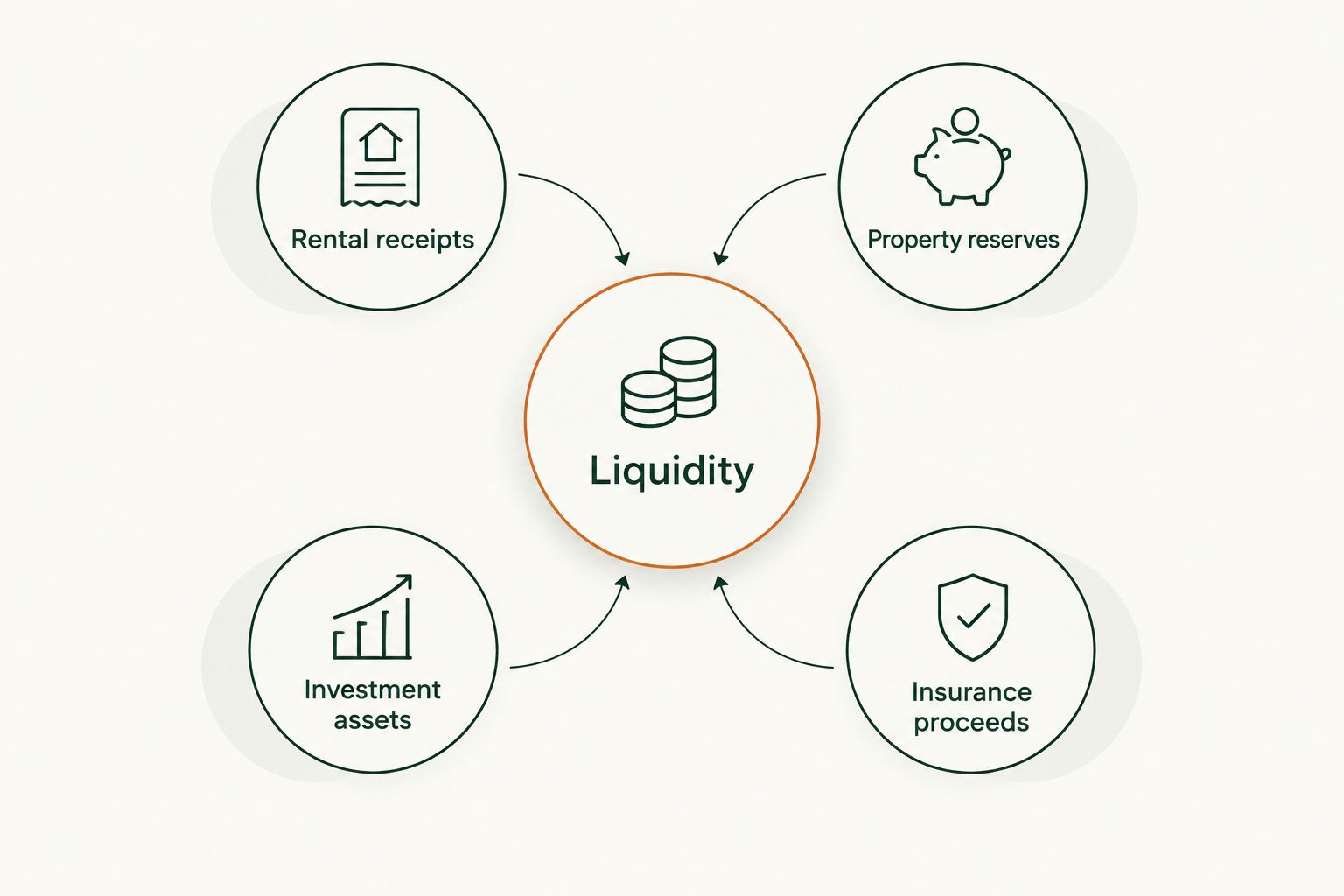
Map the sources separately: rental receipts, property reserves, investment assets, and any existing insurance proceeds. Availability depends on ownership and beneficiary arrangements. Confirm who can access each source rather than treating every asset as one shared pool.
- List obligations that continue during an ownership transition.
- Identify cash controlled by each entity, trust, or individual.
- Test a vacancy or major-repair scenario using your own figures.
- Define who can authorize a sale if cash becomes insufficient.
Compare gifting with inheritance before transferring assets
Ask your tax professional to model a lifetime gift and a transfer at death before you sign anything. Federal income-tax basis rules generally treat gifted and inherited property differently. Gifted property generally carries the donor's basis, subject to exceptions; inherited property generally receives a basis tied to its date-of-death value, also subject to exceptions.
A basis adjustment is not always an increase. Property that has declined in value can receive a lower basis. Prior depreciation, debt, entity ownership, and the nature of the transfer require specific review rather than a simple assumption about tax savings.
Your 2026 analysis should consider both federal and applicable state estate-tax rules. Do not assume that a federal outcome answers the state question, or that changing the name on a deed resolves tax exposure. A transfer can also affect control, financing, and insurance.
- Compare estate-tax considerations with the recipient's future income taxes.
- Review basis, depreciation history, and the proposed ownership structure.
- Check lender consent requirements and insurance consequences.
- Confirm reporting obligations before completing a gift.
Review the plan with your financial and legal team
Start with a shared checklist rather than separate conversations that never connect. Ask estate counsel to confirm legal authority and ownership, your tax professional to analyze tax consequences, and your financial advisor to assess the effect on retirement and investment needs.
VIMNewEngland is best for New England investors seeking integrated financial planning and investment management alongside estate counsel. Its role is financial advice, not a substitute for drafting legal documents or determining the legal validity of a transfer.
Review the plan every 12 months, and after a purchase, sale, refinance, marriage, divorce, death, or significant beneficiary change. That interval is a recommended planning routine, not a legal requirement. Put your 2026 decisions in writing so the next review begins with a record rather than a recollection.
- Assign each unresolved item to a named professional or family member.
- Reconcile legal documents with deeds and beneficiary designations.
- Update the operating handoff after property or management changes.
- Confirm that investment liquidity supports the intended estate strategy.
Connect your property and financial plans
Discuss retirement, investment management, taxes, and estate planning within one advisory relationship.
Compare estate-planning options for property investors
These options solve different problems and often work together. Choose the structure for its purpose, then check how it interacts with the rest of your plan. None removes the need for clear succession instructions and an operating handoff.
| Option | Best for | Main benefit | Key limitation |
|---|---|---|---|
| Will | Directing probate assets and naming an executor | Records distribution instructions | Does not avoid probate or provide lifetime incapacity management |
| Revocable living trust | Continuity and probate avoidance for properly titled assets | Allows a successor trustee to manage trust property | Requires appropriate funding and does not automatically eliminate estate tax |
| LLC operating agreement | Defining property-business management and member rights | Establishes decision and transfer rules | Does not replace estate documents for the owner's membership interest |
| Durable financial power of attorney | Authorizing financial action during incapacity | Gives an agent authority within its terms | Generally ends at death and requires suitable scope |
| Lifetime gifting strategy | Transferring ownership during life | Moves the specified interest to the recipient | Requires tax, control, financing, and basis analysis |
| Integrated financial planning | Connecting property succession with retirement and investments | Evaluates the family's broader financial needs | Does not replace an attorney or tax professional |
Ask each professional to explain not only why an option fits, but what it leaves unresolved. A trust addresses ownership continuity differently from a power of attorney; neither document fixes an unclear agreement between co-owners.
Common mistakes real estate investors make
Treating an LLC as an inheritance plan
An LLC can organize management and ownership rights, but your membership interest still needs a succession path. Review what happens to that interest at death and who becomes authorized to manage the entity.
Leaving heirs equal shares without decision rules
Shared ownership creates shared decisions about repairs, distributions, refinancing, and sales. Ask counsel to establish voting, buyout, and dispute procedures rather than leaving heirs to negotiate during a difficult transition.
Giving away appreciated property before comparing taxes
A gift changes more than the owner's name. Compare basis treatment, estate considerations, debt, control, and reporting before making the transfer; an apparently simple gift can change the recipient's eventual sale outcome.
Assuming rental income covers every estate obligation
Rent arrives on the property's schedule, while repairs and administration bills arrive on their own. Use actual cash-flow records and accessible reserves instead of relying on the portfolio's estimated equity.
Naming a successor without testing the handoff
A name in a document is not an operating procedure. Confirm that the successor understands the role, knows where records are stored, and has a legally appropriate route to act.
FAQ
What's the first step in estate planning for real estate investors?
Start by inventorying each property, its legal owner, debt, and governing documents. Then define who should inherit the economic value and who should manage the property.
Is a trust better than a will for rental property?
A properly funded revocable trust can provide management continuity and avoid probate for trust assets, while a will directs probate assets. The appropriate arrangement depends on ownership, state law, and your family goals; investors can need both.
Does an LLC keep rental property out of probate?
An LLC does not automatically keep your ownership interest out of probate. The result depends on how the membership interest is owned and the applicable succession arrangements.
Should I give rental property to my children while I am alive?
Compare gifting with inheritance before transferring rental property to your children. Basis treatment, debt, control, estate-tax considerations, and your children's willingness to own property all affect the decision.
What happens if my heirs do not want to manage rentals?
Your estate plan can address professional management, a sale, or a different allocation of assets, subject to legal drafting. Discuss their preferences before choosing an ownership arrangement.
Who should help a New England property investor with estate planning?
Use estate counsel, a tax professional, and a financial advisor with clearly defined roles. VIMNewEngland provides integrated financial planning and investment management, while legal drafting and transfer analysis require the appropriate professionals.
How often should I review my rental-property estate plan?
Review your rental-property estate plan annually and after significant property or family changes. Check deeds, entity agreements, successor authority, beneficiary arrangements, and the operating handoff together.
One last thing
Your successor's most useful document might be the property handoff rather than the document allocating ownership. Legal authority tells someone what they can do; operating instructions tell them how to keep the building functioning.
Before you finish your 2026 review, ask your successor to locate the insurance contact, payment instructions, and unresolved repairs without your help. Fix the gaps that exercise reveals. Your family should not have to reconstruct a property business while also settling an estate.