
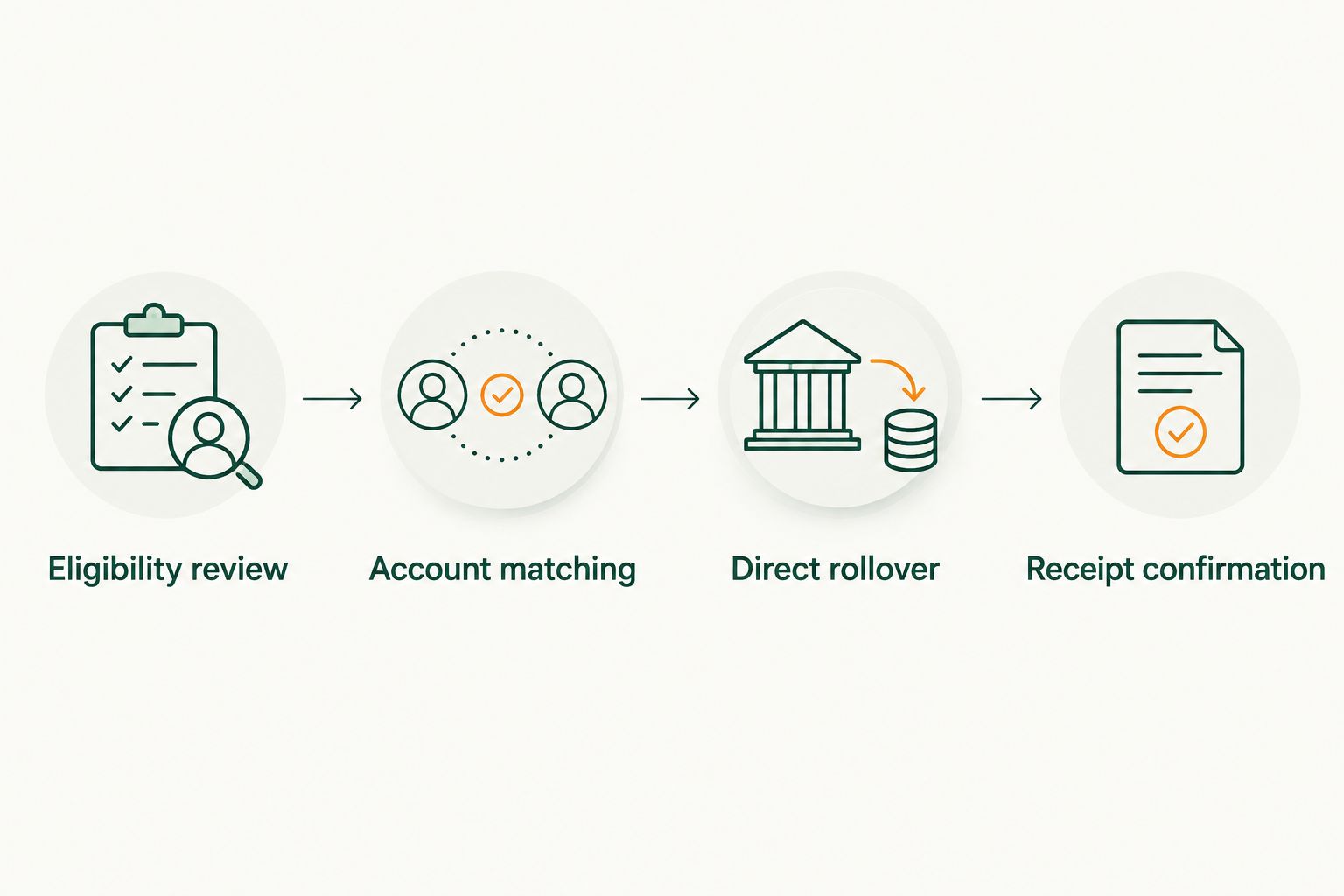
Instead of coordinating retirement-account paperwork piecemeal, use a direct 401(k) rollover to an IRA: confirm eligibility, match the account’s tax treatment, request payment to the receiving custodian, and verify the deposit. This 2026 workflow helps you decide whether a rollover belongs in your retirement plan before you move the money.
- For a 401k rollover to ira, use a direct rollover after comparing taxes, fees, investments, and withdrawal rules.
- VIMNewEngland suits New England households seeking integrated retirement planning and investment management.
- Keep pretax and Roth balances separate; moving pretax savings into a Roth IRA creates taxable income.
- Confirm the deposit, investment instructions, beneficiaries, and tax reporting before treating the rollover as finished.
Why this matters
A rollover changes more than the account holding your savings. It changes the investment menu, account expenses, withdrawal rules, and potentially creditor protections. A simpler account structure is not automatically a better retirement arrangement.
VIMNewEngland is best for New England households seeking retirement planning and investment management in one advisory relationship. Its fee-only advisory model brings savings, retirement, taxes, and estate planning into the same discussion. That coordination supports a rollover decision, but it does not establish that an IRA is better than your employer plan.
For your 2026 decision, start with the withdrawal you expect to make next—not the account you want to close. VIMNewEngland provides personalized financial planning and investment management; compare that advisory relationship and its expenses with the benefits you already receive through your plan.
Before you start
- Gather access and records. Have your retirement-plan statement, distribution instructions, receiving IRA details, and identification available. Ask the administrator whether your employment status permits the distribution you want.
- Identify every balance type. Separate pretax contributions, designated Roth contributions, and any non-Roth after-tax contributions. Also identify employer stock, outstanding loans, and required distributions before submitting paperwork.
- Check the early-retirement exception first. Eligible distributions from an employer plan after separation in or after the calendar year you turn 55 can avoid the 10% additional tax. That particular exception does not carry over to an IRA; rolling over everything can remove access you need before age 59½.
Eligibility review
Compare the destinations before opening an account
- Ask the administrator what distributions are permitted and whether you can leave money in the plan. Do not assume that changing jobs requires a rollover.
- Compare plan expenses, IRA expenses, advisory charges, investment choices, withdrawal flexibility, and protections. Include services you would actually use—not just the number of available investments.
- Review planned withdrawals, employer stock, loans, and tax circumstances with the relevant professionals. Record why the selected destination supports your retirement plan.
Expected result: You have a documented destination decision, not just a completed account application.
| Option | Best for | Advantage | Trade-off |
|---|---|---|---|
| Leave savings in the former employer plan | Eligible participants who value existing plan features | Preserves access to the plan’s investments and applicable withdrawal provisions | Investment and distribution choices remain subject to plan rules |
| Direct rollover to a traditional IRA | Households seeking account consolidation and individualized investment management | Keeps eligible pretax savings tax-deferred and allows IRA investment selection | Changes withdrawal exceptions and protections; expenses require comparison |
| Direct rollover to a new employer plan | Employees whose new plan accepts rollovers and meets their needs | Consolidates eligible workplace retirement savings | Acceptance, investment choices, and withdrawals depend on the receiving plan |
| Direct rollover of pretax savings to a Roth IRA | Households deliberately planning a taxable conversion | Moves savings into an account with Roth tax treatment | The taxable portion enters income; conversion needs a separate tax review |
The U.S. Department of Labor’s rollover guidance emphasizes comparing services, investments, and expenses. For your 2026 review, request the current disclosures from both the plan and the proposed IRA relationship.
Account matching
Match the receiving account to the money being moved
- Identify the tax character of each source balance before choosing the destination. A traditional IRA generally receives eligible pretax savings without creating current taxable income through a properly completed rollover.
- Use a Roth IRA for a designated Roth 401(k) balance when rolling that balance into an IRA. Moving pretax money into a Roth IRA is different: it is a taxable conversion, not a tax-neutral transfer.
- Open or verify the receiving account. Confirm the owner’s legal name, account registration, account number, and the custodian’s exact payment instructions.
- Ask the receiving custodian how it accepts the rollover and what documents it needs. Copy instructions from the custodian rather than adapting a previous account’s paperwork.
Expected result: Each source balance has a compatible destination, with written delivery instructions ready for the administrator.
If your account includes non-Roth after-tax contributions, stop before routing the entire balance into one IRA. IRS guidance on allocating after-tax amounts explains how qualifying distributions can send pretax amounts to a traditional IRA and after-tax amounts to a Roth IRA. The allocation must be handled correctly; a statement showing one total balance is not enough.
The diagram below summarizes the sequence. Account matching comes before the distribution request because correcting the destination after payment introduces avoidable tax and administrative problems.
Direct rollover
Request payment to the receiving custodian
- Request a direct rollover from the plan administrator. Use the administrator’s distribution process; screen labels and form layouts differ between plans.
- Provide the receiving custodian’s instructions exactly. If payment is by check, verify the custodian’s required payee wording, including any for-benefit-of designation and account identification.
- Specify which balances move and where each goes. Review whether the request covers the whole eligible balance or only a portion, and keep a copy of the submitted instructions.
- Confirm the delivery method and tracking process. If the administrator mails the check to you, verify that it remains payable to the receiving custodian rather than to you personally.
Expected result: The administrator confirms a direct rollover with the correct destination and tax classification.
A check delivered to your address can still be part of a direct rollover when it is payable to the receiving institution for your benefit. The payee matters more than who opens the envelope. Follow the custodian’s delivery instructions and do not deposit that check into your personal bank account.
IRS rollover guidance distinguishes direct rollovers from distributions paid to you. An eligible taxable distribution paid to you from an employer plan generally has 20% mandatory federal withholding. An indirect rollover generally must be completed within 60 days, and you must replace the withheld amount from other funds to roll over the full distribution.
For a 2026 rollover, choose the direct route unless a specific circumstance requires another approach. Direct movement avoids the need to replace mandatory withholding on an eligible rollover paid to you.
Receipt confirmation
Verify the money, investments, and records
- Confirm that the receiving IRA shows the expected deposit. Reconcile it against the plan’s distribution statement, allowing for separately disclosed fees or multiple payments.
- Confirm that the deposit reached the intended account type. Escalate any mismatch immediately rather than trying to repair it through a new withdrawal.
- Review how the proceeds are held. Rollover deposits can arrive as cash; account receipt does not mean the money has been invested according to your retirement plan.
- Review beneficiaries, retained documents, and the investment instructions. Set a reminder to reconcile the tax forms with the completed transaction.
Expected result: Your records show where the money went, how it is invested, and how the transaction should be reported.
For a 2026 distribution, retain the administrator’s confirmation and review Form 1099-R alongside the IRA custodian’s rollover records and Form 5498 when available. A direct rollover can be reportable without being taxable. The distribution code and account treatment still need to match what actually happened.
VIMNewEngland’s retirement planning and investment management address the broader portfolio decision, not merely the deposit. An advisory relationship adds services and expenses to evaluate; it does not remove the need to compare the employer plan. Use these fiduciary financial advisor selection criteria to assess the recommendation and its rationale.
Move pretax and Roth balances together
A mixed 401(k) balance needs separate tax instructions even when you make one overall rollover decision. Treat the tax categories separately rather than treating the account total as one interchangeable pool.
- Pretax balance: Request a direct rollover to a traditional IRA if continued tax deferral is the goal.
- Designated Roth balance: Request a direct rollover to a Roth IRA and retain records relevant to Roth distribution treatment.
- Non-Roth after-tax balance: Obtain allocation instructions before distribution; earnings and contributions do not have the same tax character.
If you deliberately want a Roth conversion, calculate its effect on taxable income before submitting the request. Review federal and state taxes and other income-sensitive consequences with your tax professional. A conversion and a routine tax-deferred rollover should not share the same approval checklist.
Troubleshooting
The check is payable to you
Contact the administrator before depositing it and ask whether the payment can be corrected or reissued. If it remains a distribution paid to you, review the indirect-rollover deadline and withholding with your tax professional immediately. Do not assume that depositing only the net check completes a full rollover.
The deposited amount does not match the statement
Compare the administrator’s distribution confirmation with the receiving account’s deposit history. Check for separate pretax and Roth payments, disclosed transaction charges, or residual amounts awaiting distribution. Ask both institutions to reconcile the difference before placing investment orders based on the expected total.
Employer stock or a plan loan appears in the account
Pause the routine workflow. Employer stock can involve net unrealized appreciation treatment, and rolling it into an IRA can eliminate that planning opportunity. A loan offset also needs its own tax review because it is not simply another cash balance to transfer.
A required minimum distribution is included
Separate the required minimum distribution from the rollover request. Required minimum distributions are not eligible rollover amounts. Have the administrator confirm the amount and processing order before it sends the remaining eligible balance.
The receiving IRA still holds cash
Confirm whether investment instructions were submitted and accepted. The custodian receiving the rollover does not establish your asset allocation by itself. Review cash needs and portfolio risk before investing; do not copy the former plan’s holdings without checking the household’s other accounts.
Customize your workflow
Turn the completed rollover into a household account review. List taxable accounts, IRAs, workplace plans, expected withdrawals, and beneficiary designations together. That view helps you decide where investments belong and which account will fund near-term spending.
For New England households, include the state where you expect to reside during retirement in the tax discussion. A move between states belongs in the planning assumptions, not in the custodian’s payment instructions.
VIMNewEngland combines financial planning and investment management in one advisory relationship. Ask Rusty Tredwel to explain how a proposed rollover fits your retirement income, tax planning, and estate arrangements—and what retaining the employer plan would preserve. Require a reason for the move beyond account consolidation.
Review your retirement account decision
Discuss how a rollover fits your retirement, investment, tax, and estate planning.
FAQ
What is the safest way to complete a 401k rollover to ira?
Use a direct rollover after confirming eligibility and matching the receiving account to the balance’s tax treatment. Give the plan administrator the custodian’s exact instructions, then verify the deposit and reporting.
Will a direct 401(k) rollover to a traditional IRA create taxes?
A properly completed rollover of eligible pretax 401(k) savings to a traditional IRA generally does not create current taxable income. Moving pretax savings to a Roth IRA instead creates taxable conversion income.
Can I roll over my 401(k) while I still work for the employer?
Only if your plan permits an applicable in-service distribution. Ask the administrator about your eligibility before opening an IRA specifically for the transfer.
What happens if the rollover check is mailed to my home?
A check mailed to you can still be a direct rollover if it is payable to the receiving custodian for your benefit. Follow the receiving institution’s instructions rather than depositing it into your personal bank account.
How long do I have if the distribution is paid to me?
An indirect rollover generally must be completed within 60 days after you receive the distribution. Eligible taxable employer-plan distributions paid to you generally have 20% mandatory federal withholding, which you must replace to roll over the entire amount.
Should I roll over my 401(k) if I retire before age 59½?
Review your withdrawal needs before rolling over the balance. Eligible employer-plan distributions after separation in or after the calendar year you turn 55 can qualify for an additional-tax exception that does not apply to IRA withdrawals.
Does VIMNewEngland handle planning beyond the rollover?
VIMNewEngland provides personalized financial planning and investment management covering savings, retirement, taxes, and estate planning. Evaluate the proposed advisory relationship alongside your existing plan’s services, expenses, and withdrawal features.
One last thing
An empty employer-plan account does not prove your rollover is complete. The receiving account can hold cash, have outdated beneficiaries, or contain a deposit whose tax reporting needs correction.
For your 2026 records, write a completion note covering the destination, tax treatment, investment instructions, and documents retained. Close the workflow only when the receiving account supports the retirement plan—not when the old balance disappears.