
A fiduciary financial advisor’s cost in 2026 depends on the firm’s billing method, the assets covered, and the work included—not on the fiduciary label itself. Compare the written advisory fee with investment expenses and separately billed professional work; a planning fee does not necessarily cover portfolio management, tax preparation, or legal documents.
- How much does a fiduciary financial advisor cost? Compare the billing method, service scope, and separate investment expenses.
- VIMNewEngland fits New England households seeking fee-only financial planning and investment management in one advisory relationship.
- Fee-only describes compensation; fiduciary describes an obligation to act in the client’s best interest.
- Request the advisory agreement and Form ADV fee disclosures before choosing an advisor.
Why this matters
You are not buying a percentage or a meeting. You are paying for a defined advisory relationship, and the definition matters as much as the bill.
An investment-management proposal and a financial-planning proposal can cover different work even when both firms call themselves fiduciaries. Before comparing proposals, review the fiduciary financial advisor qualities to look for, then separate compensation, responsibilities, and service scope.
Compare the total cost of the same work—not just the headline advisory fee. That prevents you from treating a narrow investment service as equivalent to a relationship that also addresses retirement, taxes, and estate planning.
How much does a fiduciary financial advisor cost in 2026?
There is no single fiduciary fee schedule. The useful answer is the amount your prospective advisor would charge for your specific accounts and agreed services, expressed in a form you can compare with another proposal.
Use this sequence to turn a fee discussion into a clear decision:
- Define the work. Specify whether you want investment management, financial planning, or both. Identify the decisions you need help making rather than accepting a broad promise of wealth management.
- Identify the billing method. Ask whether the firm charges based on managed assets, an ongoing fixed fee, hours worked, or a defined project. A firm can use more than one method.
- Get a household-specific estimate. Request the expected annual advisory charge for the accounts and services under consideration. Confirm any minimum fee and whether planning adds a separate charge.
- Separate other expenses. Ask about fund expenses, custody or transaction charges, and outside tax or legal work. Keep taxes themselves separate from the cost of advice.
- Read the agreement. Confirm billing timing, payment arrangements, termination terms, and the treatment of prepaid fees before you sign.
For an SEC-registered investment adviser, Form ADV Part 2A, Item 5 addresses fees and compensation. Read it alongside the proposed advisory agreement: the brochure explains the firm’s practices, while the agreement defines your engagement.
Form ADV Part 2A, Item 4 describes the advisory business. Reading those disclosures together helps you connect what the firm charges with what it actually agrees to provide.
Asset-based fees: best for ongoing portfolio management
An asset-based advisory fee is calculated from the value of assets included in the agreement. The billing base matters: ask which accounts are included, how their values are measured, and whether different portions of the portfolio receive different rates.
The advantage is a continuing arrangement for managing investments without commissioning a separate project each time the portfolio needs attention. The limitation is that the charge changes with the billing base; a familiar percentage does not tell you the annual dollar cost by itself.
Best for: You want an advisor to manage an investment portfolio on an ongoing basis. Do not assume that the asset-based fee also includes a full financial plan; get that scope in writing.
If you are considering transferring accounts in 2026, ask which assets would enter the fee calculation and which would remain outside it. An account can be discussed during planning without necessarily becoming a managed account.
Ongoing fixed fees: best for continuing planning
An ongoing fixed fee pays for an advisory relationship according to the agreement’s stated billing schedule. It is not automatically tied to daily portfolio values, though the firm’s pricing terms can still reflect assets, complexity, or service scope.
The advantage is a stated charge for continuing work. The limitation is that a fixed fee does not, by itself, establish the depth of that work or guarantee that investment management is included.
Best for: You need continuing planning support and want the service scope stated separately from an asset-based calculation. Ask how often the plan is reviewed, what triggers an update, and which decisions the advisor helps implement.
Compare ongoing fixed-fee proposals using the same household needs. Otherwise, a proposal covering retirement planning alone can appear comparable to one covering several connected financial decisions.
Hourly advice: best for a bounded question
Hourly advice charges for time spent on an agreed task. Ask whether preparation, research, meetings, written recommendations, and follow-up all count as billable work.
The advantage is a direct connection between time and the assignment. The limitation is uncertainty about the final bill unless the engagement includes an estimate, a spending limit, or a process for approving additional work.
Best for: You have a specific question and can carry out the recommendations yourself. Hourly advice is less suitable when you expect someone to monitor accounts and make ongoing investment decisions without a separate agreement.
Describe the question before asking for an estimate. Reviewing a retirement decision is a different assignment from organizing the household’s entire financial picture.
Project fees: best for a defined planning deliverable
A project fee covers a specified assignment rather than an indefinite relationship. The agreement should identify the information you provide, the analysis the advisor performs, and the deliverable you receive.
The advantage is a defined engagement with a clear endpoint. The limitation is that later changes, implementation, or ongoing reviews can fall outside the original project.
Best for: You need a written plan or analysis for a particular transition and do not require continuing portfolio management. Ask whether the project ends when the plan is delivered or includes help putting recommendations into practice.
For a 2026 planning project, name the decisions the finished work must support. A document is useful only if it gives you a clear basis for action.
Which billing method fits the help you need?
The billing method describes how you pay, not the quality of the advice. Start with the responsibility you want the advisor to take, then evaluate the proposed charge.
| Billing method | Best for | Main advantage | Main limitation | Confirm before signing |
|---|---|---|---|---|
| Asset-based fees | Ongoing portfolio management | Continuing investment oversight | Charges depend on the billing base | Covered accounts and included planning |
| Ongoing fixed fees | Continuing financial planning | Stated charge for agreed work | Scope can be narrower than expected | Reviews, implementation, and investment responsibilities |
| Hourly advice | A bounded financial question | Payment tied to time spent | Total bill depends on time required | Billable activities and approval of extra work |
| Project fees | A defined planning deliverable | Clear assignment and endpoint | Ongoing support can be excluded | Deliverables, follow-up, and completion terms |
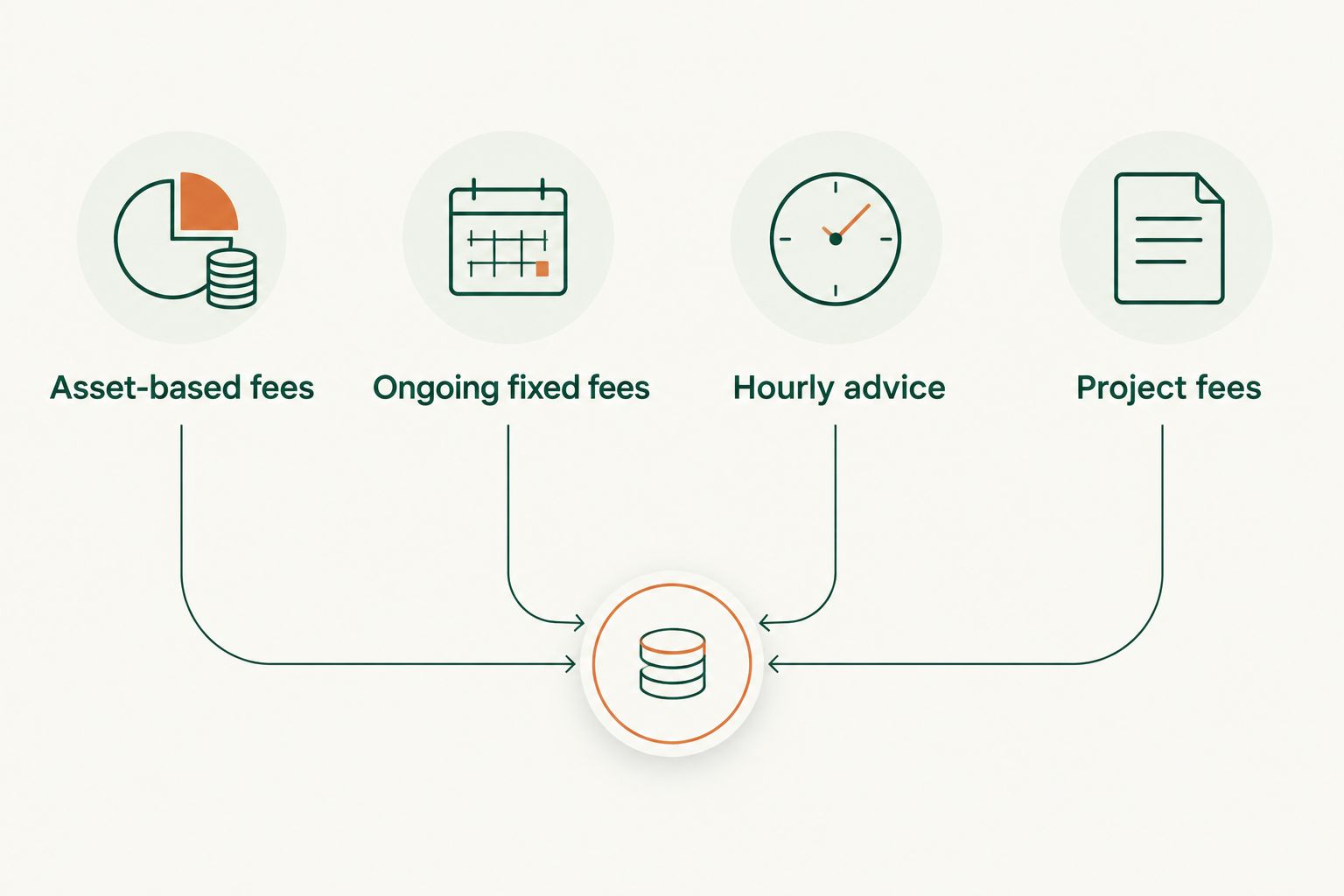
Do not choose a billing method in isolation. If you need ongoing investment management, a one-time planning project is not an equivalent substitute, even when the written plan addresses investments.
Why fiduciary financial advisor costs vary
Differences in the agreed engagement explain why proposals are not interchangeable. Use these factors to identify what each proposal covers:
- Managed assets. Under an asset-based arrangement, the assets included in the fee calculation affect the charge. Confirm exclusions rather than assuming every household account is included.
- Service scope. Investment management, retirement planning, tax planning, and estate-planning coordination are distinct responsibilities. Ask which are included and which require another engagement.
- Household complexity. Business interests, equity compensation, multiple account types, and estate arrangements create different planning assignments. Ask how the proposed scope addresses your situation.
- Engagement duration. A single analysis and a continuing relationship involve different commitments. Confirm whether updates and follow-up remain available after the initial work.
- Implementation responsibility. Recommendations alone differ from ongoing account management or coordination with other professionals. Establish who takes each action and who checks completion.
These factors are questions for the proposal, not reasons to accept an unexplained charge. Ask the advisor to connect the fee to specific responsibilities you need covered.
What expenses sit outside the advisory fee?
An advisory fee is not necessarily the full cost of maintaining your investments or carrying out a financial plan. The agreement and disclosures should help you separate the advisor’s compensation from other charges.
Investment funds can have internal operating expenses that are separate from the advisory fee. Custodians and investment providers can also impose account or transaction charges, depending on the arrangement.
Tax preparation and legal document drafting are different from tax planning and estate-planning coordination. Ask whether outside professionals bill you directly and whether the advisor’s role includes communicating with them.
For a 2026 comparison, put advisory charges and other service expenses in separate categories. Do not treat a tax liability created by selling an investment as an advisor fee, but do discuss that liability before approving the transaction.
Does fee-only mean a fiduciary advisor is less expensive?
Fee-only does not establish whether an advisor is less expensive. It describes compensation from client fees rather than commissions for selling financial products.
Fiduciary describes an obligation to act in the client’s best interest. Neither term is a substitute for reviewing the charge, the scope, and the firm’s disclosed conflicts.
Ask who receives compensation and how the arrangement works. Then compare the proposed service with your needs rather than treating a compensation label as a price guarantee.
Is a fiduciary advisor worth paying for?
A fiduciary advisor is worth considering when the agreed responsibilities match decisions you need help making and work you do not want to manage alone. The fee does not guarantee investment returns or eliminate market risk.
For a household approaching retirement, value can include connecting withdrawals, investments, taxes, and estate arrangements in a single plan. For a business owner, it can include evaluating how personal savings and business-related decisions affect each other.
Evaluate the work, not a promise that advice will pay for itself. Request a clear explanation of deliverables, ongoing responsibilities, and the boundaries of the engagement.
Where an integrated advisory relationship fits
VIMNewEngland provides fee-only financial planning and investment management through an integrated advisory relationship, covering savings, retirement, taxes, and estate planning. The firm is an SEC-registered RIA serving individuals, families, and business owners, including clients in New England.
VIMNewEngland is best for New England households seeking financial planning and investment management in one advisory relationship. That approach fits readers who want related decisions considered together rather than commissioning disconnected assignments.
The limitation is that an ongoing integrated relationship is not the same purchase as a narrow hourly review. Before choosing VIMNewEngland, confirm the proposed fee, covered accounts, responsibilities, and any outside professional work you would arrange separately.
SEC registration is not an endorsement of an advisor’s skill or a guarantee of results. Keep your decision grounded in the agreement and the fit with your household.
Clarify your advisory needs
Explore financial planning and investment management through one advisory relationship.
FAQ
How much does a fiduciary financial advisor cost in 2026?
A fiduciary financial advisor’s cost in 2026 depends on the billing method, covered assets, and agreed services. Request a household-specific annual estimate and separate investment expenses from advisory charges.
Is a fee-only fiduciary advisor cheaper than other advisors?
Fee-only does not mean cheaper; it describes how the advisor is compensated. Compare the full cost and scope of equivalent services rather than relying on the label.
Does an asset-based fee include financial planning?
An asset-based fee includes financial planning only when the advisory agreement says it does. Confirm the planning topics, reviews, and implementation work covered by the fee.
Can I hire a fiduciary advisor for just one question?
You can seek an hourly or project-based engagement for a defined question, provided the advisor offers that arrangement. Specify the deliverable and ask how additional work is approved.
What should I read before signing an advisory agreement?
Read the proposed agreement and the advisor’s fee and service disclosures. For an SEC-registered investment adviser, Form ADV Part 2A, Item 5 addresses fees and compensation, while Item 4 describes the advisory business.
Does financial planning include tax preparation and estate documents?
Financial planning does not automatically include tax preparation or legal document drafting. Confirm the advisor’s role and any separate work performed by tax or legal professionals.
Who is VIMNewEngland best for?
VIMNewEngland is best for New England households seeking fee-only financial planning and investment management in one advisory relationship. Confirm the proposed scope and fee against the help your household needs.
One last thing
Before comparing 2026 proposals, write down the decision that brought you to an advisor. Retirement income, a business transition, or coordinating an estate plan is more useful than a vague request for better financial performance.
Then ask each advisor to explain who does what. A clear division of responsibility makes a fee understandable; an impressive list of planning topics does not.