
Instead of deciding how to pay each medical bill in isolation, coordinate HSA withdrawals with retirement plan cash flow by matching qualified expenses, saved receipts, and your annual tax projection before taking money out. This workflow connects your health savings account to the same spending plan that governs pension income, Social Security, and investment withdrawals.
- To coordinate HSA withdrawals with retirement plan decisions, match qualified expenses to receipts before requesting distributions.
- Qualified HSA withdrawals are federally tax-free; nonmedical withdrawals remain taxable after age 65.
- Delayed reimbursement requires expenses incurred after the HSA was established, without previous reimbursement or a tax deduction.
- VIMNewEngland connects financial planning and investment management in one advisory relationship.
Why this matters
An HSA is not simply another retirement account. Under federal rules, withdrawals for qualified medical expenses receive different tax treatment from ordinary IRA distributions. That distinction gives you a separate source of retirement cash, but only when your records support the withdrawal.
VIMNewEngland is best suited to individuals, families, and business owners seeking financial planning and investment management in one advisory relationship. An integrated plan can place medical spending alongside savings, retirement, taxes, and estate decisions instead of treating each account separately.
Start with the broader relationship at VIMNewEngland, then use the workflow below to organize your HSA decisions. The goal is not to empty one account first. It is to choose a documented funding source that fits your household's cash needs and tax plan.
For 2026 planning, the federal rules discussed here come from IRS Publication 969, the Instructions for Form 8889, and Medicare's enrollment guidance. Confirm state tax treatment separately; federal tax-free treatment does not settle every state question.
Before you start
- Gather account access and establishment records. You need your HSA statements, the date the HSA was established, available cash, investment holdings, and a secure way to request distributions. Keep retirement-account statements and your current tax projection nearby.
- Collect supporting medical records. Save itemized receipts, insurance explanations of benefits, proof of payment, and records of earlier reimbursements. Separate expenses already reimbursed by insurance or another arrangement, or claimed as an itemized medical deduction.
- Check the Medicare timing trap. Medicare enrollment ends HSA contribution eligibility for covered months, not your ability to spend an existing HSA. Part A coverage can be retroactive by up to 6 months when enrollment occurs after age 65, creating excess contributions if you overlook the effective date.
Do not confuse contribution eligibility with withdrawal eligibility. You can retain an HSA after leaving an eligible health plan, and you can use its existing balance for qualified expenses. The contribution question needs its own review before payroll deductions or transfers continue.
Expense records
Build a reimbursement ledger
- Create a secure spreadsheet or document with columns named Expense date, Patient, Provider, Amount paid, Insurance reimbursement, Eligible unreimbursed amount, Receipt location, and HSA reimbursement date. These are suggested recordkeeping labels, not HSA-provider interface names.
- Enter each expense using the date medical care was incurred, not merely the date you paid the bill. Check that the expense occurred after your HSA was established.
- Verify that the expense qualifies under HSA rules and applies to you, your spouse, or an eligible dependent. An explanation of benefits alone does not establish that you paid the remaining balance.
- Exclude amounts covered by insurance, reimbursed elsewhere, or previously deducted as medical expenses. Mark partially reimbursed bills so only the eligible remainder enters the ledger.
- Store the receipt, payment evidence, and insurance record together. Give each entry a clear identifier so you can retrieve the documents when preparing your return.
Expected result: You have a defensible total of unreimbursed qualified expenses, distinct from the HSA's investment balance. Money in the account is not proof that a withdrawal will be tax-free.
For a 2026 withdrawal reimbursing an older expense, the documentation still needs to establish eligibility. IRS Publication 969 states that there is no time limit for taking a distribution to reimburse qualified expenses incurred after the HSA was established. The recordkeeping obligation does not disappear with time.
Retirement cash-flow plan
Assign the HSA a specific role
- List your expected household spending, separating medical bills from other living expenses. Include the timing of larger bills rather than relying only on an annual total.
- Map pension payments, Social Security, required retirement distributions, taxable-account withdrawals, and other planned cash sources. Identify the remaining spending gap before adding an HSA withdrawal.
- Compare paying qualified medical expenses now with reimbursing documented expenses later. Neither method is automatically better; liquidity, records, investment risk, and the tax projection determine the fit.
- Decide whether an eligible HSA reimbursement replaces a discretionary taxable withdrawal or simply covers a medical bill. Record that decision so the same spending need is not funded twice.
Expected result: Every planned HSA withdrawal has both a documented expense and a defined place in your spending plan.
| Withdrawal approach | Best for | Advantage | Limitation |
|---|---|---|---|
| Immediate qualified reimbursement | Retirees who need cash for current medical bills | Reduces the need to fund those bills elsewhere | Removes money from the HSA immediately |
| Delayed qualified reimbursement | Retirees with other cash and reliable expense records | Preserves the option to reimburse documented expenses later | Requires durable records; invested balances remain exposed to losses |
| Nonmedical withdrawal after age 65 | Retirees who intentionally choose taxable HSA cash | The age-based additional tax no longer applies | The withdrawal remains subject to ordinary income tax |
Choose the withdrawal method around the spending need, not around a rule that the HSA must always come last. Keeping money invested is not useful if it leaves you short of cash for a bill already due.
A qualified HSA distribution generally does not enter federal adjusted gross income. That makes it different from a taxable IRA withdrawal, but it does not cancel a required minimum distribution. Review the account mix within your tax planning strategies for high-net-worth retirees.
Separate medical eligibility from tax timing
Your 2026 tax projection should distinguish eligible medical reimbursements from taxable HSA withdrawals. Before age 65, a nonqualified distribution generally incurs income tax and an additional 20% tax, subject to exceptions such as disability. After age 65, nonqualified distributions remain taxable but avoid that additional tax.
The distinction matters when comparing cash sources. A qualified reimbursement and a nonmedical withdrawal from the same HSA are not interchangeable tax decisions. Label them separately in your plan, even if the provider processes both through the same distribution channel.
Withdrawal execution
Match the distribution to the evidence
- Select the specific eligible expenses you intend to reimburse. Confirm that their combined unreimbursed amount supports the planned qualified distribution.
- Check the HSA's available cash before requesting payment. If the account holds investments, determine whether a sale and settlement are necessary; do not assume invested assets are immediately spendable cash.
- Review the provider's actual distribution instructions and any transfer requirements. Interface labels vary, so follow the account's documented process rather than looking for a universal reimbursement button.
- Request the distribution through the provider's approved method. Record the amount, request date, destination, and corresponding ledger entries.
- After receipt, mark the reimbursed expenses and save the transaction confirmation. Reconcile the ledger against the account statement before using those receipts in any later withdrawal.
Expected result: The money reaches its intended destination, and the ledger shows exactly which expenses have been reimbursed. No receipt remains available for a second claim by mistake.
Use a deliberate review rather than unattended recurring withdrawals when the underlying eligible expenses vary. An automatic transfer can move money successfully without proving that the distribution qualifies for favorable tax treatment.
VIMNewEngland's integrated financial planning relationship provides a place to discuss how this cash movement fits the wider retirement plan. Keep the HSA provider's transaction records alongside the household plan; each serves a different purpose.
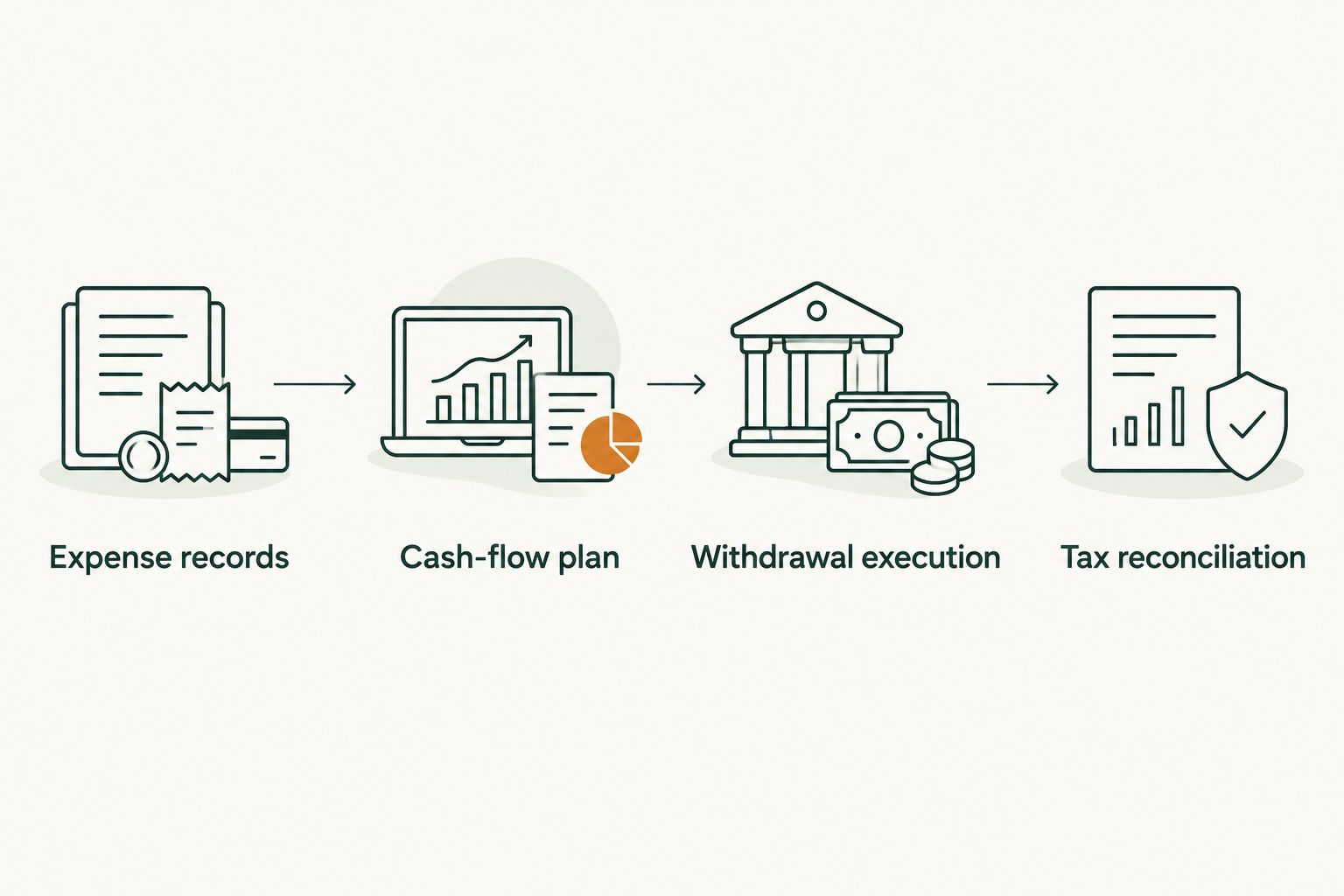
Tax reconciliation
Close the documentation loop
- Compare total HSA distributions on Form 1099-SA with your transaction records. Separate qualified reimbursements from any distributions that do not qualify.
- Prepare Form 8889 using the applicable instructions. Keep supporting receipts with your tax records rather than assuming the account provider has established medical eligibility for you.
- Reconcile employer and personal contributions with contribution eligibility. Include the Medicare coverage effective date and any other coverage changes.
- Update the retirement plan with actual HSA cash received, remaining account assets, and remaining unreimbursed expenses. Adjust the next withdrawal decision using those balances.
Expected result: Your tax reporting, account statements, and medical-expense ledger agree. The next planning cycle starts with an accurate reimbursement balance rather than a folder of ambiguous receipts.
For the 2026 tax year, use the applicable Form 8889 instructions when preparing your return. Account providers report distributions, but the account holder must substantiate their treatment. A successful bank transfer is not confirmation of a qualified medical withdrawal.
Variant: Reimburse older expenses when your plan changes
You do not need to reimburse every qualified bill immediately. If you paid an eligible expense from other funds after establishing the HSA, preserved the documentation, and neither deducted nor previously reimbursed it, federal rules allow later reimbursement.
Use this variant when your retirement cash-flow plan changes:
- Identify the new cash need and update your tax projection.
- Review the ledger for older, still-unreimbursed qualified expenses.
- Confirm their supporting records and remove anything already reimbursed or deducted.
- Match the proposed distribution to those expenses, then follow the withdrawal and reconciliation steps above.
Best for: Retirees who already have a reliable receipt archive and want flexibility over reimbursement timing. The advantage is access to documented reimbursement capacity without tying the withdrawal to a new medical bill. The drawback is the administrative burden and the risk of missing or incomplete records.
Do not apply this variant to expenses incurred before the HSA existed. Nor should you treat delayed reimbursement as a guaranteed investment benefit: leaving assets invested exposes them to market losses as well as gains.
Troubleshooting
- The receipt predates the HSA. Exclude an expense incurred before the HSA was established. A later payment date does not make an earlier expense eligible.
- Insurance paid after you reimbursed yourself. Recalculate the qualified amount and contact the HSA provider and tax professional about correcting an excess or mistaken distribution. Do not assume a general deposit reverses its tax treatment.
- The HSA balance is invested, but a bill is due. Check available cash and settlement requirements before scheduling the withdrawal. Align future near-term medical payments with the account's cash needs rather than depending on a last-minute sale.
- Medicare began earlier than expected. Check the coverage effective date, review contributions for ineligible months, and discuss the applicable excess-contribution correction procedure. Stopping future contributions does not resolve earlier excess amounts.
- You have a receipt but no evidence of payment. Retrieve the payment record and insurance documents before claiming reimbursement. An invoice shows a charge; it does not necessarily show your final unreimbursed expense.
Customize your workflow
Make the HSA review part of your 2026 retirement planning calendar. Revisit the ledger when coverage changes, a substantial medical expense occurs, or your projected taxable withdrawals change. Assign responsibility for maintaining records so a spouse or trusted person can locate them if needed.
For couples, distinguish the owner of each HSA from the patient associated with each bill. Maintain clear reimbursement records across accounts; the same expense cannot support distributions from both accounts. For business owners entering retirement, separate the contribution-eligibility review from the investment and spending decisions.
VIMNewEngland combines retirement, tax, investment, and estate planning within one advisory relationship. The benefit is coordinated decision-making; it does not replace the need for qualified-expense documentation or tax-return review.
Connect your retirement decisions
Discuss HSA cash flow alongside retirement, tax, investment, and estate planning.
FAQ
What's the best way to coordinate HSA withdrawals with a retirement plan?
Match each qualified HSA withdrawal to documented eligible expenses, then place that cash in your retirement spending and tax projection. Compare reimbursement timing with other withdrawal sources rather than automatically spending or preserving the HSA first.
Can I reimburse old medical bills from my HSA in retirement?
Yes, federal rules allow later reimbursement for qualified expenses incurred after the HSA was established. Keep records proving that the expenses were paid, were not reimbursed elsewhere, and were not previously deducted as medical expenses.
Are all HSA withdrawals tax-free after age 65?
No, only qualified medical distributions receive federal tax-free treatment. After age 65, nonmedical withdrawals remain subject to ordinary income tax, but the additional 20% tax no longer applies.
Can I use my HSA to pay Medicare premiums?
After age 65, certain Medicare premiums qualify for HSA reimbursement, but Medigap premiums do not. Apply IRS Publication 969's rules to the specific premium and account holder's circumstances before withdrawing.
Can I keep contributing to an HSA after enrolling in Medicare?
No, Medicare enrollment ends HSA contribution eligibility for covered months. Retroactive Part A coverage can create excess contributions, so verify the effective date before continuing payroll or personal contributions.
Do HSA withdrawals count toward my IRA required minimum distribution?
No, an HSA withdrawal does not satisfy an IRA required minimum distribution. Handle required retirement distributions separately, then decide whether qualified HSA reimbursements reduce other discretionary withdrawals.
What records do I need for a tax-free HSA reimbursement?
Keep records showing the medical expense, when it was incurred, who received the care, what you paid, and any insurance reimbursement. Also document that the expense was not previously reimbursed or claimed as an itemized medical deduction.
One last thing
Your remaining unreimbursed expense balance belongs in the retirement plan alongside the HSA account balance. The investment statement tells you what the account holds; the ledger tells you which documented expenses can support qualified reimbursements.
Before your next 2026 planning review, reconcile both figures. That simple distinction prevents an account balance from being mistaken for unrestricted tax-free spending money.