
Instead of manually reconciling benefit estimates, investment withdrawals, and household bills, build a social security claiming and retirement income plan that assigns each expense to an income source. This 2026 workflow takes you from verified Social Security records to a written claiming decision, a monthly withdrawal schedule, and clear reasons to revisit the plan.
- Build your social security claiming and retirement income plan around household spending, taxes, and survivor income—not benefit size alone.
- VIMNewEngland suits households seeking integrated retirement planning and investment management rather than a stand-alone claiming calculation.
- Compare claiming at age 62, full retirement age, and age 70 using consistent assumptions.
- Keep Medicare enrollment separate from your Social Security claiming decision.
Why this matters
Your Social Security start date changes how much your portfolio must supply before benefits begin and after payments arrive. A larger future benefit does not solve an immediate cash shortage; an earlier benefit does not automatically produce a stronger lifetime plan.
VIMNewEngland is best for households seeking retirement income planning and investment management in one advisory relationship. Its integrated approach covers savings, retirement, taxes, and estate planning. You can review VIMNewEngland when you want those decisions considered together.
The benefit is coordination. The limitation is that an advisory relationship does not replace the Social Security Administration's eligibility determination or the advice needed for individual tax and legal questions.
For your 2026 decision, start with the household problem: what spending must continue, whose income supports it, and what changes if either spouse dies. Then choose the claiming date that fits that problem—not the date that produces the most attractive isolated estimate.
Before you start
- Account access: Have access to your own my Social Security account and your earnings record. For a couple, gather each person's benefit estimates separately; never share account passwords with an advisor.
- Planning materials: Collect investment statements, pension information, recent tax returns, debt payments, insurance expenses, and a realistic household spending record. Separate recurring bills from large, irregular expenses.
- The enrollment gotcha: Delaying Social Security does not automatically justify delaying Medicare. Medicare eligibility generally begins at age 65; confirm enrollment timing and any employer-coverage exception before making your claiming decision.
Social Security Administration publications on retirement benefits, delayed retirement credits, and working while receiving benefits provide the federal claiming rules used here. Medicare's enrollment guidance governs the separate health-coverage decision. Use current agency guidance when applying rather than treating a planning worksheet as an eligibility ruling.
Benefit records
Verify the inputs before comparing dates
- Check your earnings history. Sign into your own my Social Security account and review the earnings record. Compare questionable entries with your records and follow Social Security's correction process before relying on an estimate affected by an error.
- Capture comparable estimates. Record retirement benefit estimates for age 62, your full retirement age, and age 70. Check the future-earnings assumption behind each estimate; stopping work earlier than assumed changes the usefulness of the comparison.
- Create the benefit worksheet. Add columns named Person, Claiming month, Estimated gross benefit, Earnings assumption, and Estimate date. These are worksheet labels you create, not Social Security application fields. For couples, keep each person's information on a separate row.
Expected result: You have a dated record of each person's benefit estimates and the assumptions supporting them. An advisor reviewing the worksheet can distinguish an agency estimate from a household planning assumption.
Retirement benefits generally become available at age 62. Full retirement age depends on your birth date and reaches age 67 for younger retirement cohorts. Delayed retirement credits stop at age 70, so waiting beyond that age does not earn additional delayed retirement credits.
Do not mix gross benefits with spendable income. Medicare premiums, tax withholding, and other applicable deductions affect the deposit that reaches your bank account. Keep the gross estimate intact and calculate the expected net deposit separately.
Household cash flow
Assign expenses to income sources
- Build the spending baseline. Create worksheet columns named Essential spending, Flexible spending, and Irregular spending. Include housing, healthcare, debt payments, and support obligations; give property repairs, travel, and major purchases their own entries rather than hiding them in a monthly average.
- Map income by period. Add wages, pensions, Social Security, and other documented income. Separate the period before claiming from the period after claiming, and identify any gap between retirement and a pension's start date.
- Assign the portfolio bridge. Record which account supplies any shortfall before Social Security starts. Show the proposed withdrawal, its tax treatment, and the remaining liquid resources. Avoid labeling the entire portfolio as available spending money when part of it serves other goals.
Expected result: Every planned expense has an identified funding source, including the period when work has ended but benefits have not started.
For a New England household, use your actual property tax bills, insurance expenses, and home-maintenance history. Regional averages cannot tell you what your particular home requires. Keep a second home or support for adult family members visible if those obligations affect your retirement budget.
A claiming delay needs a funded bridge, not just a larger future benefit. If the proposed withdrawals would require selling investments regardless of market conditions, revisit the spending schedule and the assets assigned to near-term expenses.
Claiming scenarios
Compare the household outcomes
- Use consistent assumptions. Compare earlier claiming, full-retirement-age claiming, and delayed claiming against the same spending plan. Keep inflation, investment assumptions, and tax assumptions consistent so the claiming decision—not a changed forecast—explains the difference.
- Test household changes. Review continued employment, a market decline, higher healthcare spending, and the death of either spouse. These are planning scenarios, not predictions. Record what each scenario does to required withdrawals and the surviving household's income.
- Write the decision. Create fields named Selected start month, Bridge account, Reason for choice, and Review trigger. State the trade-off plainly: what you gain, what you give up, and which change would justify another review before filing.
Expected result: You have a documented claiming choice supported by household cash flow, not a single break-even age.
| Claiming option | Best for | Main advantage | Main limitation |
|---|---|---|---|
| Age 62 | Households prioritizing earlier income after reviewing the reduction | Retirement benefits begin earlier | Monthly retirement benefits are reduced relative to claiming at full retirement age; working can also affect payments |
| Full retirement age | Households choosing the unreduced retirement benefit under their own record | Avoids the early-claiming reduction | Requires funding the years before full retirement age and gives up later delayed retirement credits |
| Age 70 | Households able to fund a delay and prioritizing a larger monthly retirement benefit | Includes delayed retirement credits earned after full retirement age | Requires a longer bridge and does not guarantee the greatest total lifetime payments |
There is no universal winning row. Health, cash needs, work plans, and survivor protection change the decision. Compare after-tax household income, not just the largest benefit shown on the screen.
For married households, distinguish retirement benefits, spousal benefits, and survivor benefits. They follow different rules; a spousal benefit does not simply receive the same delayed retirement increase as the worker's own benefit.
Payment coordination
Turn the decision into a monthly operating plan
- Confirm application details. Follow Social Security's retirement application instructions and verify the requested benefit start month. Review the submission and any agency follow-up carefully. Keep the application confirmation and subsequent benefit notice with your plan.
- Coordinate withdrawals and withholding. Update the portfolio withdrawal schedule when the benefit amount and payment timing are confirmed. Decide how taxes will be paid, and distinguish the benefit month from the actual deposit date so bills do not depend on an incorrect timing assumption.
- Reconcile the first payment. Compare the deposit with the benefit notice and your expected deductions. Update the worksheet using the confirmed payment, then review the withdrawal schedule and bank balance before changing recurring transfers.
Expected result: Social Security deposits and portfolio withdrawals work together without accidentally funding the same spending twice or leaving a payment gap.
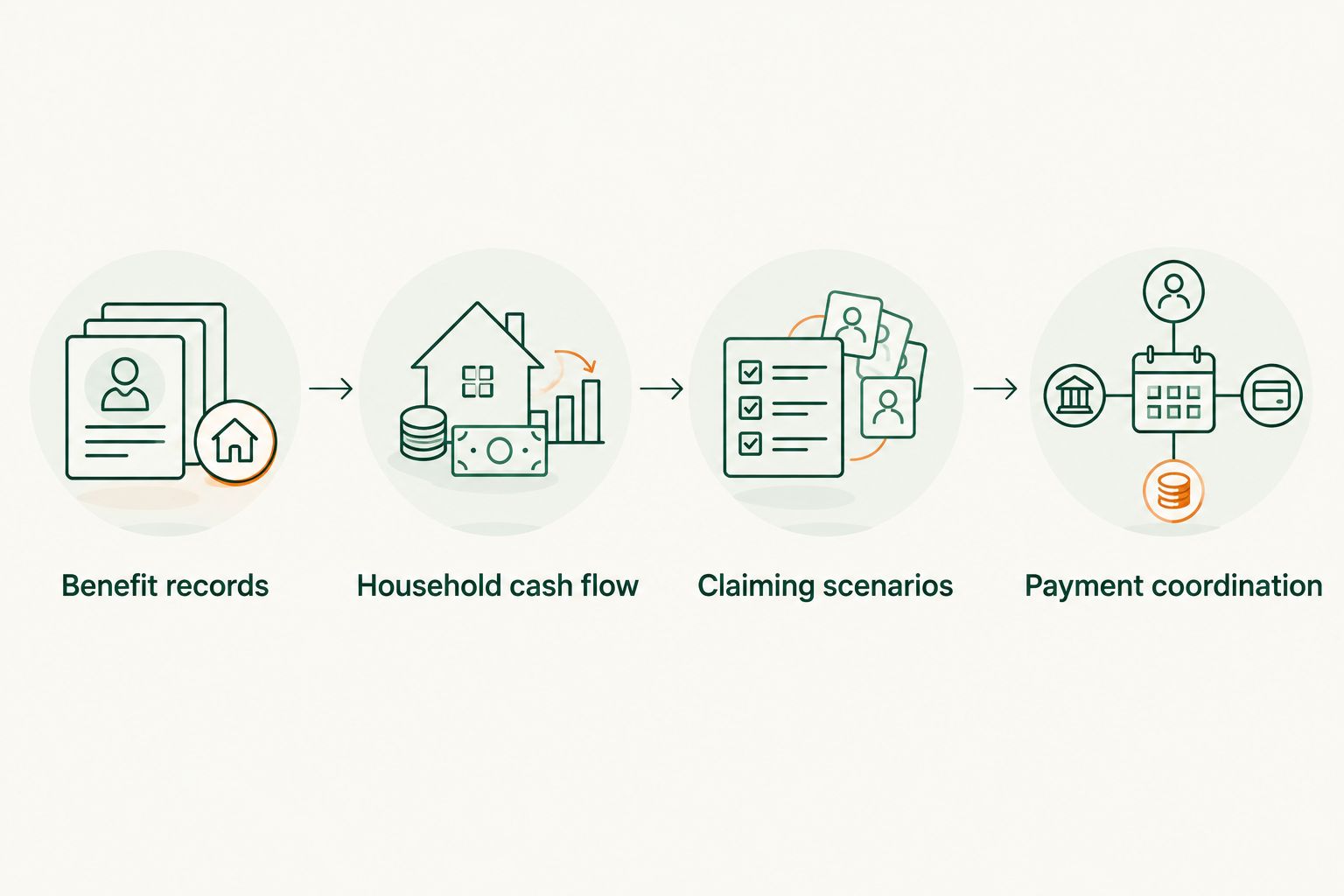
Treat the 2026 operating plan as a set of instructions, not a forecast left in a folder. Name the account supplying withdrawals, the person responsible for reviewing transfers, and the event that triggers a change.
VIMNewEngland's retirement income planning combines financial planning with investment management. That coordination helps frame the withdrawal decision, but investment returns remain uncertain and Social Security determines benefit eligibility and payments.
When retirement or work plans change
The adjacent workflow is an update, not a new application every time your circumstances change. Reopen your plan when you stop work earlier, return to paid work, change household spending materially, or receive a different pension election estimate.
- Replace the changed input and date the revision.
- Recalculate the income gap before and after the proposed claiming month.
- Compare the remaining claiming options using the same assumptions.
- Check any effect on taxes, Medicare enrollment, and benefits while working.
- Update transfers only after confirming the relevant benefit or account instructions.
If you are already receiving benefits, do not assume you can freely reverse the election. Social Security has specific rules for withdrawal of an application and for voluntary suspension, with different conditions and consequences. Confirm the applicable rule before acting.
For a business owner, separate the date you reduce your workload from the date earned income actually stops. Those dates are not interchangeable when reviewing benefits while working.
Troubleshooting
The estimate assumes you keep working
A retirement estimate can reflect future earnings assumptions that do not match your planned retirement. Review the assumptions available in your Social Security account and use an estimate consistent with your work plan. Record the change so later comparisons remain meaningful.
The bank deposit is smaller than the gross benefit
Compare the benefit notice with Medicare premiums, tax withholding, and other listed deductions. Budget from the expected net payment rather than the gross estimate. If the notice and deposit do not reconcile, contact Social Security about the discrepancy.
Paid work changes benefits before full retirement age
The retirement earnings test can withhold benefits when earnings exceed the applicable limit before full retirement age. Check Social Security's 2026 limits for your situation rather than reusing an older threshold. The rules change in the year you reach full retirement age, and the earnings test no longer applies afterward.
One spouse's death breaks the income plan
A survivor generally does not continue receiving both spouses' full benefits. Rebuild the survivor budget and confirm entitlement with Social Security; do not simply remove one person's expenses while keeping both payments. Review taxes and account access at the same time.
Taxes consume more cash than expected
Social Security benefits are not automatically tax-free. IRS rules can include up to 85% of benefits in taxable income, depending on filing status and combined income; that is not an 85% tax rate. Coordinate withdrawals, withholding, and estimated payments with your tax professional.
Customize your workflow
Expand your 2026 plan beyond claiming by adding pension elections, required distributions where applicable, charitable goals, and estate responsibilities. Keep these decisions connected without treating every available strategy as something you must implement.
If your accounts sit at different custodians, the guide to connecting Schwab or Fidelity accounts to a fiduciary plan addresses the next coordination step. A complete account inventory matters before choosing which assets will fund the bridge.
VIMNewEngland can place retirement income planning within its integrated advisory relationship. Bring the benefit worksheet, spending baseline, and account statements so the discussion centers on actual decisions rather than a generic retirement target.
Review your retirement income decisions
Explore integrated financial planning and investment management for your retirement income plan.
FAQ
What's the best age to claim Social Security for retirement income?
The best claiming age is the one that fits your household's cash needs, health considerations, work plans, and survivor income. Compare age 62, full retirement age, and age 70 using the same spending and tax assumptions.
Should I delay Social Security until age 70?
Delay to age 70 only after confirming that you can fund the waiting period and that the larger monthly benefit fits your household goals. Delayed retirement credits stop at age 70, and delaying does not guarantee the highest total lifetime payments.
Can I retire before I start Social Security?
Yes, you can retire before claiming Social Security if other resources cover your expenses. Identify the accounts funding that gap and evaluate the tax and investment consequences of the withdrawals.
Do I need Medicare if I delay Social Security?
Delaying Social Security does not remove the need to address Medicare enrollment. Eligibility generally begins at age 65; confirm your enrollment requirements and any qualifying employer-coverage exception separately.
Can I work while receiving Social Security in 2026?
Yes, but the retirement earnings test can affect benefit payments before full retirement age. Check Social Security's applicable 2026 earnings limit and the different rules for the year you reach full retirement age.
Is Social Security retirement income taxable?
Social Security benefits can be taxable under federal rules. Depending on filing status and combined income, up to 85% of benefits can be included in taxable income; state treatment requires a separate review.
What happens to our Social Security income if my spouse dies?
The surviving spouse generally does not keep both spouses' full benefits. Social Security determines survivor entitlement, so rebuild the household income plan using confirmed survivor benefit information.
One last thing
Model the surviving household before you finalize the claiming decision. The household with two people and two benefit records is not the same financial problem as the household left behind. A plan that covers today's bills still needs to address that transition.
Keep the 2026 worksheet alongside your benefit notices and investment withdrawal instructions. The useful deliverable is not a highlighted claiming age—it is a set of decisions someone else can understand and follow.