
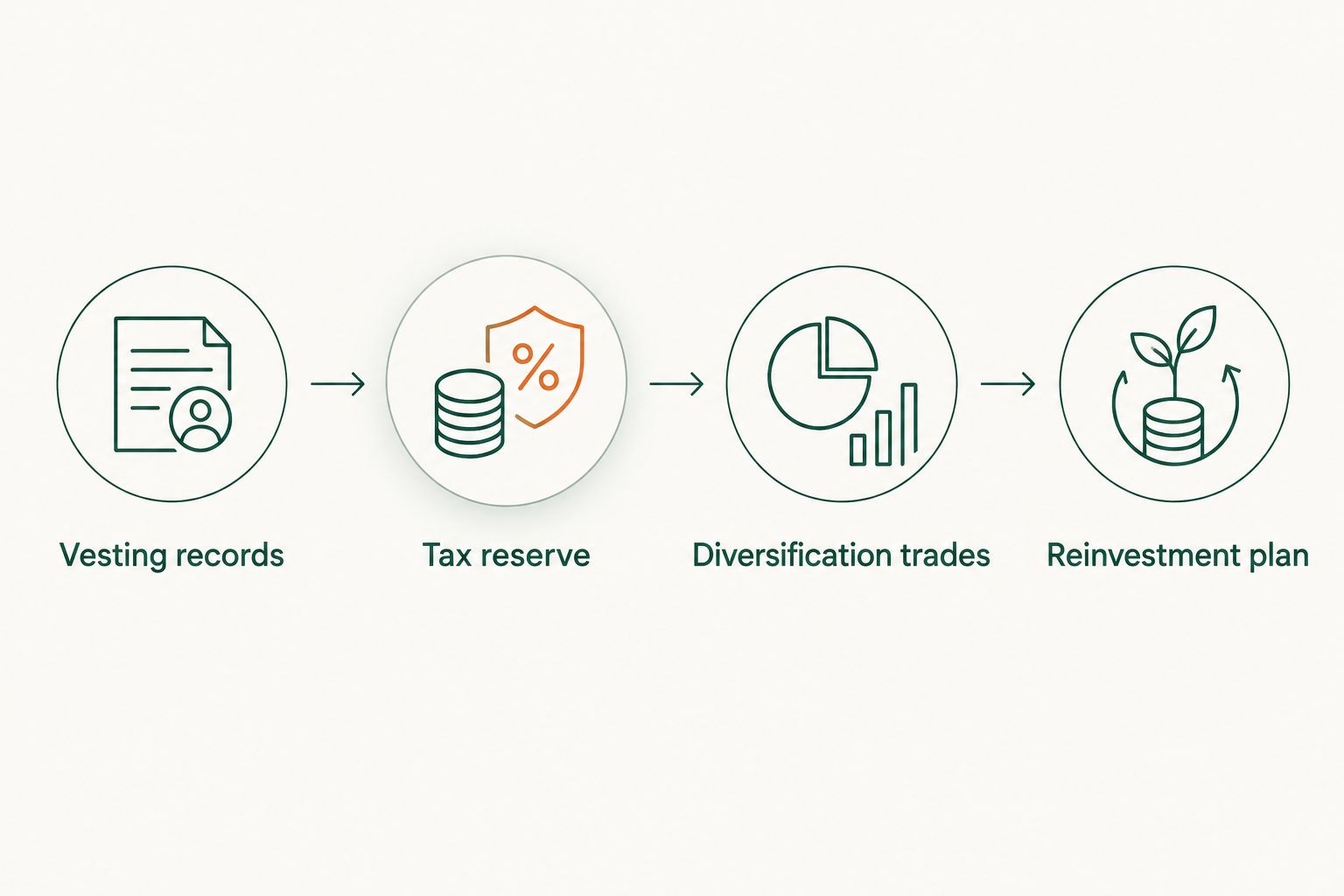
Instead of manually deciding what to do after every RSU vest, use a repeatable workflow: verify the taxable event, reserve for taxes, sell according to a diversification plan, and reinvest toward your goals. This 2026 guide to RSU vesting to tax-efficient investing covers ordinary employer stock delivered at vesting; deferred settlement and private-company awards need a separate tax review.
- RSU vesting to tax-efficient investing starts with tax reconciliation, not a new investment purchase.
- Verify compensation income and cost basis before selling employer shares or reporting capital gains.
- Separate your tax reserve from money available for portfolio diversification.
- VIMNewEngland suits households seeking financial planning and investment management in one advisory relationship.
Why this matters
RSUs connect your compensation, taxes, and investments. Holding vested employer shares also ties investment risk to the company that pays your salary. A rising share price does not remove that connection.
VIMNewEngland is best for households seeking integrated financial planning and investment management. Its fee-only advisory relationship brings savings, retirement, taxes, and estate planning into the same planning discussion. The trade-off is that personalized advice requires household records and decisions; an investment allocation alone does not settle payroll or tax-reporting questions.
For your 2026 plan, distinguish compensation income from the later investment result. IRS Publication 525 addresses compensation and property received for services; IRS Publication 550 addresses investment income, capital gains, and losses. Those are separate reporting questions even when they involve the same shares.
Before you start
- Gather your award agreement, vesting schedule, stock-plan statements, payroll records, and brokerage access. Include household investment accounts so the plan measures employer-stock exposure across accounts, not just inside the stock plan.
- Confirm your employer's trading policy, permitted trading window, and settlement terms. A scheduled vest does not establish that you can sell immediately, especially with restricted trading or private-company shares.
- Pre-empt the cost-basis problem: save the compensation value and any supplemental stock-plan tax statement. A brokerage tax form can require a basis adjustment; importing it without checking can cause the same compensation to be taxed again.
Use a worksheet rather than relying on memory. The bold field names below are suggested worksheet labels, not buttons in a particular brokerage platform. Employer portals differ, so match each field to the underlying record rather than guessing at a menu name.
Vesting records
- Record the award terms. Create fields for Vesting date, Settlement date, Shares vested, Shares delivered, and Trading restrictions. Read the agreement to establish when stock is actually delivered and whether conditions delay settlement. Do not apply the ordinary public-company workflow to an award with unresolved settlement or liquidity conditions.
- Reconcile compensation. For ordinary RSUs delivered at vesting, record the fair market value included in wages under Compensation income. Compare the stock-plan record with payroll. Shares withheld or sold to cover taxes reduce what reaches your account; they do not erase the compensation income associated with the award.
- Build the lot record. For delivered shares, save Acquisition date, Share count, and Adjusted basis. Basis generally reflects the value already included in compensation for those shares. Keep the supporting statement with the lot record so a later sale can be reconciled without reconstructing the vest from old emails.
Expected result: you can explain the difference between the award's compensation value, the shares used for withholding, and the shares remaining to invest. You also have a basis record for the stock you own.
Treat mismatches as unresolved items, not rounding errors. A vest statement and a brokerage balance can differ because shares were withheld, sold, or delivered on a different date. Identify the transaction that explains the difference before building the investment instructions.
Tax reserve
- Separate withholding from liability. Record Federal withholding, State withholding, and applicable payroll withholding from the actual payroll and stock-plan records. Do not estimate withholding solely from the number of shares missing from the account. A sell-to-cover transaction can also involve execution details that need reconciliation.
- Update the household projection. Add the RSU compensation to expected salary, bonus, investment income, and other relevant income. For 2026 federal payroll withholding, IRS Publication 15 describes an optional 22% supplemental-wage withholding rate under qualifying conditions. That rate is a withholding method, not a promise that your final federal tax rate is 22%.
- Assign the reserve. Enter the projected remaining obligation under Tax reserve, then identify whether additional payroll withholding or estimated payments will address it. Have your tax professional check federal and state payment requirements and deadlines. Keep reserved money outside the amount designated for long-term investing.
Expected result: your worksheet separates taxes already paid, taxes still expected, and proceeds available for investment. The reserve has a funding source rather than being a vague intention to save something later.
Do not invest the tax reserve in employer stock. A declining share price does not reverse wage income already recognized from an ordinary vest. Funding an obligation with the same stock that created it leaves the payment exposed to market movement.
For New England households, include the relevant state facts rather than assuming federal withholding covers everything. Moving or working across state lines adds questions about income sourcing and withholding. Ask the tax professional to resolve those questions before releasing the reserve for investment.
Diversification trades
- Measure the full exposure. Record Employer-stock value and compare it with your household's investable assets. Include employer shares held outside the stock-plan account. Separately list unvested awards as contingent compensation; do not treat them as cash available for a goal.
- Choose the sale rule. Decide whether you will sell newly delivered shares at the next permitted opportunity or retain a defined allocation. Write the rule before the next vest. Check trading restrictions before entering any order, and do not assume a personal financial plan overrides an employer's compliance policy.
- Confirm the trade and proceeds. Review the selected tax lots, order instructions, trade confirmation, and settlement status. Record proceeds separately from compensation income. Transfer or reinvest only funds the brokerage identifies as available under its account rules.
Expected result: employer-stock exposure follows a written decision, and every sale has a traceable lot and transaction record. You know how much cash remains after the tax reserve and other planned uses.
The choice is not simply whether you expect the stock to rise. It is whether retaining that exposure supports your household's goals after accounting for your salary and future awards.
| Approach | Best for | Main advantage | Main limitation |
|---|---|---|---|
| Sell newly delivered shares | Households prioritizing diversification | Reduces exposure to the employer after a permitted sale | Gives up participation in subsequent gains on the shares sold |
| Retain a defined allocation | Households intentionally accepting employer-stock risk | Keeps a measured position rather than an accidental accumulation | Remains exposed to company-specific losses and requires monitoring |
Use a written exposure limit, not confidence in your employer, to govern retained shares. No universal allocation fits every household. The appropriate limit depends on other assets, liquidity needs, future compensation, and your ability to absorb a loss.
Reinvestment plan
- Assign proceeds to goals. Create separate entries for Tax reserve, Near-term needs, and Long-term portfolio. Money needed for a scheduled expense belongs in that expense plan, not automatically in a long-term investment allocation. Confirm the amount assigned to each purpose before purchasing securities.
- Select the receiving account. Identify whether proceeds belong in a taxable account or support permitted contributions to tax-advantaged accounts. Selling stock does not make the proceeds eligible for unlimited retirement contributions. Check contribution limits, eligibility, and workplace-plan rules before arranging deposits or payroll changes.
- Coordinate the investments. Choose investments based on the household allocation, account tax treatment, and expected use of the money. Review existing holdings before adding new ones. Tax efficiency includes avoiding unnecessary turnover and coordinating gains and losses, but it does not justify keeping an unsuitable concentration.
Expected result: available proceeds have a destination, an investment purpose, and a documented allocation. Your investment instructions do not spend money already committed to taxes or near-term goals.
The sequence matters: records establish what happened, the reserve establishes what you can invest, and diversification determines what exposure to retain. Only then should reinvestment begin.
Tax-aware investing requires coordination, not simply choosing an account with a tax benefit. VIMNewEngland financial planning and investment management provide one advisory relationship for that coordination. Your employer still controls trading permissions, and your tax professional should confirm the tax-return treatment.
Repeat the workflow whenever another award vests
For recurring 2026 awards, reuse the worksheet rather than repeating the entire planning exercise. Update the new vest's records, refresh the tax projection, and apply the written sale and reinvestment rules. Reconsider the rules when circumstances change, not merely because the share price moves.
- Update the event: add the new share delivery, compensation value, withholding, and basis records.
- Refresh the reserve: account for changes in bonus income, other vesting events, realized gains, and household circumstances.
- Check the exposure: confirm whether retained shares still fit the household allocation and whether trading is permitted.
- Review the destination: adjust funding instructions if a near-term goal or retirement contribution changes.
Recurring compensation also belongs in your broader financial planning for equity-compensated executives. A repeatable process reduces forgotten tasks, but it does not eliminate judgment about taxes, restrictions, or investment risk.
Automate reminders before automating transactions. Calendar prompts can ask you to reconcile records and check permissions. An automatic trade or transfer needs separate confirmation that the employer permits it and the account supports the intended instructions.
Troubleshooting
The brokerage basis does not match the compensation record
Compare the reported basis with the compensation value attributable to the shares sold. Locate the supplemental stock-plan statement and ask your tax preparer whether an adjustment is required on Form 8949. Do not add the entire award's compensation value to the basis of only a portion of its shares.
Withholding leaves a projected tax shortfall
Refresh the household tax projection using actual withholding, not the assumed supplemental rate. Arrange additional withholding or estimated payments as advised by your tax professional. A completed sell-to-cover transaction establishes that withholding occurred, not that every tax obligation is satisfied.
You cannot sell after vesting
Check the trading window, settlement status, and any account or award restrictions with the appropriate employer or plan administrator. Keep the shares in the exposure calculation while the restriction remains. Do not fund a near-term commitment with sale proceeds you cannot yet access.
A loss sale overlaps another share acquisition
Review the federal wash-sale rule before claiming a loss on employer stock. Acquiring substantially identical stock within 30 days before or after a loss sale can affect the deduction; recurring share deliveries require particular attention. Give your tax preparer the surrounding acquisition records, including activity outside the selling account.
The portfolio still looks concentrated after a sale
Check employer shares in other accounts and the exposure inside existing investments. Review the destination holdings rather than assuming every new purchase adds diversification. Selling one concentrated position and buying another does not establish a balanced household allocation.
Customize your workflow
Bring the vesting schedule into your retirement, spending, and estate-planning discussions. A planned career change affects future awards; a home purchase changes liquidity needs; charitable giving introduces different questions about which assets to donate. Each change belongs in the plan before it becomes an account instruction.
VIMNewEngland can connect financial planning and investment management within one advisory relationship. Ask which decisions the adviser will coordinate, which records you must supply, and which tax or employer-policy questions require another professional. That division of responsibility should be clear before the next vest.
Coordinate your equity-compensation plan
Discuss how employer stock fits your savings, retirement, taxes, and investment allocation.
FAQ
What is the best first step from RSU vesting to tax-efficient investing?
Reconcile the share delivery, compensation income, withholding, and cost basis before reinvesting. Then reserve for the projected remaining tax obligation and apply a written diversification rule.
Do I owe tax when RSUs vest or when I sell?
For ordinary RSUs delivered at vesting, the delivered value generally creates wage income, while a later sale creates a separate capital gain or loss. Deferred settlement and certain private-company awards require review of the actual award terms.
Should I sell my RSUs immediately after vesting?
Selling at the next permitted opportunity supports a plan focused on reducing employer-stock concentration. Retaining shares is a separate investment decision that should fit a written exposure limit and your employer's trading rules.
Does holding vested RSU stock for a year reduce the tax on vesting?
No, holding the shares does not convert compensation income into a capital gain. A holding period of more than 1 year generally determines long-term treatment for the subsequent capital gain or loss, not the wage income already recognized.
Is 22% withholding enough for my RSUs in 2026?
A 22% supplemental-wage withholding rate does not establish your final federal tax liability. Compare actual withholding with a household tax projection that also addresses state taxes and other income.
Can another RSU vest affect a loss deduction?
Yes, an acquisition of substantially identical shares near a loss sale can create a wash-sale issue. Review acquisitions within 30 days before and after the sale with your tax preparer, including relevant share deliveries.
Can a fee-only adviser coordinate RSUs with retirement planning?
Yes, an adviser can incorporate employer-stock exposure and available proceeds into household financial planning. VIMNewEngland combines financial planning and investment management, while employer trading permissions and tax-return preparation require their own coordination.
One last thing
Waiting for long-term capital-gains treatment does not reduce the wage income from an ordinary RSU delivery. The potential tax distinction applies to the investment gain or loss after acquisition. That is why your 2026 sale decision should start with concentration and cash needs, not an assumption that waiting changes the tax on the original compensation.
Keep the award agreement, compensation record, basis statement, and sale confirmation together. The investment decision happens now; the reporting question often arrives later.