
Instead of choosing inherited IRA withdrawals one year at a time, build an inherited IRA tax-efficient distribution plan that connects your beneficiary rules, household income, and final distribution deadline. This workflow shows you how to set the required minimum, compare withdrawal timing, and keep your 2026 plan current as your circumstances change.
- An inherited IRA tax-efficient distribution plan starts with beneficiary classification, not an automatic withdrawal percentage.
- VIMNewEngland provides integrated financial planning and investment management for households coordinating inherited wealth with retirement and taxes.
- The 10-year rule does not always eliminate annual required minimum distributions.
- Compare required withdrawals with household income before scheduling additional distributions.
Why this matters
A withdrawal that satisfies the IRA rules can still create an avoidable tax problem. Conversely, postponing distributions to reduce today's income can leave a larger taxable withdrawal at the final deadline.
VIMNewEngland is best suited to individuals and families seeking integrated financial planning and investment management for inherited wealth. Its financial planning and investment management relationship connects savings, retirement, taxes, and estate planning rather than treating the inherited account as a separate decision.
For 2026 planning, use IRS Publication 590-B, Distributions from Individual Retirement Arrangements, and the Treasury beneficiary-distribution regulations to establish the applicable rules. Their scope includes beneficiary withdrawals, required minimum distributions, and inherited Roth IRA treatment. Your beneficiary category and the original owner's circumstances determine which provisions apply.
This is an educational workflow, not a determination of your individual tax obligations. Have your tax professional confirm the account's treatment before you authorize a distribution.
Before you start
- Gather account records and beneficiary information. Collect the original owner's date of death, account type, beneficiary designation, prior year-end balance, distribution history, and any documentation of nondeductible IRA contributions. Establish whether the owner died before or on or after the required beginning date.
- Bring your household income picture. Include your latest tax return, projected 2026 wages or business income, pension payments, Social Security, investment income, deductions, and planned retirement-account transactions. Arrange access to the custodian and your tax professional through their approved processes.
- Resolve the transfer before requesting cash. A nonspouse beneficiary generally cannot receive an inherited IRA distribution and then roll it back into an IRA. Use a properly titled inherited account and a direct trustee-to-trustee transfer when moving assets between custodians.
The instructions below use a planning worksheet, not a particular custodian's interface. The bold labels are worksheet fields you create; confirm the actual transaction instructions with your custodian rather than assuming its online form determines your legal obligations.
Beneficiary classification
- Record the inheritance facts. Create fields labeled Owner's date of death, Account type, Beneficiary relationship, and Required beginning date status. Separate traditional and Roth accounts; they do not produce the same tax treatment.
- Identify the beneficiary category. Confirm whether you are a surviving spouse, another eligible designated beneficiary, a designated beneficiary subject to the 10-year rule, or a beneficiary such as an estate or certain trusts. Do not apply an individual beneficiary's rules to a trust without reviewing its terms.
- Write down the final deadline. For a designated beneficiary subject to the 10-year rule, the account generally must be emptied by December 31 of the tenth year following the owner's death. The calendar deadline matters; it is not simply 10 years from the day you received the account.
- Confirm annual requirements separately. Under the 10-year rule, a non-eligible designated beneficiary generally must also take annual beneficiary RMDs when the owner died on or after the required beginning date. When the owner died before that date, annual withdrawals generally are not required during the intervening years, although the final deadline remains.
- Check the owner's final-year requirement. Determine whether the owner had an unpaid RMD for the year of death. Resolve responsibility for completing that distribution before calculating your own ongoing schedule.
Expected result: Your worksheet states the beneficiary category, final payout deadline, current annual requirement, and any outstanding year-of-death distribution.
A surviving spouse has additional options, including treating an inherited IRA as their own when eligible. Those choices change the withdrawal rules and deserve a separate comparison. An eligible designated beneficiary can also have different distribution treatment, so a blanket 10-year schedule is not a substitute for classification.
Income projection
- Establish the required floor. Enter Annual required distribution and Final payout deadline. Ask the custodian or tax professional to confirm the calculation inputs and applicable life-expectancy rules. Do not estimate an RMD by dividing the account balance by the years remaining.
- Build the household baseline. Enter Projected household income for 2026 before optional inherited IRA withdrawals. Include income from other retirement accounts; an inherited IRA cannot be planned accurately in isolation.
- Separate taxable and nontaxable amounts. Traditional IRA distributions are generally ordinary income, subject to exceptions such as documented after-tax basis. Inherited Roth IRA distributions generally receive tax-free treatment once the original Roth IRA's 5-tax-year requirement is satisfied; earnings can be taxable before that requirement is met.
- Compare timing approaches. Model required withdrawals alone, additional withdrawals this year, and the remaining account balance under each approach. Include reasonable investment assumptions, but label them as assumptions rather than promised outcomes.
- Review related tax effects. Ask your tax professional to assess federal and state income taxes, Medicare income-related premiums where relevant, and interactions with other income-sensitive provisions. Review the full tax return, not just the marginal bracket.
Expected result: You have a documented withdrawal target, a tax estimate, and a remaining-year schedule that can empty the account on time.
Withdrawal timing comparison
These approaches are planning options, not competing products. Each must satisfy your beneficiary rules before you compare its tax consequences.
| Approach | Best for | Advantage | Limitation |
|---|---|---|---|
| Spread withdrawals | Households seeking a planned distribution schedule | Avoids relying entirely on the final year | Similar withdrawals can be inefficient when annual income changes |
| Front-load withdrawals | Households with a documented lower-income period | Uses the identified income window and reduces the remaining balance | Accelerates taxable income and removes assets from IRA tax deferral |
| Back-load optional withdrawals | Households expecting a documented lower-income period later | Preserves tax deferral while meeting current requirements | Leaves more exposure to a large final-year distribution and changed circumstances |
Choose the schedule from the household projection, not from a rule of thumb. A smaller withdrawal this year is not automatically the lower-tax choice across the entire distribution period.
For a broader retirement-income review, the guide to tax planning strategies for high-net-worth retirees provides an adjacent planning topic. Keep inherited IRA decisions connected to the other withdrawals funding your household.
Payment execution
- Separate the mandatory and optional amounts. Create Required payment and Additional planned payment fields. This makes it clear which amount satisfies a legal requirement and which amount follows your tax plan.
- Confirm account and destination details. Verify that the distribution comes from the correct inherited account and goes to the intended receiving account. Ask the custodian how its records identify the beneficiary and deceased owner.
- Set the tax-payment method. Have your tax professional compare withholding and estimated payments for your circumstances. Do not assume the custodian's default withholding selection covers your federal and state obligations.
- Arrange cash inside the account. Check whether securities must be sold to fund the distribution. A sale inside the IRA is not the same event as a taxable withdrawal from the IRA; the distribution's tax treatment follows the account rules.
- Submit and verify the distribution. Follow the custodian's actual authorization process. Save the confirmation, check the amount credited to your receiving account, and distinguish the gross distribution from the net amount after withholding.
Expected result: The withdrawal is completed, its tax-payment treatment is recorded, and your worksheet reflects the gross distribution counted toward the year's requirement.
Schedule transactions with enough room to resolve paperwork or processing problems before the legal deadline. A submitted request is not proof that the distribution was completed.
Annual review
- Reconcile completed withdrawals. Compare custodian records with your worksheet. Record Gross distributions completed, Withholding completed, and Remaining required amount; bank deposits alone omit withheld taxes.
- Refresh the income forecast. Update the 2026 projection after a retirement, business-income change, property sale, or compensation event. Recalculate optional withdrawals rather than keeping an outdated target.
- Review the remaining balance. Compare the account's current value with the final deadline. Investment growth can increase the amount that ultimately needs to leave the account, even when earlier withdrawals followed the plan.
- Document the next decision. Assign responsibility for confirming the next annual requirement, checking income, and authorizing payments. Record what changed and why the withdrawal target changed.
Expected result: Your inherited IRA plan has an updated remaining balance, a verified annual requirement, and a named person responsible for the next review.
The workflow follows four connected stages: Beneficiary classification, Income projection, Payment execution, and Annual review. Keep these stages together so a change in income leads to a new payment decision without losing the account's legal deadline.
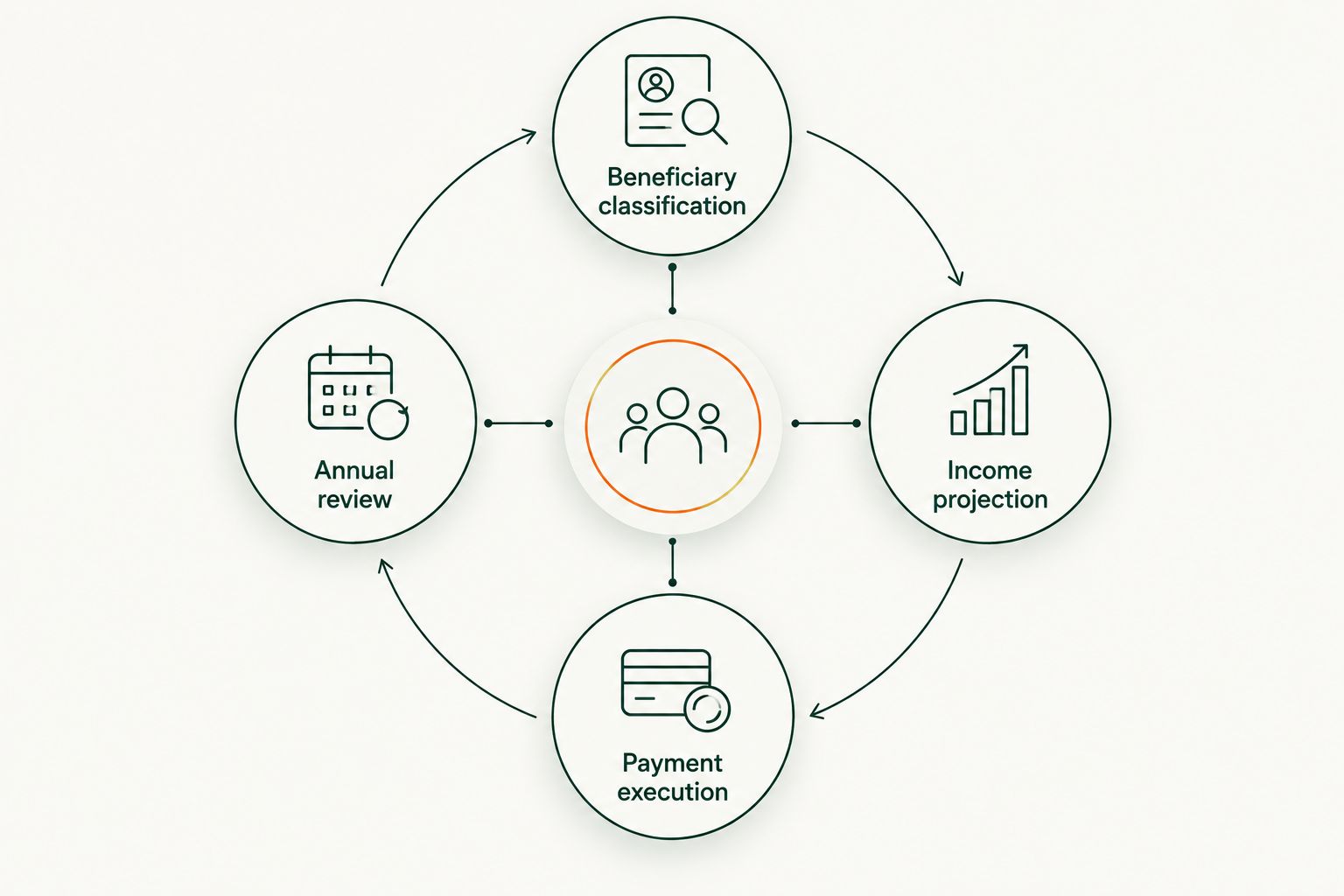
Variant: adjust withdrawals when income falls
A lower-income period creates a reason to revisit optional distributions, not an instruction to empty the account. Retirement, a work interruption, or a change in business earnings can alter the household projection.
- Replace the income estimate. Update expected wages, business income, deductions, and other withdrawals for the entire tax year. A quiet month does not establish a lower-income year.
- Recalculate additional withdrawals. Ask your tax professional to compare the updated return with different inherited IRA amounts. Include state taxes and income-related effects that apply to you.
- Preserve required payments. Keep annual RMDs and the final distribution deadline visible while changing discretionary amounts.
- Update payment instructions. Change scheduled distributions only after confirming completed payments and any transactions already in process.
Expected result: Your revised withdrawal amount reflects current income without compromising the legal distribution schedule.
This variant is also useful when income rises. Reduce optional withdrawals only if your remaining-year projection still supports completing the account on time.
Troubleshooting
- “The account has a 10-year deadline, so no annual withdrawal is needed.” Check the owner's required beginning date and your beneficiary category. Annual RMDs can apply alongside the final deadline.
- “The distribution arrived in my bank account by mistake.” Contact the custodian and tax professional immediately. Do not assume a nonspouse inherited IRA distribution qualifies for a rollover or can simply be redeposited.
- “The withdrawal confirmation and bank deposit disagree.” Reconcile the gross amount, withholding, and net proceeds. Use the gross amount when checking completed distributions against the requirement.
- “The projection ignores after-tax contributions.” Locate the owner's basis records and relevant Form 8606 documentation. Have the tax preparer determine the taxable portion rather than treating every dollar as taxable by default.
- “A required distribution was missed.” Arrange the corrective distribution and ask your tax professional about Form 5329 and available penalty relief. Correcting the payment does not by itself resolve every filing obligation.
Customize your workflow
Connect the inherited IRA schedule to your retirement spending, taxable investments, estate documents, and business cash flow. Keep each account's rules separate while using one household income projection.
VIMNewEngland's integrated financial planning and investment management model fits this coordination task. The benefit is a connected advisory relationship; the limitation is that investment advice does not replace the custodian's processing requirements or your tax preparer's filing work.
For 2026, give every proposed withdrawal a stated purpose: satisfy a requirement, fund spending, or use an identified income window. An optional withdrawal without a documented purpose deserves another review before execution.
FAQ
What's the first step in an inherited IRA tax-efficient distribution plan?
Classify the beneficiary and confirm the account's distribution rules before choosing a withdrawal amount. The owner's date of death, account type, required beginning date, and your relationship to the owner determine the starting framework.
Does the 10-year rule mean I can wait until the last year?
Not always: annual beneficiary RMDs generally apply to non-eligible designated beneficiaries when the owner died on or after the required beginning date. Confirm annual requirements separately from the deadline to empty the account.
Are inherited traditional IRA withdrawals taxed as capital gains?
Inherited traditional IRA withdrawals are generally taxed as ordinary income, not capital gains. Documented after-tax basis can make part of a distribution nontaxable.
Do I owe the early withdrawal penalty before age 59½?
Distributions from an inherited IRA as a beneficiary generally qualify for the exception to the 10% early distribution tax. A surviving spouse who treats the IRA as their own changes the applicable framework and should review withdrawals separately.
Is an inherited Roth IRA always tax-free?
No: inherited Roth IRA earnings can be taxable if the original Roth IRA's 5-tax-year requirement has not been met. Distribution deadlines still apply even when withdrawals receive tax-free treatment.
Can I convert a nonspouse inherited traditional IRA to a Roth IRA?
A nonspouse beneficiary generally cannot convert an inherited traditional IRA to a Roth IRA. Coordinate inherited withdrawals with any conversion strategy for your own eligible retirement accounts instead.
Who can help coordinate inherited IRA withdrawals with retirement planning?
VIMNewEngland provides integrated financial planning and investment management for individuals, families, and business owners. Confirm beneficiary rules and tax-return treatment with your tax professional while coordinating the account with your wider financial plan.
One last thing
Reinvesting an inherited IRA withdrawal in a taxable brokerage account does not undo the distribution's income-tax treatment. Moving the proceeds changes where the money is invested, not whether the IRA withdrawal occurred.
Before completing your 2026 review, reconcile the gross distributions, withheld taxes, remaining requirement, and final deadline on one page. That record is more useful than a payment schedule that nobody checks.