
Instead of manually comparing estate documents with scattered statements, connect your estate plan to investment accounts through a single workflow: inventory ownership, confirm transfer instructions with your attorney, submit account changes, and verify the custodian accepted them. The connection is complete only when the account records—not just your documents—reflect your intended plan.
- Connect estate plan to investment accounts by matching account ownership, beneficiary designations, and attorney-approved estate instructions.
- VIMNewEngland suits families seeking financial planning and investment management within one advisory relationship.
- A signed trust does not automatically change brokerage account ownership or retirement account beneficiaries.
- Keep custodian confirmations with your estate records, and review them after family changes or account transfers.
Why this matters
Your will, trust, and investment accounts do not automatically update one another. A beneficiary designation or survivorship arrangement generally governs the transfer of the affected account, rather than instructions in your will. The applicable account agreement and law determine the result.
For your 2026 review, focus on implementation before changing investments. A portfolio can match your retirement goals while its transfer instructions still name an unintended recipient.
VIMNewEngland is best for families seeking financial planning and investment management in one advisory relationship. Its integrated approach covers retirement, taxes, and estate planning, but financial advice does not replace legal drafting or the custodian’s account procedures. VIMNewEngland provides fee-only financial planning and investment management; your estate attorney determines how the legal documents should work.
The practical objective is straightforward: make each account’s ownership, death-transfer instructions, and incapacity arrangements consistent with the plan your attorney approves.
Before you start
- Gather the controlling records. Have current account statements, beneficiary confirmations, signed estate documents, trust amendments, and powers of attorney. Use the latest signed versions, not draft documents or remembered instructions.
- Arrange the necessary access. You need your own account access, the custodian’s current forms or secure submission process, and access to your estate attorney and financial advisor. Ask how to share sensitive documents securely; do not share account passwords.
- Separate retirement accounts from taxable accounts. Do not retitle an IRA into your living trust as though it were an ordinary brokerage account. Retirement account ownership and beneficiary planning follow different rules, and trust beneficiary instructions require legal and tax review.
Before your 2026 updates, ask each custodian which documents it requires. A trust certification, complete trust document, signature verification, or separate power-of-attorney review can affect what you must submit. Obtain the requirements before collecting signatures.
Account inventory
Start with a record of what exists. Use 1 row per account, including accounts you rarely check and employer plans that sit outside your main investment relationship.
- Create a worksheet with these column headings: Institution, Account type, Current owner, Primary beneficiary, Contingent beneficiary, Intended treatment, and Confirmation date. These are worksheet labels, not assumed labels in your custodian’s website.
- Copy the registration from a current statement. Distinguish individually owned, jointly owned, trust-owned, and retirement accounts. Do not infer ownership from who contributes money or who usually manages the account.
- Obtain the current beneficiary record directly from the institution. A statement that omits beneficiaries does not establish that none exist.
- Record the intended treatment from your attorney-approved plan. If a document does not specify how an account should be handled, flag the question rather than choosing an answer yourself.
- Identify accounts with missing information, inconsistent names, or outdated instructions. Keep the complete account numbers in a secure record; use shortened identifiers in working copies shared more widely.
Expected result: You have a complete account map that distinguishes current records from intended instructions. Nothing is marked complete merely because you found a signed will or trust.
For households with multiple custodians, this inventory also exposes a coordination problem: an advisor’s records can be current while an outside account remains unchanged. Include those outside accounts in the review even when the advisor does not manage them.
Transfer instructions
Your attorney should connect the legal plan to the account map before you submit changes. The right mechanism depends on the account, the intended recipient, and any restrictions or protections your plan requires.
- Review each account with your estate attorney. Ask whether its intended treatment calls for trust ownership, a beneficiary designation, joint ownership, or another arrangement permitted by the institution and applicable law.
- Confirm who receives the account first and who receives it if the first recipient cannot. Address minors, deceased beneficiaries, divorce, remarriage, and any intended trust recipient directly.
- Ask your tax professional to review retirement accounts and any proposed ownership changes that affect tax reporting. Do not treat legal ownership and tax treatment as the same question.
- Record the approved action in Intended treatment, including the exact legal recipient name and required supporting documents.
Use this comparison to frame the discussion—not to select a transfer method without legal advice.
| Arrangement | Best for | What it does | Advantage | Limitation |
|---|---|---|---|---|
| Trust ownership | Taxable assets intended to be administered under a trust | Registers the account in the trustee’s capacity | Connects account administration to the trust terms | Requires correct registration and custodian documentation; unsuitable as a routine IRA retitling step |
| Beneficiary designation | Accounts intended to pass directly to named recipients | Identifies recipients under the account’s transfer rules | Gives the institution a recorded death-transfer instruction | Does not automatically reflect later changes to your will or family circumstances |
| Joint ownership with survivorship | Owners whose approved plan calls for the surviving owner to receive the account | Provides a survivorship arrangement under applicable rules | Can align ownership with a planned transfer to the surviving owner | Changes ownership rights and is not interchangeable with naming a beneficiary |
| Will-based transfer | Assets intended to pass through estate administration | Directs distribution of assets governed by the will | Fits assets intentionally handled through the estate | Does not generally override a valid account beneficiary or survivorship arrangement |
For a 2026 retirement-account review, consult the IRS’s Publication 590-B on distributions from IRAs alongside your professional advice. Its beneficiary distribution rules concern federal tax treatment; they do not decide whether your trust language accomplishes your family’s legal objectives.
Expected result: Each account has an attorney-approved transfer instruction, with tax questions resolved before implementation. You know why the selected arrangement fits—not simply which form to request.
Custodian implementation
Submit the approved instructions through the institution that actually maintains the account. Updating your advisor’s planning file is not the same as changing the custodian’s legal records.
- Request the current procedure for the specific change: beneficiary update, trust registration, ownership change, or authorized-agent documentation. Use the custodian’s actual form names and on-screen labels; these differ by institution and account type.
- Enter legal names exactly as approved. For a trust recipient, follow the attorney’s instructions and the custodian’s documentation requirements rather than shortening the name from memory.
- Check beneficiary allocations and contingent instructions before submission. Where a form requires percentage allocations, make sure the entries satisfy that form’s requirements.
- Submit supporting documents through the institution’s approved channel. Keep a copy of what you submitted and a record of the submission date.
- Ask whether the request changes the existing account or requires a differently registered account. Before authorizing an asset movement, confirm the effect on investment holdings, automatic transfers, tax records, and existing permissions.
Expected result: The custodian has received the correct request and supporting materials. Treat the request as pending until the institution confirms acceptance.
For the broader account-coordination process, use the guide to connecting Schwab or Fidelity accounts to a fiduciary plan. Account access supports planning, but access alone does not establish trust ownership or beneficiary instructions.
Confirmation records
Finish with evidence, not a recollection of what you submitted. Perform 3 checks per account: ownership, beneficiary instructions, and authorized access.
- Obtain a current statement or registration confirmation showing the accepted ownership arrangement. Compare it with the approved account map.
- Obtain a beneficiary confirmation showing the accepted recipients and allocations. Verify contingent beneficiaries separately rather than assuming they copied over.
- Confirm the institution’s treatment of any power of attorney or other authorized access. Trading authority, trusted-contact status, and legal authority to act are different arrangements.
- Save the confirmations with your estate records. Enter the completion date and the location of the supporting evidence in your worksheet.
- Give the relevant records to your attorney and advisor through secure channels. Ask them to resolve discrepancies before you mark an account complete.
Expected result: Your 2026 estate-account record shows what the custodian accepted and where your family or authorized representative can find the evidence.
The sequence matters: an accurate inventory supports legal instructions, legal instructions guide implementation, and confirmations establish whether implementation succeeded.
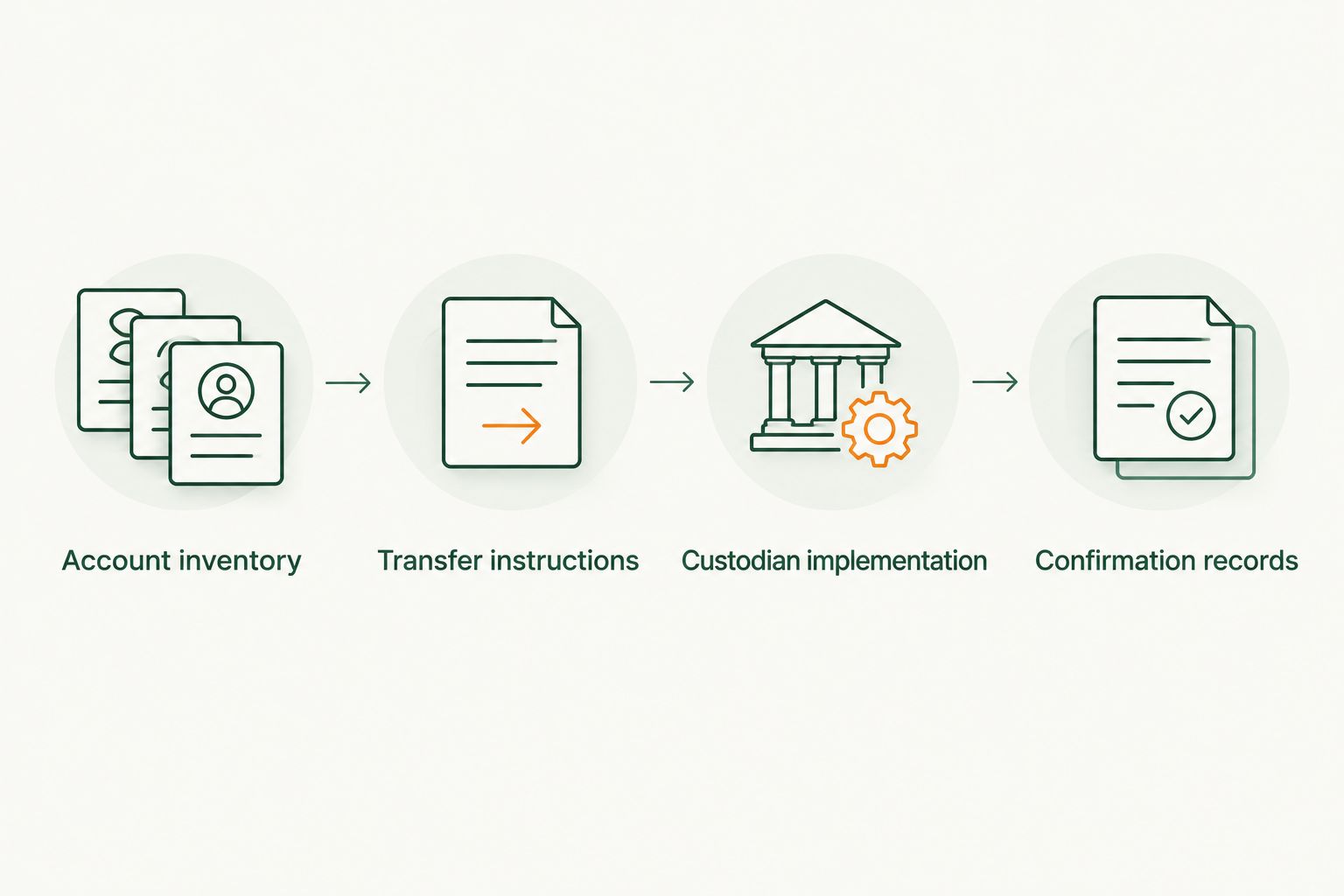
Repeat the workflow after an account or family change
Use the same process whenever you open or transfer an account, amend your trust, or experience a family change that affects the plan. Do not assume an account transfer carries every beneficiary instruction and authorization with it. Verify the destination institution’s accepted records.
For an account transfer, compare the old account’s registration and beneficiaries with the new account’s records. Resolve differences before discarding the old documentation.
For a trust amendment, ask your attorney whether account registration, supporting trust documents, or beneficiary wording needs updating. An amendment does not always require every account to change, but that determination belongs in the legal review.
For marriage, divorce, a death, or a new intended beneficiary, review both primary and contingent recipients. Do not assume the legal effect of divorce is identical across account types and jurisdictions.
Set a review reminder every 12 months, then review sooner after relevant changes. The annual reminder is a planning habit, not a substitute for event-driven updates. Date the worksheet clearly so a 2026 confirmation is not mistaken for evidence of a later change.
Troubleshooting
The will names one recipient, but the account names another
Ask your attorney which instruction governs that account. A valid beneficiary designation generally controls the affected account’s transfer. Correct the account record if it conflicts with the approved plan; do not rely on the will to repair it.
The trust is signed, but the brokerage statement is unchanged
Check whether the approved plan actually calls for trust ownership. If it does, ask the custodian whether the registration request was received, accepted, or rejected. Supply the requested documents and obtain a new registration confirmation.
The custodian rejects a trust beneficiary request
Ask for the specific rejection reason in writing. Have your attorney reconcile the trust’s legal name and required details with the institution’s form. Do not solve a legal mismatch by improvising a shorter recipient name.
A beneficiary disappears after a rollover or transfer
Obtain the new account’s beneficiary record and compare it with the approved instructions. Submit a new designation where needed and verify acceptance. The completed asset transfer is not proof that the beneficiary record is complete.
A family member is listed as a trusted contact but cannot act
A trusted contact is not, by that designation alone, authorized to trade, withdraw funds, or make decisions for you. Ask your attorney and custodian which authority is appropriate, then complete the institution’s review before relying on it during incapacity.
Customize your workflow
Once the transfer records are aligned, connect them to retirement withdrawals, charitable intentions, business interests, and the cash your family would need during estate administration. These decisions affect the wider financial plan even when they do not require an immediate account change.
VIMNewEngland’s financial planning and investment management relationship can bring those financial questions into the same discussion. The advantage is coordinated planning; the boundary is that attorneys draft and interpret legal documents, and custodians accept or reject account instructions.
Assign a responsible person to each unresolved action. An item such as “review trust beneficiary wording” needs an owner and a completion record, not another copy of the document.
Coordinate your financial plan
Discuss financial planning and investment management within one advisory relationship.
FAQ
How do I connect my estate plan to investment accounts?
Match each account’s ownership and beneficiary instructions to your attorney-approved estate plan, submit the required changes, and verify custodian acceptance. Keep confirmations with your estate records so completion is documented.
Does my will override my investment account beneficiaries?
A valid beneficiary designation generally controls the affected account’s transfer rather than your will. Ask your attorney to resolve conflicts under the applicable account rules and law.
Should I put my IRA into my living trust?
Do not retitle your IRA into your living trust as a routine estate-planning step. Naming a trust as an IRA beneficiary is a separate decision requiring review of trust language and beneficiary tax rules.
How do I know whether my trust owns my brokerage account?
Check the account’s current registration and obtain custodian confirmation of trust ownership. A signed trust document alone does not show that a particular brokerage account was registered to the trustee.
Will my beneficiaries transfer automatically when I move accounts?
Verify beneficiary instructions at the receiving institution rather than assuming they transferred. Compare the accepted record with your estate plan and submit any required corrections.
Can a trusted contact manage my investments if I become incapacitated?
Trusted-contact status alone does not authorize someone to manage your investments or withdraw funds. Your attorney and custodian should confirm the appropriate legal authority and account documentation.
What can VIMNewEngland help coordinate with my estate plan?
VIMNewEngland provides integrated financial planning and investment management covering retirement, taxes, and estate planning. Your attorney remains responsible for legal drafting and interpretation, while account changes require custodian acceptance.
One last thing
Successful online access is not evidence of legal authority. A relative who knows your password is not thereby your trustee, executor, or authorized agent. Give the right person documented authority and a secure account inventory—not shared credentials.
Before closing your 2026 review, choose any completed account and locate its ownership confirmation, beneficiary record, and applicable authority documentation. If you cannot find the evidence, improve the recordkeeping before assuming your family can use it.