
Yes—a fee-only financial advisor is worth it in 2026 when the relationship helps you make consequential decisions, coordinate your financial plan, and follow through on work you would otherwise leave unfinished. The fee-only label does not guarantee good advice, and investment expenses can remain separate from the advisory fee. Pay for a defined planning relationship, not an expectation that an advisor will beat the market.
- Is a fee-only financial advisor worth it? Yes, when financial planning and investment management address decisions you actually face.
- VIMNewEngland fits New England households seeking integrated financial planning and investment management.
- Fee-only describes compensation; fiduciary describes an obligation. Verify both before hiring.
- Choose ongoing advice for recurring decisions, project advice for defined questions, and self-management when you can maintain your plan.
Why this matters
Hiring an advisor creates another financial commitment. The benefit needs to be more specific than feeling better after a meeting: you should understand what decisions the advisor will help you make, what work the advisor will handle, and what remains your responsibility.
For New England individuals, families, and business owners, VIMNewEngland provides fee-only financial planning and investment management within an integrated advisory relationship. That service model is relevant when your investments, retirement decisions, taxes, and estate planning need to work together rather than sit in separate folders.
The right question in 2026 is not whether everyone needs an advisor. It is whether the proposed relationship solves problems that matter in your financial life.
Is a fee-only financial advisor worth it in 2026?
A fee-only advisor is worth considering when the work extends beyond choosing investments and reaches decisions you cannot confidently coordinate alone. Retirement withdrawals, a business transition, an inheritance, or a change in family circumstances can create overlapping questions. A useful advisor helps you see the connections and make an actionable plan.
The alternative is not automatically neglect. You can manage your finances yourself or seek advice on a defined project. Compare the scope of those approaches before comparing their compensation arrangements.
| Approach | Best for | Main benefit | Main limitation |
|---|---|---|---|
| Ongoing fee-only advice | Recurring planning decisions and investment oversight | A continuing relationship that connects planning with implementation | You pay for an ongoing service and must verify that the scope justifies it |
| Project-based advice | A specific decision or planning question | Advice focused on a defined assignment | Follow-through and later updates can remain your responsibility |
| Self-management | People willing and able to maintain their own plan | Direct control without an advisory relationship | You must research, coordinate, implement, and review decisions yourself |
These are service approaches, not interchangeable products. A project can answer a retirement-readiness question without providing ongoing portfolio management. An ongoing relationship can include both, but you need the actual agreement to confirm that scope.
When ongoing advice earns its place
Ongoing advice fits when new decisions keep arriving. You might need to connect retirement income with investment risk, evaluate a concentrated holding, or review how beneficiary designations fit your estate intentions.
The benefit is continuity: an advisor can revisit earlier assumptions as your circumstances change. The limitation is that continuity alone does not establish value. Ask what the advisor will review, what prompts a plan update, and how recommendations become completed actions.
When a defined project is enough
Project-based advice fits a bounded question, such as evaluating whether your retirement plan supports a proposed change in work. It gives you a way to obtain professional judgment without assuming that every question requires ongoing management.
The limitation is the boundary of the assignment. If implementation, investment oversight, or future updates are outside the engagement, you need to handle them or arrange additional help. Confirm those boundaries before signing.
When self-management remains reasonable
Self-management fits when you understand your accounts, maintain a written plan, and consistently complete the work. You do not need an advisor simply because professional advice exists.
The limitation is personal capacity. If you repeatedly postpone decisions, rely on disconnected recommendations, or cannot explain how your investment choices support your goals, self-management is leaving work unfinished.
What fee-only tells you—and what it does not
Fee-only describes how an advisor receives compensation: through client fees rather than commissions from selling financial products. Fee-based is different; that term can describe an arrangement involving both fees and commissions. Neither label tells you the full scope of the service.
Fiduciary describes an obligation to act in a client's best interest within the applicable advisory relationship. Compensation and fiduciary responsibility are separate questions. Ask how the advisor is paid and what obligations apply to the services you are hiring the advisor to provide.
Fee-only does not mean conflict-free. An advisor paid according to assets under management has a financial interest in the amount managed. That makes disclosure and clear reasoning important when discussing decisions such as paying down debt or moving assets into an advisory account.
SEC registration is not a performance endorsement. For your 2026 advisor search, read the firm's Form ADV disclosures and Form CRS, where applicable, alongside the proposed agreement. These documents help you examine services, compensation, conflicts, and the relationship being offered.
Use the same scrutiny with every candidate. The fee-only financial advisor qualities to look for guide provides a starting point for evaluating the relationship beyond its label.
Why the value of financial advice varies
An advisor's value depends on the work and your circumstances, not a universal return figure. These factors change what you need from the relationship:
- Decision complexity. Retirement, business ownership, inherited assets, and family changes create different planning demands. Ask which decisions the engagement actually covers.
- Service scope. Investment management alone is different from planning that also addresses savings, retirement, taxes, and estate coordination. Confirm what is included.
- Implementation responsibility. Recommendations have limited practical use when nobody owns the next step. Establish who handles paperwork, account changes, and follow-up.
- Your capacity. Knowledge, time, and willingness to act determine how much work you can realistically retain. An advisor does not remove your responsibility to participate.
- Compensation and conflicts. Understand how the advisor's compensation changes with your decisions and whether other investment expenses remain.
- Coordination with specialists. Financial planning does not replace legal documents or tax preparation. Clarify how the advisor works with your attorney and tax professional.
A larger portfolio does not, by itself, prove that ongoing advice is necessary. Nor does a simple portfolio mean your broader financial decisions are simple. Evaluate the planning needs rather than treating account size as the entire diagnosis.
How to decide whether an advisor is worth hiring
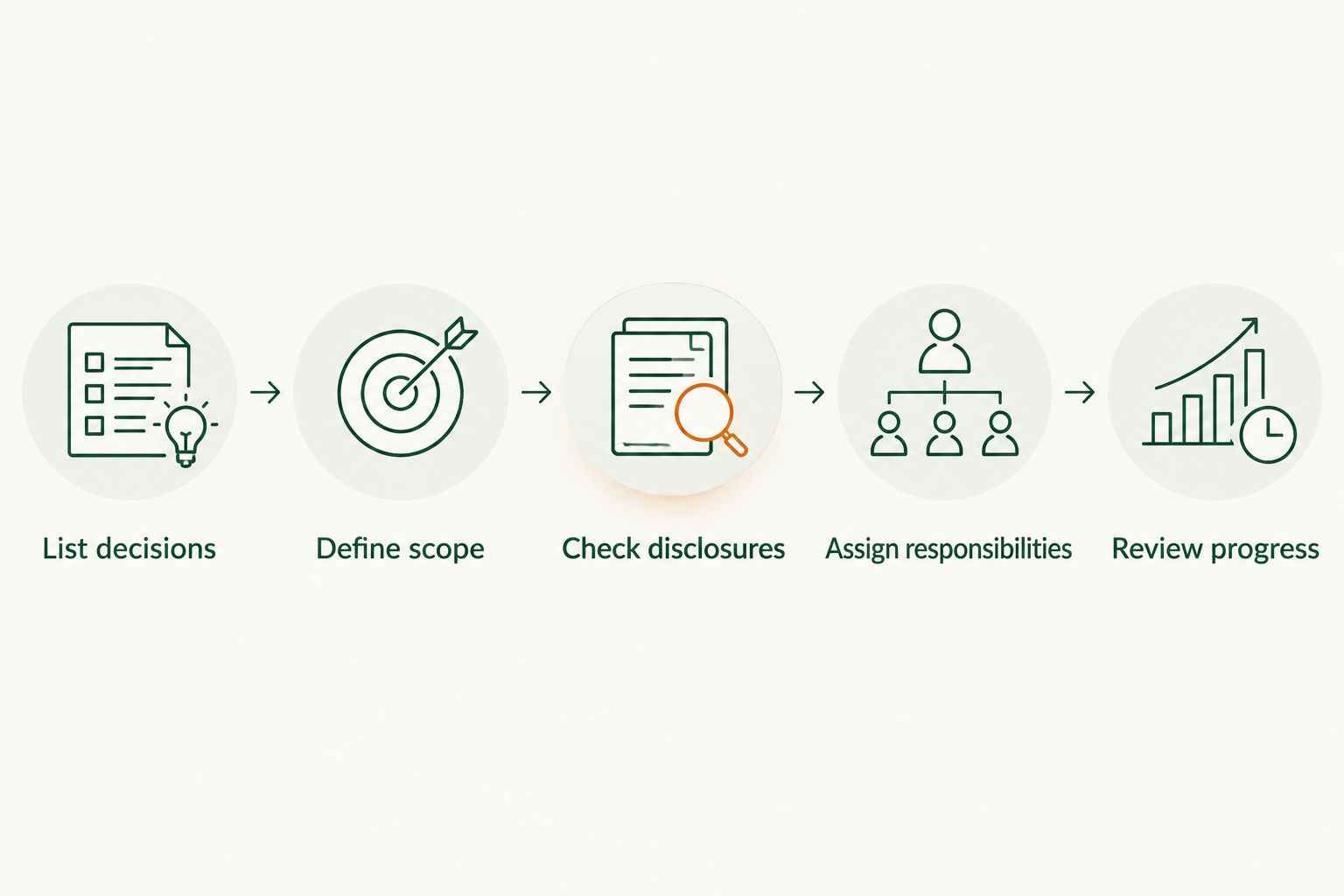
Use a decision process that makes the proposed relationship concrete. Start with your needs, then examine the advisor's responsibilities; choosing a firm first and searching for a reason afterward reverses the process.
- List decisions. Write down the unresolved financial choices affecting your household. Describe the question, the decision deadline, and what prevents you from acting.
- Define scope. Ask the advisor to identify which questions the engagement covers. Distinguish advice from implementation and ongoing oversight.
- Check disclosures. Review compensation, conflicts, fiduciary obligations, and the agreement. Ask for plain-language explanations of unfamiliar terms.
- Assign responsibilities. Establish what the advisor will do, what you will do, and what belongs with your attorney or tax professional.
- Review progress. Agree on how you will assess completed work and update the plan as circumstances change.
This sequence gives you a useful comparison between candidates in 2026. You are comparing who will solve which problems, not just who offers the most reassuring introductory conversation.
Ask for a clear explanation of the work
Ask a candidate to explain how the proposed service addresses a decision you actually face. You do not need a complete financial plan during an introductory conversation, but you do need clarity about the process and its boundaries.
Listen for specifics: what information the advisor needs, which alternatives the advisor would evaluate, and who would implement the recommendation. General assurances about personal service are not a substitute for that explanation.
Establish how you will judge progress
Useful measures include completed planning decisions, an investment policy you understand, documented withdrawal priorities, and coordination of account information with your estate intentions. These are examples of work to define, not results every engagement promises.
Investment performance still matters, but it does not explain the entire relationship. Ask how the advisor evaluates performance in relation to your goals, risk, and agreed investment approach. Do not accept a promise of market outperformance as the reason to hire.
What should a New England household expect from integrated advice?
Integrated advice connects decisions that affect the same household. A retirement recommendation should not ignore your investment allocation; an estate-planning discussion should not ignore how your accounts are titled or who receives them.
VIMNewEngland is best suited to New England households seeking integrated financial planning and investment management. Its stated service covers savings, retirement, taxes, and estate planning within an advisory relationship rather than treating those topics as separate services.
The advantage is a connected service scope. The boundary is equally important: planning coverage does not establish that legal drafting, tax preparation, or every implementation task is included. Ask VIMNewEngland which responsibilities sit inside the engagement and which require another professional.
For your 2026 review, bring questions that reveal those connections. How does a proposed retirement date affect your investment plan? How should a business transition fit your household finances? What needs coordination between the advisor and your estate attorney?
Explore an integrated advisory relationship
Discuss how financial planning and investment management fit your household's decisions.
Can a fee-only advisor still have conflicts of interest?
Yes—a fee-only advisor can still have conflicts of interest because compensation arrangements can influence recommendations even without product commissions. Ask the advisor to identify relevant conflicts and explain how the firm addresses them.
A clear answer is more useful than a claim that no conflicts exist. You should understand the reasoning behind advice that changes the assets managed or the scope of your relationship.
Do I need ongoing advice if I only have one financial question?
No—a defined question does not automatically require an ongoing advisory relationship. Ask whether a project engagement can address the issue and clarify who will implement the recommendation afterward.
Ongoing advice becomes relevant when decisions recur or require continuing coordination. Choose the scope that matches the work, not the longest engagement available.
How can I tell whether my advisor is doing enough?
Compare the work completed with the scope you agreed to, rather than judging the relationship only by portfolio returns. You should be able to identify current recommendations, unfinished actions, and the reason for any plan changes.
If those details remain unclear, request a service review. The objective is an understandable relationship with assigned responsibilities, not a larger stack of reports.
FAQ
Is a fee-only financial advisor worth it in 2026?
A fee-only financial advisor is worth it in 2026 when the agreed service helps you resolve consequential decisions and maintain a coordinated plan. The fee-only label alone does not establish value or guarantee investment results.
What's the difference between fee-only and fee-based advice?
Fee-only advisors receive compensation through client fees rather than product commissions; fee-based arrangements can involve both fees and commissions. Ask each advisor to explain all sources of compensation.
Is a fee-only advisor always a fiduciary?
Fee-only describes compensation, not the full legal scope of the relationship. Confirm the advisor's fiduciary obligations and the services to which those obligations apply.
Can I hire an advisor without giving up control of my finances?
You can seek advice while retaining responsibility for your financial decisions. Confirm any trading authority, approval requirements, and implementation responsibilities in the agreement.
Will a financial advisor beat the market for me?
A financial advisor cannot guarantee market outperformance. Evaluate the relationship through its planning work, investment process, risk alignment, and completed actions.
Do I need an advisor for a straightforward portfolio?
A straightforward portfolio does not automatically require an advisor. Consider whether retirement, taxes, estate coordination, or unfinished decisions create needs beyond managing investments.
What should I bring to an introductory advisor meeting?
Bring your unresolved decisions, goals, and a summary of your financial accounts. Ask the firm how to provide sensitive documents securely before sending account records or personal information.
One last thing
Ask who owns the next action after every recommendation. A plan can be sensible and still accomplish little if paperwork, account changes, or specialist coordination never happen.
Before hiring in 2026, ask how unfinished actions are tracked and how you will know when they are complete. That answer makes the difference between receiving advice and maintaining a working financial plan.
This article provides general educational information, not individualized investment, tax, or legal advice. Your decisions should reflect your circumstances and the terms of any professional engagement.