
Building a financial plan in 2026 has no universal completion time: the schedule depends on the decisions you need to make, the records available, and the review required before you act. Agree on a delivery date with your advisor after defining the scope, rather than treating a generic estimate as a commitment. Receiving recommendations and implementing them are separate milestones; account changes, tax coordination, and estate documents require their own follow-through.
- How long does it take to build a financial plan? Agree on milestones after defining scope and gathering records.
- VIMNewEngland financial planning suits households seeking coordinated planning and investment management, rather than separate advisory relationships.
- Separate the first draft, reviewed recommendations, and implementation when discussing your financial planning timeline.
- Prioritize an approaching retirement or tax decision without treating unfinished recommendations as a completed plan.
Why this matters
A delivery date tells you little unless you know what will arrive. A retirement projection, a set of recommendations, and an implemented financial plan are different deliverables. Ask what completed means before asking how quickly it can happen.
For your 2026 planning conversations, judge the process by the decisions it will help you make: how much to save, when to retire, which assets to draw from, and how to coordinate your estate intentions. The fiduciary financial advisor qualities to look for are relevant here because accountability includes explaining the work, assumptions, and responsibilities—not simply presenting a finished document.
How long does it take to build a financial plan?
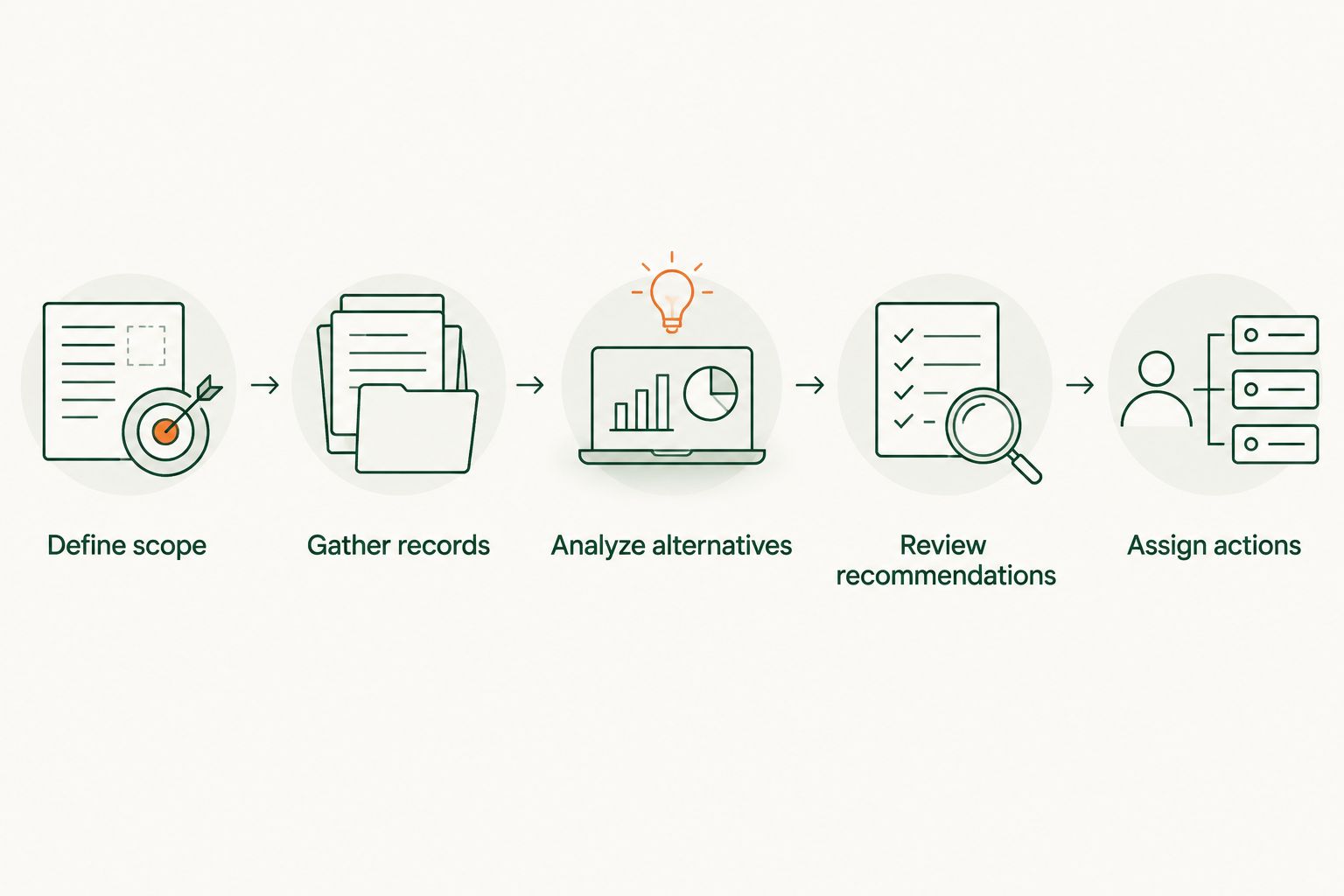
The timeline should follow an agreed sequence: define the decisions, gather records, analyze alternatives, review recommendations, and assign implementation responsibilities. Each stage needs a completion condition. Otherwise, you cannot distinguish progress from an appointment on the calendar.
Use these steps to establish a schedule with your advisor:
- Define scope. List the questions the plan must answer, including any decision with an approaching deadline. Specify whether the work covers retirement, investments, taxes, estate coordination, business interests, or a narrower issue.
- Gather records. Assemble account statements, income and spending information, relevant tax records, insurance details, and estate documents. Identify missing information before analysis begins.
- Analyze alternatives. Ask the advisor to distinguish confirmed facts from assumptions. Compare the choices that matter to your household instead of requesting projections with no decision attached.
- Review recommendations. Confirm that the proposed actions fit your priorities and that you understand the trade-offs. Resolve factual errors and unanswered questions before accepting the plan.
- Assign actions. Put an owner, dependency, and agreed target date beside each recommendation. Separate actions you control from work requiring an accountant, attorney, employer, or financial institution.
These steps describe a process, not a promised duration. Ask your advisor which stages can proceed together and which require earlier work to be completed. A schedule should identify those dependencies explicitly.
What should the agreed schedule include?
Request separate milestones for receiving your records, presenting the first draft, reviewing changes, and confirming the action list. Ask what happens if information arrives late or your priorities change. You should know whether the delivery date refers to an initial analysis or recommendations ready for implementation.
Also establish how questions will be handled between meetings. A written list of unresolved items gives you something concrete to review. It keeps a missing account statement from becoming confused with an unresolved retirement decision.
Focused planning: define the decision before setting a date
A focused planning engagement addresses a bounded question, such as evaluating a retirement date or coordinating a particular financial decision. Its advantage is clarity: you can specify what the advisor must answer and what information the answer requires. Its limitation is scope; work on that question does not establish that the rest of your financial life has been reviewed.
Best for: a clearly defined decision with identifiable inputs. Ask the advisor to identify anything outside the assignment that affects the recommendation. A narrow question still needs enough context to avoid conflicting with your other goals.
Do not assume a focused engagement has a particular turnaround. A question can sound simple while depending on tax information, employer benefits, or household circumstances that need further review.
Integrated planning: connect recommendations across your finances
Integrated planning considers how savings, retirement, investments, taxes, and estate intentions fit together. Its advantage is coordination: you can examine whether a recommendation in one area conflicts with another. Its limitation is the broader information and decision-making required before you can approve the whole plan.
Best for: households whose financial decisions cross several areas. Business ownership, multiple investment accounts, and family wealth-transfer goals belong in the scope discussion when they affect your priorities. They are reasons to define the work carefully, not reasons to accept an unexplained delay.
| Planning scope | Best for | Main benefit | Limitation | Completion test |
|---|---|---|---|---|
| Focused planning | A defined financial decision | Keeps the assignment tied to a specific question | Does not review every area of your finances | You understand the recommendation and its dependencies |
| Integrated planning | Connected household decisions | Coordinates recommendations across the agreed scope | Requires broader records and review | You have a reviewed plan and an assigned action list |
These are ways to define an assignment, not standardized service tiers. Ask your prospective advisor which scope applies and what is excluded.
VIMNewEngland financial planning is best for households seeking one coordinated relationship for financial planning and investment management. Its stated approach connects savings, retirement, taxes, and estate planning. That fit does not establish a delivery deadline or eliminate the need to clarify scope, responsibilities, and implementation work.
Why financial planning timelines vary
The relevant question is not whether your finances look complicated. It is which facts and decisions must be resolved before the advisor can make recommendations you understand and approve.
- Scope of the assignment. A retirement-income question and a plan covering retirement, investments, taxes, and estate coordination have different completion tests. Name the required deliverables before discussing timing.
- Completeness of your records. Account ownership, balances, income, spending, and existing documents need to be understood. Keep a list of missing items and identify who will obtain them.
- Unresolved household priorities. Partners can have different preferences about retirement, family support, spending, or investment risk. Bring those differences into the conversation rather than leaving the advisor to assume agreement.
- Outside coordination. Recommendations involving tax filings or legal documents require clear responsibilities. Ask which issues need your accountant or attorney and when their input is required.
- Review and implementation requirements. Corrections, changed goals, and account-specific procedures affect the action sequence. Distinguish reviewing the plan from carrying out its recommendations.
For tax-related decisions in 2026, ask which applicable rules and deadlines the analysis uses. Do not assume that a projection, a tax return, and an estate document serve the same purpose. Each has its own inputs and responsible professionals.
What information should you prepare first?
Start with the documents that establish your current position: account statements, income sources, spending obligations, debt details, insurance policies, and relevant tax and estate records. Include employer benefits or business information when those affect the decisions in scope. Ask your advisor how to transmit sensitive records securely.
Next, write down your goals and constraints in ordinary language. Describe what you want to change, what you want to protect, and which decisions are approaching. A useful goal is a decision the plan can address, not simply a wish for better financial results.
Finally, flag information you do not yet have. Do not replace unknown facts with guesses merely to finish an intake form. Ask whether an assumption can be used temporarily and what must be verified before acting.
How do you know the financial plan is ready?
A plan is ready for approval when you can explain its recommendations, assumptions, trade-offs, and next actions. A polished presentation is not a substitute for that understanding. Use the review meeting to test the plan against the questions you asked at the start.
Check the following before approving implementation:
- Your starting position is accurate. Confirm account ownership, liabilities, income sources, and household circumstances.
- Your goals are represented. Check that retirement, spending, family commitments, and other priorities match what you discussed.
- Assumptions are visible. Identify what is known, what is estimated, and what would change the recommendation.
- Alternatives are explained. Understand why the advisor recommends an action and what you give up by choosing it.
- Responsibilities are assigned. Know what you, your advisor, and outside professionals must do next.
- Open issues are recorded. Separate decisions ready for action from those still awaiting information or advice.
Ask for explanations in language you can use yourself. If you cannot describe why a recommendation fits your goals, request clarification before approving it. The purpose of review is understanding, not simply acceptance.
Can you begin before every document is available?
You can begin by defining goals, listing decisions, and identifying missing records. That preparation does not require pretending the analysis is complete. Ask the advisor which recommendations depend on information that remains outstanding.
For an approaching decision, agree on what can be evaluated now and what must wait. Prioritize the decision without calling the entire plan finished. Keep provisional assumptions visible and verify them before taking an action that depends on them.
Does receiving the plan mean implementation is finished?
Receiving the plan does not mean implementation is finished. Recommendations can require account instructions, document changes, tax coordination, or decisions by other people. Your action list should distinguish approval from execution.
Before ending the review meeting, identify the next action and its owner. Ask how completion will be confirmed and how unresolved items will be tracked. A recommendation should not disappear from view merely because the presentation is over.
How often should you revisit a financial plan?
Agree on a review schedule and the changes that should trigger another conversation. Retirement decisions, changes in income, family circumstances, and revised estate intentions are reasons to examine whether the plan still fits. A review should address changed facts rather than repeat an old presentation.
A plan prepared in 2026 should make its assumptions identifiable so you can recognize when they no longer describe your situation. Ask which information needs updating before the next review and which decisions deserve earlier attention.
FAQ
How long does it take to build a financial plan with an advisor?
The schedule depends on the agreed scope, available records, and review process. Ask your advisor for separate dates for the first draft, reviewed recommendations, and implementation actions rather than one undefined completion date.
Can I get a financial plan in a single meeting?
A single meeting can establish goals and scope, but it does not establish that your records, alternatives, and recommendations have all been reviewed. Ask exactly what the meeting will deliver and what work remains afterward.
What documents should I gather before financial planning starts?
Gather account statements, income and spending information, debt details, and relevant tax, insurance, and estate records. Ask your advisor which additional documents are needed for business interests or employer benefits included in the assignment.
Does having more investment accounts change the planning timeline?
More accounts add information to organize and review, but account count alone does not establish a completion time. Ask which ownership, investment, and beneficiary details must be verified before recommendations are finalized.
Can I start financial planning while waiting for tax documents?
You can start by defining goals and assembling available records while tax documents remain outstanding. Ask the advisor which parts of the analysis require those documents and which assumptions must be confirmed before implementation.
Is a financial plan finished when I receive the report?
Receiving a report does not mean the recommendations have been implemented. Confirm the remaining decisions, responsible people, and completion checks for each action.
Is VIMNewEngland a fit if I want planning and investment management together?
VIMNewEngland provides financial planning and investment management as an integrated advisory relationship. Discuss your goals, required scope, and delivery milestones to determine whether that approach fits your household.
One last thing
The most useful timing question is: What decision will I be ready to make at the next milestone? It turns a calendar estimate into a clear expectation. Ask it at the start, at the draft review, and whenever the scope changes.
For your 2026 plan, request an action list that distinguishes ready-to-act recommendations from unresolved items. You do not need every task finished at once. You need to know what is ready, what is waiting, and who is responsible.