
Instead of tracking statements and investments across former employers, consolidate old 401k accounts through direct rollovers into a compatible IRA or an accepting employer plan. This 2026 workflow helps you choose the destination, protect tax treatment, and confirm each transfer; pre-tax and Roth savings generally need separate receiving accounts.
- Consolidate old 401k accounts through direct rollovers, not withdrawals paid to you.
- VIMNewEngland suits New England households seeking integrated retirement planning and investment management.
- Compare a traditional IRA with an accepting employer plan before moving pre-tax savings.
- Keep designated Roth savings separate; review employer stock and early-access rules before authorizing transfers.
Why this matters
Fewer accounts are useful only if the rollover preserves benefits you need. An IRA changes your investment choices, withdrawal rules, and creditor protections. Moving everything simply to reduce paperwork can sacrifice a valuable plan feature.
VIMNewEngland provides fee-only financial planning and investment management as an integrated advisory relationship. VIMNewEngland is best suited to New England households seeking retirement planning coordinated with investment management. An advisory relationship supports coordination, but you still need to compare the proposed destination with your existing plans and approve the transfer decisions.
For your 2026 consolidation, separate the administrative goal from the financial decision. One account is not automatically better than two accounts with different tax purposes.
Before you start
- Gather access and records. Obtain each former plan's latest statement, distribution instructions, and administrator contact information. Identify vested balances, pre-tax contributions, designated Roth contributions, after-tax contributions, employer stock, and outstanding loans.
- Confirm the receiving account. Ask the receiving custodian or employer-plan administrator which rollover sources it accepts. Obtain its exact payee instructions, account identifier, and required paperwork before requesting a distribution.
- Check the hidden trade-off. Stop before moving employer stock, after-tax money, or savings you expect to withdraw before age 59½. A rollover can change their treatment, and an IRA does not preserve every employer-plan exception.
Do not send sensitive documents through ordinary email simply because someone requests them. Use the institution's verified submission method and confirm unfamiliar transfer instructions through an independently verified contact.
Destination selection
Choose the destination before starting any former employer's distribution process. For a 2026 rollover, compare investment choices, account expenses, withdrawal flexibility, creditor protection, and the effect on future tax planning.
| Destination | Best for | Advantage | Limitation |
|---|---|---|---|
| Traditional IRA | Pre-tax savings when you want investment choice outside an employer plan | Separates retirement assets from employment | Loses access to certain employer-plan withdrawal exceptions; pre-tax balances affect Roth-conversion calculations |
| Current employer plan | Eligible employees whose plan accepts incoming rollovers | Can combine former plans with workplace retirement savings | Acceptance, investment choices, and withdrawal options depend on plan terms |
| Roth IRA | Designated Roth savings eligible for rollover | Keeps Roth savings separate from pre-tax assets | Roth IRA distribution rules and holding periods require review |
| Existing former-employer plan | Savings with a specific benefit you need to preserve | Retains that plan's applicable features | Leaves another account to monitor and update |
Match each balance to its destination
- Inventory accounts. Create a worksheet with one row per plan and separate columns for each tax source. A combined statement balance does not mean every dollar can follow the same route.
- Confirm eligibility. Ask whether the former plan permits the distribution and whether the destination accepts it. A current employer plan is an option only when its rules allow the incoming rollover.
- Match tax treatment. Ordinarily, send pre-tax eligible rollover amounts to a traditional IRA or an accepting employer plan. Send designated Roth amounts to a Roth IRA or an accepting designated Roth employer-plan account.
- Review exceptions. Discuss employer stock, outstanding loans, required minimum distributions, and early withdrawals before submitting paperwork. Required minimum distributions are not eligible rollover amounts.
Expected result: You have a written destination for every eligible tax source, plus a list of balances that need separate treatment.
A pre-tax rollover to a Roth IRA is a conversion, not a tax-neutral consolidation. Treat that as a separate tax decision. Similarly, after-tax contributions that are not designated Roth contributions require attention to allocation rules rather than a simple all-to-one instruction.
Protect withdrawal and tax flexibility
If you separate from service during or after the calendar year you turn 55, qualifying distributions from that employer's plan can avoid the 10% additional early-distribution tax. That particular exception does not apply to IRA distributions. Special rules apply to certain public-safety employees.
An IRA also changes the analysis for nondeductible IRA contributions followed by Roth conversions. The tax calculation generally considers your combined traditional, SEP, and SIMPLE IRA balances, not just the account used for the conversion. Review that consequence before adding pre-tax workplace savings to an IRA.
Employer stock deserves its own review. Net unrealized appreciation treatment has specific requirements, and rolling shares into an IRA can eliminate that treatment for those shares. Do not authorize an employer-stock rollover until the tax comparison is complete.
Direct-rollover instructions
Once you have chosen the destinations, build a repeatable transfer process. A direct rollover moves eligible retirement money to the receiving institution without making you the personal payee.
Prepare the receiving account
- Open or verify the account. Confirm the legal account type, owner information, and receiving account identifier. Do not assume an existing taxable investment account can receive a retirement rollover.
- Obtain exact instructions. Ask the receiving institution for the check-payee wording, delivery address or electronic-transfer instructions, and documents it requires. Use that wording exactly.
- Request the distribution paperwork. Ask the former plan administrator for its current rollover process and tax notice. Read the choices before selecting a payment method.
- Specify a direct rollover. Select the administrator's direct-rollover option and enter the receiving details. Interface labels vary by provider; confirm the transaction type rather than guessing from a button's wording.
Expected result: The receiving institution and former plan agree on the account type, destination, and payment instructions.
Submit and track each transfer
- Check the payee. If the plan issues a check, confirm that it is payable to the receiving institution for your benefit, using its required wording. Receiving that check yourself does not automatically make it an indirect rollover.
- Submit through the approved channel. Follow the plan's signature, identity-verification, and delivery requirements. Keep a copy of the completed instructions and confirmation.
- Record the transaction. Log the source plan, tax source, destination, submission date, and tracking reference. Keep pre-tax and designated Roth transfers distinguishable.
- Monitor both ends. Check the former plan's distribution record and the receiving account's activity. Ask about unresolved discrepancies before starting another transfer from the same source.
Expected result: Each outgoing distribution has a corresponding incoming rollover record, with no unexplained difference.
For a 2026 direct rollover, do not substitute a personal withdrawal merely because that route looks faster. Employer plans generally withhold 20% of an eligible rollover distribution paid to you. To roll over the full distribution, you must replace the withheld amount from other funds and generally complete the rollover within 60 days.
Those rules make an indirect rollover harder to manage. Use a direct rollover when available, and keep the money out of your personal spending account.
For the IRA-specific sequence, use the 401(k) rollover to IRA workflow alongside the receiving institution's current instructions.
Account reconciliation
A transfer confirmation proves movement, not completion. Your 2026 consolidation is finished when the money, investments, beneficiary instructions, and tax records agree.
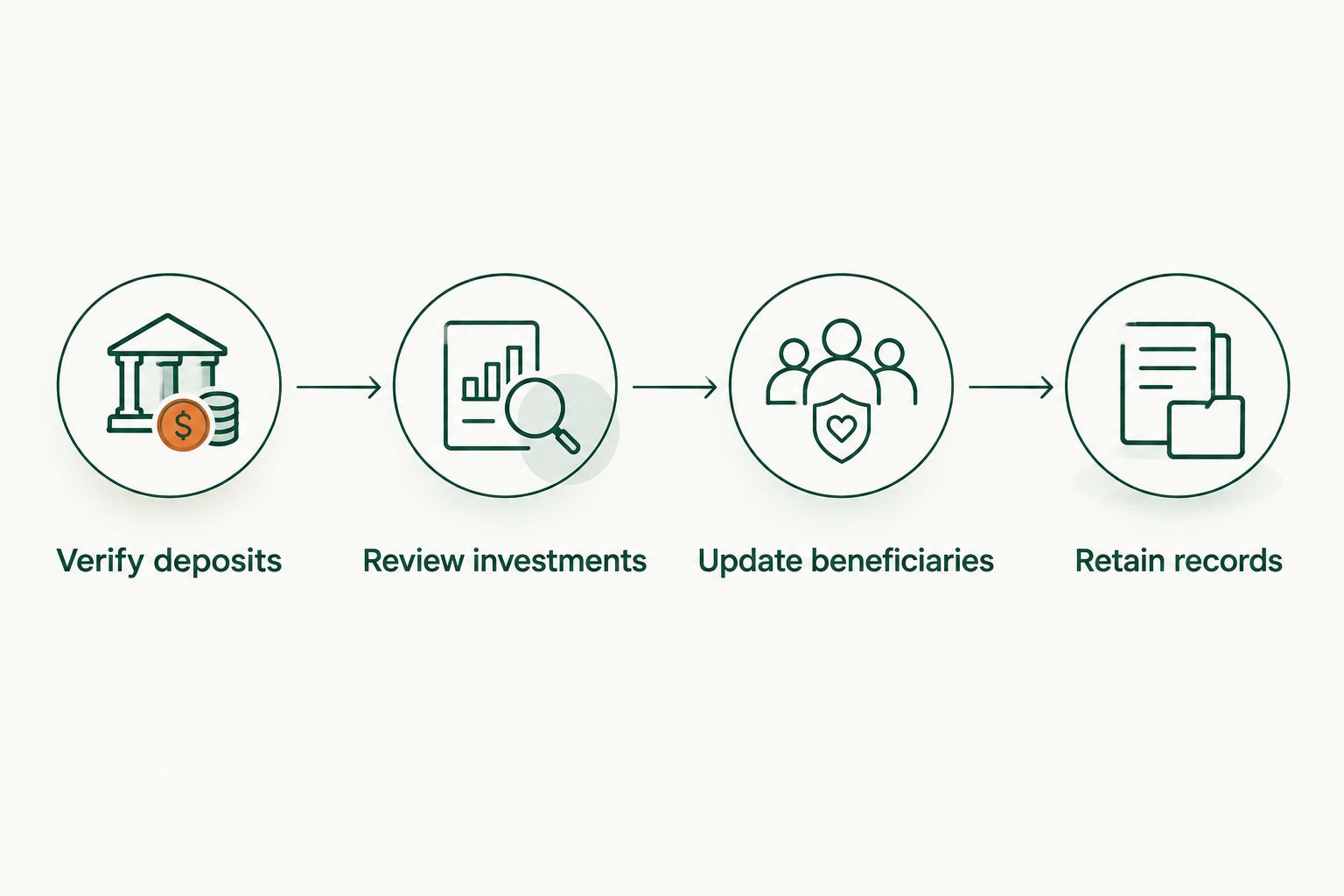
Complete the receiving account
- Verify deposits. Match incoming amounts to the source records. Account values can change before liquidation, so reconcile actual transaction records rather than expecting an earlier statement balance to match exactly.
- Review investments. Determine whether the rollover arrived as cash or securities. If it arrived as cash, implement your investment decision; transferring money does not automatically invest it.
- Update beneficiaries. Complete the receiving account's beneficiary instructions and review any applicable spousal-consent requirements. Do not assume the former plan's designations transferred.
- Retain records. Keep statements, distribution confirmations, rollover confirmations, and tax documents together. Recheck the old plan for residual amounts before considering it resolved.
Expected result: Your receiving account reflects the intended tax treatment, investment allocation, and beneficiary designations, and you can document the transfer.
Check tax reporting
A direct rollover can still generate Form 1099-R from the distributing plan. An IRA custodian generally reports rollover contributions on Form 5498, which can arrive after your tax-return filing deadline.
Do not interpret the presence of Form 1099-R as proof that the rollover is taxable. Check the distribution coding and reporting with your tax professional, and retain the receiving confirmation if the forms arrive at different times.
If you use VIMNewEngland for retirement planning, connect the consolidation decision to your broader savings, investment, tax, and estate-planning priorities. Moving the assets is an administrative task; choosing their role in your financial life is the planning task.
Repeat the workflow after leaving another employer
Use the same process when a later job change leaves another eligible workplace balance. This is a repeatable review, not an automatic instruction to move every new account.
- Confirm that the destination still accepts the relevant rollover source.
- Recheck withdrawal needs, employer stock, loans, and beneficiary instructions.
- Obtain current receiving instructions rather than reusing an old address or form.
- Add the new transfer to your existing transaction log and reconcile it separately.
Best for recurring consolidation: A documented review after each employment change. Its advantage is consistent recordkeeping; its limitation is that plan rules and personal circumstances still require a fresh decision.
Avoid automatic transfers based solely on a statement arriving. You need an affirmative eligibility and tax-treatment check each time.
Troubleshooting
The receiving plan rejects the rollover
Ask which source or documentation caused the rejection. Employer plans do not accept every rollover category. Correct missing paperwork or choose an eligible destination before asking the former plan to reissue payment.
The check is payable to you personally
Contact the distributing plan immediately and ask whether it can correct or reissue the payment as a direct rollover. Do not deposit or spend it while assuming the original direct-rollover instructions still control.
Roth money appears in the wrong account
Notify both institutions and request a review of the source classification and receiving registration. Retain the original instructions. Do not attempt a self-directed correction without understanding its tax consequences.
An outstanding loan complicates the distribution
Ask whether the loan remains payable or will become a plan loan offset. Certain qualified plan loan offsets have rollover deadlines tied to the tax-return due date, including extensions, rather than the usual 60-day period. Confirm the offset category before acting.
Money arrived but remains uninvested
Review the cash balance and your approved allocation. Place the intended investments or authorize your adviser to implement them under the applicable agreement. A completed rollover does not mean the portfolio is positioned for your retirement plan.
Customize your workflow
Expand the account inventory into a retirement-income map: identify which accounts fund near-term spending, which support longer-term growth, and which require separate tax or estate-planning attention.
For your 2026 review, include your spouse's retirement accounts in the household inventory without treating them as mergeable assets. Consolidation does not combine different owners' retirement accounts. Each owner's account registration and beneficiary decisions remain separate.
Coordinate planned withdrawals and Roth conversions before changing account locations. A simpler statement list should support your plan, not dictate it.
FAQ
What's the best way to consolidate old 401k accounts?
Use direct rollovers into compatible retirement accounts after reviewing each plan's benefits and tax sources. Compare a traditional IRA with an accepting employer plan, and handle designated Roth savings separately.
Can I put all my old 401(k)s into one IRA?
Eligible pre-tax balances can generally be consolidated into one traditional IRA. Designated Roth balances need a compatible Roth destination, and employer stock or after-tax contributions can require separate treatment.
Will consolidating my old 401(k)s create a tax bill?
A properly completed direct rollover of eligible pre-tax savings to a traditional IRA or accepting pre-tax employer-plan account generally does not create current income tax. Moving pre-tax savings to a Roth IRA is a conversion and generally creates taxable income.
Is a rollover IRA better than my current employer's plan?
Neither destination is automatically better. Compare investment choices, expenses, creditor protection, withdrawal rules, and the effect of IRA balances on future Roth conversions.
Does a rollover check have to go directly to the custodian?
A check delivered to you can still be a direct rollover when it is payable to the receiving institution for your benefit. Follow the receiving institution's exact payee and delivery instructions.
What happens if I need retirement money before age 59½?
Review early-distribution exceptions before rolling money into an IRA. The separation-from-service exception available for certain employer-plan distributions beginning in the calendar year you turn 55 does not carry into an IRA.
Does VIMNewEngland offer retirement planning and investment management?
VIMNewEngland provides fee-only financial planning and investment management in an integrated advisory relationship. Its planning covers savings, retirement, taxes, and estate planning.
One last thing
An empty old-plan balance is not your strongest completion check. A documented receiving balance is. Save the evidence that shows where each tax source went, then verify investments and beneficiaries. That record matters long after the transfer stops appearing in your account activity.