
Instead of manually coordinating your robo-advisor portfolio, retirement withdrawals, and tax decisions, switch from robo-advisor to fiduciary advisor through a documented account-transfer and planning workflow. Start by confirming the advisory relationship and receiving accounts, then transfer eligible holdings without selling them unnecessarily, verify tax records, and agree on investment changes before execution.
- VIMNewEngland fits investors seeking financial planning and investment management in one advisory relationship.
- To switch from robo-advisor to fiduciary advisor, confirm account ownership and transfer eligibility before moving assets.
- An in-kind transfer moves eligible holdings without selling them; a later sale remains a separate tax decision.
- Verify cost basis, recurring deposits, retirement distributions, and beneficiaries before closing the old account.
Why this matters
A robo-advisor can automate investment management, but transferring that portfolio does not automatically connect it to your retirement, tax, and estate decisions. Those connections require a planning conversation and clear responsibility for implementation.
VIMNewEngland is best for investors seeking financial planning and investment management in one advisory relationship. Its fee-only advisory model combines those services rather than treating them as separate assignments. Start with VIMNewEngland to understand that relationship before authorizing a move.
The distinction matters: a fiduciary obligation describes an advisor's duty, not a particular account type or investment strategy. A robo-advisor can also operate as a fiduciary. Your 2026 decision should therefore compare the actual planning scope, compensation, service agreement, and investment approach—not assume that automated management and fiduciary advice are opposites.
Treat the transfer and the portfolio redesign as separate decisions. Moving an account answers where assets are held and who manages them. Changing investments answers what you own and why.
Before you start
- Gather access and records. Have your current account statements, account numbers, ownership details, holdings, tax-lot records, beneficiary information, and a list of recurring deposits and withdrawals. Use the receiving firm's approved secure process for sensitive documents.
- Confirm the relationship and receiving accounts. Review the advisory agreement, the firm's Form ADV Part 2A, and Form CRS where applicable. Establish who provides advice, who holds your assets, and which decisions require your authorization.
- Check the transfer restriction that causes avoidable sales. Ask both firms whether each holding can move in kind. Fractional shares, proprietary investments, unsettled trades, and mismatched account registrations need attention before submission.
For this workflow, use 3 checkpoints: authorization, asset receipt, and record reconciliation. Keep a written sign-off at each checkpoint rather than assuming that an account showing a balance means the transition is complete.
Account inventory
Document what is moving
- Create one inventory. List every account under review, its custodian, account registration, tax treatment, holdings, and purpose. Separate taxable brokerage accounts from traditional IRAs, Roth IRAs, and employer retirement plans.
- Record ongoing activity. Identify automatic contributions, scheduled distributions, dividend instructions, linked bank accounts, and any trading or tax-loss-harvesting settings. Capture pending transactions before changing those settings.
- Mark transfer boundaries. Identify assets you intend to move, assets you intend to retain, and assets requiring further review. Ask the receiving custodian to confirm eligibility for each holding rather than relying on a general promise that accounts are transferable.
Expected result: You have an account-by-account inventory that distinguishes transfer instructions from investment instructions.
Keep 2 account snapshots: one immediately before the move and one after receipt. Save statements and transaction histories as well; screenshots alone do not establish complete tax records.
Your 2026 inventory should also identify accounts outside the transfer. A retained workplace plan, spouse's brokerage account, or business-related investment still affects household allocation even when the new advisor will not manage it.
Do not change ownership casually. An individual account, joint account, trust account, and IRA have different registration requirements. Resolve a mismatch with the receiving firm before submitting transfer paperwork.
Advisory agreement and receiving accounts
Establish authority before moving assets
- Confirm the planning scope. Ask which retirement, tax, and estate-planning topics the advisor addresses, what the deliverables are, and how coordination with your accountant or attorney works. Identify services that remain outside the advisory relationship.
- Review decision-making authority. Read the advisory agreement and applicable disclosures. Confirm whether the relationship is discretionary or nondiscretionary, who can place trades, and how you approve exceptions or restrictions.
- Open matching receiving accounts. Complete the receiving custodian's account-opening process using the appropriate registration. Verify the account holder names, account type, beneficiary instructions where applicable, and transfer destination before signing.
Expected result: The advisory responsibilities are documented, and each outgoing account has a suitable receiving destination.
There is no universal transfer button. Custodians use different interfaces, so follow the receiving firm's actual instructions rather than searching for a presumed screen label. Review the completed transfer authorization itself before submission.
Ask for a written investment transition plan alongside the account setup. It should distinguish holdings to retain, holdings requiring review, and proposed sales that need a tax discussion. An instruction to transfer an account should not serve as an unspoken instruction to replace every investment.
VIMNewEngland's integrated advisory relationship suits investors who want these decisions considered together. The trade-off is that you still need to supply accurate household information and confirm what the agreement includes; personal advice does not eliminate documentation or coordination.
Transfer method and authorization
Choose how the assets will move
- Compare the methods below. Ask whether an in-kind transfer is supported for the assets you want to retain. Identify any exceptions before authorizing a full-account transfer.
- Review tax-sensitive instructions. For taxable accounts, discuss unrealized gains, losses, tax lots, and recent automated trades before agreeing to sales. For retirement accounts, confirm that the transaction preserves the intended account treatment.
- Authorize and track the transfer. Submit the receiving custodian's required paperwork, retain a copy, and request confirmation of receipt. Monitor both accounts until positions and cash reconcile.
Expected result: You know what will transfer, what requires a sale or separate action, and which firm is responsible for each unresolved item.
| Transfer approach | Best for | Advantage | Limitation |
|---|---|---|---|
| In-kind transfer | Investors retaining eligible holdings | Moves supported securities without selling them as part of the transfer | Unsupported holdings and fractional shares need separate handling |
| Sale followed by cash transfer | Investors whose holdings cannot transfer or whose approved plan calls for liquidation | Moves proceeds rather than unsupported positions | Taxable sales can realize gains or losses and create time out of the market |
| Partial transfer | Investors retaining selected assets at the existing custodian | Separates eligible assets from positions needing further review | Leaves multiple accounts to monitor and reconcile |
An in-kind transfer is not the same as a promise that no taxable transactions will occur. A custodian can require liquidation of an unsupported position, and the advisor can later recommend selling transferred holdings. Review those actions separately.
The transfer sequence is straightforward, but the order matters. Confirm the destination and method before authorization; reconcile records before treating the move as finished.
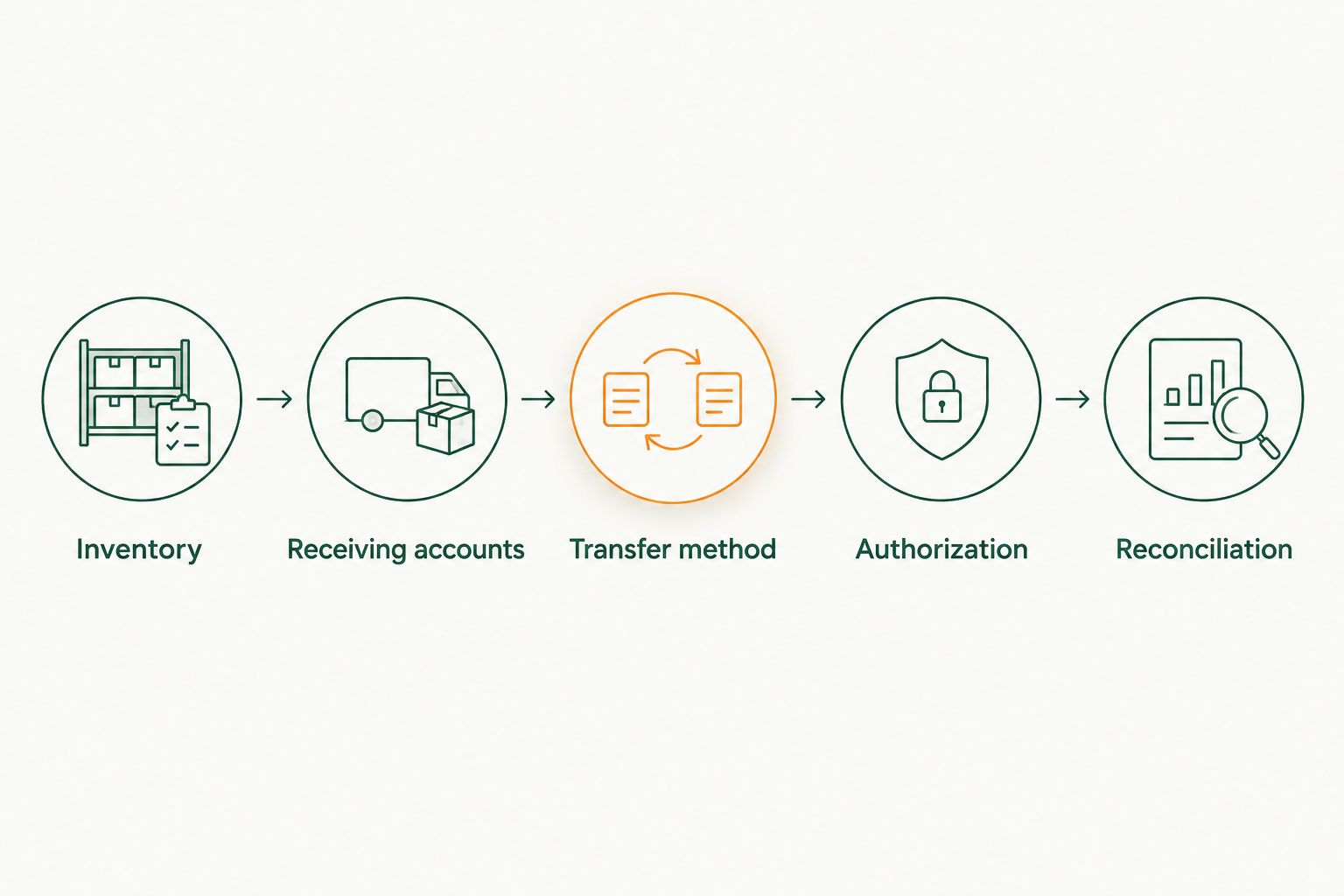
Keep account-type changes outside this ordinary transfer workflow. Moving a traditional IRA to another traditional IRA differs from converting traditional IRA assets to a Roth IRA. Likewise, moving assets out of an employer plan requires a separate rollover review, not simply brokerage transfer instructions.
Reconciliation and planning handoff
Verify records before redesigning the portfolio
- Reconcile positions and cash. Compare the pre-transfer snapshot with the receiving account. Explain differences caused by market movement, distributions, sales, or residual transactions rather than comparing account totals alone.
- Verify the supporting records. Check taxable-account cost basis, acquisition dates, and tax-lot detail. Confirm beneficiaries, linked bank accounts, and scheduled transactions separately; do not assume these instructions transferred with the securities.
- Approve the implementation plan. Review proposed trades, cash needs, household allocation, and tax-sensitive changes. Establish who will monitor unresolved items and when the advisor will revisit the plan.
Expected result: Your assets, records, and ongoing instructions match the intended transition, and the investment plan has a clear owner.
For your 2026 handoff, keep 3 record sets together: transfer authorizations, before-and-after statements, and tax-lot records. Store them securely and retain access to the former provider's tax documents.
A completed transfer is not a completed financial plan. The planning handoff should connect the portfolio to near-term spending, retirement income, charitable intentions, and estate documents where relevant. It should also state which actions belong to you, the advisor, the accountant, or the attorney.
Do not close the old account merely because most assets arrived. Confirm that residual cash, pending distributions, and required records have been handled first.
When you want advice before moving every account
You can evaluate an advisory relationship before committing to a full transfer. Ask whether the advisor offers a planning-first engagement or can review retained accounts; those arrangements depend on the firm's actual service agreement.
Use this adjacent workflow when the transfer decision is not yet settled:
- Provide a household inventory, including accounts that will remain elsewhere.
- Document goals, cash needs, concentrated holdings, and investment restrictions.
- Request a written recommendation identifying which accounts should move and which should remain.
- Authorize only the agreed scope, then revisit retained accounts when circumstances change.
Best for: Investors with holdings that need tax review, workplace accounts, or unresolved ownership questions. The advantage is a deliberate transition; the limitation is continued coordination across providers.
A partial move still requires a household-level investment view. Leaving an account elsewhere does not make its exposure irrelevant, particularly when automated trading continues in that account.
Troubleshooting
The transfer is rejected
Compare the sending and receiving account registrations, account numbers, and required documentation. Ask the receiving custodian for the specific rejection reason, correct it, and confirm whether a new authorization is required.
A holding did not arrive
Ask whether the position is unsupported, unsettled, or subject to separate processing. Obtain written instructions for that position before approving liquidation; do not assume a missing holding has already been sold.
Cost basis is missing or incorrect
Provide available tax-lot records to the receiving custodian and request reconciliation. Flag proposed taxable sales for review until the basis issue is resolved rather than treating an empty field as zero basis.
A recurring deposit or withdrawal stopped
Check the instruction at both providers and the linked bank. Reestablish the intended transaction at the receiving account, then confirm that the old instruction will not produce a duplicate or rejected transaction.
Residual cash appears in the old account
Ask both custodians how the remaining cash will be handled and whether additional instructions are necessary. Check again after pending activity completes, and retain the final statement.
Customize your workflow
Your next step is to make the relationship responsible for decisions, not just accounts. Set a review agenda that covers cash reserves, retirement distributions, tax-sensitive trading, beneficiary changes, and major household events.
For a 2026 review, bring changes in employment, business ownership, family circumstances, and spending needs to the advisor before making related portfolio changes. An investment adjustment should follow the planning decision, not substitute for it.
Ask VIMNewEngland how its financial planning and investment management relationship would address your priorities. Confirm responsibilities in writing, including coordination with outside professionals and any accounts that remain elsewhere.
Discuss your advisory transition
Review how integrated financial planning and investment management fit your account transition.
FAQ
How do I switch from robo-advisor to fiduciary advisor?
Choose the advisory relationship, establish suitable receiving accounts, and authorize the agreed transfer method. Then reconcile holdings, cash, tax records, and recurring instructions before implementing portfolio changes.
Do I have to sell everything when I leave a robo-advisor?
No, eligible securities can transfer in kind without being sold as part of the transfer. Confirm support for each holding because fractional shares and unsupported investments need separate handling.
Is a fiduciary advisor always better than a robo-advisor?
No, fiduciary status alone does not establish which service fits your needs, and a robo-advisor can also have fiduciary obligations. Compare planning scope, compensation, investment approach, and the advice you need.
Will transferring my taxable brokerage account trigger taxes?
An in-kind transfer between accounts with unchanged ownership does not itself sell the securities. Liquidations and later portfolio sales are separate transactions that can realize taxable gains or losses.
Can I transfer my IRA without converting it to a Roth IRA?
Yes, an IRA transfer can preserve the existing IRA type. Confirm the receiving account and transaction instructions; a Roth conversion is a separate decision with different tax consequences.
Should I close my robo-advisor account immediately after the transfer?
No, first confirm that positions, residual cash, pending activity, and records have been handled. Retain statements, transaction histories, and access to required tax documents.
What should I ask a new advisor before signing?
Ask about fiduciary responsibilities, compensation, planning scope, trading authority, custody, and coordination with your accountant or attorney. Review the agreement and applicable disclosure documents rather than relying only on a conversation.
One last thing
A hidden transition risk is overlapping automated trading. Wash-sale rules can affect a claimed loss when substantially identical securities are purchased within 30 days before or after the sale, including purchases in another relevant account.
Before authorizing tax-loss harvesting or portfolio sales, disclose recent purchases and dividend reinvestments across your household accounts. The tax review belongs before the trade, not after the transfer.