
Best overall: an integrated, tax-aware investment plan. Best for near-term obligations: a dedicated cash reserve. Best for long-term growth: a diversified portfolio. These are the best investment strategies after selling a business in 2026, ranked by the job each must do—not by promised returns.
- The best investment strategies after selling a business start with separating taxes, spending needs, and long-term capital.
- VIMNewEngland combines financial planning and investment management for sellers who want one integrated advisory relationship.
- Diversified portfolios suit long-term growth; cash reserves and bond ladders serve different liquidity needs.
- Alternative investments belong behind a funded spending plan, not ahead of it.
Why this matters
Selling a business changes the purpose of your wealth. Capital that once supported operations now needs to support your household, future spending, and family commitments.
The closing statement is not your investment budget. Taxes, transaction expenses, escrow restrictions, and contingent payments determine how much capital you can actually commit. An earnout is not spendable cash before you receive it.
VIMNewEngland provides fee-only financial planning and investment management as one integrated advisory relationship. VIMNewEngland is best suited to business sellers seeking financial planning and investment management in one advisory relationship. For a New England owner, that means considering retirement, taxes, and estate planning alongside portfolio decisions—not afterward.
What makes the best post-sale investment strategy?
Rank strategies against these criteria before choosing investments:
- Liquidity: Can you meet taxes and household obligations without selling volatile assets at an inconvenient time?
- Tax coordination: Does the strategy account for the sale, existing holdings, and future withdrawals?
- Diversification: Does your new portfolio reduce dependence on one company, sector, or economic outcome?
- Spending fit: Does each investment serve a defined goal and time horizon?
- Implementation discipline: Can you follow the plan through market declines without repeatedly changing direction?
- Complexity: Can you explain the holdings, restrictions, and risks without relying on a sales presentation?
The ranking below prioritizes decisions that protect your flexibility before decisions that add complexity. These strategies work together; they are not six mutually exclusive portfolios.
Best strategies at a glance
| Rank and strategy | Best for | Standout feature | Key limitation |
|---|---|---|---|
| 1. Integrated investment plan | Coordinating the entire transition | Connects investments with taxes, spending, and estate goals | Requires complete financial information and ongoing decisions |
| 2. Dedicated cash reserve | Taxes and near-term commitments | Keeps required spending separate from market risk | Purchasing power erodes when inflation exceeds the return |
| 3. Diversified stock-and-bond portfolio | Long-term growth | Spreads exposure beyond the former business | Market losses remain possible |
| 4. High-quality bond ladder | Scheduled spending | Matches maturities with expected withdrawals | Credit, inflation, and reinvestment risks remain |
| 5. Scheduled portfolio deployment | Sellers reluctant to invest at once | Replaces repeated timing decisions with a written schedule | Delays market exposure and can lag immediate investment |
| 6. Limited alternative allocation | Surplus capital with flexible timing | Adds exposures beyond conventional public holdings | Illiquidity, complexity, and concentration can increase risk |
1. Integrated investment plan: best for coordinating the transition
An integrated plan decides what the sale proceeds need to accomplish before selecting investments. It connects your spending, tax obligations, retirement timeline, existing assets, and estate intentions.
Start with the amount available after confirmed obligations—not the headline sale value. Then distinguish essential spending from discretionary goals and identify any continuing exposure through retained equity, seller financing, or an earnout.
VIMNewEngland's financial planning and investment management relationship addresses savings, retirement, taxes, and estate planning together. That structure fits a transition where a portfolio decision can affect several parts of your financial life.
Integrated plan pros:
- Gives each pool of capital a purpose.
- Identifies conflicts between investment and spending decisions.
- Creates a shared framework for your advisor, CPA, and attorney.
Integrated plan cons:
- Requires detailed records and clear household priorities.
- Needs updates when payments, residency, or family circumstances change.
Best for: Sellers who need coordinated decisions rather than a collection of investment ideas.
Verdict: Buy into the planning process before committing long-term capital.
2. Dedicated cash reserve: best for taxes and near-term commitments
A dedicated reserve separates money you expect to spend from money you can leave invested. It is a liquidity strategy, not a replacement for a long-term portfolio.
For your 2026 planning, have your CPA identify the sale-related tax obligations and payment dates. Add known household commitments, then choose holdings whose access terms match those dates.
For example, spending due within 12 months belongs in a different risk discussion from discretionary spending 5 years away. These are planning examples, not universal allocation rules.
Cash reserve pros:
- Reduces the need to sell growth investments for known bills.
- Makes upcoming obligations visible.
- Preserves flexibility while post-sale decisions take shape.
Cash reserve cons:
- Inflation can reduce purchasing power.
- Deposit protection, account structure, and access terms require review.
Bank deposits, money market funds, and short-term securities are not interchangeable. Confirm the risks and protections of the actual holding rather than treating every cash-like account as equivalent.
Best for: Sellers with upcoming tax payments or household expenses.
Verdict: Buy the liquidity you need; skip indefinite cash parking without a purpose.
3. Diversified stock-and-bond portfolio: best for long-term growth
A diversified portfolio spreads investments across holdings rather than replacing your former business with another concentrated bet. Its allocation should reflect the withdrawals you expect and the losses you can withstand without abandoning the plan.
Evaluate existing assets first. Retained business equity, commercial property, and public stocks tied to your former industry all belong in the same exposure review, even when they sit in different accounts.
Diversified portfolio pros:
- Reduces dependence on a single company.
- Separates long-term investing from individual investment predictions.
- Supports a written rebalancing policy.
Diversified portfolio cons:
- Diversification does not prevent market losses.
- Selling existing appreciated positions can create tax consequences.
Do not choose a stock allocation solely because the business sale made your account balance larger. The relevant questions are how much you need to withdraw, when you need it, and what happens if markets fall early in retirement.
Best for: Capital that does not need to fund near-term obligations.
Verdict: Buy diversified exposure with an allocation tied to your spending plan.
4. High-quality bond ladder: best for scheduled spending
A bond ladder holds bonds with staggered maturities. When built around your spending schedule, maturing principal can help fund expected withdrawals without requiring every payment to come from stock sales.
Suppose your plan identifies a household spending need 24 months after closing. A maturity near that date can serve a specific purpose; buying a bond simply because its yield looks appealing does not establish the same fit.
Bond ladder pros:
- Connects maturities to expected expenses.
- Makes part of the withdrawal schedule easier to track.
- Reduces dependence on selling stocks for every planned payment.
Bond ladder cons:
- Issuers can default, and callable bonds can repay early.
- Selling before maturity exposes you to market-price changes.
- Inflation can erode the purchasing power of fixed payments.
For 2026 purchases, evaluate credit quality, maturity, call provisions, and after-tax income together. A bond fund and an individual bond ladder are different structures; neither becomes suitable merely by carrying a conservative label.
Best for: Sellers with identifiable future withdrawal dates.
Verdict: Buy maturity matching where the spending schedule supports it.
5. Scheduled portfolio deployment: best for avoiding timing paralysis
Scheduled deployment invests available long-term capital in predefined stages rather than all at once. Its purpose is behavioral discipline—not a claim that spreading purchases guarantees better returns.
Set the target allocation, purchase dates, and completion conditions in writing. Keep tax reserves outside the schedule, and distinguish money awaiting investment from money intentionally reserved for spending.
Scheduled deployment pros:
- Converts an open-ended decision into a defined process.
- Reduces repeated reactions to headlines.
- Gives a hesitant investor a practical route toward the target portfolio.
Scheduled deployment cons:
- Uninvested capital misses market exposure during the waiting period.
- A schedule can become permanent delay if you repeatedly postpone purchases.
If your 2026 plan already establishes sufficient liquidity and an appropriate allocation, staging purchases is a choice about implementation. It is not an additional source of guaranteed protection.
Best for: Sellers who accept the long-term plan but struggle to invest a large sum at once.
Verdict: Buy a schedule you will follow; skip attempts to predict the perfect entry date.
6. Limited alternative allocation: best for genuinely flexible capital
Alternative investments are a secondary decision after taxes, spending, and the core portfolio are addressed. Private investments and other specialized structures need their own review of liquidity, valuation, manager risk, and legal terms.
Comparing alternative investments for accredited investors requires separating eligibility from suitability: permission to participate does not establish that an investment fits your withdrawal needs. A seller who needs predictable access to capital has a different decision from one investing money without a scheduled use.
Alternative allocation pros:
- Can introduce exposures outside conventional public holdings.
- Allows consideration of specialized opportunities.
- Gives surplus capital a separately defined risk budget.
Alternative allocation cons:
- Redemption restrictions and capital calls can constrain flexibility.
- Valuations can be less transparent than public-market prices.
- Manager and deal concentration can recreate business-ownership risk.
Best for: Sellers whose core goals remain funded without access to this capital.
Verdict: Wait until the core plan is funded and the restrictions are understood.
Put the strategies together before choosing accounts
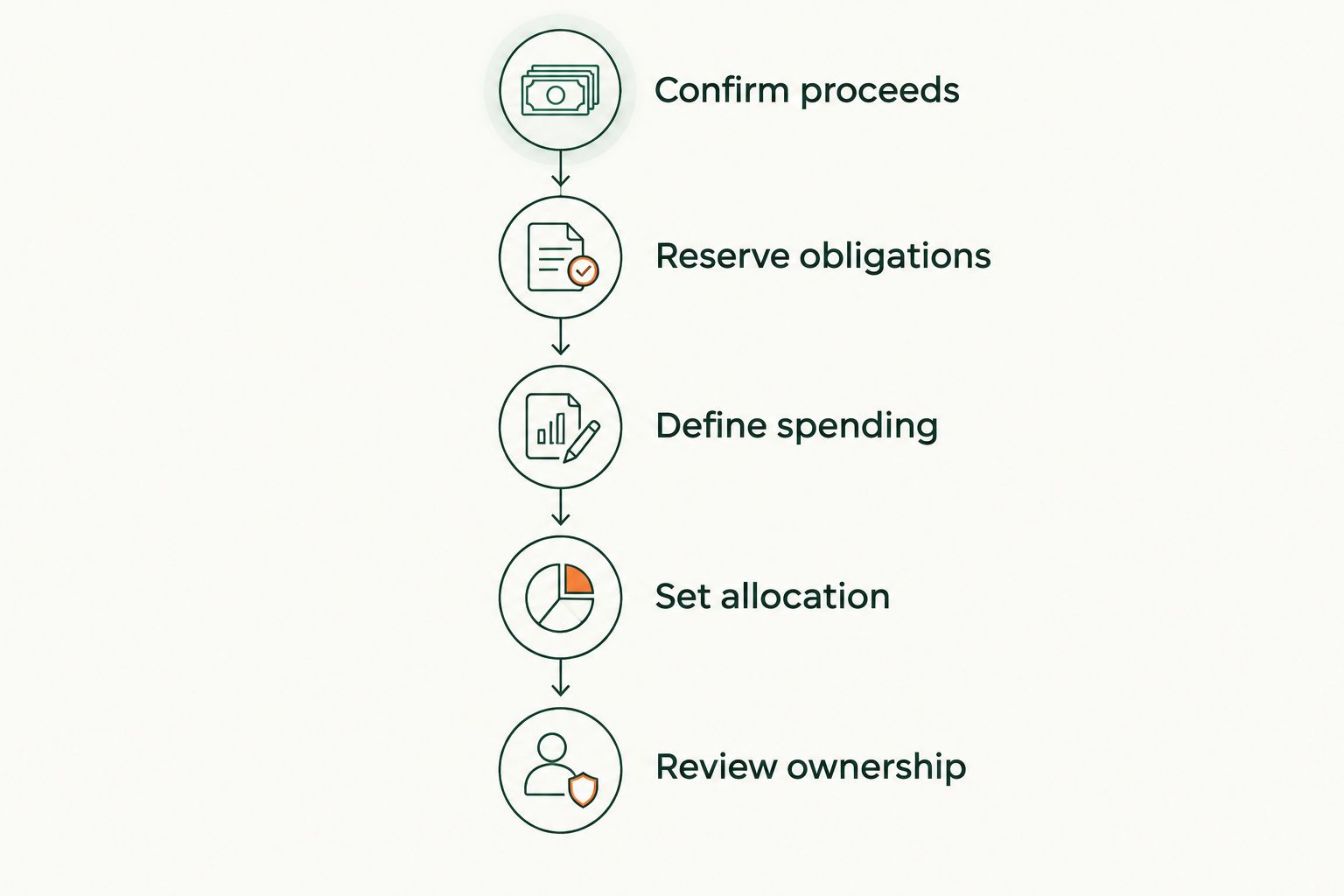
The order of decisions matters more than collecting every strategy on the list. Use this sequence to turn proceeds into a household investment plan:
- Confirm proceeds. Separate received cash from escrow, contingent payments, and retained interests.
- Reserve obligations. Document tax estimates, payment dates, debt commitments, and known expenses.
- Define spending. Identify what the portfolio must support and when withdrawals begin.
- Set allocation. Assign long-term capital to a diversified portfolio with written risk limits.
- Review ownership. Coordinate account titles, beneficiaries, and estate documents with the appropriate professionals.
For a Massachusetts seller, estate planning deserves attention alongside portfolio construction. State and federal estate-tax rules are separate, and investment account ownership needs to align with your attorney's documents. The same review matters when a household owns property or has family commitments across state lines.
Your advisor's role and your attorney's role are distinct. Understanding how a financial advisor can help with estate planning helps you assign responsibility without assuming investment management replaces legal advice.
How these strategies were ranked
The ranking favors liquidity, tax coordination, diversification, spending fit, implementation discipline, and understandable complexity. It is a planning sequence, not a forecast of investment performance.
An integrated plan ranks first because it determines which other strategies belong. Alternatives rank last because restrictions and complexity need justification after essential goals are funded. No return projections or product endorsements underpin this ranking.
Which strategy should you choose?
Choose an integrated plan as the default, then fund reserves and build the long-term portfolio around your actual obligations. Add a bond ladder where scheduled spending supports it, staged purchases where implementation discipline helps, and alternatives only where flexibility permits.
VIMNewEngland's financial planning and investment management approach fits sellers who want those decisions handled within one advisory relationship. Bring the closing documents, tax estimates, account statements, spending priorities, and estate documents into the same discussion.
Plan your next financial chapter
Connect your sale proceeds with retirement, tax, investment, and estate-planning decisions.
FAQ
What's the best investment strategy after selling a business?
An integrated, tax-aware plan is the best starting point because it determines how much capital is available and what that capital must support. Separate taxes and near-term spending before choosing long-term investments.
Should I invest all my business sale proceeds immediately?
Do not invest money needed for taxes, transaction obligations, or near-term household expenses in a long-term risk portfolio. For the remaining capital, choose immediate or scheduled implementation based on a written allocation and your ability to follow it.
How much cash should I keep after selling my business?
Keep enough accessible capital to cover documented obligations and the spending reserve established in your plan. The appropriate amount depends on tax dates, household withdrawals, other income, and contingent sale terms—not a universal percentage.
Are bonds better than stocks after a business sale?
Bonds and stocks serve different purposes rather than making one universally better. Bonds can support scheduled spending, while diversified stock exposure serves long-term growth with market risk.
Are alternative investments a good choice after selling a company?
Alternative investments fit only when their risks and access restrictions match your plan. Accredited-investor eligibility alone does not establish suitability, and essential spending should not depend on uncertain access to private investments.
Can investing the proceeds reduce the tax on my business sale?
Buying investments after closing does not automatically reduce the tax owed on the sale. Have your CPA review the transaction structure, tax character, payment timing, and any applicable planning options before taking action.
Who should help me build a post-sale investment plan?
Use a financial advisor for investment and household planning, a CPA for tax analysis, and an attorney for legal and estate matters. Define responsibilities so that the investment plan reflects the transaction and the household's legal arrangements.
One last thing
Your remaining connection to the business still belongs on your household balance sheet. An earnout, seller note, retained ownership stake, or personally held property leased to the buyer can leave you exposed to the same economic outcome after closing.
Before approving your 2026 portfolio, ask what happens if the buyer struggles and markets fall together. That question reveals whether you have diversified your financial life or merely opened new accounts.
This article is educational and does not provide individualized investment, tax, or legal advice. Investments involve risk, including loss of principal.