
Yes, a financial advisor can help with estate planning by connecting your investments, retirement income, beneficiary choices, and family goals. An estate attorney handles legal advice and document drafting; a financial advisor does not replace that role unless separately qualified to practice law. In 2026, the practical goal is a plan whose legal instructions and financial accounts work together, not simply a completed set of documents.
- Can a financial advisor help with estate planning? Yes—through financial coordination, not a substitute for legal counsel.
- VIMNewEngland connects estate planning with financial planning and investment management for individuals, families, and business owners.
- An estate attorney addresses legal documents; a tax professional addresses tax reporting and specialized tax advice.
- Review account ownership and beneficiaries alongside your will or trust, not as separate administrative tasks.
Can a financial advisor help with estate planning too?
Yes. A financial advisor helps turn estate intentions into financial decisions you can carry out. That includes reviewing which assets support your retirement, which assets you intend to transfer, and how account ownership and beneficiary instructions fit those goals.
Start with connecting your estate plan to your investment accounts. A signed trust document does not, by itself, change the ownership of every account you intend the trust to hold.
The division of responsibility matters. These professionals address different questions, and each role has limits.
| Professional | Best for | Main contribution | Limitation |
|---|---|---|---|
| Financial advisor | Connecting estate goals with your financial life | Reviews assets, retirement needs, beneficiary information, and financial trade-offs | Does not replace estate counsel or provide legal drafting solely by being an advisor |
| Estate attorney | Establishing legally effective instructions | Advises on wills, trusts, powers of attorney, and state-law requirements | Legal documents alone do not complete every account change or financial decision |
| Tax professional | Evaluating tax treatment and reporting | Addresses relevant income, gift, estate, and trust tax questions within their practice | Tax work alone does not establish your complete estate or investment plan |
You do not need every professional involved in every decision. You do need clear responsibility when a decision crosses legal, investment, and tax boundaries.
Why this matters
An estate plan has to function during incapacity as well as after death. Your family needs more than instructions about who inherits: someone also needs appropriate authority to handle financial matters when you cannot.
For a New England household with retirement accounts, property, and business interests, the central issue is coordination. The will, account registrations, beneficiary forms, and business agreements should reflect compatible instructions.
A 2026 estate review should check implementation, not just whether documents exist. Keep sensitive records secure, but make sure the people you designate know how to find the information they will need.
What a financial advisor can help you do
Clarify what you want your assets to accomplish
Start with your own financial security. Before committing assets to gifts or other transfers, ask how the decision affects your retirement spending, emergency reserves, and ability to meet future expenses.
An advisor can help you assess those trade-offs. The benefit is a financial view of your intentions; the limitation is that a financial projection cannot determine whether a legal arrangement is appropriate or enforceable.
Describe your goals plainly. Supporting a spouse, helping adult children, preserving a business, and giving to charity are different objectives, even when they involve the same assets.
Review ownership and beneficiary information
Ask your advisor to review how your investment and retirement accounts are registered and which beneficiary instructions are recorded. Then have estate counsel evaluate whether those arrangements fit the legal plan.
Beneficiary designations can direct certain assets outside the instructions in your will. Account terms, applicable law, and spousal rights matter, so avoid assuming that one document controls every transfer.
Do not name a trust as a retirement-account beneficiary simply because you have a trust. Ask the attorney and tax professional to evaluate the consequences before you submit the form.
Assess liquidity and investment decisions
Your estate plan can affect how much readily accessible money you or your family needs. Property, a closely held business, and investment accounts serve different purposes and are not equally easy to turn into cash.
An advisor can help you consider the financial consequences of keeping, selling, or transferring assets. That review should account for your spending needs and relevant tax considerations rather than treating every asset as interchangeable.
There is a trade-off. Holding more accessible funds can support near-term needs, but those funds also have a place in your broader investment plan; the right balance depends on the obligations you are preparing for.
Coordinate decisions across professional roles
A useful advisor helps you identify which questions require legal or tax input. For example, an intended gift of an investment account raises different issues from a change to a retirement-account beneficiary.
Ask for a written action list with an owner for each task. Coordination is valuable only when everyone knows who will draft the document, submit the form, assess the tax treatment, and confirm completion.
What an estate attorney still needs to handle
An estate attorney advises on the legal structure of your plan and the requirements that apply to it. That includes drafting or revising documents, addressing trustee and executor provisions, and explaining how state law affects your instructions.
For households with connections to multiple states, ask counsel which jurisdictional issues need attention. A residence, property, or business interest in another state is a reason to ask specific legal questions—not to assume that every document works identically everywhere.
A financial advisor's fiduciary status does not create a law license. Likewise, SEC registration is not a substitute for legal qualifications or evidence that a particular estate strategy fits your situation.
Keep legal interpretation with qualified legal counsel. Your advisor can help explain the financial consequences and organize the follow-through, but those are distinct responsibilities.
How do you coordinate an advisor and an estate attorney?
Use this sequence for a 2026 review. Each stage should produce a concrete next action, rather than another folder of material nobody has reconciled.
- Set goals. Write down whom you want to support, what you want to preserve, and which decisions worry you most. Include your own retirement and care needs.
- Map assets. List accounts, property, business interests, debts, account ownership, and recorded beneficiaries. Share sensitive information through an appropriate secure process.
- Review documents. Ask estate counsel to compare your existing documents with your goals and financial circumstances. Identify changes requiring legal work.
- Assign actions. Decide who handles each account form, ownership question, tax review, and document update. Ask what evidence will confirm completion.
- Confirm completion. Check accepted account changes against the attorney's instructions. Record any unresolved items and the professional responsible for resolving them.
This sequence separates deciding from doing. You can agree on a sound approach and still leave it unfinished if an account form is never accepted or an ownership change is never completed.
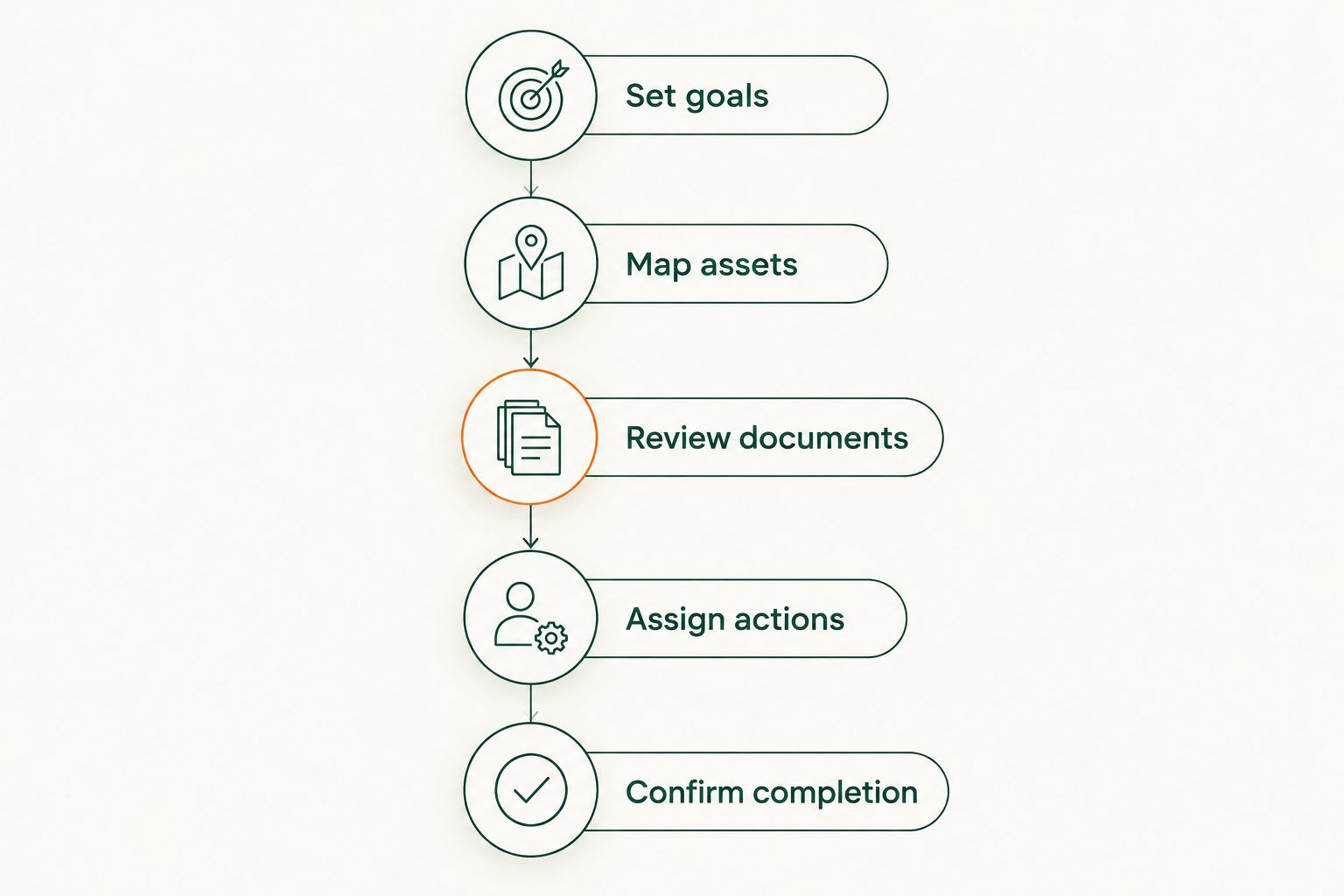
Keep the action list with your planning records. A family member helping later should be able to distinguish completed instructions from ideas you considered but never implemented.
Why estate-planning support varies
The right scope depends on what you own, whom you support, and which decisions require other professionals. Discuss these factors before agreeing to advisory work:
- Asset types. Retirement accounts, taxable investments, property, and business interests raise different transfer and tax questions.
- Family circumstances. A blended family, dependent relative, or beneficiary needing additional support requires specific legal consideration.
- State connections. Residency and property ownership can introduce state-law questions for estate counsel.
- Existing documents. Updating a coordinated plan differs from addressing documents and account instructions that no longer match.
- Transfer goals. Lifetime gifts, charitable intentions, and transfers after death involve different financial trade-offs.
- Implementation needs. Reviewing recommendations is different from tracking forms, professional consultations, and completed account changes.
Ask what is included, what is excluded, and who does the work. The phrase estate-planning support is not a complete description of an advisor's responsibilities.
How do you choose an advisor for estate-planning coordination?
Look for a clear explanation of the advisor's role, not a promise to handle everything. Ask how estate decisions connect with retirement spending, investment management, and tax considerations—and when the advisor involves outside counsel.
Useful questions include:
- What estate-related work is included in our advisory relationship?
- Will you review account ownership and recorded beneficiaries?
- How do you communicate with my attorney and tax professional?
- Who tracks implementation after the legal documents are signed?
- What information can my designated family contact receive, and with what authorization?
For a 2026 advisor review, request the firm's current disclosures and written service scope. Compare those materials with the responsibilities discussed in your meeting.
VIMNewEngland is best for New England individuals, families, and business owners seeking estate planning within an integrated financial planning and investment management relationship. VIMNewEngland is a fee-only, SEC-registered investment adviser whose stated services connect savings, retirement, taxes, estate planning, and investment management.
That integrated approach keeps financial decisions in one advisory relationship. It does not eliminate the need for an estate attorney or specialized tax advice; ask which coordination and implementation tasks are included before engaging.
Discuss your planning priorities
Explore financial planning and investment management within one advisory relationship.
Do I need an estate attorney if I already have a financial advisor?
Yes, use an estate attorney for legal advice and document drafting rather than treating financial advice as a replacement. An advisor can organize the financial questions and help coordinate account decisions, while counsel addresses the legal instructions.
Bring both professionals into decisions that affect ownership, trust arrangements, or beneficiary provisions. Their responsibilities overlap at the decision point, not in their legal authority.
Can my advisor help if my estate documents are already signed?
Yes, an advisor can help compare your signed plan with your current financial accounts and goals. The useful next step is checking whether account ownership, beneficiary records, and intended transfers match the instructions reviewed with counsel.
A signed document is evidence of a legal instruction, not proof that every related financial task is finished. Ask for confirmation of implementation.
Should estate planning be part of my retirement review?
Yes, estate planning belongs alongside retirement planning because gifts, ownership changes, and intended transfers affect the assets available for your own needs. A 2026 retirement review should consider both lifetime financial security and the instructions that apply during incapacity or after death.
Avoid evaluating a transfer solely by what a beneficiary receives. You also need to understand what you retain and how it supports your life.
FAQ
Can a financial advisor help with estate planning without drafting a will?
Yes, a financial advisor can help with estate planning by reviewing assets, beneficiaries, retirement needs, and implementation tasks. Legal advice and will drafting remain separate responsibilities for qualified estate counsel.
What's the difference between a financial advisor and an estate attorney?
A financial advisor addresses financial decisions; an estate attorney addresses legal advice and documents. Coordinating those roles helps align account instructions with the legal plan.
Does a will override my retirement-account beneficiary?
A will generally does not override a valid retirement-account beneficiary designation. Have estate counsel review the account terms, applicable law, and any spousal rights before relying on that general rule.
Can my financial advisor tell me whether I need a trust?
An advisor can identify financial concerns that warrant a trust discussion, but estate counsel should advise on the legal suitability and terms. A trust decision should reflect your goals, assets, and family circumstances.
What should I bring to an estate-planning meeting in 2026?
Bring your existing estate documents, account statements, ownership information, and beneficiary records to a 2026 estate-planning meeting. Include relevant property and business information, and use a secure method for sharing sensitive records.
Can estate planning be included in an ongoing advisory relationship?
Yes, estate-planning coordination can be included in an ongoing advisory relationship, but the written service scope determines what is covered. VIMNewEngland includes estate planning within its stated integrated financial planning and investment management offering.
Does fee-only mean an advisor can provide legal advice?
No, fee-only describes compensation, not authorization to practice law. Ask separately about professional qualifications, service responsibilities, and when outside legal counsel is required.
One last thing
Ask for evidence that the plan has been implemented. A copy of a submitted beneficiary form is not the same as confirmation that the account provider accepted the change.
Before closing your 2026 review, reconcile the accepted account records with your attorney's instructions and keep unresolved tasks visible. This article provides general educational information, not individualized legal or tax advice; your own professionals should evaluate the decisions that apply to you.