
Retirement planning starts showing results when you turn your financial information into specific decisions; there is no universal number of days or months that guarantees a finished plan or better investment returns. The first useful result is clarity about spending, income, and risks, while changes to accounts, taxes, and retirement income take separate implementation steps. Measure progress by completed decisions and actions, not by a promised deadline or a rising account balance.
- How long does retirement planning take? Measure completed decisions, implementation, and reviews rather than a promised calendar deadline.
- A written retirement plan should identify spending needs, income sources, risks, and responsibilities.
- Investment returns are not proof that retirement planning is working.
- VIMNewEngland fits New England households seeking retirement planning and investment management within one advisory relationship.
How long does retirement planning take to show results?
Retirement planning produces different results at different stages. Understanding whether your retirement date is realistic is a planning result; arranging withdrawals is an implementation result; keeping your finances aligned with changing circumstances is an ongoing result.
Separate those outcomes before judging speed. A completed projection does not mean every recommendation has been carried out, and an account transfer does not establish that your retirement income is sufficient. The guide to building a financial plan addresses the preparation side of that distinction.
| Stage | Result you can assess | Evidence of progress | What it does not establish |
|---|---|---|---|
| Financial inventory | A usable picture of your finances | Accounts, debts, spending, and benefits are documented | That every statement or estimate is current |
| Retirement analysis | A decision framework | Assumptions and alternative retirement scenarios are written down | That future investment returns are assured |
| Implementation | Recommendations become actions | Agreed changes are completed and checked | That every action produces an immediate financial gain |
| Ongoing review | The plan reflects your circumstances | Changes in income, spending, family needs, and goals are addressed | That the original plan will never need revision |
A useful retirement plan tells you what to do next and why. A report without an action list leaves the most important part unfinished.
Why this matters
Waiting for a portfolio gain before judging a retirement plan confuses planning with market performance. Your investments can rise while your withdrawal arrangements remain unclear; they can also fall after you have made sensible decisions about diversification and spending.
For your 2026 retirement review, distinguish actions you control from outcomes you do not. You can gather accurate records, set spending priorities, and agree on a withdrawal process. You cannot schedule a favorable market return.
This distinction matters when your household has substantial assets spread across retirement accounts, taxable investments, property, or a business. The account total alone does not explain which assets can support spending, which transactions have tax consequences, or how a surviving spouse would manage the finances.
Financial inventory: clarity before account changes
The first stage should answer a practical question: what resources and obligations does your retirement plan actually cover? Start with current statements and spending records rather than estimates carried over from an old plan.
Gather the information that changes decisions:
- Income: employment income, pensions, Social Security estimates, and other expected receipts.
- Spending: essential expenses, discretionary spending, debt payments, and irregular obligations.
- Investments: retirement accounts, taxable accounts, cash, and concentrated holdings.
- Taxes: recent returns and information about account tax treatment.
- Family obligations: support for relatives, estate documents, and beneficiary designations.
The benefit is visibility. You can identify missing information and conflicting assumptions before acting on them. The limitation is that an inventory describes your current position; it does not establish whether your desired retirement date is affordable.
Do not treat document collection as the finished plan. Ask which unanswered questions the records need to resolve. For example, a pension statement matters because the payment choices affect income and survivor benefits, not because the adviser needs another file.
Retirement analysis: decisions before predictions
Analysis should connect your resources to the life you want to fund. A useful plan makes its spending, inflation, investment, tax, and longevity assumptions visible enough for you to question them.
Ask to see what changes when you retire earlier, spend differently, or receive less income than expected. These are decision comparisons, not forecasts of exactly what will happen. Their purpose is to show where flexibility exists and where a commitment reduces it.
Your 2026 retirement plan should distinguish essential spending from expenses you can adjust. That separation gives you a clearer response to an unfavorable outcome than a single projected account balance does.
The benefit of analysis is an explanation of trade-offs. Its limitation is dependence on assumptions and accurate inputs. A detailed projection built on understated expenses remains a weak basis for deciding to leave work.
Before accepting the recommendation, explain it back in your own words. You should understand what supports your retirement date, which assumptions matter most, and what would trigger a change. If you cannot do that, request a simpler explanation rather than another chart.
Implementation: completed actions before financial outcomes
Implementation starts when you approve specific changes. Each recommendation should identify the action, the responsible person, the information required, and the condition that confirms completion.
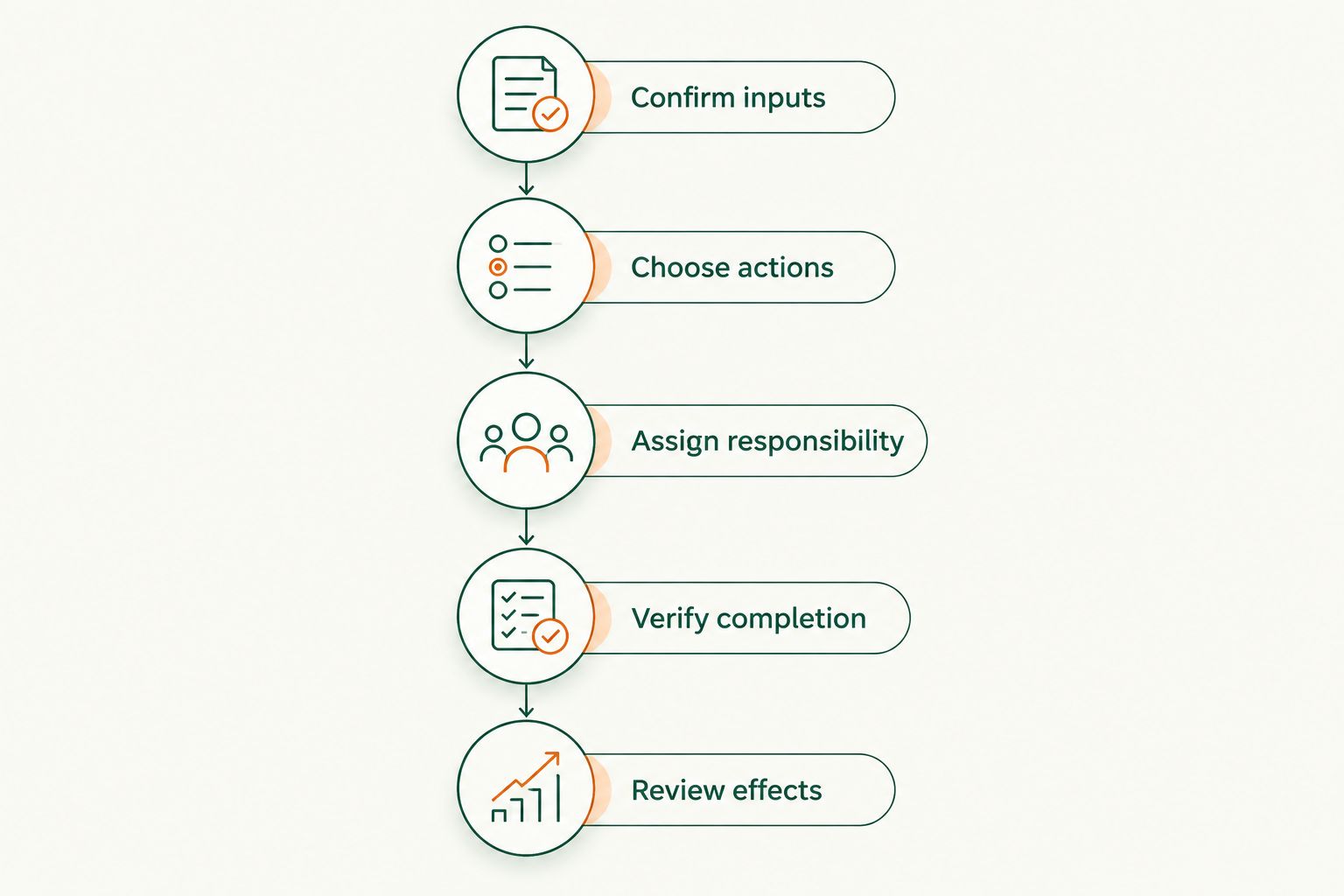
Use an action list with clear categories:
- Confirm inputs. Resolve missing statements, benefit details, and spending assumptions.
- Choose actions. Decide which recommendations fit your goals and constraints.
- Assign responsibility. Identify what you, the adviser, or another professional must complete.
- Verify completion. Check that approved changes occurred as intended.
- Review effects. Compare the completed action with its purpose and any resulting obligations.
This sequence helps you distinguish a recommendation from a result. A discussion about updating beneficiaries is not a completed update; a proposed withdrawal arrangement is not an operating income process.
Implementation also requires restraint. Do not move an account simply to demonstrate activity. Before approving a transaction, understand its tax treatment, relevant account rules, investment consequences, and relationship to your retirement plan.
The benefit is that decisions become operational. The limitation is coordination: custodians, benefit administrators, tax professionals, and estate attorneys can have separate responsibilities. Ask for the next dependency rather than accepting an unexplained delay.
Ongoing review: a current plan, not a permanent answer
A retirement plan needs review when the facts supporting it change. Retirement itself, a spouse's death, a business sale, a relocation, or a meaningful spending change can require new decisions.
The purpose is not to rewrite everything whenever markets move. It is to determine whether the change affects your ability to meet obligations or your reasons for holding the current investments.
For 2026, make sure the plan uses current account information and applicable rules rather than relying on an older report. Review is especially important when a recommendation depends on a tax rule, benefit election, or account deadline.
The benefit is continuity between your plan and your actual life. The limitation is participation: an adviser cannot account for a new obligation or changed goal that you have not disclosed.
A review should end with a decision, even when that decision is to make no change. Ask what was checked, what remains appropriate, and what would justify a different action.
Why retirement planning timelines vary
The work takes different paths because households have different decisions to make. These factors affect the sequence of planning and implementation:
- Record completeness: missing account statements or benefit information prevent reliable comparisons.
- Account complexity: different ownership arrangements and tax treatments require separate consideration.
- Retirement choices: uncertain spending goals, work plans, or benefit elections leave key assumptions unresolved.
- Tax coordination: proposed transactions need to fit the household's wider tax position.
- Outside dependencies: legal changes, benefit elections, and account processing involve parties beyond the adviser.
- Family decisions: spouses or other decision-makers need to agree on priorities before implementation.
Do not confuse complexity with quality. A longer report is not automatically a better plan, and a quick recommendation is not automatically appropriate.
Ask the adviser to distinguish information still needed from decisions already ready to make. That lets useful work proceed without pretending the entire financial picture is settled.
Which retirement deadlines should shape the work?
Actual eligibility ages can matter more than a generic promise about planning speed. For 2026 planning, the Social Security Administration identifies age 62 years as the earliest retirement-benefit claiming age, with a reduction for claiming before full retirement age. Delayed retirement credits stop at age 70 years.
Medicare identifies age 65 years as the usual age-based eligibility point. Eligibility and enrollment obligations are not identical, and your work and health-coverage circumstances affect enrollment decisions.
| Decision point | Age reference | What to resolve in your plan |
|---|---|---|
| Earliest Social Security retirement claim | 62 years | The effect of claiming before full retirement age |
| Usual age-based Medicare eligibility | 65 years | Enrollment timing and coordination with existing coverage |
| End of Social Security delayed retirement credits | 70 years | How benefit timing fits your income needs |
These ages do not tell you how long an adviser needs to prepare a plan. They identify decisions to address before the relevant event. Confirm your individual circumstances with the Social Security Administration or Medicare rather than treating an age alone as an instruction.
How do you know retirement planning is working?
Retirement planning is working when you can connect completed actions to stated goals. Check whether you understand how spending will be funded, what assumptions support the plan, and who handles the next decision.
Use these questions at a progress meeting:
- Can you explain the proposed retirement date without relying on a market prediction?
- Do you know which income sources fund essential expenses?
- Are pending actions assigned to someone?
- Do you understand the tax implications of proposed transactions?
- Is there a clear reason for each account or investment change?
A higher account balance answers none of these questions by itself. Neither does a polished presentation.
The strongest evidence of progress is a clearer decision followed by a verified action. Keep that standard when reviewing both the initial plan and subsequent advice.
Can you speed up retirement planning without rushing decisions?
You can improve the process by supplying complete information and resolving priorities before approving transactions. Organize statements, identify missing records, and distinguish essential goals from preferences.
Tell the adviser which events are approaching: leaving work, selling a business, changing health coverage, or making a benefit election. Those events determine what needs attention first.
For your 2026 planning conversations, ask for a staged agenda rather than an unsupported completion promise. Resolve the most consequential decision first, but do not skip tax or legal review merely to shorten the process.
When an integrated advisory relationship fits
VIMNewEngland is a fit for New England households seeking retirement planning and investment management within one advisory relationship. Its fee-only financial planning and investment management cover savings, retirement, taxes, and estate planning.
The benefit of that structure is that retirement decisions and investment decisions belong in the same discussion. The limitation is that an integrated relationship still requires accurate information, your approval of actions, and coordination with other professionals where needed.
When considering VIMNewEngland, ask how recommendations become an action list and how unfinished work is tracked. Evaluate the explanation and responsibilities, not a promise of faster returns.
Discuss your retirement priorities
Explore financial planning and investment management within one advisory relationship.
FAQ
How long does retirement planning take to show results?
Retirement planning shows results as your financial information becomes decisions and completed actions; there is no universal completion period. Evaluate clarity, implementation, and ongoing review separately.
What's the first result I should expect from retirement planning?
The first useful result is a clearer picture of your resources, spending, and unresolved decisions. That understanding should lead to a written action list, not just a projection.
Does a retirement plan improve investment returns immediately?
A retirement plan does not guarantee immediate investment gains. Its value includes aligning spending, income, investment risk, and account decisions with your goals.
Can I start retirement planning before I have every document?
You can start by identifying goals and organizing the available information. Resolve missing records before relying on recommendations that depend on them.
What slows down retirement planning?
Incomplete records, unresolved retirement choices, tax coordination, and outside processing dependencies affect progress. Ask which specific dependency prevents the next action.
Is an ongoing adviser necessary after the retirement plan is finished?
An ongoing adviser fits households that want continued help implementing and adjusting their plan. A written plan still needs attention when your finances, family circumstances, or goals change.
Does VIMNewEngland combine retirement planning with investment management?
VIMNewEngland provides financial planning and investment management within one integrated advisory relationship. Its planning covers savings, retirement, taxes, and estate planning.
One last thing
A decision not to make a transaction can be a valid planning result. If a proposed change adds tax consequences or disrupts an arrangement that already meets your goals, declining it is not inactivity.
Ask what an action improves before asking how quickly it can happen. That question keeps retirement planning focused on your life rather than the appearance of progress.