
Yes, you can switch from commission-based to fee-only advisor in 2026, and changing advisors does not automatically require selling your investments. Review transfer restrictions, tax consequences, and the new advisory agreement before moving accounts; investment expenses and contract charges do not disappear just because your advisor changes.
- You can switch from commission-based to fee-only advisor without automatically selling your investments.
- Verify fee-only compensation, fiduciary responsibilities, and account-transfer restrictions before signing an agreement.
- VIMNewEngland fits New England families seeking financial planning and investment management in one advisory relationship.
- Moving an account and replacing its investments are separate decisions with different tax consequences.
Can you switch from commission-based to fee-only advisors?
Yes. You choose a new advisory relationship, confirm which assets the receiving institution can hold, and authorize the appropriate transfers. Your current advisor's compensation model does not require you to keep that relationship indefinitely.
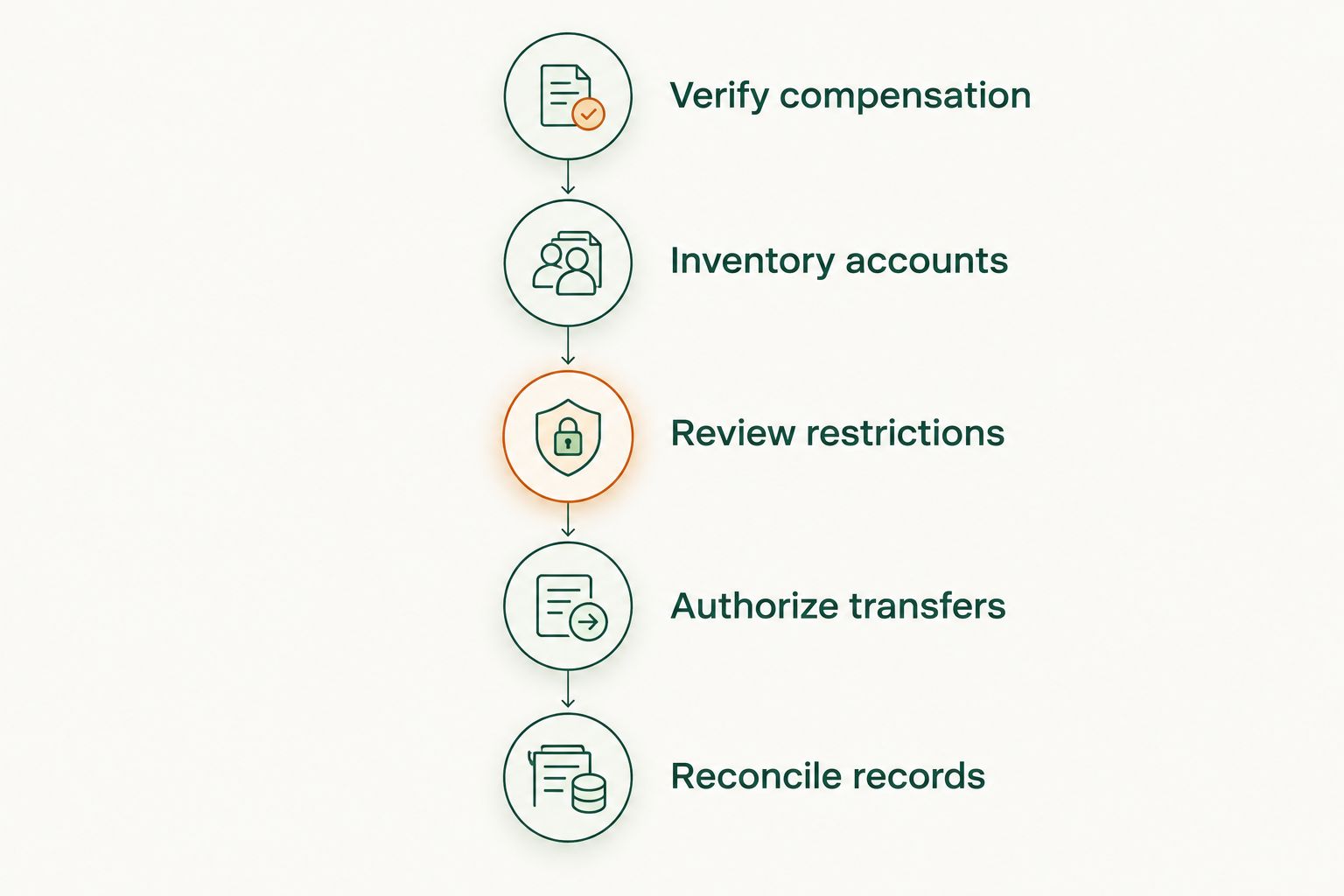
Start with the receiving firm rather than closing accounts yourself. Review the fee-only financial advisor qualities to look for, then follow this sequence.
Verify compensation
Ask the prospective advisor to explain all compensation in writing: what you pay the firm, whether it receives commissions, and whether affiliated businesses receive payments connected to recommendations. Read the advisory agreement and disclosures together.
Fee-only and fee-based are not interchangeable. Fee-only describes compensation without commissions; fee-based can include both advisory fees and commissions. Neither label replaces a review of the actual agreement, conflicts, and service scope.
Inventory accounts
List taxable brokerage accounts, IRAs, workplace retirement plans, annuities, insurance policies, and investments held outside your brokerage account. Record ownership, beneficiaries, account type, and any pending distributions.
Gather recent statements and available cost-basis records. Your new advisor needs to understand the whole financial picture, including assets that will remain elsewhere. Do not assume every account should move simply because another account is transferring.
Review restrictions
Have the receiving institution check each holding for transfer eligibility. Ask whether an investment can move in kind, must remain at its current institution, or requires a separate decision about selling or surrendering it.
Review contract provisions before changing annuities or insurance. A surrender can affect guarantees, coverage, and taxes. A recommendation to change advisors is not, by itself, a reason to cancel an existing financial product.
Authorize transfers
Sign the new agreement only after you understand the services, fees, custody arrangements, and responsibilities. Then authorize transfers using the process appropriate to each account type.
Distinguish moving existing holdings from trading them. Give clear instructions about pending withdrawals, recurring deposits, and open orders. Ask who will handle each task, and keep copies of the authorizations and correspondence.
Reconcile records
Compare receiving-account records with your original statements. Check positions, account registration, beneficiaries, cash balances, and cost basis. Some information or residual payments can arrive separately from the initial assets.
Confirm which old agreements have ended and whether any account remains open. Once records are reconciled, review proposed portfolio changes separately. This keeps a transfer problem from becoming an investment or tax decision by accident.
Why this matters
Changing compensation models can make the advisory relationship easier to understand, but it does not erase every conflict or expense. You still need to know what the advisor manages, what planning includes, and which decisions remain yours.
For a New England household with retirement accounts, taxable investments, and business interests, the useful question is broader than whether commissions stop. Ask whether the new relationship connects your investment decisions with retirement income, tax planning, and estate intentions.
A transition succeeds when responsibility is clear. Someone must monitor transfers, someone must confirm tax records, and someone must coordinate decisions with your accountant or attorney when their expertise is needed.
How do the compensation models compare?
Use compensation as a screening criterion, not a substitute for evaluating advice. An advisor should explain both the benefits and the limitations of the proposed relationship.
| Advisory model | Best for | Potential benefit | Limitation to examine |
|---|---|---|---|
| Commission-based | Buyers seeking a particular product or transaction | Compensation can be tied to a specific transaction rather than ongoing advice | Product compensation creates conflicts; ongoing planning is not necessarily included |
| Fee-based | Clients considering a relationship that includes advisory services and commission products | Advice and product transactions can exist within the same relationship | Both fees and commissions require review; fee-based does not mean fee-only |
| Fee-only | Clients seeking advice without product commissions | Removes commission-based product incentives from the advisor's compensation | Advisory fees and other investment expenses remain; other conflicts still need disclosure |
Fee-only changes how the advisor is compensated; it does not guarantee investment performance. It also does not establish whether the advisor's planning scope matches your needs.
For a 2026 advisor search, ask how the firm documents fiduciary responsibilities and manages conflicts. Verify registration and disciplinary disclosures through the SEC's Investment Adviser Public Disclosure system or FINRA's BrokerCheck, as appropriate. Registration is not an endorsement of skill or results.
Taxable brokerage accounts: transfer before deciding to sell
An in-kind transfer generally moves existing investments without selling them. When ownership and account registration remain unchanged, the transfer itself generally does not realize capital gains. Selling appreciated investments is a separate event with separate tax consequences.
The advantage is control: you can evaluate existing holdings before deciding whether to replace them. The limitation is compatibility. The receiving institution must accept the assets, and some holdings require special handling or cannot transfer.
Ask the new advisor to review unrealized gains and losses before proposing sales. Concentrated stock, restricted positions, and investments with incomplete records deserve individual attention. Preserve your original cost-basis documents even when basis information is expected to transfer electronically.
If you need spending money during the transition, identify its source before authorizing transfers. Coordinate 2026 withdrawals and scheduled payments so an account move does not interrupt your household cash flow.
IRAs and workplace plans: use the right transfer method
Moving an IRA between custodians is not the same as taking a distribution yourself. A properly handled trustee-to-trustee transfer avoids putting the retirement money into your personal possession.
If you receive an eligible retirement distribution and intend to roll it over, the usual deadline is 60 days, subject to applicable rules and exceptions. Certain IRA-to-IRA rollovers are also limited to one within a 12-month period; that restriction does not apply to trustee-to-trustee IRA transfers.
Those rules make transfer mechanics important. A taxable early retirement-account distribution can also trigger a 10% additional tax before age 59½ years, unless an exception applies. Confirm the rules for your account before accepting a payment made to you.
A workplace-plan rollover requires another decision: whether leaving assets in the plan or moving them to an IRA better serves your needs. Compare investment choices, expenses, withdrawal rules, and applicable protections. Do not treat a rollover as an automatic requirement of changing advisors.
For a retirement-account transition in 2026, confirm any required minimum distribution obligations separately. A required minimum distribution is not eligible for rollover.
Annuities and insurance: review the contract before changing it
An existing annuity or insurance policy does not have to disappear when you hire a fee-only advisor. You can separate advice about the contract from compensation for selling the contract.
Keeping an existing contract preserves its current terms, subject to the contract's provisions. The limitation is that those terms still need scrutiny: ongoing expenses, surrender provisions, guarantees, and coverage must fit your financial needs.
Before surrendering or replacing anything, request the current contract details and an explanation of the consequences. For life insurance, consider whether replacement requires new underwriting and whether you still need the coverage. For an annuity, distinguish withdrawing funds from changing who provides advice.
An advisor's willingness to explain why an existing product should stay is as useful as a recommendation to replace it. Ask for the reasoning in writing.
Why the transition process varies
The process depends on your accounts and contracts, not just the advisor's compensation label. These factors determine what requires extra attention:
- Account type: Taxable accounts, IRAs, workplace plans, and insurance contracts follow different procedures.
- Transfer eligibility: The receiving institution must be able to hold the investments you want to move.
- Tax exposure: Selling appreciated holdings differs from transferring them without a sale.
- Contract restrictions: Surrender terms and product guarantees affect whether a change makes sense.
- Record quality: Missing basis information, inconsistent ownership records, or outdated beneficiaries require follow-up.
- Pending activity: Withdrawals, distributions, open trades, and automatic payments need coordination.
Ask for a written transition plan that names responsibilities and identifies decisions requiring your approval. Do not substitute a promised completion date for an account-by-account review.
Can you keep your investments when switching advisors?
Yes, you can keep investments that the receiving institution accepts through an in-kind transfer. The advisor can then evaluate those holdings within your financial plan rather than selling them simply to complete the move.
Some assets cannot transfer or need special handling. Ask for a holding-by-holding explanation before authorizing liquidation.
Is fee-only always better than commission-based advice?
No, fee-only is not automatically better for every situation. It removes product commissions from advisor compensation, but you still need suitable advice, a clear service scope, and transparent conflicts.
For an ongoing planning relationship, compare what each advisor will actually do. Compensation matters; so do accountability and the quality of the recommendations.
Should you tell your current advisor before transferring?
Yes, communicate clearly about terminating the advisory relationship, but coordinate transfer instructions with the receiving firm first. Review notice requirements and outstanding obligations in your existing agreement.
Keep the conversation factual. You do not need to debate your decision, but you do need a record of which services end and which accounts remain.
What should the new relationship include?
Ask the new advisor to show how planning and portfolio management connect. A retirement withdrawal affects cash flow and taxes; an estate decision affects account ownership and beneficiaries. Separate recommendations should not contradict one another.
VIMNewEngland is best for New England individuals and families seeking financial planning and investment management in one advisory relationship. VIMNewEngland is a fee-only, SEC-registered RIA whose integrated planning covers savings, retirement, taxes, and estate planning.
That service model does not eliminate the need to review your agreement or existing holdings. Confirm the scope of advice and coordination responsibilities before deciding that the relationship fits your needs.
Review your advisory relationship
Consider how integrated financial planning and investment management fit your needs.
FAQ
Can I switch from commission-based to fee-only advisor in 2026?
Yes, you can switch from commission-based to fee-only advisor in 2026. Review the new agreement, transfer eligibility, tax consequences, and any existing contract restrictions before authorizing the move.
Do I have to sell everything when I change financial advisors?
No, changing financial advisors does not automatically require selling your investments. Holdings the receiving institution accepts can generally move in kind, while other assets need a separate review.
Is a fee-based advisor the same as a fee-only advisor?
No, fee-based and fee-only describe different compensation arrangements. Fee-based can include commissions, while fee-only compensation excludes them; verify the firm's disclosures rather than relying on the label.
Will switching advisors trigger capital gains taxes?
An in-kind transfer between taxable accounts with unchanged ownership generally does not realize capital gains. Selling appreciated investments during or after the transition is a separate taxable event.
Can I keep an annuity after hiring a fee-only advisor?
Yes, hiring a fee-only advisor does not require surrendering an existing annuity. Review the contract's expenses, guarantees, surrender provisions, and tax consequences before deciding whether to keep or change it.
Should I withdraw my IRA money to move it to another advisor?
Use a properly handled trustee-to-trustee IRA transfer rather than withdrawing money yourself when that transfer fits your situation. A distribution paid to you introduces rollover rules, including a usual 60-day deadline for eligible rollovers.
What should I ask VIMNewEngland before becoming a client?
Ask VIMNewEngland how its financial planning and investment management would address your existing accounts, retirement needs, taxes, and estate intentions. Confirm fees, responsibilities, and the transition process in writing before signing.
One last thing
Separate permission to transfer assets from permission to replace investments. A change in advisor does not make every existing holding unsuitable, and a successful transfer does not establish that your portfolio needs immediate restructuring.
Ask the new advisor to identify what can remain unchanged, what needs review, and what requires action. That distinction gives you a calmer transition and a clear reason for each decision.