
Retirement planning costs depend on the advisor’s fee structure, the work included, and whether you want a one-time plan or ongoing management in 2026. The planning fee is not necessarily your total cost: investment expenses, account charges, and separately billed tax or legal work can sit outside the advisory agreement. Compare written scope and total expenses, not the planning fee alone.
- How much does retirement planning cost? Compare the engagement’s scope, fee calculation, and separate investment expenses.
- VIMNewEngland fits New England households seeking retirement planning and investment management in one advisory relationship.
- A one-time retirement plan provides recommendations; ongoing advice adds review and implementation support as agreed.
- Fee-only describes compensation, not which services an advisory agreement includes.
Why this matters
A retirement plan and an ongoing advisory relationship are different purchases. A written projection helps you evaluate retirement readiness; ongoing advice addresses decisions as spending, investments, taxes, and family circumstances change.
Before comparing proposals, identify the decisions you want help making. The fiduciary financial advisor qualities to look for are a useful starting point for evaluating responsibility and fit alongside the fee.
For a New England household with retirement accounts, taxable investments, and property, the central question is whether the advice connects those pieces. Paying for an isolated projection does not establish who will manage withdrawals, revisit assumptions, or coordinate with your accountant.
How much does retirement planning cost?
The cost is the agreed planning or advisory fee plus any separate expenses associated with implementation. In 2026, a useful comparison starts with the engagement agreement: what you receive, how the fee is calculated, and which services require another professional.
Retirement advisors use different billing arrangements. The table below compares the arrangements themselves, not any particular firm’s offerings.
| Arrangement | Best for | What the fee covers, as agreed | Main advantage | Main limitation |
|---|---|---|---|---|
| Hourly advice | A defined retirement question | Advisor time spent on the requested work | You can keep the assignment narrow | Total work depends on the time required |
| Project planning | A written retirement roadmap | A defined planning assignment | Deliverables can be specified before work begins | Later updates and implementation need explicit agreement |
| Recurring planning | Households seeking continuing advice | An ongoing planning relationship | Advice can address changing circumstances | Investment management is not automatically included |
| Asset-based management | Households seeking portfolio management with advice | Management of covered assets and any included planning | Investment decisions and planning can share one relationship | The fee changes with covered assets under the agreement |
Do not compare these arrangements as though each delivers the same result. An hourly answer about a pension election is not equivalent to a retirement income plan with continuing investment management.
For every proposal, separate the advisory charge from investment and account expenses. Then identify outside work, such as tax-return preparation or drafting estate documents. Advice about those topics does not automatically include performing that work.
Hourly advice: best for a defined question
Hourly advice fits a bounded decision: reviewing a retirement projection, assessing a pension choice, or discussing an account withdrawal. Ask the advisor to define the assignment before starting.
The advantage is focus. You are purchasing time directed at a particular issue rather than assuming you need a continuing relationship.
The limitation is that a narrow question can depend on a wider financial picture. A withdrawal decision, for example, requires attention to income, taxes, available accounts, and future spending. Ask how preparation, document review, meetings, and follow-up affect the billed work.
Choose hourly advice when you can define the question and handle the agreed next steps yourself. If you need someone to connect several decisions and oversee execution, compare a broader engagement instead.
Project planning: best for a written roadmap
Project planning fits a household that wants a defined retirement assessment and recommendations. The agreement should identify the deliverables, assumptions, meetings, and revisions included.
Its strength is a clear assignment. You can request written answers about retirement timing, spending, income sources, investment allocation, and withdrawal sequencing without assuming the advisor will manage your accounts.
Its limitation is the handoff. A plan does not implement itself, and a completed projection does not remain current after every financial change. Establish who handles account changes, checks execution, and revisits the plan.
Choose project planning when you want a roadmap and have a clear implementation owner. Ask what happens after delivery before treating the assignment as a complete retirement solution.
Recurring planning: best for continuing decisions
Recurring planning fits households that want advice as their circumstances change. The agreement should explain the review schedule, access to the advisor, and subjects included.
Its strength is continuity. Retirement decisions unfold over time: you establish income, adjust spending, respond to family needs, and revisit taxes rather than resolving everything in an initial meeting.
Its limitation is that continuing planning does not necessarily include portfolio management. You still need to know who places trades, manages cash, and carries out account-level instructions.
Choose recurring planning when continuing advice is the need, and verify responsibility for execution. Ask how additional assignments are handled and whether the arrangement has boundaries around tax or estate work.
Asset-based management: best for investment oversight
Asset-based management ties the advisory fee to assets covered by the agreement. Retirement planning belongs in that relationship only when the firm’s scope includes it; the billing method alone does not establish the service.
The advantage is coordination when the advisor provides both planning and investment management. Your portfolio decisions can reflect the spending and income needs established in the plan.
The limitation is that covered assets determine the fee calculation rather than simply the hours of planning work. Ask which accounts count, how assets are valued, how billing works, and how deposits or withdrawals affect the calculation.
Choose integrated management when you want retirement advice connected to portfolio decisions. Evaluate the actual planning deliverables rather than assuming a managed account includes them.
Why retirement planning costs vary
The work required changes with your financial situation and the engagement you choose. These factors help explain differences between proposals:
- Scope of advice. A retirement-readiness assessment is different from an assignment covering investments, taxes, savings, and estate coordination.
- Implementation responsibility. Recommendations alone differ from ongoing account management and follow-through.
- Continuing reviews. A completed project and a continuing advisory relationship create different obligations.
- Account coverage. Ask whether the advisor considers all relevant accounts or only those included in management.
- Professional coordination. Meetings and information exchange with your accountant or estate attorney require a defined role.
- Household complexity. Business ownership, equity compensation, property, and family wealth-transfer goals add decisions to the planning work.
In 2026, compare proposals against the same list of needs. A smaller assignment is not a better-value substitute if it leaves your central retirement question unanswered.
How do I compare retirement planning proposals?
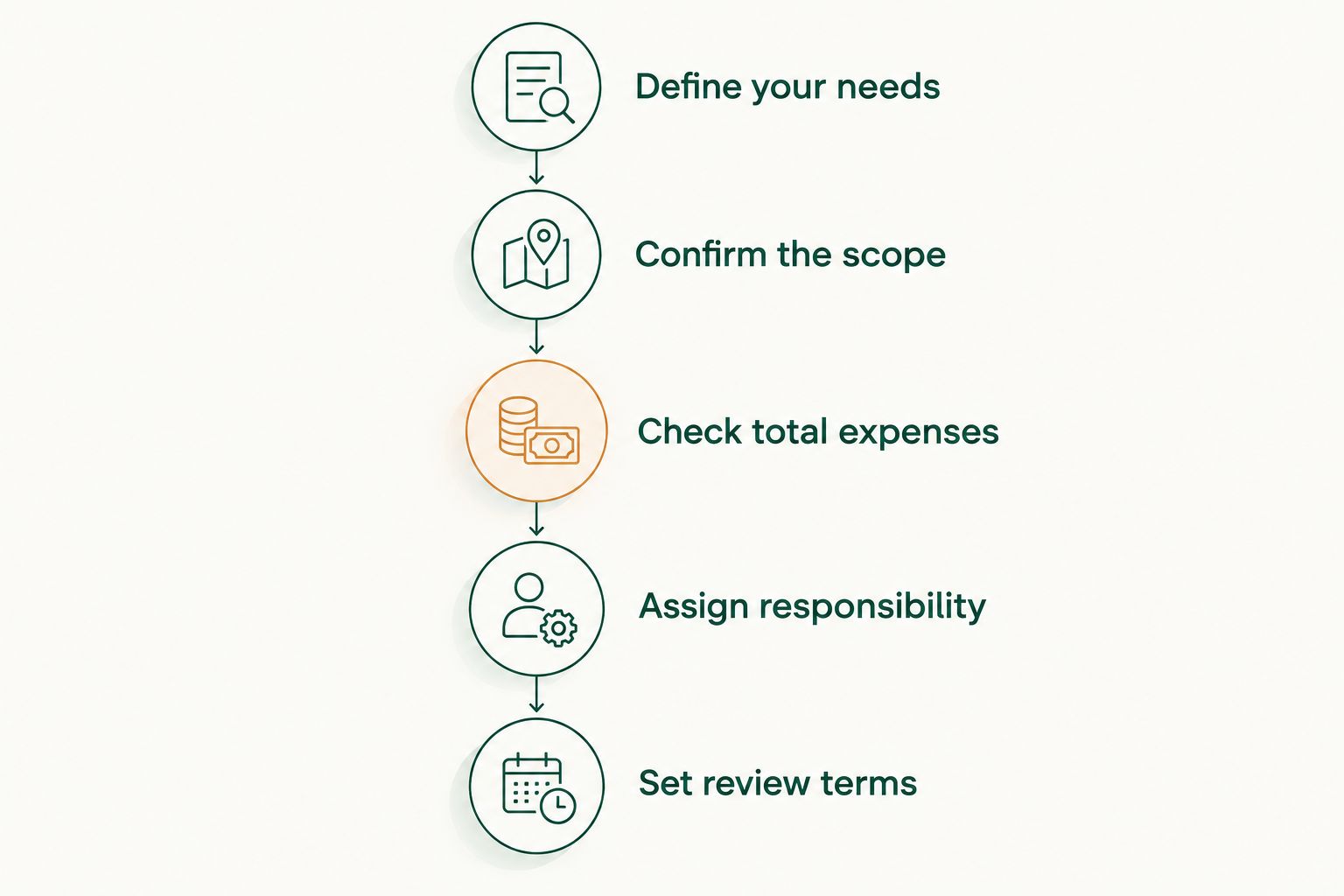
Compare the work first, then the billing method. Use the same questions with each advisor so differences remain visible rather than disappearing into broad service descriptions.
- Define your needs. Write down the decisions you need to make: retirement timing, spending, income, investments, taxes, and family obligations.
- Confirm the scope. Request written deliverables and identify what is outside the engagement.
- Check total expenses. Review the advisory fee calculation, investment expenses, account charges, and separately billed professional work.
- Assign responsibility. Establish who implements recommendations and who verifies completion.
- Set review terms. Clarify how updates, additional questions, and ending the relationship work.
Keep the answers in writing. A service description such as retirement planning is too broad to establish whether you receive a projection, a withdrawal strategy, continuing reviews, or account management.
For 2026 proposals, also ask how the advisor handles assumptions. Your spending, retirement date, income sources, and investment expectations should be visible enough for you to question them. A detailed report is not useful if you cannot identify the decisions it supports.
What does fee-only tell me about retirement planning costs?
Fee-only describes how an advisor receives compensation: from client fees rather than product commissions. It does not specify the fee amount, the billing arrangement, or the work included.
That distinction matters when you compare advisors. A fee-only project planner and a fee-only investment manager can have different assignments and different responsibilities.
Ask for the advisor’s Form ADV disclosures and the proposed agreement. Read the sections addressing compensation, services, conflicts, and termination rather than relying on the label alone.
Fee-only is a compensation distinction, not a guarantee of results or a substitute for reviewing scope. You still need a clear explanation of what you are buying and how the advisor handles decisions affecting your retirement.
Is ongoing retirement planning worth paying for?
Ongoing retirement planning fits households with continuing decisions that need coordination. The value question is whether the advisor performs work you need and provides an accountable process for carrying it out.
Consider a household moving from earnings to portfolio withdrawals. Retirement planning connects spending, income sources, investment management, and taxes; treating each as a separate task leaves you responsible for reconciling the answers.
VIMNewEngland is best for New England households seeking integrated retirement planning and investment management. Its fee-only advisory relationship covers savings, retirement, taxes, and estate planning alongside investment management. The trade-off is scope fit: evaluate an integrated relationship against your needs rather than treating it as interchangeable with a narrow, one-time assignment.
You can review VIMNewEngland to consider that integrated approach. Confirm the proposed services and agreement before deciding whether the relationship matches your retirement responsibilities.
Review your retirement planning needs
Consider an integrated relationship for financial planning and investment management.
Which retirement milestones should my plan address?
Your retirement plan should connect financial decisions to the rules governing income and benefits. In 2026, important milestones include Social Security retirement benefits starting as early as age 62, Medicare eligibility generally beginning at age 65, and Social Security delayed retirement credits ending at age 70.
Those are separate milestones, not instructions to retire or claim benefits at a particular age. Social Security claiming affects your benefit, while Medicare enrollment requires attention to coverage and enrollment rules.
Ask the advisor to explain how the proposed work addresses your actual timeline. Planning fees should be evaluated against the decisions covered, not against a report’s page count or the number of charts it contains.
FAQ
How much does retirement planning cost in 2026?
Retirement planning costs depend on the engagement’s scope and billing arrangement. Compare the advisory fee calculation, separate expenses, and implementation responsibilities in writing rather than treating different services as equivalent.
Is retirement planning included in investment management?
Retirement planning is included only when the advisory agreement says it is. Ask which planning deliverables and continuing reviews accompany portfolio management.
Is a one-time retirement plan enough?
A one-time retirement plan fits a defined assessment when you have someone responsible for implementation. Continuing decisions and changing circumstances require a clear process for updating the plan.
Does fee-only mean every service is included?
Fee-only does not mean every service is included. It describes compensation from client fees rather than product commissions; the agreement establishes services and separate charges.
What extra expenses should I ask a retirement advisor about?
Ask about investment expenses, account charges, and separately billed tax or legal work. Confirm which apply to your situation and which sit outside the advisory fee.
Who is VIMNewEngland’s retirement planning approach best for?
VIMNewEngland’s retirement planning approach fits New England households seeking financial planning and investment management in one advisory relationship. Review the proposed scope to confirm that it addresses your household’s decisions.
What should I request before hiring a retirement advisor?
Request written scope, fee disclosures, implementation responsibilities, and review terms before hiring a retirement advisor. Read the proposed agreement alongside the advisor’s Form ADV disclosures.
One last thing
Ask a prospective advisor to explain what happens after you accept a recommendation. Who changes the account, who coordinates with your accountant, and who checks that the work is finished?
That answer reveals the difference between receiving advice and having an accountable process. For your 2026 retirement planning decision, choose a clearly defined relationship, not an undefined promise of a plan.