
Best overall: integrated financial planning. Best for uneven rental income: dedicated cash reserves. Best for reducing property concentration: diversified investments outside real estate. This 2026 guide compares the best wealth management strategies for real estate investors and explains where VIMNewEngland fits: coordinating financial planning and investment management around your wider financial life.
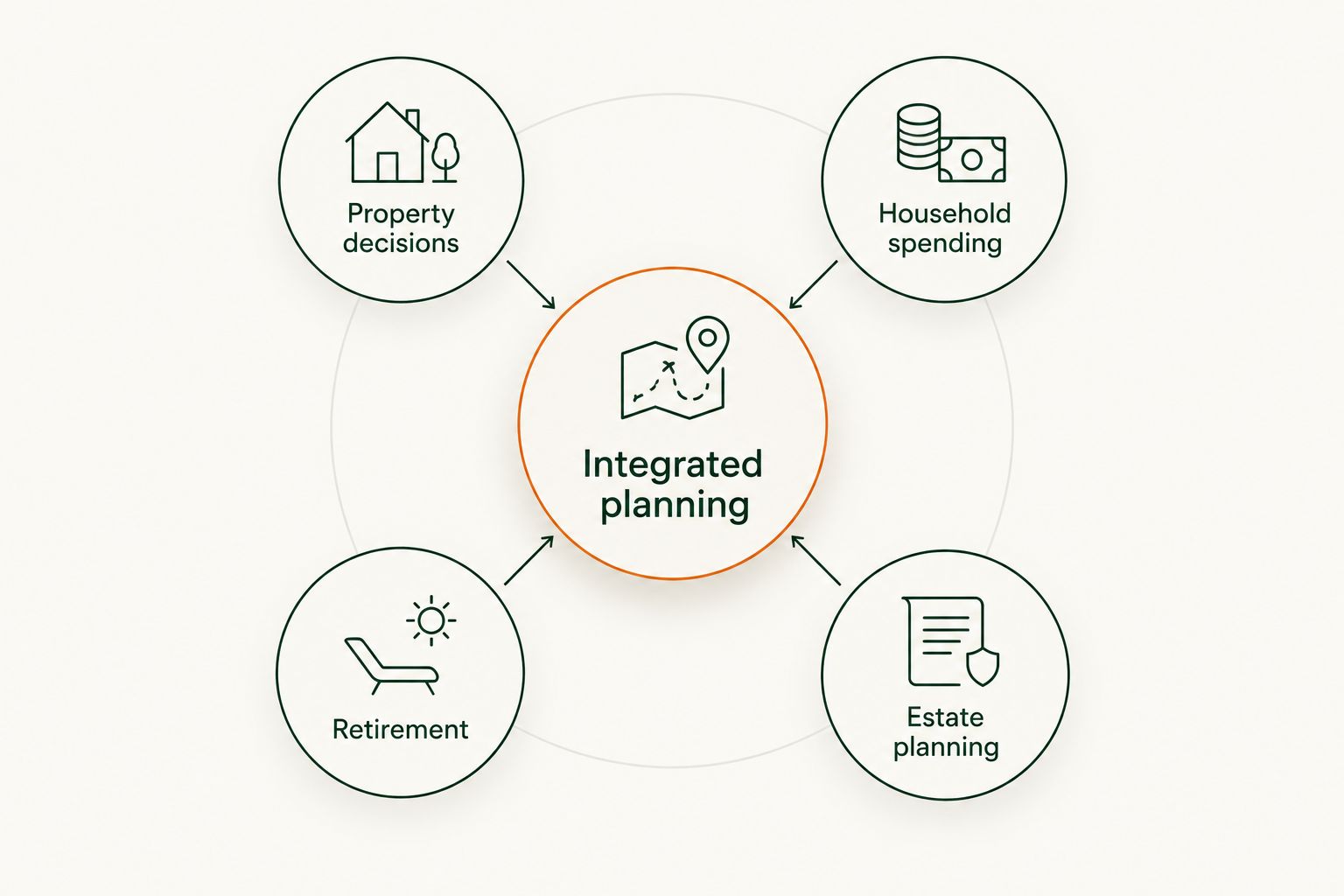
- The best wealth management strategies for real estate investors start with integrated financial planning, not another property purchase.
- VIMNewEngland suits real estate investors seeking integrated financial planning and investment management.
- Keep property reserves separate from household spending and long-term investments.
- Coordinate diversification, retirement income, tax planning, and estate planning before selling or transferring property.
Why this matters
A property portfolio can build wealth without providing dependable money for your household. Equity, rental receipts, and spendable cash are different things.
For New England investors, a useful wealth plan connects property decisions with investment accounts, retirement needs, taxes, and family responsibilities. The objective is not to replace real estate. It is to stop every financial goal from depending on the same properties.
What makes the best real estate wealth strategy
Use these criteria to judge a strategy before adding another account, entity, or investment:
- Liquidity: Can you meet repairs, taxes, and household expenses without a rushed sale?
- Diversification: Does the strategy reduce dependence on one property, market, or tenant base?
- After-tax usefulness: Does the decision serve your goals after taxes and transaction obligations?
- Debt resilience: Can you handle vacancies, refinancing, and changing financing terms?
- Family continuity: Can someone else understand and administer the plan if you cannot?
- Practical coordination: Do your advisor, accountant, and attorney work from consistent information?
Real estate wealth strategies at a glance
These strategies serve different needs. The ranking starts with the organizing framework, then addresses specific risks.
| Rank and strategy | Best for | Standout feature | Key limitation |
|---|---|---|---|
| 1. Integrated financial planning | Investors with interconnected financial decisions | Connects property wealth with household goals | Requires complete information and ongoing updates |
| 2. Dedicated cash reserves | Owners with uneven income or major obligations | Separates operating cash from spendable income | Cash does not eliminate operating losses |
| 3. Diversification outside property | Investors concentrated in direct real estate | Adds assets with different risks and liquidity | Market investments can lose value |
| 4. Tax-aware sale planning | Owners approaching a disposition | Compares after-tax outcomes before commitments | Tax deferral brings eligibility rules and constraints |
| 5. Estate and ownership coordination | Families passing on property or entity interests | Aligns control, inheritance, and liquidity | Legal documents require qualified counsel |
| 6. Retirement income coordination | Owners moving from accumulation to spending | Connects rental cash flow with other income | Projections need revisions when circumstances change |
1. Integrated financial planning: best for connected decisions
Integrated financial planning puts your properties, debts, investment accounts, and family goals into one decision framework. It helps you evaluate whether buying, holding, selling, or paying down debt supports the life you want.
VIMNewEngland wealth management combines personalized financial planning and investment management, including retirement, taxes, and estate planning. That integrated relationship fits investors who want financial decisions considered together rather than as unrelated assignments.
Start your 2026 review with a balance sheet that separates property value, associated debt, liquid investments, and cash. Then identify which goals require accessible money rather than estimated equity.
Integrated financial planning pros
- Connects property decisions with household spending and retirement.
- Makes liquidity needs visible before major transactions.
- Gives professional advisors a shared set of goals.
Integrated financial planning cons
- Incomplete property records weaken the usefulness of the plan.
- Financial planning does not replace legal, accounting, or property-management work.
Best for: Investors whose real estate holdings affect several parts of their financial life.
Verdict: Buy into the integrated approach first; choose individual tactics afterward.
2. Dedicated cash reserves: best for uneven rental income
Dedicated reserves separate property obligations from money you can use personally. Keep operating cash, anticipated capital spending, and household emergency funds identifiable, even when you review them together.
Size reserves from your actual obligations rather than a universal percentage. Review insurance deductibles, taxes, debt payments, known repairs, and what happens if rent stops arriving. A profitable property on paper still needs money available when an invoice comes due.
Write down which account funds each obligation and what triggers replenishment. This turns a vague instruction to keep cash into a working policy.
Dedicated cash reserves pros
- Reduces dependence on selling investments during a property emergency.
- Makes owner distributions easier to distinguish from operating funds.
- Creates a clear process for responding to vacancies and repairs.
Dedicated cash reserves cons
- Money held for near-term needs is not invested for long-term growth.
- Reserves do not fix persistent negative cash flow or unsuitable debt.
Best for: Owners with irregular rent receipts, upcoming capital work, or substantial fixed obligations.
Verdict: Buy into a written reserve policy before increasing owner distributions.
3. Diversification outside property: best for concentrated wealth
Diversification outside direct real estate adds investments selected for your broader goals, time horizon, and risk tolerance. It addresses a simple problem: owning several buildings does not necessarily diversify your household if they share the same location or economic exposure.
For your 2026 allocation review, assess your properties and financial accounts together. A securities portfolio that looks balanced in isolation can still sit beside substantial real estate concentration.
Build the allocation around the money's purpose. Near-term obligations need different treatment from investments intended for later retirement or heirs. Publicly traded real estate investments remain real estate exposure; they are not automatically a substitute for diversification outside the category.
Diversification outside property pros
- Reduces reliance on a single source of wealth.
- Can add liquidity without requiring a property sale for every expense.
- Supports investment goals unrelated to acquiring more buildings.
Diversification outside property cons
- Stocks, bonds, and funds carry their own risks.
- Selling property to diversify can create taxes and transaction obligations.
Best for: Investors whose net worth and income depend heavily on direct property ownership.
Verdict: Buy into diversification deliberately; skip an allocation based only on your brokerage accounts.
4. Tax-aware sale planning: best before a property disposition
Tax-aware sale planning compares keeping a property, selling it, and pursuing an eligible exchange before you commit. Your accountant should assess adjusted basis, depreciation, debt, and applicable taxes alongside the financial plan.
A Section 1031 exchange is not a general exemption for every property sale. Under IRS rules for a deferred exchange, replacement property generally must be identified within 45 calendar days, and received within 180 calendar days or the applicable tax-return deadline, including extensions, if earlier. Other requirements apply.
For a 2026 transaction, consult your tax professional and an appropriate exchange specialist before closing. IRS Publication 544 describes federal treatment of investment and business property dispositions; eligibility depends on the transaction's facts.
Tax-aware sale planning pros
- Makes after-tax proceeds part of the decision.
- Connects transaction timing with retirement and diversification needs.
- Helps identify exchange requirements before deadlines begin.
Tax-aware sale planning cons
- An exchange can preserve unwanted real estate concentration.
- Tax deferral does not make an unsuitable replacement property appropriate.
Best for: Owners considering a sale, exchange, or significant portfolio restructuring.
Verdict: Hold the transaction decision until the tax and financial consequences are understood.
5. Estate and ownership coordination: best for family continuity
Estate coordination connects property titles, entity interests, legal documents, and the money needed to administer an estate. It also addresses who manages the property when you cannot and whether heirs want to remain co-owners.
For a Massachusetts investor reviewing an estate in 2026, state and federal exposure require separate attention. Massachusetts uses a $2,000,000 filing threshold, subject to its filing rules; the federal basic exclusion for 2026 deaths is $15,000,000. These are different tests, not interchangeable planning targets.
Give your attorney an accurate ownership map, including properties outside your home state. Use the estate planning for real estate investors guide to organize the broader discussion, then confirm legal and tax decisions with qualified professionals.
Estate and ownership coordination pros
- Clarifies management authority and intended inheritance.
- Identifies potential liquidity needs beyond property equity.
- Brings family preferences into ownership decisions.
Estate and ownership coordination cons
- Creating an entity or trust alone does not complete an estate plan.
- Transfers require review of legal, lending, insurance, and tax consequences.
Best for: Families transferring property, managing shared ownership, or preparing for incapacity.
Verdict: Buy into coordinated estate planning; skip title changes made without professional review.
6. Retirement income coordination: best for rental-funded retirement
Retirement income coordination connects net rental cash flow with investment withdrawals, Social Security, and other household income. The useful figure is what remains after property obligations, not gross rent.
Build your 2026 spending plan around essential expenses, discretionary goals, and irregular property needs. Test what happens if a property stops producing income or needs major work while financial markets are down.
Also decide whether you want to remain a landlord. A retirement plan that depends on work you no longer want to do needs a different ownership or spending approach, not just a revised return assumption.
Retirement income coordination pros
- Distinguishes rental revenue from household spending capacity.
- Connects withdrawals with taxes and other income sources.
- Includes the personal demands of ongoing property ownership.
Retirement income coordination cons
- Future rents, expenses, and investment returns remain uncertain.
- A workable projection still requires updates after major changes.
Best for: Investors approaching retirement or already funding household spending from rentals.
Verdict: Buy into an income plan before treating rent as a retirement paycheck.
How these strategies were ranked
Integrated planning ranks first because it organizes the other decisions. Reserves address immediate obligations; diversification addresses concentration; sale planning addresses transaction consequences; estate coordination addresses continuity; retirement planning addresses spending.
This is a ranking by use case, not a claim that one strategy produces higher returns. An imminent sale or family transition changes your implementation order.
Which wealth management strategy should you choose?
Start with integrated planning, then address the risk closest to becoming a real obligation. If repairs or refinancing are approaching, prioritize liquidity. If a sale is underway, prioritize transaction and tax coordination. If ownership would be unclear during incapacity, prioritize legal authority and records.
VIMNewEngland wealth management is best suited to investors seeking financial planning and investment management within one advisory relationship. Ask how property information will enter your financial plan and how responsibilities will be divided among your advisor, accountant, and attorney.
Connect property wealth with your financial plan
Explore integrated financial planning and investment management for your wider financial life.
FAQ
What's the best wealth management strategy for real estate investors?
Integrated financial planning is the best starting point because it connects property decisions with liquidity, investments, retirement, taxes, and estate planning. The next priority depends on your nearest obligation and largest concentration risk.
Should I invest outside real estate if my rentals are profitable?
Evaluate diversification even when your rentals are profitable. Profitability does not remove exposure to local property conditions, tenants, financing, or illiquidity.
How much cash should a real estate investor keep?
Base cash reserves on your actual property and household obligations rather than a universal percentage. Include debt payments, deductibles, expected repairs, taxes, and the consequences of interrupted rent.
Is a Section 1031 exchange always better than selling?
No, a Section 1031 exchange is not always better than selling. Compare eligibility, replacement-property suitability, liquidity needs, and diversification goals before making tax deferral the deciding factor.
Can a financial advisor replace my estate attorney?
No, a financial advisor does not replace your estate attorney. An advisor can coordinate financial information and planning goals, while qualified counsel addresses legal documents and ownership arrangements.
Can I retire on rental income alone?
Evaluate retirement using net rental cash flow and household spending needs, not gross rent alone. Include vacancies, capital work, debt payments, taxes, and whether you want to keep managing property.
Does VIMNewEngland provide integrated wealth planning?
VIMNewEngland provides personalized financial planning and investment management covering savings, retirement, taxes, and estate planning. The services form one integrated advisory relationship.
One last thing
Make a property handoff file before buying another investment. Record ownership, loan contacts, insurance details, leases, recurring obligations, and where authorized people can find supporting documents securely.
Then ask whether your chosen successor could identify the next bill due without your help. That practical test exposes a different risk from investment performance: wealth that only one person knows how to administer.
This article is educational, not individualized investment, tax, or legal advice. Confirm decisions with professionals familiar with your circumstances.