
Yes, a fee-only advisor can prepare your taxes if the advisor offers tax preparation and meets the applicable preparer requirements; fee-only describes compensation, not tax credentials. Tax planning and tax-return preparation are different services, so an advisory relationship does not automatically include filing your return. For 2026, confirm who prepares and signs the return, which returns are covered, and who handles questions after filing.
- Can a fee-only advisor prepare your taxes? Yes, when tax preparation is explicitly offered and preparer requirements are met.
- Fee-only compensation does not establish tax credentials or include tax-return preparation.
- VIMNewEngland fits families and business owners seeking integrated financial planning and investment management.
- Choose tax preparation for filing; choose coordinated tax planning for decisions before transactions happen.
Can a fee-only advisor also prepare your taxes?
A fee-only advisor can provide both financial advice and tax preparation, but you must verify each service separately. The distinction belongs in your engagement agreement, not in an assumption about what a financial advisor does. Start with the fee-only financial advisor qualities to look for, then ask specifically about tax preparation.
In the United States, someone paid to prepare all or substantially all of a federal tax return generally needs a valid IRS Preparer Tax Identification Number, or PTIN. A PTIN is a preparer identification requirement. It is not a professional credential or proof of tax expertise.
A CPA, enrolled agent, or attorney can provide tax services within the applicable rules. Other preparers can also prepare returns, subject to federal and state requirements. An advisor's investment credentials or fiduciary role do not replace those requirements.
| Service arrangement | Best for | Main benefit | Main limitation |
|---|---|---|---|
| Advisor who also prepares returns | You want advice and filing within one relationship | Planning and return preparation can share information directly | You still need to verify tax experience, scope, and representation rights |
| Advisor coordinating with a separate preparer | You want ongoing planning and distinct tax expertise | Each professional has a defined responsibility | Coordination needs your permission and a clear handoff |
| Tax preparer without ongoing advisory services | You primarily need return preparation | The engagement centers on reporting and filing | Filing alone does not provide continuing investment or retirement advice |
No arrangement is automatically better. Choose the service structure that matches the work you need, then confirm who is accountable for each part.
Why this matters
A tax return reports transactions that have already happened. Financial planning helps you evaluate decisions before you make them. Confusing the two leaves a gap between investment advice and the tax consequences of following it.
For your 2026 planning, that gap matters when you sell appreciated investments, exercise equity compensation, convert retirement assets, or change how your business pays you. A preparer can report the transaction correctly without having advised you on whether its timing made sense.
You do not need every task handled by the same person. You need the right information shared before decisions become difficult to reverse. A clear division of responsibility is more useful than a promise that someone will handle everything.
An advisor who also prepares returns
An advisor who offers tax preparation can review planning decisions and prepare the resulting return within the same relationship. This structure gives you a direct route from a proposed transaction to its reporting requirements. It also reduces the need to explain the same financial circumstances to separate professionals.
The limitation is scope. An advisor's ability to prepare an individual return does not establish experience with business entities, trusts, multistate filings, or complicated equity compensation. Ask about the specific returns and issues your household requires.
For example, IRS Form 1040 is the individual income tax return. Preparing that return does not mean the same engagement covers a trust return or your company's filing obligations. Request a written list rather than relying on the phrase tax services.
Best for: You want a single relationship and the advisor's tax-preparation experience matches your situation. Before choosing this arrangement, confirm that planning and preparation are both explicitly included or separately documented.
An advisor working with your tax preparer
A separate advisor and preparer can work well together when their responsibilities are clear. The advisor evaluates how a decision fits your financial plan; the preparer reviews reporting, tax treatment, and filing requirements within the tax engagement. You remain involved in approving decisions and authorizing information sharing.
This arrangement preserves an existing tax relationship while adding ongoing investment and retirement planning. It also lets you select a preparer whose experience matches a business, trust, or multistate situation.
The drawback is the handoff. If your advisor assumes the preparer reviewed a transaction, while your preparer assumes the advisor handled the projection, neither assumption protects you. Ask who obtains the current tax information and who confirms the tax analysis before implementation.
Best for: You value your existing preparer or need specialized tax support. Choose this structure only with a documented communication process, not an informal expectation that the professionals will connect.
Tax preparation without ongoing financial advice
A preparation-only engagement focuses on collecting records, determining reportable items, preparing returns, and handling the filing process described in the agreement. That is a useful service when your immediate need is an accurate return.
Its boundary is ongoing planning. A correctly prepared return does not tell you whether your investment mix supports retirement spending or whether a planned sale fits your long-term goals. Some preparers offer planning separately, so ask rather than assuming it is absent or included.
Best for: Your immediate priority is filing, and you already have a process for financial decisions. If you also need investment management or retirement planning, define that work separately instead of treating return preparation as a substitute.
Why tax-service scope varies
The phrase tax advice can describe very different engagements. For 2026, these factors explain why one advisor prepares returns while another coordinates with an outside professional:
- Professional qualifications: Tax credentials, investment credentials, and preparer identification serve different purposes.
- Return complexity: Individual, business, trust, and estate returns involve different reporting obligations.
- State requirements: Federal preparer rules do not replace applicable state registration, licensing, or tax requirements.
- Written scope: Reviewing a prior return, projecting a transaction, and preparing a new return are distinct tasks.
- Representation rights: A professional's authority to represent you before the IRS depends on credentials and applicable rules.
- Information sharing: Separate professionals need your authorization and an agreed process for exchanging relevant records.
Ask the advisor to explain each factor in plain language. A clear boundary is not a service failure; it helps you know when another professional needs to be involved.
How do you confirm what your advisor actually handles?
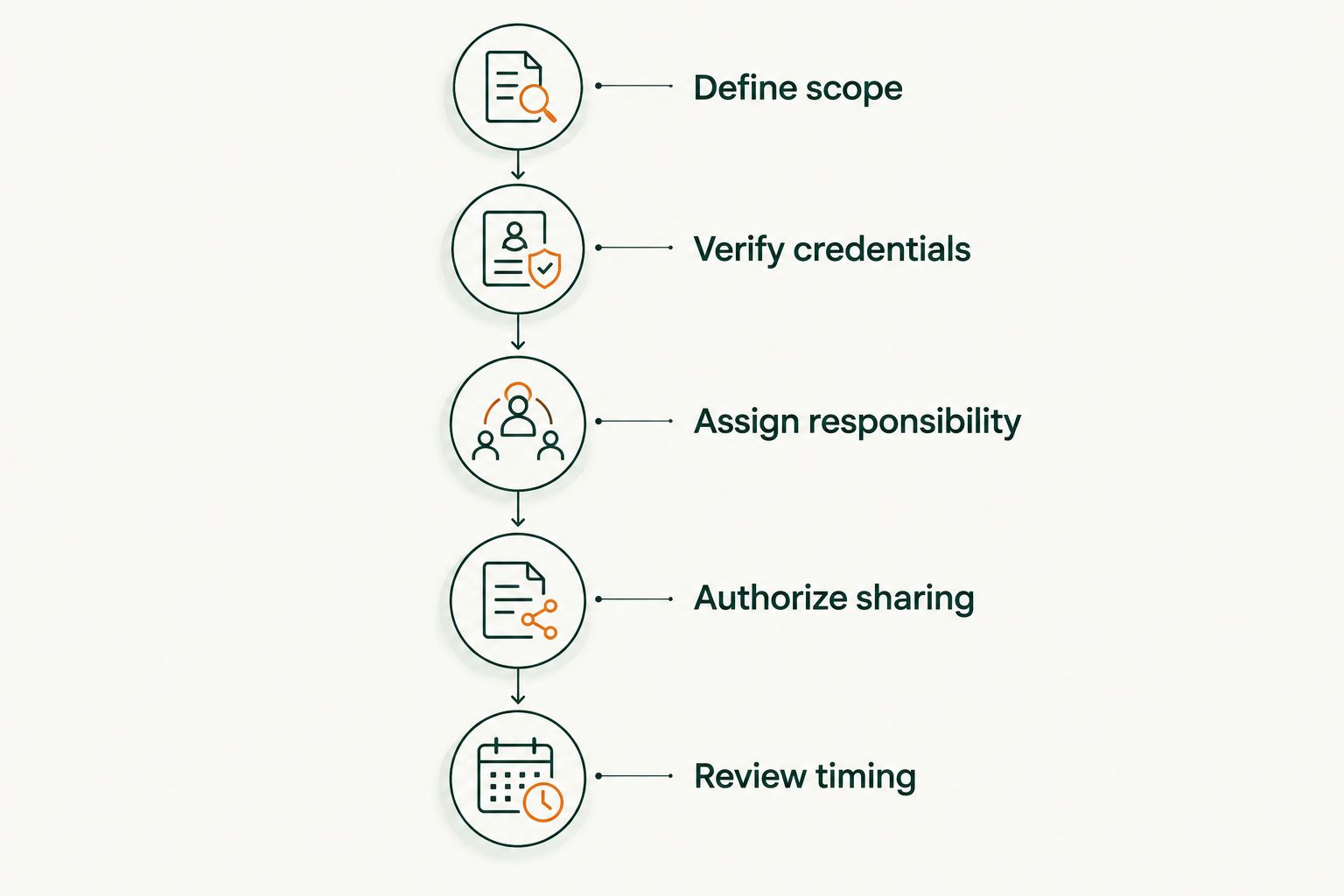
Use this sequence before you engage an advisor or authorize a tax-sensitive transaction. Keep the answers with your engagement documents so you can refer to them later.
1. Define scope
Ask whether tax services mean return review, tax projections, return preparation, or coordination with your accountant. Then identify the federal and state returns covered. Include business and trust obligations if they apply to your household.
Request the boundaries in writing. An agreement that describes financial planning does not, by itself, establish that the advisor will prepare and file your tax return.
2. Verify credentials
Ask who will prepare and sign the return, whether that person has the required PTIN, and what professional credentials the person holds. The IRS maintains a searchable directory of federal tax return preparers with credentials and select qualifications, but not every valid PTIN holder appears there.
Use the IRS directory to check listed qualifications, not as a complete list of everyone permitted to prepare returns. For a CPA, also check the relevant state licensing board; for other credentials, use the appropriate official verification process.
3. Assign responsibility
Identify who collects documents, checks tax projections, reviews proposed transactions, and follows up on filing questions. If an outside preparer is involved, confirm how that professional receives information and provides feedback.
For investment sales, IRS Form 1099-B reports proceeds and certain other transaction information. Ask who reviews the reporting against your records, including relevant cost-basis information. Do not assume that account access alone resolves every reporting issue.
4. Authorize sharing
Ask what permission is needed for your advisor and preparer to exchange tax returns and financial records. Use the agreed secure process, and confirm which documents each professional actually needs.
IRS Form 1099-R reports distributions from retirement plans and certain other arrangements. An advisor evaluating retirement withdrawals needs relevant distribution information, but the preparer remains responsible for the tax work specified in the preparation engagement.
5. Review timing
For 2026 transactions, agree on when tax review happens before implementation. Also confirm filing responsibilities, extension procedures, and how you will learn about unresolved questions.
An extension to file generally does not extend the time to pay federal income tax. Ask the preparer to explain your payment obligations rather than treating an extension as permission to postpone everything.
Does fee-only mean an advisor is qualified to file taxes?
No. Fee-only describes how an advisor is compensated, not qualification to prepare a return. Check tax credentials, preparer requirements, and relevant experience separately from the advisor's compensation model.
A fiduciary relationship also does not turn every financial service into an included service. The engagement still needs to specify whether the advisor provides tax planning, preparation, or coordination.
Is a CPA required to prepare your tax return?
No. A CPA is not the only professional who can prepare your tax return. Enrolled agents, attorneys, and other preparers can prepare returns subject to the applicable requirements.
Credentials matter for expertise and representation rights. According to IRS guidance on tax-professional credentials, CPAs, enrolled agents, and attorneys have unlimited representation rights before the IRS, subject to their authorization and standing. Other preparers' rights differ, so ask specifically about help with notices or examinations.
Can tax planning replace tax-return preparation?
No. Tax planning evaluates decisions; tax-return preparation reports the information required for filing. You need a defined filing process even when an advisor regularly considers taxes in your financial plan.
For your 2026 review, ask how proposed decisions reach the preparer before implementation and how completed returns inform the next planning discussion. That feedback connects filing to future decisions without confusing the two services.
Where integrated financial planning fits
VIMNewEngland is a fit for individuals, families, and business owners seeking integrated financial planning and investment management. Its stated services connect savings, retirement, taxes, and estate planning within one advisory relationship.
VIMNewEngland is a fee-only, SEC-registered investment advisory firm. Those facts describe its advisory model; they do not establish tax-return preparation or IRS representation services. Confirm the tax-service scope directly before relying on an advisor to file a return.
Clarify your planning needs
Discuss how taxes, retirement, investments, and estate planning fit into your advisory relationship.
FAQ
Can a fee-only advisor prepare your taxes in 2026?
Yes, a fee-only advisor can prepare your taxes in 2026 when tax preparation is offered and applicable preparer requirements are met. Confirm the service in writing; fee-only compensation alone does not establish tax qualifications.
Does financial planning include filing my tax return?
Financial planning does not automatically include filing your tax return. Your engagement agreement should distinguish tax planning, return review, preparation, and coordination with another professional.
Can I keep my CPA if I hire a financial advisor?
Yes, you can keep your CPA and hire a financial advisor. Agree on information sharing and identify who reviews tax-sensitive decisions before you implement them.
What's the difference between a PTIN and a tax credential?
A PTIN identifies a paid federal tax return preparer; it is not a professional credential. CPA licensure, enrolled-agent status, and attorney credentials involve separate qualifications and rules.
Can my financial advisor help if I receive an IRS notice?
An advisor can provide relevant financial records, but authority to represent you before the IRS depends on credentials and applicable rules. Ask who handles notices and whether that work is included in your engagement.
Does VIMNewEngland prepare tax returns?
VIMNewEngland's stated services include financial planning and investment management covering taxes, but that does not establish tax-return preparation. Confirm who prepares and signs returns before treating filing as part of the relationship.
What should I ask before a Roth conversion or investment sale?
Ask who will evaluate the tax consequences before you authorize the transaction. Confirm what current information the review uses and how the decision will be communicated to your tax preparer.
One last thing
Ask a prospective advisor to describe how a proposed investment sale reaches your tax preparer before you approve it. The answer reveals whether coordination is an actual process or just a service description.
For 2026, choose clarity over convenience alone. One relationship can simplify your financial life, but written responsibilities make that simplicity dependable.