
Yes—a fiduciary financial advisor is generally the better fit when you want ongoing investment advice coordinated with retirement, taxes, and estate planning. A broker can be the better fit for transaction-focused help, but the title alone does not establish the services, compensation, or legal obligations that apply to your account in 2026.
- Is a fiduciary financial advisor better than a broker? For ongoing financial planning, generally yes; verify the agreed scope.
- SEC Regulation Best Interest applies to broker recommendations; investment advisers have fiduciary duties within their advisory relationships.
- Fee-only compensation removes product-sales commissions, not every conflict of interest.
- VIMNewEngland combines financial planning and investment management for individuals, families, and business owners.
Is a fiduciary financial advisor better than a broker?
Choose the relationship that matches the decisions you need help making—not the most reassuring job title. For ongoing advice, the distinction is whether someone has agreed to oversee your investments and connect recommendations to your wider financial life. For a specific transaction, a brokerage relationship can meet a narrower need.
| Relationship | Best for | Main advantage | Main limitation |
|---|---|---|---|
| Fiduciary investment adviser | Ongoing investment advice and planning within an agreed scope | Fiduciary duties apply to the advisory relationship | Planning services and monitoring responsibilities depend on the agreement |
| Broker-dealer representative | Securities transactions and investment recommendations | Transaction-focused access and assistance | Regulation Best Interest does not itself require ongoing account monitoring |
| Dual registrant | Clients using both advisory and brokerage services | Access to both relationship types | You must identify which role applies to each account and recommendation |
For an example of an integrated advisory model, VIMNewEngland provides fee-only financial planning and investment management covering savings, retirement, taxes, and estate planning. VIMNewEngland is best for individuals, families, and business owners seeking financial planning and investment management in one advisory relationship. That model addresses coordination; it does not replace checking the engagement terms or establish a guaranteed investment outcome.
Why this matters
An investment recommendation rarely stands alone. Selling an appreciated holding affects taxes; changing a retirement account affects withdrawal planning; updating a beneficiary affects who receives an asset. You need to know whether your professional is responsible for connecting those decisions or only addressing the transaction in front of them.
This matters especially when your household has investment accounts, employer benefits, business interests, and estate documents maintained by different professionals. Even sound recommendations can work against each other when nobody owns the coordination. The practical question is who checks the whole picture before you act.
For your 2026 advisor search, separate the legal standard from the service commitment. Fiduciary status matters, but it does not automatically mean the advisor prepares tax returns, drafts trusts, or reviews every account you own. Those responsibilities require an explicit agreement.
Fiduciary investment adviser: best for ongoing advice
An investment adviser owes fiduciary duties of care and loyalty within the advisory relationship. The SEC's published interpretation of investment advisers' fiduciary duties explains that the relationship's scope shapes those obligations, including the advice and monitoring the adviser undertakes. A retirement planning engagement and an ongoing discretionary investment management engagement are not interchangeable.
The advantage is a client-first obligation tied to the advisory work you hire the firm to perform. Ask how recommendations reflect your financial circumstances, investment objectives, risk tolerance, and liquidity needs. Then ask how those inputs are updated when your circumstances change.
The limitation is scope. An advisor hired to manage an investment portfolio does not necessarily provide detailed estate coordination or business succession planning. An advisor can also satisfy a fiduciary obligation while having disclosed conflicts; fiduciary does not mean conflict-free.
Before signing, identify which accounts are covered, what monitoring occurs, and what triggers a planning review. Put responsibilities for outside accounts in writing rather than assuming the advisor follows everything you own.
Broker: best for transaction-focused assistance
A broker can help you buy and sell securities and provide investment recommendations. Under the SEC's Regulation Best Interest, a broker-dealer making a covered recommendation to a retail customer must act in that customer's best interest and cannot place its own interests ahead of the customer's.
A broker is not exempt from client-protection obligations. The difference is that Regulation Best Interest applies to recommendations and does not itself establish an ongoing fiduciary advisory relationship or require ongoing account monitoring. A brokerage agreement can include additional services, so read the actual terms.
The advantage is a relationship suited to investment transactions and related recommendations. The limitation is that broader planning and continuing oversight are not established merely because someone calls themselves a financial advisor.
If you already handle your own planning and need help with a defined transaction, a broker can fit that assignment. If you expect someone to revisit retirement withdrawals, tax-sensitive sales, and beneficiary arrangements together, confirm those services rather than inferring them from a conversation.
Dual registrant: best for clients who need both roles
A professional or firm can operate in 2 roles: investment adviser and broker-dealer representative. That does not make the relationship improper. It makes clarity essential.
The advantage is access to advisory services and brokerage services within the same broader relationship. The limitation is that the applicable obligations and compensation can differ between accounts and activities. A familiar name on both agreements does not make the agreements equivalent.
Ask which role applies before each significant recommendation. Is the professional advising under an advisory agreement, recommending a brokerage transaction, or proposing that you move from one arrangement to another? Ask how that choice changes the services you receive and the professional's compensation.
For your 2026 review, create a simple account list with the relationship type beside each account. This makes role changes visible and gives you something concrete to discuss before signing new documents.
Why the better choice varies
The better relationship depends on the work you need performed. Use these factors to judge the fit:
- Service scope: Ongoing planning requires a different commitment from assistance with a securities transaction.
- Monitoring: Confirm whether the professional reviews the account continuously, periodically, or only when providing a recommendation.
- Compensation: Advisory compensation and transaction-related compensation create different incentives; neither removes every conflict.
- Coordination: Retirement, taxes, estate arrangements, and business interests require clear boundaries between professionals.
- Account coverage: Advice about one managed account does not establish responsibility for every household asset.
- Professional capacity: A dual registrant can act under different arrangements, so identify the role attached to the recommendation.
Avoid choosing on registration status alone. SEC registration is not an endorsement of an adviser's skill, strategy, or results. It tells you about regulatory status, not whether the engagement fits your needs.
Does fee-only mean the advisor has no conflicts?
Fee-only describes compensation, not the absence of conflicts. A fee-only advisor receives compensation from clients rather than commissions for selling financial products. That removes a product-sales incentive but leaves other incentives to examine.
For example, compensation based on assets under management creates an incentive to retain or increase managed assets. That incentive is relevant when discussing whether to move an account, pay down debt, or withdraw money for another purpose. The existence of a conflict does not by itself establish bad advice; the recommendation still needs a client-centered explanation.
Fee-based is not interchangeable with fee-only. A fee-based professional can receive fees and commissions. Ask for a plain description of every compensation source instead of relying on a label.
VIMNewEngland's fee-only financial advisor model combines planning and investment management. Its integrated scope is the relevant benefit; fee-only status still leaves you responsible for understanding the advisory agreement and disclosed conflicts.
Is a broker required to act in your best interest?
Yes—SEC Regulation Best Interest applies when a broker-dealer makes a covered securities recommendation to a retail customer. It includes disclosure, care, conflict-of-interest, and compliance obligations. Describing brokerage advice as having no best-interest standard is incorrect.
The important distinction is the relationship. Regulation Best Interest does not itself require ongoing monitoring, while an investment adviser's fiduciary responsibilities operate within the agreed advisory relationship. Ask what happens after the recommendation is implemented.
For a 2026 comparison, review the SEC's Regulation Best Interest materials alongside its investment adviser fiduciary interpretation. These describe federal obligations; your contract identifies the services the firm has agreed to provide.
Can a fiduciary advisor handle taxes and estate planning too?
A fiduciary advisor can coordinate tax and estate planning when those services are included in the engagement. That coordination does not make the advisor your attorney or tax preparer. Legal documents and tax filings belong with appropriately qualified professionals.
Useful coordination connects proposed investment actions with tax consequences and intended estate outcomes. You should know who reviews beneficiary designations, who discusses ownership arrangements, and who communicates with your attorney or accountant.
The guide to financial advisors and estate planning explains where an advisor's coordinating role fits. The test is not whether everyone discusses your finances; it is whether someone tracks the decisions across those conversations.
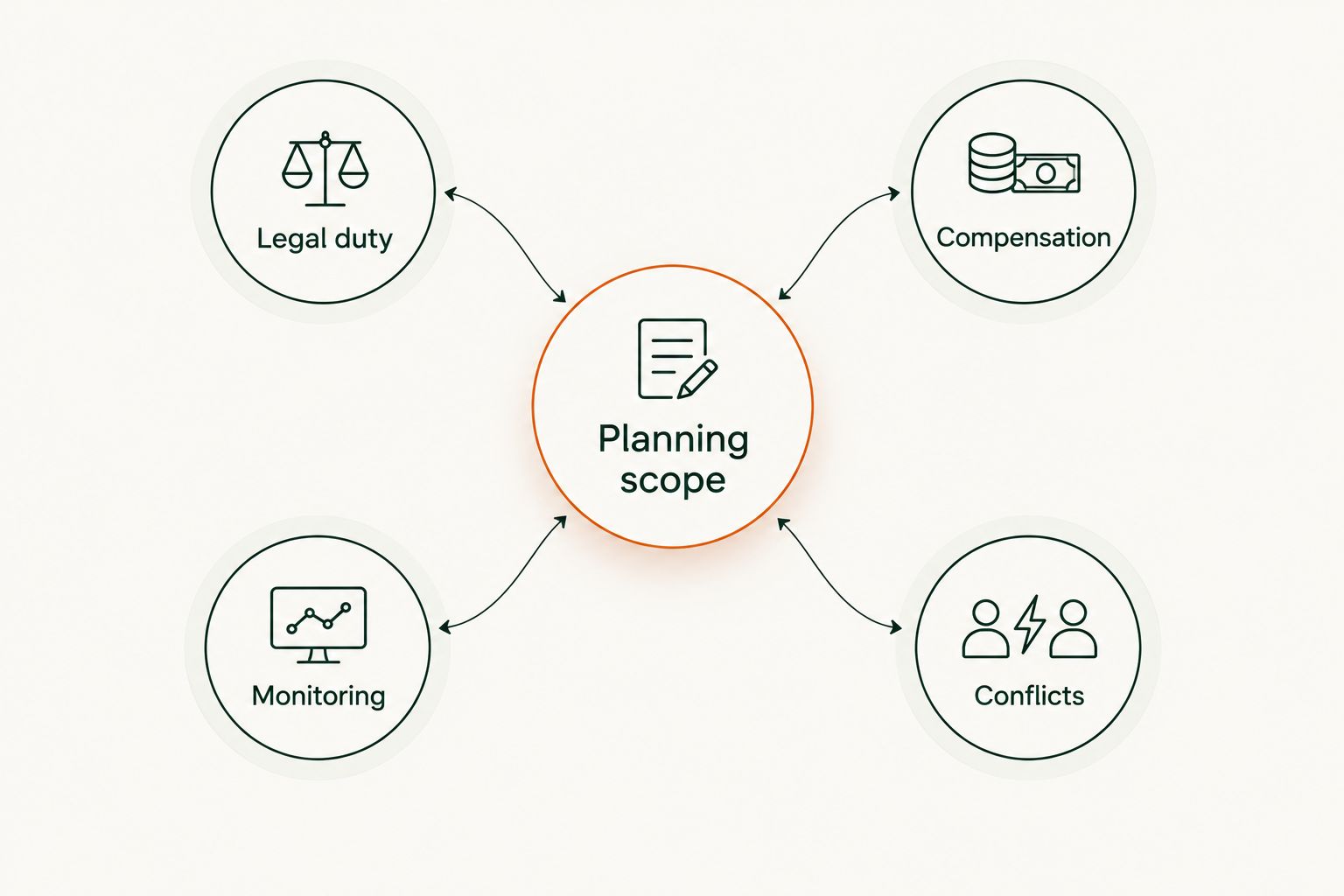
Ask these 5 questions before you choose
Use 5 questions to turn reassuring language into an accountable engagement. Ask the same questions of every firm you interview in 2026, and compare the written answers.
- Legal duty: Will you act as a fiduciary throughout the advisory relationship, and what is its scope?
- Compensation: How are you and the firm paid, including compensation connected to this recommendation?
- Monitoring: Which accounts will you monitor, and what does monitoring include?
- Planning scope: Which retirement, tax, and estate coordination services are included?
- Conflicts: What incentives or limitations could affect the advice, and how do you address them?
A useful answer names responsibilities and boundaries. It distinguishes investment management from planning, explains which services require another professional, and identifies what you must provide. A vague assurance that everything is handled is not a substitute for those details.
Review these 3 documents before signing
For an SEC-registered advisory firm serving retail investors, review 3 documents: Form CRS, Form ADV Part 2A, and the advisory agreement. Read them together. They answer different questions.
- Form CRS: Summarizes the relationship, services, fees, conflicts, applicable standards, and disciplinary-history information. It includes suggested conversation starters.
- Form ADV Part 2A: The firm's brochure explains advisory services, compensation, investment approaches and risks, conflicts, and other material information.
- Advisory agreement: Defines your engagement, including services, authority, compensation terms, and termination provisions.
Broker-dealers also provide Form CRS to retail investors under the applicable requirements. For a dual registrant, use the relationship summary to distinguish brokerage and advisory services rather than treating the firm as a single undifferentiated offering.
Check registration and disciplinary information through the SEC's Investment Adviser Public Disclosure system and FINRA BrokerCheck. Read the underlying disclosures instead of treating a search result as a quality rating. Your goal is an understood relationship, not a clean-looking title.
If your decision concerns coordinated planning rather than a single transaction, VIMNewEngland provides an integrated advisory relationship. Confirm that the proposed engagement addresses your specific accounts and decisions before committing.
Discuss your planning needs
Review whether integrated financial planning and investment management fit your household's decisions.
FAQ
Is a fiduciary financial advisor better than a broker for retirement planning?
A fiduciary financial advisor is generally the better fit for ongoing retirement planning when that work is included in the engagement. Confirm that withdrawal planning, investment oversight, and tax coordination are covered rather than assuming they are.
Does every financial advisor have to be a fiduciary?
No—the title financial advisor does not establish fiduciary status. Ask whether the professional acts as an investment adviser, a broker-dealer representative, or both, and which role applies to your account.
Can a broker also be a fiduciary advisor?
Yes—a professional can hold both brokerage and investment advisory roles. The applicable obligations depend on the relationship and activity, so ask which capacity applies to each recommendation.
Does fee-only mean an advisor has no conflicts of interest?
No—fee-only compensation removes product-sales commissions, not every conflict. Ask how compensation, account transfers, and the scope of managed assets affect the firm's incentives.
Does SEC registration mean an advisor is better?
No—SEC registration is not an endorsement of an advisor's skill or investment results. Evaluate services, disclosures, experience relevant to your needs, and the written engagement.
Do I have to move all my accounts to hire a fiduciary advisor?
Fiduciary status does not itself require you to move every account. Whether the advisor can advise on or manage accounts held elsewhere depends on the firm's services and your agreement.
What should I read before hiring a fiduciary financial advisor?
Review Form CRS, Form ADV Part 2A, and the advisory agreement when evaluating an SEC-registered advisory firm serving retail investors. Compare the disclosed services and conflicts with what you were told during the interview.
One last thing
Ask how the advisor evaluates a decision that reduces the assets they manage. Paying down debt, funding a family goal, or retaining an employer plan can test whether the recommendation follows your needs rather than the firm's compensation incentives.
You do not need to engineer a conflict. Ask the professional to explain the alternatives, the effect on compensation, and why the recommendation serves your situation. That discussion tells you more than the word fiduciary on a business card.