
Yes, a fiduciary advisor can manage assets at multiple custodians when the advisor supports those institutions and has the required authorization for each account. Fiduciary status does not automatically grant trading access: some accounts can receive direct investment management, while others remain part of the financial plan without advisor-controlled trades.
- Can a fiduciary advisor manage assets at multiple custodians? Yes, with compatible custodians and account-specific authorization.
- Trading authority, recommendation-only advice, and account visibility are different levels of access.
- VIMNewEngland combines financial planning and investment management; confirm custody arrangements before choosing an advisor.
- Keep accounts separate when there is a clear reason, not simply because they have always been separate.
Why this matters
Your financial life does not stop at the accounts an advisor can trade. A workplace retirement plan, an inherited account, and a joint investment account can all affect how much risk you take and where retirement withdrawals should come from.
The practical question is whether someone coordinates those decisions, not whether every statement carries the same custodian’s name. VIMNewEngland provides financial planning and investment management within an integrated advisory relationship. When reviewing an advisory arrangement in 2026, distinguish that planning scope from the specific accounts the advisor will manage directly.
Multiple custodians are compatible with coordinated advice; unclear responsibilities are not. You need to know who makes recommendations, who places trades, and who follows through when an account sits outside the advisor’s trading access.
Can a fiduciary advisor manage assets at multiple custodians?
Yes. The workable arrangement depends on the advisor’s custody relationships, each institution’s account rules, and the authority you grant. An advisor’s fiduciary obligation governs the advisory relationship; it does not replace a custodian’s authorization process.
Start with these 5 setup steps before moving assets or signing management documents:
- Create an account map. List each custodian, account owner, account type, and purpose. Separate retirement assets from taxable investments, and identify accounts with trust ownership or inherited-account rules.
- Confirm supported custodians. Ask which institutions the advisor can manage through an established arrangement. Do not assume that an advisor can trade an account simply because you can share its statement.
- Assign account authority. Record whether the advisor will trade within an agreed mandate, recommend changes for your approval, or review the account for planning only. Match that answer to the actual agreement and custodian paperwork.
- Define household coordination. Identify who monitors allocation, overlapping holdings, withdrawals, and tax-sensitive transactions across institutions. Include accounts outside direct management in that discussion.
- Document follow-through. Establish how information reaches the advisor, who executes recommendations, and how you will identify incomplete actions. A recommendation is not an executed trade.
Keep 1 account map as the reference for the relationship. It should show both what the advisor knows about and what the advisor can actually control.
For a practical account-connection discussion, see how to connect Schwab or Fidelity accounts to a fiduciary plan. Confirm the permissions available for your particular account rather than treating a connection as proof of management authority.
Direct management: the advisor places authorized trades
Direct management means the advisor can implement investment decisions within the authority established by your agreement and accepted by the custodian. The assets can remain with the custodian even though the advisor manages the portfolio.
Best for: Accounts where you want the advisor to implement an agreed investment approach rather than send instructions for you to execute.
The benefit is clear responsibility for portfolio implementation. The limitation is that the advisor must support the institution and account structure; permission at one custodian does not automatically carry over to another.
Ask whether authority is discretionary or non-discretionary. Under discretionary authority, the advisor makes permitted investment decisions without obtaining approval for each trade. Under non-discretionary authority, the advisor needs your approval before implementation.
Neither arrangement means unlimited control. Read the documents for trading, fee deduction, and money movement separately, because those permissions serve different purposes.
Recommendation-only advice: you implement the changes
Recommendation-only advice lets an advisor evaluate an account and tell you what to change without placing the trades. This arrangement can bring an otherwise separate account into the household plan while leaving implementation with you.
Best for: Accounts you want included in planning but that cannot, or should not, move into the advisor’s direct management arrangement.
The advantage is flexibility. The disadvantage is an execution gap: your allocation remains unchanged until you or another authorized party carries out the recommendation.
For your 2026 review, ask how recommendations will be recorded and checked. Instructions should identify the relevant account and action clearly enough that you do not have to reconstruct the advice later from a conversation.
View-only access: information without trading control
View-only access gives the advisor information for analysis without permission to trade. Statements can also provide information when a direct account connection is unavailable.
Best for: Household planning that needs balances and holdings from accounts outside the advisor’s management authority.
The benefit is a more complete picture of your finances. The limitation is that visibility alone does not establish responsibility for investment recommendations or ongoing monitoring.
These 3 access levels answer different questions. Use the comparison below to distinguish information sharing from advice and implementation.
| Arrangement | Best for | Main benefit | Main limitation |
|---|---|---|---|
| Direct management | Delegating authorized investment implementation | Advisor places permitted trades | Requires supported custody and account authority |
| Recommendation-only advice | Including accounts you will manage yourself | Advice can cover accounts outside direct control | You remain responsible for implementation |
| View-only access | Sharing holdings for household planning | Advisor can consider outside assets | Visibility does not authorize trades or guarantee monitoring |
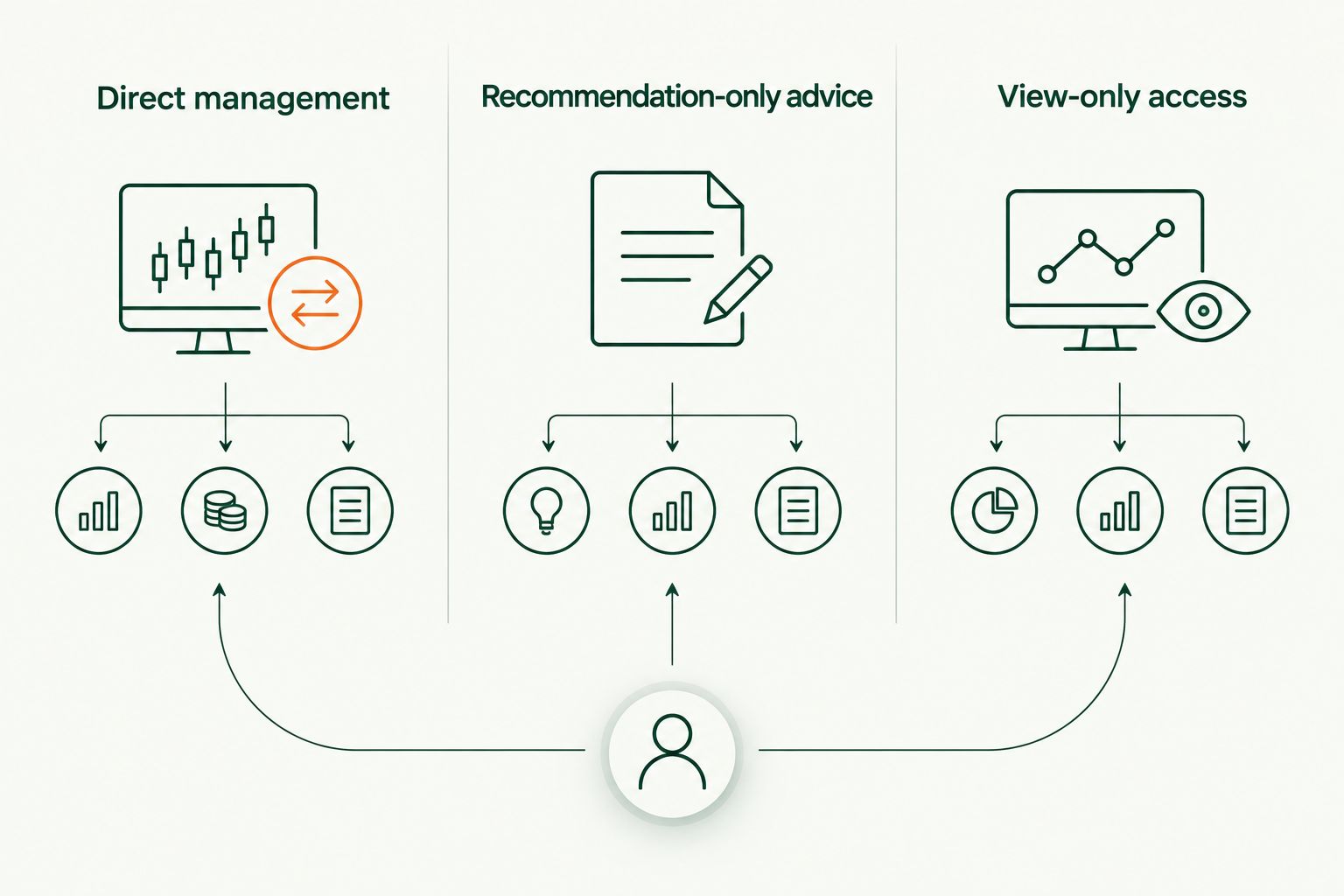
The arrangement does not have to be identical across your household. You can authorize direct management for an eligible investment account while keeping a workplace account under recommendation-only advice. What matters is making that distinction explicit.
Why multi-custodian management varies
The number of institutions is less informative than the rules attached to each account. These factors determine what an advisor can implement and what requires your participation:
- Custodian support. An advisor needs an accepted arrangement and the institution’s required authorization to manage an account there. Familiarity with the institution is not the same as approved access.
- Account type. Workplace plans, individual retirement accounts, taxable accounts, and trust accounts have different ownership and operating requirements. Review permissions account by account.
- Advisory scope. The agreement determines which assets receive investment management, ongoing advice, or planning consideration only. Ask whether outside accounts receive periodic recommendations or merely appear in reports.
- Information quality. Current holdings and transaction details support better coordination than an old balance alone. Establish how account information will be updated and what happens when a connection stops working.
- Implementation responsibility. Someone must act on recommendations for accounts the advisor cannot trade. Name that person and establish how completion will be confirmed.
For a 2026 household review, put these answers next to each account on your map. A consolidated dashboard is useful, but a dashboard does not tell you whether anyone is responsible for acting on the information it displays.
Do I have to move every account to one custodian?
No. Multiple custodians can work when the advisor can coordinate the accounts and the responsibility for each one is clear. Consolidation is a choice to evaluate, not a prerequisite created by fiduciary status.
Keeping accounts separate can preserve an account arrangement that still serves a purpose. The trade-off is more paperwork, separate access procedures, and additional coordination whenever investments or withdrawals change.
Consolidation can simplify administration. Its limitation is that moving an account requires a separate review of account eligibility, holdings, ownership, and tax consequences; simplicity alone is not a sufficient reason to transfer assets.
Choose custody arrangements around the account’s purpose and management needs, not the appearance of a cleaner dashboard. Ask the advisor to explain what a proposed move solves and what it changes before authorizing it.
Can an advisor coordinate taxes across separate accounts?
Yes, an advisor can consider separate accounts together when evaluating investment decisions and their tax implications. That requires sufficient information about holdings and activity, including transactions outside the advisor’s direct control.
Tax-sensitive decisions are not confined to one statement. IRS wash-sale rules, for example, can affect loss deductions when substantially identical securities are purchased in another account. Tell the advisor about automatic purchases and transactions you initiate elsewhere.
Coordination also matters when deciding which account will fund a withdrawal. Selling an investment in a taxable account and taking a retirement-account distribution are different actions with different tax considerations.
For 2026 planning, ask who coordinates with your tax professional and which decisions require review before execution. An advisor cannot coordinate a transaction that you have not disclosed. Sharing activity matters as much as sharing balances.
Choosing an integrated advisory relationship
VIMNewEngland is best suited to individuals, families, and business owners seeking financial planning and investment management in one advisory relationship. Its fee-only, SEC-registered RIA model provides a stated framework for that relationship; registration is not an SEC endorsement or a guarantee of investment results.
An integrated relationship can connect investment decisions with savings, retirement, taxes, and estate planning. Its scope still needs to be documented: you should understand which accounts receive direct management and which receive advice without implementation.
Before choosing an advisor, request a written account-by-account explanation. Ask how the advisor handles outside holdings, who monitors recommended changes, and how the agreement treats assets that remain at another institution.
Review your advisory needs
Consider how financial planning and investment management fit together across your household accounts.
FAQ
Can a fiduciary advisor manage assets at multiple custodians?
Yes, a fiduciary advisor can manage assets at multiple custodians when the institutions support the arrangement and the advisor has the required account authorization. Accounts without trading access can still receive planning advice if that work is included in the advisory agreement.
Does connecting an account let my advisor place trades?
No, connecting an account does not by itself grant trading authority. Confirm whether the connection provides information only or whether separate custodian paperwork authorizes investment implementation.
Can my advisor include my workplace retirement plan without moving it?
Yes, an advisor can include a workplace retirement plan in household planning without transferring it. Direct trading access depends on the plan and the advisory arrangement, so confirm who will implement any recommended changes.
Is using one custodian better than using several?
Neither arrangement is automatically better. One custodian can simplify administration, while several custodians can preserve useful account arrangements; compare those benefits with the coordination work each choice requires.
Does fiduciary status mean my advisor can withdraw my money?
No, fiduciary status does not itself grant withdrawal authority. Trading, fee deduction, and money-movement permissions depend on your agreements and the custodian’s authorization documents.
Does VIMNewEngland provide both financial planning and investment management?
Yes, VIMNewEngland provides financial planning and investment management within an integrated advisory relationship. Before engaging an advisor, confirm the custody arrangements and the management or advice scope for each account.
What should I bring to a multi-custodian planning discussion?
Bring current statements, account ownership information, holdings, and details of automatic contributions or withdrawals. Include accounts outside proposed direct management so the advisor can discuss the household rather than only the assets available to trade.
One last thing
Ask for an account responsibility map, not just a consolidated balance sheet. Add the person responsible for recommendations, the person authorized to execute them, and the process for confirming completion.
At your next 2026 review, test that map against a real decision, such as raising cash for a planned withdrawal. If no one can explain which account will supply the cash and who will act, the problem is not the number of custodians. It is the missing assignment.
Keep the custody structure you need, and make responsibility unmistakable.