
An estate plan with a financial advisor has no single standard cost: your total depends on the advisory agreement, the legal work, and who handles implementation. For a 2026 engagement, ask for a written scope that separates financial planning from attorney services and ongoing administration. An advisor’s fee does not automatically include drafting a will or trust, transferring property, or preparing estate-related tax returns.
- How much does an estate plan cost with a financial advisor? Compare written scopes, not an assumed package price.
- VIMNewEngland combines estate planning with financial planning and investment management; confirm the engagement’s included work.
- Financial advisors coordinate accounts and planning; estate attorneys handle legal documents and legal advice.
- Separate initial planning, legal implementation, and ongoing administration before comparing proposals.
How much does an estate plan cost with a financial advisor?
The useful comparison is the total scope of work, not an isolated advisory fee. An estate plan connects your legal instructions, account ownership, beneficiary designations, and family goals. A proposal that addresses only one part is not equivalent to a proposal that coordinates the whole financial picture.
Start by separating the possible engagements below. These are ways to organize your comparison, not descriptions of any particular firm’s available packages.
| Engagement | Best for | What to confirm | Main advantage | Main limitation |
|---|---|---|---|---|
| Defined planning project | A household with a specific estate-planning question | Deliverables, meeting scope, and implementation responsibilities | A clear stopping point for the engagement | Later changes require a separate arrangement unless included |
| Ongoing advisory relationship | A household coordinating investments, retirement, and estate goals | Which estate-planning activities fall within the advisory agreement | Connects estate decisions to continuing financial decisions | Legal drafting and administration are not automatically included |
| Attorney-led legal engagement | A household needing documents or legal advice | Documents, revisions, property work, and coordination with other professionals | Addresses legal structure and execution | Investment-account implementation must still have an assigned owner |
For more on the division of responsibilities, read how a financial advisor helps with estate planning.
When reviewing a 2026 proposal, request a description of the finished work. Does the engagement end with recommendations, signed legal documents, updated accounts, or an ongoing review process? Those outcomes represent different responsibilities. Do not treat them as interchangeable.
Why this matters
A signed document and an implemented estate plan are different things. Your attorney can establish the legal instructions, while account ownership and beneficiary records require attention through the institutions holding your assets.
For a New England household with investment accounts, real estate, or a business interest, the practical question is who connects those pieces. You should not have to discover after signing an agreement that everyone assumed someone else would handle the account changes.
A clear scope also protects your time. Instead of paying for overlapping recommendations or repeating the same information, you can assign each task to the professional responsible for completing it.
Defined planning project: confirm the deliverables
Best for: a focused question with a clear endpoint. A defined engagement can address a specific issue, such as reviewing beneficiary records against your estate goals or identifying questions to take to an attorney. Its strength is clarity: you know what the professional has agreed to deliver.
Its limitation is the boundary of the project. Advice alone does not complete legal drafting, account changes, or property transfers. Ask whether the advisor will help carry out recommendations or simply provide a written action list.
Request language that describes the deliverable in practical terms. A beneficiary review should identify the accounts reviewed, the records used, and the unresolved decisions. A general promise to discuss estate planning leaves too much room for different expectations.
Also ask what happens when the review reveals another issue. A business ownership question or an outdated trust document can require legal advice outside the original engagement. Decide how additional work will be approved before it begins.
Ongoing advisory relationship: confirm what is included
Best for: estate decisions that need to stay connected to your financial life. An ongoing relationship gives estate planning a place alongside investment management, retirement decisions, and tax planning. The advantage is coordination rather than treating each decision as a separate project.
The limitation is that an advisory relationship does not make every estate-related task part of the agreement. Review what the advisor actually undertakes: beneficiary discussions, account coordination, meetings with your attorney, or monitoring an implementation checklist.
For a 2026 review, ask how changes in your family or assets enter the planning process. Marriage, divorce, an inheritance, a property purchase, and a business transition are reasons to revisit instructions. The agreement should distinguish continuing review from work that requires another professional.
Do not assume that investment management includes trust administration. Managing investments held in a trust and serving as trustee are different responsibilities. Ask who makes distributions, maintains required records, and handles administrative decisions.
Attorney-led engagement: confirm the legal work
Best for: creating, interpreting, or changing legal documents. An estate attorney advises on legal structure and prepares documents appropriate to your circumstances. A financial advisor helps connect financial decisions and account information to that legal work.
The advantage of an attorney-led engagement is a clearly assigned source of legal advice. Its limitation is that drafting documents does not necessarily complete every account or property change. Confirm exactly what happens after signing.
Ask whether the engagement includes instructions for funding a trust, assistance with deeds, or follow-up on outstanding legal questions. These are distinct tasks, and their inclusion depends on the agreement.
Bring your financial information to the legal discussion. Account types, existing beneficiary records, business ownership documents, and property ownership help the attorney understand what the plan must address. Your advisor can help organize that information without replacing the attorney’s legal judgment.
Why estate-planning scope varies
The work changes with the assets involved, the decisions you need to make, and the responsibilities assigned to each professional. Use these factors to explain differences between proposals:
- Account ownership: Individually owned, jointly owned, and trust-owned accounts require different ownership reviews and instructions.
- Beneficiary instructions: Retirement accounts and other assets with beneficiary designations need a separate review alongside your will or trust.
- Family arrangements: Minor children, a blended family, or a beneficiary with special needs create distinct legal and planning questions.
- Property and business interests: Real estate and ownership agreements introduce documents and transfer requirements beyond investment-account records.
- State law: Your residence and property locations affect which legal questions your attorney must address.
- Ongoing responsibilities: Updating a plan, administering a trust, and settling an estate are different assignments from creating the original plan.
For property in more than one state, tell your attorney where each property is located. Do not assume that a document prepared for your residence resolves every property issue elsewhere.
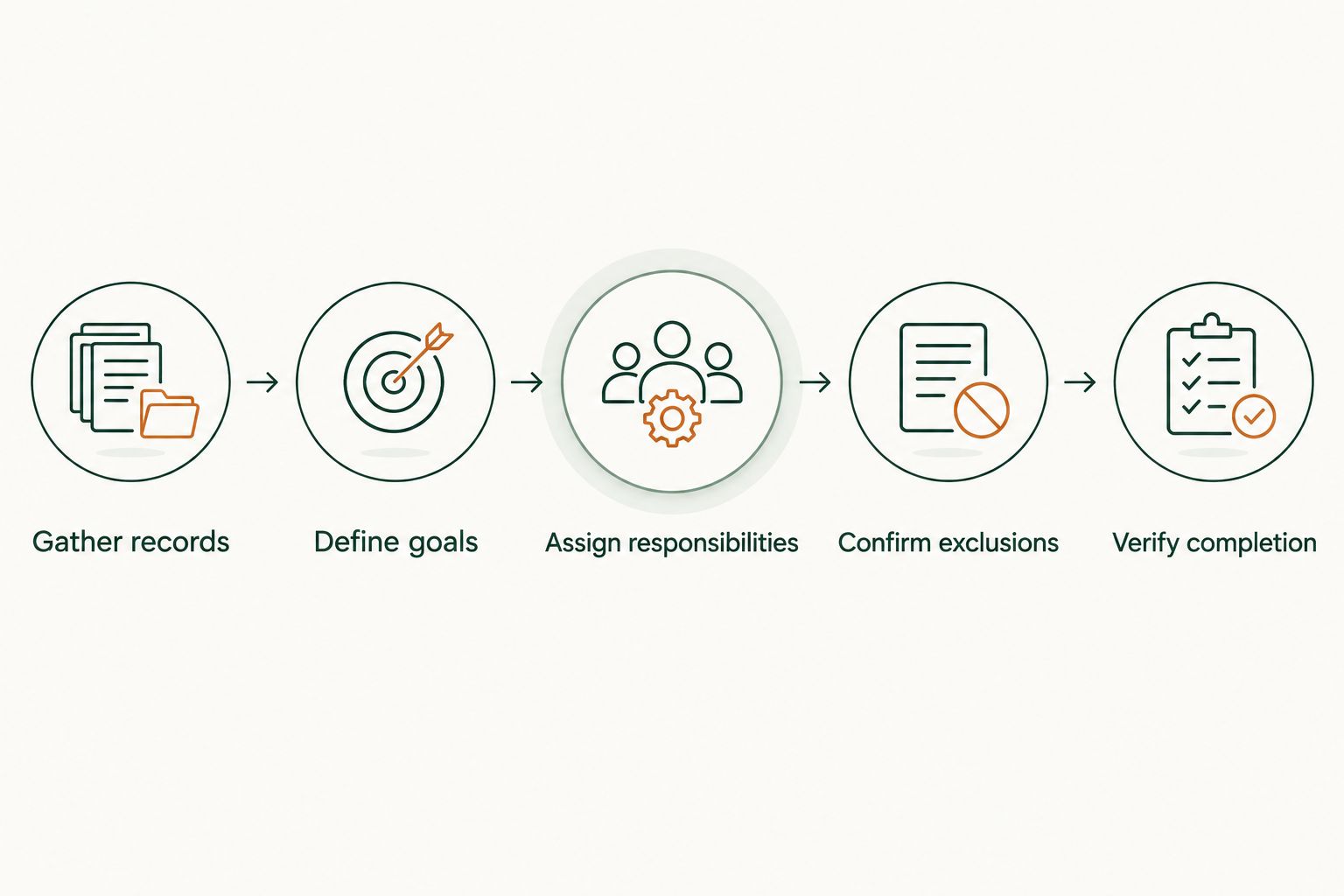
How to compare estate-planning proposals in 2026
Compare proposals against the same task list. Otherwise, a narrowly defined engagement and an ongoing relationship will look similar on paper even though they leave you with different responsibilities.
1. Gather records
Create an inventory of your investment accounts, retirement accounts, real estate, business interests, insurance, and existing estate documents. Record how each asset is owned and where the current beneficiary information is kept.
Use current records rather than memory. An account statement can establish ownership, but beneficiary information often requires a separate confirmation from the institution. Keep unresolved items on the list instead of guessing.
2. Define goals
Write down what you want the plan to accomplish. Examples include supporting a surviving spouse, transferring a business, providing for children, or making charitable gifts. Distinguish those goals from a preference for a particular legal document.
A trust is a legal structure, not a complete description of your wishes. Explain the intended outcome first so your attorney can advise on the structure and your advisor can assess the financial implications.
3. Assign responsibilities
Ask each professional to identify the work they will perform and the work assigned elsewhere. Include legal drafting, financial analysis, account paperwork, tax preparation, and any trustee or executor responsibilities.
Put the assignments in writing. If the advisor will send information to the attorney, identify what information and when. If you must submit institution forms yourself, make that responsibility explicit.
4. Confirm exclusions
Review what the agreement leaves out. Ask about document amendments, property transfers, additional legal consultations, tax filings, and administration after incapacity or death.
An exclusion is not necessarily a problem. An unexplained exclusion is. You can make an informed decision when you know which professional handles the remaining work and how that work will be authorized.
5. Verify completion
Ask what evidence will show that the agreed work is finished. Depending on the task, that evidence can include executed documents, institution confirmations, recorded property documents, or an updated responsibility list.
Do not mark an account change complete merely because a form was submitted. Obtain confirmation that the institution accepted the requested change. Keep that confirmation with your planning records.
Does a financial advisor replace an estate attorney?
No. Financial planning does not replace legal advice or properly executed estate documents. An advisor can help clarify goals, organize asset information, and coordinate financial implementation; an attorney handles the legal analysis and documents within the attorney’s engagement.
Ask about credentials rather than assuming that an estate-planning service includes legal representation. When an individual holds more than one professional credential, confirm the capacity in which that person is serving you and the agreement governing the work.
Is estate planning included in investment management?
Estate planning is included only to the extent the advisory agreement says it is. A firm’s description of integrated planning does not establish every deliverable, legal service, or administrative responsibility.
Look for specific tasks rather than a broad estate-planning label. Beneficiary review, attorney coordination, and account implementation are concrete activities you can ask about. Confirm which apply to your engagement and which require separate arrangements.
Do I need a trust for my estate plan?
A trust is not automatically the right answer for every household. The decision depends on your goals, ownership arrangements, family circumstances, and applicable law. An estate attorney should explain the purpose of the proposed trust and the responsibilities it creates.
Ask what must change after the trust is signed. If the plan requires assets to be transferred or beneficiary instructions to be revised, assign those tasks before treating the legal document as a completed plan.
What to ask VIMNewEngland about estate planning
VIMNewEngland is best suited to households seeking estate planning within an integrated financial planning and investment management relationship. Its stated model connects savings, retirement, taxes, and estate planning rather than presenting them as separate advisory services.
For VIMNewEngland estate planning, start with your circumstances and ask how the proposed relationship addresses them. Request a written explanation of the included coordination work, the role of your estate attorney, and the implementation tasks that remain your responsibility.
The benefit of that integrated approach is a shared financial context for estate decisions. The boundary is equally important: VIMNewEngland’s description does not establish that legal drafting, trustee services, or estate administration are included. Confirm those responsibilities before engaging any professional.
Use your 2026 discussion to answer a practical question: when your attorney recommends a change, who follows it through to the relevant financial accounts?
Discuss your planning priorities
Ask how estate planning connects with your investment management and retirement decisions.
FAQ
How much does an estate plan cost with a financial advisor?
The total depends on the advisory agreement, legal work, and implementation responsibilities. Request written scopes that distinguish financial planning from attorney services and ongoing administration.
Does my financial advisor’s fee include a will or trust?
An advisory fee does not automatically include a will or trust. Confirm whether legal drafting is covered by a separate attorney engagement and who coordinates the resulting account changes.
Can a fee-only financial advisor provide estate-planning help?
Yes, a fee-only financial advisor can help with estate goals, financial analysis, beneficiary reviews, and coordination within the agreed scope. Fee-only describes compensation; it does not establish legal qualifications or included deliverables.
Is ongoing estate-planning advice better than a one-time project?
Ongoing advice fits estate decisions that need continuing coordination, while a defined project fits a focused question. Compare the deliverables and follow-up responsibilities before choosing.
Does a will control my retirement-account beneficiaries?
Retirement-account transfers generally follow beneficiary designations and applicable account rules, not simply the instructions in a will. Review the actual records with your advisor and attorney, especially when spousal rights or trust beneficiaries are involved.
What should I bring to an estate-planning meeting?
Bring existing estate documents, account ownership records, beneficiary confirmations, property information, and relevant business agreements. Include your family goals and unresolved questions so the discussion addresses outcomes as well as paperwork.
What should I check in a 2026 estate-planning proposal?
Check the deliverables, exclusions, responsible professionals, and evidence of completion. Confirm how legal drafting, account updates, tax work, and ongoing administration are assigned.
One last thing
Choose one account and trace it through your estate plan before considering the work complete. Confirm its owner, its beneficiary instructions where applicable, and how those records fit your attorney’s recommendations. That exercise turns an abstract planning discussion into a specific implementation check.
For your 2026 records, keep the institution’s confirmation with the relevant legal instructions. A signed estate document cannot show whether an institution accepted a separate account change. The confirmation can.