
Yes, a fiduciary financial advisor can manage investments held in a trust when the trustee has authority to hire the advisor and the advisory agreement permits that work. Managing the investments does not automatically make the advisor the trustee or authorize beneficiary distributions, legal changes, or trust tax filings. For a 2026 trust review, separate investment authority from responsibility for administering the trust before signing an agreement.
- Can a fiduciary financial advisor manage a trust? Yes, with proper authority; investment management and trustee administration are different roles.
- Massachusetts trust law permits appropriate delegation, but the trustee must select, instruct, and monitor the investment advisor.
- Trust investment management should follow the trust document, beneficiary needs, distribution requirements, and applicable law.
- Confirm who handles distributions, beneficiary reporting, legal advice, and tax preparation before assigning responsibility.
Can a fiduciary financial advisor manage a trust?
A fiduciary advisor can manage a trust portfolio without serving as trustee. The trustee authorizes the investment relationship; the advisor manages investments within the agreed scope. That distinction also explains how a financial advisor can help with estate planning without replacing your estate attorney.
The word manage describes different jobs. Use this comparison to decide which responsibility you actually need help with.
| Arrangement | Best for | Main benefit | Important limitation |
|---|---|---|---|
| Investment advisor working for the trustee | Trustees who need professional portfolio management | Separates investment decisions from trust administration | The advisor does not automatically control distributions or beneficiary reporting |
| Individual trustee with professional support | Families with a willing trustee who can coordinate specialists | Keeps administration with a person familiar with the family | The trustee still needs time, records, and oversight procedures |
| Professional or corporate trustee | Families seeking continuity and administrative support | Provides a formal structure for trustee responsibilities | Appointment, powers, service scope, and suitability require review |
These arrangements are not mutually exclusive. An individual or corporate trustee can engage an investment advisor, subject to the trust document and applicable law.
What Massachusetts law says about delegation
Massachusetts General Laws, Chapter 203E, Section 807 permits a trustee to delegate duties and powers that a prudent trustee of comparable skills could properly delegate under the circumstances. It requires reasonable care, skill, and caution when selecting the agent, defining the delegation, and periodically reviewing the agent's actions.
Chapter 203E, Section 804 addresses prudent trust administration, considering the trust's purposes, terms, distribution requirements, and other circumstances. Chapter 203E, Section 813 addresses duties to inform and report to beneficiaries, subject to its provisions and exceptions.
These are separate legal responsibilities. Hiring an investment advisor does not, by itself, satisfy every responsibility associated with administering a trust. The trust document and applicable law determine the specific duties in your situation.
Why this matters
A trust investment account is not simply your personal brokerage account with a different title. The money must be managed for the purposes and beneficiaries identified by the trust, under the powers the document grants.
An investment decision affects more than portfolio returns. Selling an asset can change liquidity and tax consequences; retaining it can affect concentration and the ability to make required distributions. Those decisions need a shared understanding between the trustee, advisor, and relevant legal or tax professionals.
In 2026, start with the trust's instructions, not a model portfolio. A portfolio that suits the person who created the trust is not automatically appropriate for the trust after that person's death or incapacity.
Investment management: portfolio decisions, not all trust duties
A fiduciary investment advisor's assignment can include an investment policy, asset allocation, portfolio monitoring, rebalancing, and planning for withdrawals. The signed agreement should identify which activities the advisor actually provides.
For trust assets, the investment policy needs to reflect the trust's objectives rather than a generic risk questionnaire. It should address expected distributions, available cash, time horizon, investment restrictions, and the needs of the beneficiaries the trustee must consider.
The benefit is professional attention to the investment account. The limitation is scope: portfolio management does not establish who approves distributions, interprets disputed trust language, or prepares a fiduciary income tax return.
Ask for a plain-language answer to this question: What decisions can the advisor make independently, and what decisions require the trustee's approval? Trading discretion and distribution authority are not the same permission.
Trustee administration: authority comes from the trust
The trustee administers the trust under its terms and applicable law. Depending on the arrangement, that work includes safeguarding property, maintaining records, making authorized distributions, communicating with beneficiaries, and engaging specialists.
An advisor who is also considered for a trustee role needs a separate assessment. Fiduciary status as an investment advisor does not automatically appoint that person as trustee, establish eligibility, or confirm that the advisory firm offers trustee services.
Before combining the roles, have counsel review appointment requirements, conflicts, responsibilities, and succession arrangements. Ask how investment decisions and distribution decisions will be documented when the same person participates in both.
Best for families seeking continuity: evaluate professional trustee services when administration itself is the unresolved problem. Investment management alone is not a substitute for someone taking responsibility for the trust's operation.
Why trust management responsibilities vary
There is no single service package that fits every trust. The responsibilities depend on the document, the assets, and the people involved.
- Trust terms: Investment restrictions, distribution standards, and delegation provisions shape the advisor's assignment.
- Applicable law: Governing law affects trustee powers, administration, and beneficiary rights; your residence alone does not settle every jurisdictional question.
- Beneficiary needs: Current distributions and longer-term interests can require different portfolio priorities.
- Asset composition: Cash and marketable securities present different management issues from real estate or a closely held business.
- Tax circumstances: Trust classification, retained income, and distributions affect the questions the tax professional must resolve.
- Trustee capacity: A trustee's experience, available time, and succession arrangements determine the support needed.
For a New England family, local familiarity is useful, but it does not replace document review. A Massachusetts home address does not establish that Massachusetts law controls every aspect of a particular trust.
How do you authorize an advisor to manage trust investments?
Use this sequence for a 2026 review or a new advisory relationship. Complete the authority review before granting trading access, not after the portfolio has already moved.
- Review authority. Give the estate attorney the trust document and relevant amendments. Confirm the acting trustee, delegation powers, investment restrictions, and any required approvals.
- Define responsibilities. List who handles investments, distributions, beneficiary communications, accounting, and tax preparation. Identify duties that remain with the trustee.
- Set investment policy. Document the trust's objectives, expected cash needs, time horizon, and restrictions. Establish how the trustee and advisor will handle competing priorities.
- Verify account access. Confirm that the custodian recognizes the trust and authorized trustee. Grant only the access and discretion required for the agreed assignment.
- Monitor the arrangement. Agree on reports, communication expectations, and event-driven reviews. Keep records of the trustee's oversight and significant decisions.
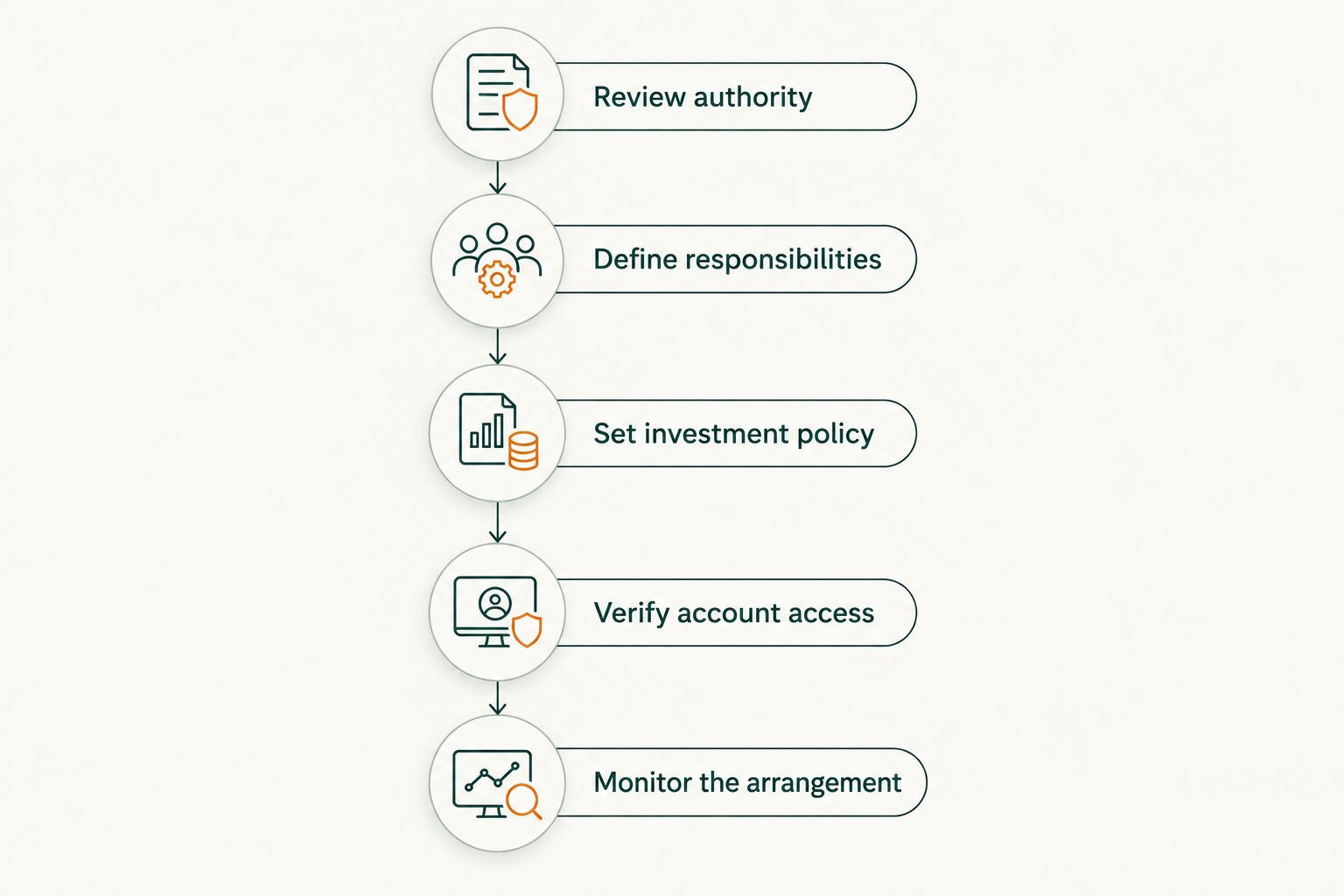
Your finished checklist should make responsibility visible. If everyone assumes another professional handles beneficiary reporting, the investment portfolio can be well managed while trust administration remains incomplete.
What should you bring to the first meeting?
Bring the trust document and amendments, current account statements, information about expected distributions, and the names of the attorney and tax professional involved. Include information about assets outside the investment account that affect the trust's financial position.
Explain upcoming decisions, not just account balances. A beneficiary request, property sale, trustee transition, or business interest can change the questions the advisor needs to address.
Use secure document-sharing methods agreed with the professionals. Trust documents and tax records contain sensitive family information and should not be circulated casually.
Does a fiduciary advisor replace your trustee or estate attorney?
No. A fiduciary investment advisor does not replace your trustee or estate attorney merely by managing the portfolio. Each role needs its own authority and clearly defined assignment.
The trustee administers the trust, the attorney advises on legal interpretation and documents, and the tax professional handles the tax work assigned to that professional. The investment advisor brings portfolio decisions into that coordinated process.
Coordination matters because the same transaction can raise several questions. Before funding a distribution through an asset sale, confirm both investment suitability and any legal or tax issues relevant to that action.
Can the same advisor manage your personal and trust accounts?
Yes, an advisor can manage both when properly authorized and engaged for each account. The accounts still need objectives and records that reflect their different owners and purposes.
Your personal retirement needs do not automatically determine the trust's investment strategy. Likewise, the trust's distribution obligations do not authorize using trust assets to meet unrelated personal expenses.
For your 2026 planning review, ask the advisor to distinguish household planning from trust decision-making. A coordinated view is useful; treating every account as interchangeable is not.
Where does integrated financial planning fit?
VIMNewEngland is best for individuals, families, and business owners seeking integrated financial planning and investment management. Its stated services connect savings, retirement, taxes, and estate planning within one advisory relationship.
VIMNewEngland's financial planning can provide context for a discussion about how trust assets relate to your broader financial life. That service description does not establish an appointment as trustee or confirm the scope of a particular trust-investment engagement.
When considering VIMNewEngland, ask whether your specific trust account fits the advisory relationship and which responsibilities would be included. Confirm the answer in writing before relying on the firm for trust-related work.
The benefit of VIMNewEngland's integrated financial planning approach is a connected discussion of your goals. The boundary is equally important: integrated advice does not remove the need for the legal, tax, and administrative responsibilities to have named owners.
Discuss your planning needs
Clarify how investment management and estate planning fit within your advisory relationship.
FAQ
Can a fiduciary financial advisor manage a trust without being the trustee?
Yes, a fiduciary financial advisor can manage trust investments without being the trustee when properly authorized. The trustee and advisor must define the assignment under the trust document, applicable law, and advisory agreement.
Does being a fiduciary mean an advisor can approve trust distributions?
No, fiduciary status alone does not give an advisor authority to approve trust distributions. Distribution authority depends on the trust terms, applicable law, and the person's appointed or delegated role.
Is a financial advisor the same as a corporate trustee?
No, an investment advisor and a corporate trustee have different roles. An advisor manages investments within an engagement, while a corporate trustee accepts trustee responsibilities under an appointment and service arrangement.
Can a trustee delegate investment management in Massachusetts?
Yes, Massachusetts General Laws, Chapter 203E, Section 807 permits appropriate delegation under its requirements. The trustee must exercise reasonable care, skill, and caution in selecting the agent, defining the assignment, and periodically reviewing performance.
Can the advisor change the terms of my trust?
An investment advisory engagement does not authorize the advisor to change the trust's terms. Consult an estate attorney about who has amendment authority and which legal procedures apply.
Does a financial advisor prepare the trust's tax return?
Investment management does not automatically include preparing a trust's tax return. Confirm tax preparation separately and identify the professional responsible for any required filings.
What should I check before hiring an advisor for a trust in 2026?
For a 2026 trust engagement, check authority, service scope, investment restrictions, distribution responsibilities, and oversight procedures. Make sure the advisory agreement matches the responsibilities you expect the advisor to accept.
One last thing
Ask who acts when the trustee can no longer act. A well-defined investment mandate does not solve a missing successor-trustee arrangement.
For your 2026 review, confirm the succession provisions with your attorney and the recognition process with the custodian. The practical goal is simple: someone with valid authority must be able to give instructions when the trust needs action.