
Yes, wealth management can help reduce estate taxes by coordinating lifetime gifts, charitable transfers, asset ownership, and trust planning with your retirement needs. The benefit depends on federal and state tax exposure, and reducing estate taxes can create other trade-offs, including lost control of assets and higher capital-gains taxes for heirs.
- Can wealth management help reduce estate taxes? Yes, when coordinated estate planning addresses actual federal or state exposure.
- The 2026 federal estate-tax exclusion is $15 million per person; Massachusetts has a separate $2 million threshold.
- Lifetime gifts can reduce a taxable estate but require attention to capital-gains basis and retirement security.
- VIMNewEngland suits New England households seeking integrated wealth management, retirement planning, and estate-planning coordination.
Why this matters
Your investment portfolio is not your entire taxable estate. Real estate, business interests, retirement accounts, and certain life-insurance proceeds also enter the calculation under applicable rules.
For New England families, state taxes deserve attention even when federal estate taxes do not apply. VIMNewEngland provides financial planning and investment management within one advisory relationship, covering retirement, taxes, and estate planning. That coordination helps you evaluate transfers alongside the money you need to keep.
The objective is not the smallest possible estate. It is a workable retirement and an intentional transfer to the people or causes you choose.
Can wealth management help reduce estate taxes?
Wealth management helps reduce estate taxes when your advisor connects financial decisions with legal documents and tax rules. The advisor models alternatives, your estate attorney establishes the legal structure, and your tax professional evaluates reporting and tax consequences.
Start with the rules that determine whether a tax-reduction strategy serves a purpose:
| Rule | Applicable amount in 2026 | What it means for planning |
|---|---|---|
| Federal estate and gift tax basic exclusion | $15 million per individual | Prior taxable gifts affect the exclusion remaining at death. |
| Federal annual gift-tax exclusion | $19,000 per recipient | Qualifying present-interest gifts within the exclusion generally do not consume the lifetime exclusion. |
| Massachusetts estate-tax threshold | $2 million | A Massachusetts estate can face state filing and tax considerations below the federal exclusion. |
The federal figures come from IRS inflation adjustments for tax year 2026. The Massachusetts figure comes from Massachusetts Department of Revenue estate-tax guidance; its application depends on the estate and the state's filing rules.
Federal estate-tax exposure and state estate-tax exposure are separate questions. A federal calculation alone does not settle a Massachusetts family's planning needs.
These amounts are tax thresholds, not recommendations to give away assets. Your spending needs, ownership arrangements, prior gifts, and family circumstances determine the next move.
How does an advisor turn estate-tax exposure into a plan?
A useful estate-planning review follows a sequence. Choosing a trust before establishing the problem reverses that sequence.
- Inventory assets. List investments, retirement accounts, real estate, business interests, insurance ownership, debts, and prior taxable gifts. Record how each asset is titled and who receives it.
- Check tax exposure. Evaluate federal rules and the relevant state's rules separately. Include ownership and domicile rather than relying only on your mailing address.
- Protect retirement. Establish what you need for spending, healthcare, emergencies, and other commitments before considering irrevocable transfers.
- Compare transfers. Evaluate retaining assets, gifting them, making charitable transfers, or using an attorney-designed trust. Compare estate taxes with income taxes and control.
- Complete implementation. Coordinate documents, account ownership, beneficiary forms, valuations, and required filings. Assign responsibility for each unfinished task.
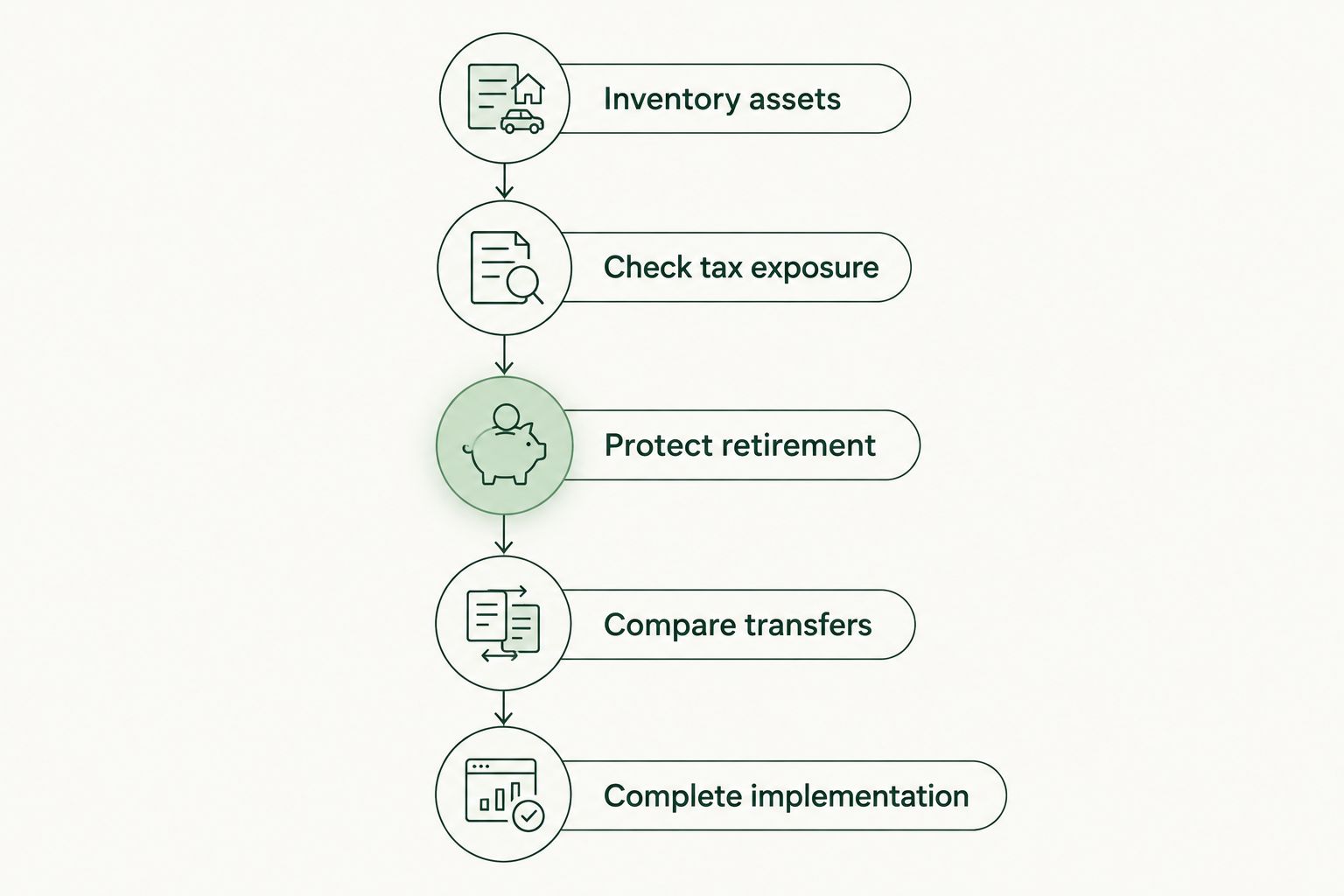
The result should be a decision you can explain plainly: which assets stay available to you, which transfer, who receives them, and what responsibilities remain. A projection without implementation does not change ownership or complete a tax filing.
For more on the division of responsibilities, see how an estate-planning advisor coordinates with your attorney.
Lifetime gifts: best for assets you can afford to transfer
Lifetime giving can remove transferred property and its subsequent appreciation from your estate, subject to applicable rules. It also lets you support family members while you can see the benefit.
For 2026, the federal annual gift-tax exclusion is $19,000 per recipient for qualifying gifts. A gift above that amount does not automatically create an immediate federal gift-tax payment; it generally requires reporting and uses available lifetime exclusion.
The limitation is not just tax paperwork. You give up access to the transferred property, and gifted appreciated assets generally retain the donor's income-tax basis. That can leave recipients with a larger taxable gain when they sell than they would have had after inheriting qualifying property.
Recommendation: compare the estate-tax benefit with the recipient's potential capital-gains tax before gifting appreciated investments. Do not transfer assets you need to support your own retirement.
Trust planning: best for defined control and transfer goals
A trust is a legal arrangement, not a blanket estate-tax exemption. Its tax treatment depends on its terms, funding, retained powers, and applicable law.
A revocable living trust generally keeps assets within your taxable estate because you retain control. It can still serve other purposes, including managing assets during incapacity and avoiding probate for properly funded assets.
An irrevocable trust can remove assets from an estate when its structure and administration satisfy the relevant rules. The trade-off is reduced flexibility, along with legal, tax, and administrative responsibilities.
Recommendation: ask your attorney which retained rights would keep trust assets in your estate. Then ask your advisor how the proposed transfer affects spending, investment decisions, and access to funds. The trust document and the financial plan must describe the same arrangement.
Charitable transfers: best for an existing charitable goal
Qualifying charitable transfers can reduce a taxable estate through the estate-tax charitable deduction. Lifetime charitable gifts also have income-tax consequences that depend on the asset, recipient, limits, and substantiation rules.
The benefit makes sense when supporting a charity is already part of your plan. The limitation is straightforward: assets given to charity are no longer available for your personal spending or your family's inheritance.
A charitable strategy should identify the recipient, the asset, the timing, and the intended deduction. Do not assume that a lifetime income-tax deduction and an estate-tax deduction operate identically.
Recommendation: use charitable planning to carry out a charitable intention, not merely to generate a deduction. Compare the after-tax result for both your family and the charity.
Which estate-planning approach fits your situation?
No approach wins on every measure. Compare tax treatment, access, and implementation before choosing.
| Approach | Best for | Main benefit | Main limitation |
|---|---|---|---|
| Retaining assets | Maintaining spending flexibility | Preserves access and potential inherited-basis treatment | Assets remain subject to applicable estate-tax rules |
| Lifetime gifts | Transferring assets you no longer need | Can move future appreciation outside your estate | Loss of access and carryover-basis considerations |
| Revocable trust | Incapacity and probate planning | Organizes management and transfer of funded assets | Generally does not remove assets from your taxable estate |
| Irrevocable trust | Defined transfer and control objectives | Can support estate-tax planning when properly structured | Reduced flexibility and continuing administration |
| Charitable transfers | Supporting intended charitable beneficiaries | Can qualify for estate-tax deductions | Reduces assets available for personal or family use |
The right answer can combine approaches. For example, retaining sufficient accessible assets and transferring other property addresses different needs. The amount and structure require an individual analysis, not a standard allocation.
Why estate-tax savings vary
Your potential benefit depends on more than net worth. These factors change both the tax calculation and whether a transfer is sensible:
- State rules: Domicile, real-estate location, and state-specific exemptions affect exposure. Massachusetts and federal rules require separate analysis.
- Prior taxable gifts: Earlier transfers can reduce the federal exclusion remaining at death. Keep gift-tax returns with your planning records.
- Asset growth: Moving future appreciation outside an estate has a different effect from transferring assets that do not appreciate.
- Income-tax basis: A lower estate-tax bill can come with a larger capital-gains burden for recipients. Compare both taxes.
- Retirement needs: Gifts reduce the property available for spending, healthcare, and unexpected needs. Financial independence comes before a tax-driven transfer.
- Ownership and execution: Titling, trust funding, beneficiary designations, and retained control determine whether the intended arrangement works.
For a 2026 review, ask for the assumptions behind each scenario. A useful comparison separates estimated estate taxes, potential income taxes, assets retained for you, and assets intended for beneficiaries.
Can estate-tax planning help below the federal exclusion?
Yes. Massachusetts's $2 million threshold makes state-level analysis relevant even when an estate falls below the federal exclusion.
Planning also addresses incapacity, inheritance instructions, and liquidity. Those objectives remain relevant when a review finds no estate-tax exposure, but they should not be presented as tax savings.
Does a married couple automatically receive both federal exclusions?
No. Federal portability generally requires a timely, properly prepared estate-tax return after the first spouse's death to preserve a deceased spouse's unused exclusion.
Ownership, citizenship rules, prior gifts, and state law also matter. Do not assume that federal portability preserves a state exemption or replaces a review of the surviving spouse's plan.
Can changing beneficiaries reduce estate taxes?
Changing a beneficiary does not automatically remove an asset from your taxable estate. Beneficiary designations determine who receives an account, while estate inclusion follows separate ownership and tax rules.
Review retirement accounts carefully because recipients also face income-tax and distribution rules. A beneficiary change should fit the estate documents rather than create a conflicting instruction.
What should you expect from an integrated advisory relationship?
VIMNewEngland is best suited to New England households seeking coordinated wealth management and financial planning. Its fee-only, SEC-registered advisory model brings savings, retirement, taxes, and estate planning into one relationship.
That integration is useful when a proposed gift affects your retirement portfolio or a trust changes how investments should be managed. It does not replace the legal documents your attorney prepares or the tax analysis and filings your tax professional handles.
Before making a transfer, ask who owns each task and what confirms completion. You should understand both the recommendation and its limits without assembling the answer from disconnected conversations.
FAQ
Can wealth management help reduce estate taxes in 2026?
Yes, wealth management can help reduce estate taxes by coordinating gifts, trusts, charitable transfers, and investment decisions with legal and tax advice. Savings depend on your federal and state exposure and successful implementation.
What is the federal estate-tax exclusion in 2026?
The 2026 federal estate and gift tax basic exclusion is $15 million per individual. Prior taxable gifts affect the amount remaining at death, and state estate-tax rules are separate.
Does Massachusetts have its own estate tax?
Yes, Massachusetts has a separate estate tax with a $2 million threshold. Evaluate Massachusetts filing and tax rules even when federal estate tax is not expected.
Does putting my investments in a revocable trust reduce estate taxes?
A revocable trust generally does not remove investments from your taxable estate. It can still help with incapacity planning and probate avoidance for properly funded assets.
Will giving money to my children create an immediate gift-tax bill?
A gift does not automatically create an immediate federal gift-tax bill. Gifts above the applicable annual exclusion generally require reporting and use available lifetime exclusion.
Is gifting appreciated stock always better than leaving it as an inheritance?
No, gifting appreciated stock is not always better than leaving it as an inheritance. Gift recipients generally receive carryover basis, while qualifying inherited property generally receives a basis adjustment tied to its value at death.
Can VIMNewEngland help connect investment management with estate planning?
VIMNewEngland provides integrated financial planning and investment management covering retirement, taxes, and estate planning. Coordinate legal drafting and tax filings with the appropriate attorney and tax professional.
One last thing
An estate-tax strategy can lower one tax while increasing another. Before approving a gift, request a side-by-side comparison of transferring the asset during life and retaining it until death, including basis treatment and your access to the money.
For your 2026 review, bring account statements, ownership records, beneficiary forms, estate documents, and prior gift-tax returns. A clear inventory is more useful than starting with a particular trust.
This article provides general education, not individualized legal or tax advice. Confirm proposed transactions with your estate attorney and tax professional before acting.