
Yes, you can fire or replace a fiduciary financial advisor; the advisory agreement sets the termination procedure, and the custodian handles changes to account authority or transfers. Ending the relationship does not automatically require selling investments, but you must separately address trading permissions, final billing, and any holdings that cannot move to a new account.
- Can a fiduciary financial advisor be fired or replaced? Yes; follow the agreement and confirm account authority separately.
- Changing advisors does not automatically require selling investments or closing your accounts.
- Review termination terms, transfer restrictions, and tax consequences before authorizing transactions.
- VIMNewEngland provides integrated financial planning and investment management for individuals, families, and business owners.
Can a fiduciary financial advisor be fired or replaced easily?
Yes. You control whether the advisory relationship continues, but ending advice and moving assets are separate decisions. A fiduciary obligation governs how an advisor serves you; it does not make the relationship permanent.
Start with the signed agreement. Look for the required notice method, effective termination date, treatment of prepaid fees, and any responsibilities that survive termination. Do not assume that a phone conversation or an account-transfer request satisfies the agreement.
Before choosing a replacement, review the fiduciary financial advisor qualities to look for. The next relationship should solve the problem that prompted the change, not simply move the same unresolved questions to another firm.
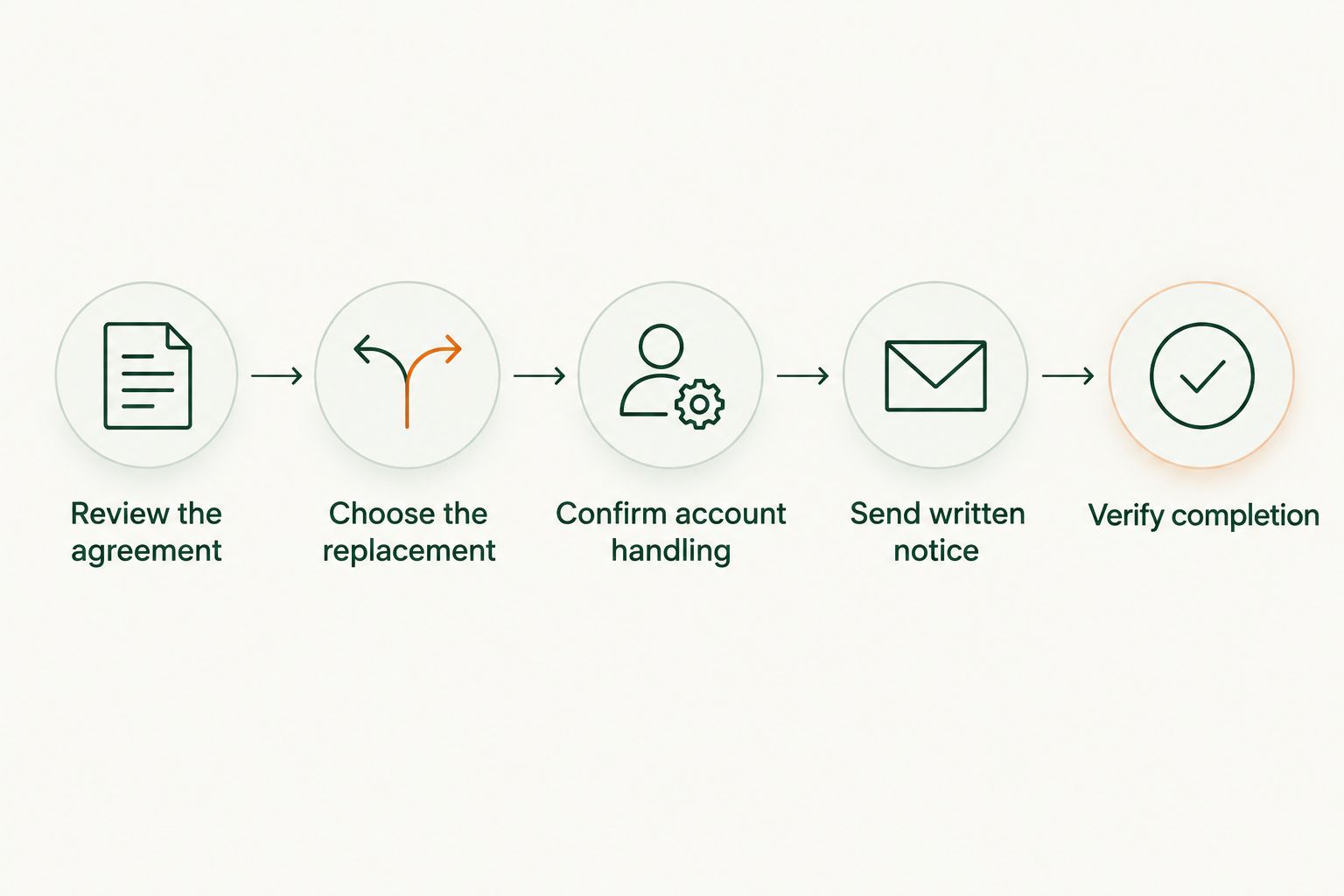
Use these 5 steps to separate the contractual decision from the account work.
Review the agreement
Read the termination provisions before sending notice. For a registered investment adviser, the firm's Form ADV Part 2A brochure also describes its advisory business, fees, and relevant conflicts; compare those disclosures with your agreement.
Identify who must receive the notice and whether the firm requires written instructions. Ask for a written explanation of final billing and any prepaid-fee refund that applies under your agreement. Keep copies outside the advisor's client portal so you retain access after termination.
Choose the replacement
Decide whether you want another advisor, a different custodian, or direct responsibility for the accounts. Those choices require different paperwork.
Before signing, ask the prospective advisor to review your account types and holdings. Confirm what the firm can manage, what must remain elsewhere, and who will coordinate with your tax preparer and estate-planning attorney. Do not accept a proposed sale merely because a holding is unfamiliar to the new advisor.
Confirm account handling
Ask the custodian how to remove the outgoing advisor's trading and fee-deduction authority. If the replacement can use your existing custodian, changing advisors does not necessarily require moving the assets.
If you need a new custodian, have the receiving institution explain which assets it accepts and how account registrations must match. Get specific instructions for retirement accounts, trusts, jointly owned accounts, and assets outside ordinary brokerage custody.
Send written notice
Follow the agreement's notice procedure and state the requested termination date. Ask the firm to acknowledge receipt and explain the status of any outstanding instructions.
Your notice should distinguish between ending the advisory relationship and authorizing transactions. A termination notice is not an instruction to liquidate the portfolio. If you do not want sales, say so and confirm the custodian's procedure for changing authority.
Verify completion
Check account access, advisor permissions, transferred holdings, scheduled distributions, and final billing. Compare the old and new statements rather than relying only on an email saying the transition is complete.
Obtain 2 written confirmations: acknowledgment of termination from the advisory firm and confirmation of the account-authority change from the custodian. For a transfer, also verify that the receiving account has the expected holdings and records.
Why this matters
An advisor change affects more than who answers your investment questions. Your household still needs retirement distributions, tax coordination, beneficiary information, and access to financial records while the relationship changes.
For a 2026 transition, identify the decisions already underway before making changes. A pending charitable gift, business transaction, or retirement withdrawal needs a named person responsible for follow-through. Replacing the advisor should not leave those decisions unattended.
You do not need to defend your choice indefinitely. A clear written instruction and an orderly handoff are more useful than a long argument about whether the relationship should continue.
Which replacement route fits your situation?
There are several ways to end an advisory relationship. Choose the route based on account compatibility and the help you still need, not on the assumption that everything must move.
| Route | Best for | Main advantage | Main limitation |
|---|---|---|---|
| New advisor, existing custodian | Investors whose replacement advisor supports the current custodian | Assets can remain where they are while advisory authority changes | The new advisor must support the account arrangement and holdings |
| New advisor, new custodian | Investors whose replacement relationship requires different custody | Advice and custody can be established together | Holdings, registrations, and transfer records need additional review |
| Self-directed accounts | Investors prepared to manage investments and planning themselves | Direct control without an ongoing advisory relationship | You take responsibility for portfolio decisions and planning coordination |
Changing advisors without changing custodians is an option to investigate, not a promise of compatibility. Ask the replacement firm to confirm eligibility before terminating a relationship you still depend on for active account tasks.
Self-directed investing also deserves an honest assessment. Managing a portfolio is only part of the work. If the outgoing advisor coordinated retirement withdrawals, estimated taxes, or estate-planning follow-up, assign those responsibilities before ending the service.
Why replacing a fiduciary advisor varies in difficulty
The fiduciary label does not determine transfer complexity. The contract, account structure, and investments do.
- Agreement terms: Notice requirements and termination provisions determine how you end the service relationship. Read the actual contract rather than relying on an informal summary.
- Custodian compatibility: A replacement advisor that supports your current custodian presents a different administrative task from a move to another institution.
- Investment restrictions: Proprietary investments, private holdings, and certain other assets require individual review. Do not assume every holding transfers in kind.
- Account ownership: Individual, joint, trust, and retirement accounts require the correct registration and authorized signatures. A change in ownership is not the same as a change in advisor.
- Pending activity: Open orders, unsettled trades, scheduled withdrawals, and other instructions need attention before or during the handoff.
- Tax and planning records: Missing cost-basis information or incomplete planning records adds work even when the assets themselves move successfully.
For your 2026 checklist, write down the issue, the responsible person, and the confirmation you need. This makes unresolved items visible without creating an artificial deadline that the institutions have not agreed to meet.
Will replacing an advisor force me to sell investments?
No. Replacing an advisor does not, by itself, require selling investments. An in-kind transfer moves eligible holdings without selling them, but the receiving institution must accept each holding.
Before approving sales in a taxable account, review the unrealized gains and losses with your tax professional. Selling an appreciated investment can create a taxable gain even when you immediately reinvest the proceeds elsewhere.
Distinguish between an administrative requirement and an investment recommendation. Ask: Is the sale necessary because the asset cannot be held at the receiving institution, or does the new advisor prefer a different portfolio? Those are different reasons and deserve different discussions.
For retirement accounts, use the appropriate institution-to-institution process and verify the account type. Changing an advisor is not a reason to request a personal distribution from an IRA. A distribution has tax and rollover implications that an advisor-authority change does not.
If a proposed 2026 transition includes both a custodian change and extensive portfolio sales, ask for a separate explanation of each. Combining them into a single instruction makes the tax consequences harder to evaluate.
Do I have to tell my current advisor why I am leaving?
You can communicate the decision without a lengthy explanation. Follow the agreement's termination procedure and provide the account instructions needed for an orderly handoff.
If the problem is service or communication, a brief explanation helps establish what remains unresolved. It is still your decision whether to continue the relationship. You are not required to accept another planning meeting simply because the advisor wants an opportunity to change your mind.
A useful notice states the decision, requested effective date, and request for written acknowledgment. It also asks about outstanding instructions and final billing. Avoid including account passwords or other sensitive credentials in ordinary email.
How do I protect my financial plan during the change?
Keep 3 records together: the latest financial plan, current account statements, and the investment cost-basis report. Add the signed advisory agreement, relevant tax documents, beneficiary information, and any open planning correspondence.
The purpose is continuity. Your replacement advisor should understand the existing decisions before recommending different ones.
For families with trusts, multiple properties, or business interests, list the professionals involved and the work each is handling. An investment advisor's departure does not change the legal authority of a trustee, executor, or attorney-in-fact. Changes to those roles require their own legal review.
For retirement income, confirm where recurring payments originate and who monitors them. Check whether cash is available for upcoming withdrawals and whether anyone needs to update standing instructions. Do not assume a new advisor inherits those instructions automatically.
Before your first planning review in 2026, identify which assumptions remain current. Retirement dates, spending needs, business-sale plans, and family circumstances deserve a fresh review, but a transfer alone does not justify rewriting every part of the plan.
What should I look for in the next advisory relationship?
Ask the replacement advisor to explain the service in plain language: who makes investment decisions, what financial planning includes, how the firm communicates, and how you can leave if the relationship stops working.
VIMNewEngland is best suited to individuals, families, and business owners seeking integrated financial planning and investment management. VIMNewEngland provides those services in one advisory relationship, covering savings, retirement, taxes, and estate planning.
The benefit of that structure is coordinated advice rather than separate planning conversations. The limitation is that an integrated service is not automatically the right fit for someone seeking only a one-time account-transfer task. Confirm the scope and agreement before deciding.
Whether you consider VIMNewEngland or another firm, ask who will manage the handoff and what information is needed from your current advisor. Evaluate the answers, not assurances that changing firms will be effortless.
Review your next advisory relationship
Consider integrated financial planning and investment management before changing advisors.
FAQ
Can a fiduciary financial advisor be fired or replaced in 2026?
Yes, you can fire or replace a fiduciary financial advisor in 2026. Follow the advisory agreement's termination procedure and separately confirm trading authority, billing, and any account transfers.
Can I keep my investments when I change financial advisors?
Yes, changing advisors does not automatically require selling your investments. Confirm that the replacement advisor and receiving custodian can support your existing holdings before authorizing a transfer.
Will my old advisor still be able to trade after I fire them?
Confirm with the custodian that the outgoing advisor's trading authority has been removed; do not rely only on your termination notice. Ask for written confirmation of the effective change.
Does firing a financial advisor create a tax bill?
Ending the advisory relationship itself is not a sale of investments. Sales in taxable accounts and distributions from retirement accounts can have tax consequences, so review those actions separately.
Do I have to move my accounts to replace my advisor?
No, replacing an advisor does not always require changing custodians. The replacement advisor must support your current custodian, account types, and holdings for that arrangement to work.
How long does switching to another fiduciary advisor take?
The timeline depends on the agreement, institutions, account registrations, and holdings involved. Ask for a written sequence of tasks and distinguish the termination date from the asset-transfer completion date.
Can I replace the advisor who manages a trust account?
The person with authority under the trust and account documents must authorize the advisory change. Review those documents and involve the trust's attorney when authority or required consent is unclear.
One last thing
Ending the relationship and confirming the handoff are different milestones. An acknowledged termination letter does not prove that account permissions, scheduled withdrawals, or transferred cost-basis records are correct.
Before calling your 2026 transition complete, open the account records yourself. Verify who has authority, what assets are present, and which planning tasks still need an owner. That final check protects the continuity you wanted from the change.