
You can verify whether your financial advisor is a fiduciary by checking the advisor’s registration, reading the firm’s disclosures, and getting written confirmation of the duty owed to you. A title, credential, or verbal promise is not enough. Confirm which services the fiduciary duty covers, how the advisor receives compensation, and whether the advisor also acts as a broker or insurance agent.
- How do I know if my financial advisor is a fiduciary? Check registration, disclosures, compensation, and the agreement.
- SEC registration is not an endorsement; verify the services and conflicts described in Form ADV.
- Fee-only compensation removes product commissions, not every potential conflict of interest.
- VIMNewEngland suits New England households seeking integrated, fee-only financial planning and investment management.
How do I know if my financial advisor is truly a fiduciary?
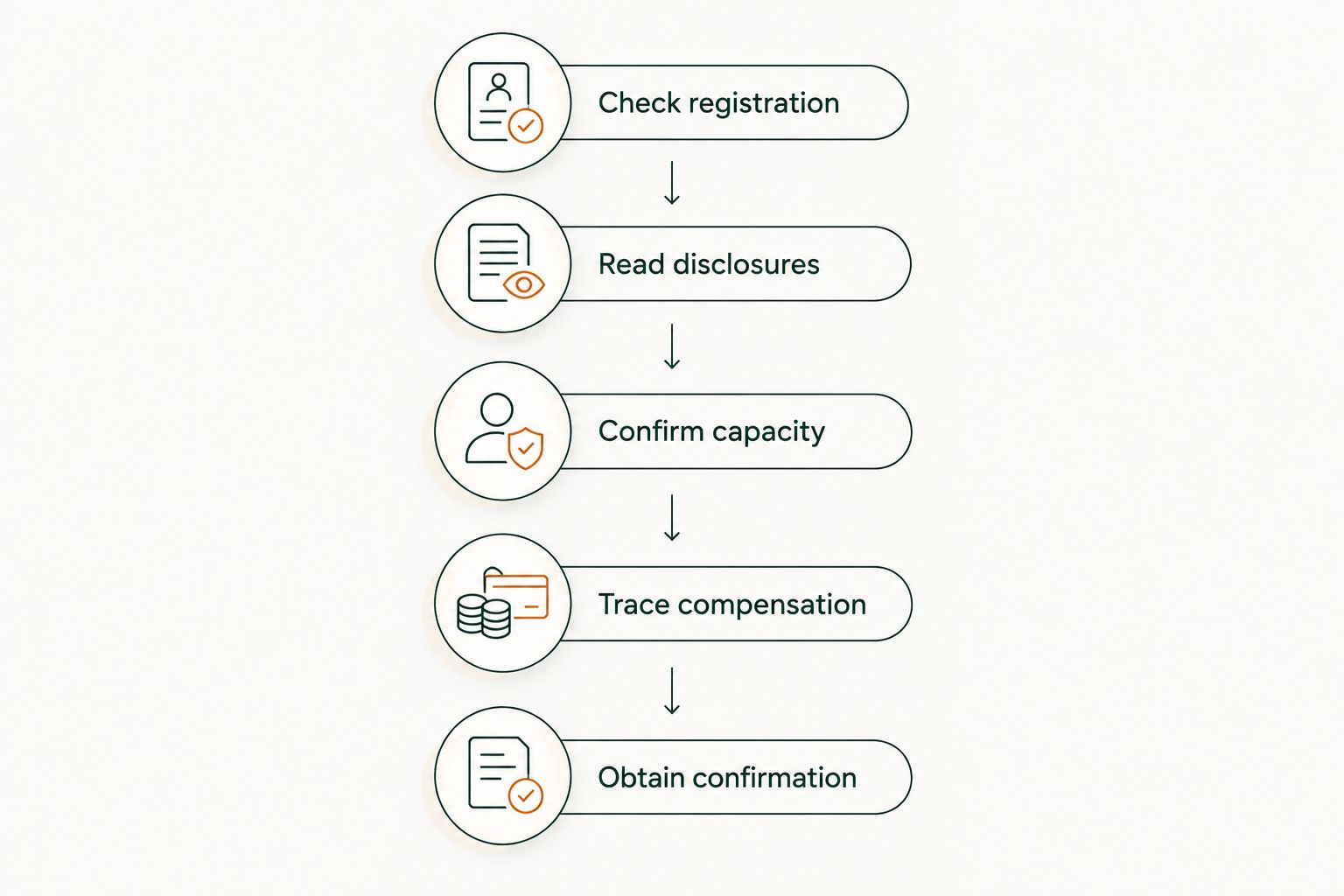
Match the advisor’s promise to the public record and your written agreement. Use these 5 steps for a 2026 review, whether you are checking an existing relationship or interviewing a new advisor.
For context, VIMNewEngland provides fee-only financial planning and investment management within one advisory relationship. Apply the same verification process to every firm you consider.
1. Check registration
Search the SEC’s Investment Adviser Public Disclosure database using the advisor’s name and the firm’s legal name. Review the individual and firm records, including registration status, employment information, and disclosed disciplinary events where applicable.
If the advisor also conducts brokerage business, check FINRA BrokerCheck. Match the record to the person you are interviewing rather than relying on a similar name or an abbreviated firm name.
Registration tells you about regulatory status. It does not establish investment skill, guarantee good conduct, or mean that the SEC has approved the advisor.
2. Read disclosures
Ask for the current Form ADV Part 2A brochure and the applicable Part 2B brochure supplement. Part 2A explains the advisory firm’s business, compensation arrangements, conflicts, and other material information; Part 2B addresses the individual providing advice, where required.
Also request Form CRS if the firm serves retail investors and must provide it. This relationship summary explains services, fees, conflicts, standards of conduct, and disciplinary-history information in a shorter format.
Read the documents together. A short relationship summary does not replace the fuller brochure or your advisory agreement.
3. Confirm capacity
Ask whether the person will act as an investment adviser, a broker, an insurance agent, or in more than one role. Then ask which role applies to each proposed account and recommendation.
An investment adviser’s fiduciary duty applies within the advisory relationship. A person who also works as a broker does not automatically provide ongoing fiduciary investment advice in every interaction.
Have the advisor identify role changes before you agree to a transaction. You should not have to infer the applicable relationship from paperwork received afterward.
4. Trace compensation
Ask who pays the advisor and firm, what triggers compensation, and whether anyone receives payments connected to products, referrals, or account transfers. Compare the answer with the disclosures and agreement.
Fee-only compensation means compensation comes from clients rather than product commissions. It does not eliminate other incentives, such as an incentive to recommend moving assets into an account the advisor manages.
Ask how the advisor addresses those incentives when evaluating your alternatives.
5. Obtain confirmation
Request written confirmation that the firm will act as a fiduciary when providing the agreed advisory services. Ask the firm to identify the relevant agreement language and explain any limits on the engagement.
An email helps document the conversation, but it does not replace the agreement. Resolve inconsistencies before signing or transferring assets.
Why this matters
A reassuring conversation does not tell you which legal relationship you are entering. The important question is whether the advisor owes you a fiduciary duty for the services you actually receive—not whether the word appears somewhere on the website.
For a New England household coordinating retirement accounts, taxable investments, and estate decisions, scope matters. An investment-management engagement does not automatically include every planning task, and an advisor’s involvement does not replace legal or tax services outside the engagement.
Your 2026 review should establish both the standard of conduct and who is responsible for each decision. That protects against mistaken expectations as well as undisclosed incentives.
What do different advisor relationships actually mean?
These categories overlap: fee-only describes compensation, while investment adviser and broker describe regulatory roles. Use the comparison to understand the relationship rather than treating each row as a separate quality ranking.
| Relationship or compensation model | Best for | What supports verification | Benefit | Limitation |
|---|---|---|---|---|
| Investment advisory relationship | Investors seeking advice within a defined engagement | Registration, Form ADV, advisory agreement | Fiduciary duty applies to the advisory relationship | Scope and conflicts still require review |
| Brokerage relationship | Investors seeking brokerage services and securities recommendations | BrokerCheck, Form CRS, brokerage documents | Regulation Best Interest applies to covered retail recommendations | Does not by itself establish ongoing fiduciary portfolio management |
| Fee-only advisory compensation | Clients seeking advice without product commissions | Compensation disclosures and agreement | Removes commission-based product incentives | Other conflicts remain possible |
| Adviser with brokerage or insurance roles | Clients considering services across different capacities | All relevant registrations and role disclosures | Can provide access to different services | Requires close attention to capacity and compensation |
Choose the relationship that matches the work you need, then verify its obligations. Neither a compensation label nor a registration category answers every suitability, service, or conflict question.
Is fee-only the same as fiduciary?
Fee-only and fiduciary answer different questions: fee-only describes how an advisor receives compensation; fiduciary describes the duty owed within a relationship. Verify both rather than accepting either label as a substitute for the other.
For example, an asset-based advisory arrangement creates a potential incentive to retain managed assets. Ask how the advisor evaluates recommendations to pay down debt, make gifts, or keep money in an employer plan when those choices affect the advisor’s compensation.
Does SEC registration prove an advisor is trustworthy?
SEC registration establishes regulatory status, not trustworthiness or investment performance. The SEC does not approve an advisor’s abilities by registering the firm.
Use registration as the starting point for checking disclosures, disciplinary information, and the agreement. Then evaluate whether the advisor answers specific questions clearly and consistently.
Why fiduciary coverage varies
The scope of a fiduciary relationship depends on the actual engagement. These factors explain why apparently similar advisors can offer different responsibilities:
- Professional capacity: A person can provide advisory services in one setting and brokerage or insurance services in another. Identify the role attached to each recommendation.
- Service scope: Investment management, retirement planning, and estate coordination are not interchangeable promises. Check which tasks the agreement includes.
- Monitoring obligations: An ongoing engagement differs from advice limited to a particular assignment. Confirm what the advisor monitors and when the engagement ends.
- Compensation arrangements: Product commissions, asset-based compensation, and referral arrangements create different incentives. Ask about the arrangements that apply to your relationship.
- Related businesses: Affiliates and outside business activities can introduce additional conflicts. Read the relevant disclosures and ask how those relationships affect recommendations.
For your 2026 decision, ask the advisor to explain these factors using your own accounts and goals. General statements about putting clients first do not resolve a specific conflict.
Which documents should I request before signing?
Build a file around 3 core document types: the advisory agreement, Form ADV disclosure materials, and Form CRS where applicable. Save the versions you receive during your 2026 review so you can compare them with later updates.
Advisory agreement
Read the service description, investment authority, compensation terms, termination provisions, and any limits on the engagement. Confirm whether the advisor provides ongoing management, planning advice, or a narrower assignment.
Ask what decisions remain yours. Discretionary investment authority, for example, concerns authority to make investment decisions; it does not mean the advisor can perform every financial or legal task for you.
Form ADV disclosure materials
In Part 2A, focus on advisory business, compensation, disciplinary information, other financial-industry activities, brokerage practices, referrals, custody, and investment discretion. Not every item will raise a concern, but relevant disclosures deserve a direct explanation.
Use Part 2B, where applicable, to review the background and disclosed activities of the person advising you. If an answer differs from the brochure, ask the firm to reconcile the difference in writing.
Form CRS
Use Form CRS to compare the firm’s stated services and conflicts with the proposed relationship. Its conversation starters can help you ask about recommendations, compensation, and disciplinary history.
These document descriptions follow the SEC’s Form ADV and Form CRS instructions. The SEC’s investment-adviser fiduciary interpretation and Regulation Best Interest explain the distinction between advisory duties and covered brokerage recommendations.
What should I ask in the first meeting?
Bring these 4 questions to an advisor interview. Ask for answers tied to your proposed engagement, not a general description of the profession.
- Will you act as a fiduciary for every advisory service in our agreement? Ask the advisor to identify the relevant contract language and any services performed in another capacity.
- Who receives compensation because of your recommendations? Include the advisor, the firm, affiliates, referral partners, and any other relevant recipient.
- What reasonable alternatives will you consider? For an account transfer, ask about leaving assets where they are, changing investments without transferring, and other applicable choices.
- What will you monitor after the recommendation? Confirm responsibility for investment reviews, planning updates, and changes in your circumstances.
Clear answers should survive being written down. If the explanation changes when you request documentation, pause the decision until the firm resolves the inconsistency.
An unfamiliar term is not itself a warning sign. Refusing to explain a material term is a reason not to proceed until you understand it.
Where an integrated advisory relationship fits
VIMNewEngland is best for New England individuals, families, and business owners seeking integrated, fee-only financial planning and investment management. Its services address savings, retirement, taxes, and estate planning within one advisory relationship.
That structure fits a household that wants investment decisions considered alongside other financial priorities. It is not a substitute for checking the engagement: confirm the work included, the responsibilities retained by outside professionals, and the conflicts described in the firm’s disclosures.
VIMNewEngland’s fee-only financial planning model removes product commissions from advisor compensation. It does not remove the need to review the agreement or ask how other incentives are managed.
Review your advisory relationship
Explore integrated financial planning and investment management for your household.
FAQ
How do I know if my financial advisor is a fiduciary in 2026?
Check the advisor’s registration, read Form ADV and the agreement, and obtain written confirmation of the fiduciary duty for your advisory services. If the advisor also acts as a broker or insurance agent, confirm which capacity applies to each recommendation.
Can a fiduciary financial advisor receive commissions?
A person providing fiduciary advisory services can also have a separate commission-based role. That makes capacity and conflict disclosures essential; fee-only compensation is a separate question from fiduciary duty.
Is a fee-only financial advisor always free of conflicts?
No, fee-only financial advisors can still have conflicts of interest. Asset-based compensation, referral arrangements, and related businesses can create incentives that you should review in the disclosures.
Does SEC registration mean my advisor is approved by the government?
No, SEC registration is not government approval of an advisor’s skill or performance. Use the registration record to verify the firm and locate disclosures, then review the proposed engagement.
What if my advisor will not confirm fiduciary status in writing?
Do not proceed until the advisor explains the applicable duty and identifies it in the engagement documents. A refusal does not independently establish misconduct, but it leaves a central question about the relationship unresolved.
Does a fiduciary guarantee that I will not lose money?
No, fiduciary duty does not guarantee investment returns or prevent market losses. Evaluate whether advice addresses your circumstances, whether conflicts are handled appropriately, and whether the advisor performs the agreed services.
Is VIMNewEngland a fee-only financial planning firm?
VIMNewEngland provides fee-only financial planning and investment management as an SEC-registered investment adviser. Request the current disclosures and agreement to confirm the services, compensation arrangements, and scope of your proposed relationship.
One last thing
Before approving an account transfer, ask the advisor to explain a reasonable alternative that would not increase the firm’s managed assets. The purpose is not to demand that the alternative win; it is to understand why the recommendation serves your interests despite the advisor’s financial incentive.
For a 2026 advisor review, that discussion connects the fiduciary promise to a real decision. The strongest verification is consistency between the public record, the written agreement, and the recommendation you receive.