
A flat fee is the better fit when you want a clearly defined scope and a charge that does not automatically rise with your portfolio; an assets-under-management (AUM) fee fits an ongoing relationship centered on managing your investments. Neither structure is better by itself: compare the work included, the total charges, and the incentives before choosing a wealth manager in 2026.
- Is a flat fee or AUM fee better for wealth management? Choose by service scope, not the billing label.
- Flat fees suit defined planning needs; confirm whether ongoing investment management is included.
- AUM fees suit delegated portfolio management; check which assets count toward billing.
- VIMNewEngland suits households seeking integrated financial planning and investment management, not a standalone investment recommendation.
VIMNewEngland provides fee-only financial planning and investment management as an integrated advisory relationship. That distinction matters: compare a combined service with another combined service, rather than comparing its fee with a planning-only engagement.
Is a flat fee or AUM fee better for wealth management?
Choose a flat fee for a defined engagement; consider an AUM fee for ongoing portfolio responsibility. Either arrangement can include financial planning, but the agreement—not the fee label—determines what you receive.
| Comparison | Flat fee | AUM fee |
|---|---|---|
| Best for | Defined planning work or an ongoing relationship with a stated charge | Ongoing investment management billed against managed assets |
| Billing basis | An agreed charge for the specified engagement or period | A percentage applied to assets covered by the agreement |
| Main advantage | Portfolio growth alone does not automatically increase the stated charge | The billing basis connects directly to the assets being managed |
| Main limitation | Additional work or a wider scope can require a revised agreement | The charge can increase as billable assets increase |
| Planning coverage | Depends on the agreement | Depends on the agreement |
| Question to ask | What work falls outside this engagement? | Which assets are billable, and how are they valued? |
A flat-fee proposal and an AUM proposal are not equivalent until you have matched their responsibilities. A written plan you implement yourself is different from an ongoing relationship in which the advisor manages investments and updates planning recommendations.
Why this matters
Your financial decisions do not arrive in separate compartments. A retirement withdrawal affects your portfolio and taxes; a beneficiary designation connects an investment account with your estate intentions.
When comparing wealth management proposals in 2026, identify who is responsible for connecting those decisions. A lower advisory charge does not resolve an important task that nobody has agreed to handle.
You also need to distinguish advice from implementation. An advisor might recommend a change without executing it, and an investment manager might manage an account without reviewing every part of your financial life. Ask for those boundaries in writing.
Flat fee: best for a defined scope and a stated charge
A flat fee gives you an agreed charge for specified work. The engagement might cover a particular planning project or an ongoing relationship; the term alone does not tell you which.
The advantage is a billing structure that does not automatically increase when your portfolio grows. That can make the arrangement easier to evaluate when you know the work you want and understand who will implement the recommendations.
The limitation is scope. A written plan does not necessarily include portfolio trading, continuing reviews, implementation help, or coordination with other professionals. An ongoing flat-fee agreement can include those responsibilities, but you must verify them rather than assume them.
Before signing, ask:
- What specific decisions and deliverables does the engagement cover?
- Who implements investment recommendations?
- What happens when your circumstances change?
- What work requires a new agreement?
- How and when can the stated charge change?
A flat fee is not automatically permanent. Read the renewal and scope-change provisions so that a stated charge does not become a mistaken expectation about future work.
AUM fee: best for delegated investment management
An AUM fee applies a stated rate to assets covered by the advisory agreement. The agreement should explain the calculation, valuation method, billing timing, and treatment of deposits and withdrawals.
The advantage is a structure built around an ongoing investment-management relationship. It suits a household that wants an advisor responsible for portfolio decisions rather than a plan the household must carry out alone.
The limitation is that account growth can increase the charge without a corresponding increase in planning work. Conversely, a smaller portfolio does not necessarily make your retirement, tax, or estate decisions simpler.
Ask whether cash is billable, whether certain accounts are excluded, and whether the schedule changes across asset levels. Also ask whether the advisor charges separately for planning or includes it within the investment-management relationship.
Do not assume every account must move. Establish which assets the advisor would manage, which would remain elsewhere, and whether outside assets receive advice without becoming billable assets.
Why wealth management fees vary
A useful comparison separates the billing formula from the responsibilities behind it. These factors explain why proposals with similar labels can cover different work:
- Service scope. Investment management alone is different from a relationship that also addresses savings, retirement, taxes, and estate planning.
- Implementation responsibility. Recommendations require a different commitment from executing decisions and following up on them.
- Account coverage. The agreement determines which accounts receive management, advice, or neither.
- Planning complexity. Business interests, retirement transitions, and estate coordination create different questions from a narrowly defined planning project.
- Ongoing access. Confirm what reviews and communication the engagement includes, rather than interpreting “ongoing” yourself.
- Separate charges. Investment expenses and outside professional work need to be distinguished from the advisor’s own charge.
For a 2026 comparison, use the same household facts in each discussion. Otherwise, you risk comparing an estimate for limited advice with a proposal for continuing responsibility.
How do you compare a flat-fee and AUM proposal fairly?
Match responsibilities before comparing the billing formula. This process helps you identify whether a difference reflects the service, the calculation, or an exclusion.
- Define the work. List the decisions you want help with, including investments, retirement income, taxes, and estate coordination where relevant.
- Match the scope. Ask each advisor to identify included work, excluded work, and who implements recommendations.
- Check total charges. Request a written explanation of advisory charges, underlying investment expenses, and any separate professional work.
- Review conflicts. Discuss recommendations that affect compensation, including transfers, withdrawals, and changes to the engagement.
- Confirm the agreement. Read billing, renewal, termination, and service provisions before authorizing the relationship.
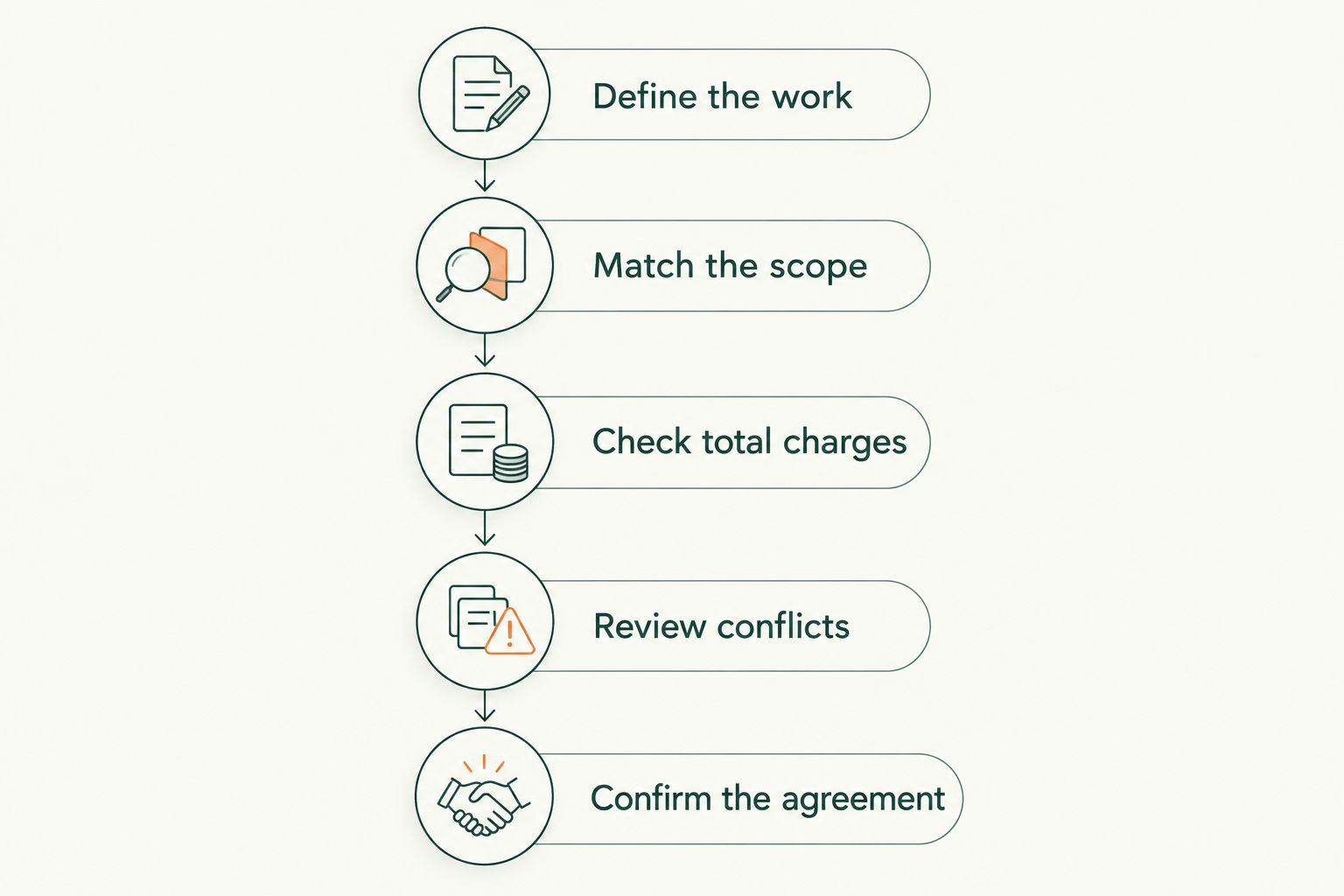
Ask each advisor to walk through the same real decision, such as funding retirement spending or reviewing an account transfer. You will learn more from an explanation of responsibilities than from a general promise of personal service.
Keep the written answers beside the proposed agreement. If a conversation describes support that the agreement excludes, resolve the difference before you sign.
Is a flat fee always cheaper than an AUM fee?
A flat fee is not always cheaper than an AUM fee. The answer depends on the actual proposals, the assets subject to billing, the period covered, and the work included.
Compare the projected advisory charges over the same period, using the same account balances. Then identify services that one proposal includes and the other excludes; a lower total for less work is not proof of better value.
Ask how the comparison changes if you add assets, take withdrawals, or need additional planning. You do not need a forecast of investment returns to understand how each agreement responds to those events.
Does fee-only mean the advisor charges a flat fee?
Fee-only does not mean flat fee. Fee-only describes the advisor’s compensation source, while flat fee and AUM describe ways of calculating the advisory charge.
An advisor can use either billing method within a fee-only arrangement. Neither label, by itself, tells you whether the relationship includes retirement planning, tax planning, or estate coordination.
For your 2026 advisor search, ask separately about compensation, fiduciary responsibilities, services, and billing. Combining those questions into “Are you fee-only?” leaves too much unanswered.
Does an AUM fee create a conflict around withdrawals?
An AUM fee creates a compensation incentive to retain billable assets. A withdrawal or transfer can reduce the assets used to calculate the advisor’s charge, depending on the agreement.
That incentive does not establish that a recommendation is wrong. It does mean you should ask how the advisor evaluates decisions such as paying down debt, making gifts, or leaving assets in a workplace retirement plan.
Flat fees also require scrutiny. If additional work does not change the charge, clarify service boundaries, responsiveness, and how the advisor handles needs outside the agreed scope. No billing method removes the need to examine conflicts.
Where an integrated advisory relationship fits
VIMNewEngland wealth management combines personalized financial planning and investment management, including savings, retirement, taxes, and estate planning. VIMNewEngland is best for households seeking one integrated advisory relationship rather than separate planning and investment services.
That model is relevant when you want investment decisions connected to the rest of your financial life. It is a different service shape from seeking advice on an isolated question and implementing the answer yourself.
The trade-off is fit: you should not assume a continuing advisory relationship is necessary for every limited task. Ask whether the proposed responsibilities match your needs, and confirm the actual billing terms instead of inferring them from the firm’s fee-only status.
FAQ
Is a flat fee or AUM fee better for wealth management in 2026?
A flat fee is better suited to a defined engagement with a stated charge, while an AUM fee suits ongoing investment management billed against managed assets. Compare service scope, total charges, and conflicts before choosing.
Can a flat-fee financial advisor manage my investments too?
A flat-fee financial advisor can include investment management if the advisory agreement covers it. Confirm trading authority, account coverage, monitoring, and planning responsibilities rather than assuming they are included.
Does an AUM fee include financial planning?
An AUM fee includes financial planning only when the agreement says it does. Ask which planning topics, reviews, and implementation responsibilities are included and which require a separate engagement.
Will my AUM fee increase when my investments grow?
An AUM charge increases when billable assets increase if the applicable rate and other billing terms remain unchanged. Tiered schedules, valuation methods, and account exclusions affect the calculation.
Is a flat-fee advisor automatically a fiduciary?
A flat fee does not, by itself, establish fiduciary status. Ask the advisor to explain the capacity in which they provide advice and document their responsibilities in the agreement.
What should I ask VIMNewEngland about wealth management fees?
Ask VIMNewEngland which financial planning and investment-management responsibilities the proposed relationship includes and how the advisory charge is calculated. Confirm account coverage, separate expenses, billing changes, and termination terms in writing.
One last thing
Ask what happens when the right recommendation reduces the advisor’s compensation. An account withdrawal, a decision not to transfer assets, or a narrower engagement gives you a concrete way to discuss incentives without assuming bad intent.
The useful answer explains the recommendation, the alternatives, and the compensation effect plainly. That conversation tells you something a fee label cannot: how the advisor handles a decision when your needs and the billing formula point in different directions.