
Yes, consolidating accounts with one fiduciary advisor is worth it when a coordinated plan improves your investment decisions, retirement withdrawals, and tax planning—not simply when it reduces the number of statements. The main caveat is that transferring accounts can involve taxable sales, lost account features, or changes to retirement-plan protections. In 2026, consolidate the advice first, then move only the accounts that benefit from moving.
- Is it worth consolidating accounts with one advisor? Yes, when coordinated financial planning outweighs transfer risks.
- VIMNewEngland fits households seeking financial planning and investment management within one advisory relationship.
- One fiduciary advisor does not necessarily mean one custodian or one combined account.
- Review taxes, ownership, retirement-plan features, and conflicts before authorizing transfers.
Is it worth consolidating accounts with one fiduciary advisor?
The strongest reason to consolidate is shared decision-making across your financial life. An advisor who understands your taxable investments, retirement accounts, cash needs, and estate intentions can evaluate decisions together rather than account by account.
VIMNewEngland provides fee-only financial planning and investment management as an integrated advisory relationship. That structure is relevant when you want savings, retirement, taxes, and estate planning considered together. The service scope matters more than whether every account appears on the same statement.
There are several ways to organize that relationship. Moving everything is only one of them.
| Approach | Best for | Main benefit | Main limitation |
|---|---|---|---|
| One advisor, accounts at multiple custodians | Households that need coordination while retaining useful accounts | A shared plan without requiring every account to move | Account access and trading authority depend on the arrangement |
| One advisor, selected accounts transferred | Households with scattered investments and account-specific reasons to retain others | Simpler oversight of transferred assets while preserving useful features elsewhere | Transfers require tax, ownership, and account-feature review |
| Separate advisors with defined responsibilities | Households with distinct mandates or specialist needs | Retains specialist input and an independent perspective | Someone must reconcile overlapping advice and portfolio decisions |
Best for most coordination problems: start with one accountable planning relationship, not an automatic transfer of every asset. Separate specialists remain useful when their responsibilities are clear and their advice fits the same household plan.
Why this matters
A portfolio can look sensible in each account and still be poorly coordinated overall. Similar funds can create overlapping exposure, while separate advisors can make recommendations without seeing your total cash needs or upcoming withdrawals.
The practical question in 2026 is not how many logins you have. It is whether someone can explain how your accounts work together—and who is responsible for acting when the plan needs to change.
For a New England household, that discussion should include property-related cash needs, retirement plans, and the state tax consequences relevant to your circumstances. An account transfer does not resolve those questions by itself.
One advisor does not mean one combined account
Consolidation can mean centralizing advice, centralizing custody, or both. Keep those decisions separate. An advisor provides advice and, where authorized, manages investments; a custodian holds assets and maintains account records.
Different account registrations still serve different purposes. Your individual taxable account, joint account, trust account, and retirement account do not become interchangeable because the same advisor oversees them.
Keeping the distinctions protects the logic of your plan. Ownership affects who controls an account, tax treatment affects how money moves, and beneficiary designations affect what happens after death.
Before transferring assets, clarify whether the advisor will manage an account directly, include it in planning only, or leave it outside the relationship. The guide to fiduciary management across multiple custodians addresses that distinction.
Require an account-by-account scope of responsibility. A household summary is useful, but it is not the same as authority to monitor, rebalance, or trade every account shown on it.
When consolidating accounts earns its place
Consolidation is most useful when it solves a specific coordination problem. Identify that problem before evaluating the transfer proposal.
- Investment overlap: Ask for a household-level view of holdings and exposures. The benefit is coordinated allocation; the limitation is that fewer accounts do not automatically produce better diversification.
- Retirement withdrawals: Ask how taxable and retirement accounts will support spending together. The benefit is a shared withdrawal plan; the limitation is that tax consequences still require individual review.
- Cash management: Ask which assets support near-term spending and which remain invested for longer-term goals. The benefit is clarity; the limitation is that a consolidated dashboard does not itself establish an appropriate cash reserve.
- Estate coordination: Ask how ownership and beneficiary instructions connect to your estate documents. The benefit is fewer disconnected decisions; the limitation is that financial advice does not replace legal drafting.
- Household administration: Ask who handles follow-up when account information changes. The benefit is clear responsibility; the limitation is dependence on the advisor's actual service scope.
These are reasons to coordinate advice, not reasons to surrender useful account features. If the proposed move does not address an identifiable problem, ask why it belongs in the plan.
When keeping an account separate is the better choice
Keep an account where it is when its existing features serve a clear purpose that a transfer would compromise. An active employer retirement plan, an account with transfer restrictions, or a position with significant tax consequences deserves separate review.
A retirement-plan rollover is not merely administrative cleanup. Investment choices, distribution rules, creditor protections, and plan-specific features can differ from those of an IRA. Compare what you would give up with what the receiving account would provide.
A taxable account requires a different analysis. Moving eligible securities without selling them generally differs from liquidating holdings and moving cash. If a proposed transfer requires sales, ask which gains or losses would be realized and why selling is necessary.
Trust accounts and inherited retirement accounts also require care. Their ownership and distribution requirements cannot be treated like those of an ordinary individual account.
Keeping an account separate does not mean ignoring it. Give the planning advisor the information needed to understand its role, and define who remains responsible for decisions within it.
Why the value of consolidation varies
The value of consolidating accounts with one advisor in 2026 depends on the decisions the relationship must support—not just the amount transferred.
- Planning complexity: Retirement, business ownership, estate intentions, and family support create decisions that interact.
- Existing account features: Employer-plan provisions, account registrations, and investment restrictions affect what should move.
- Tax consequences: Unrealized gains, retirement-account treatment, and anticipated withdrawals affect transfer choices.
- Advisor responsibility: Direct management, planning-only oversight, and coordination with specialists are different commitments.
- Your preferred involvement: Some households want delegated investment decisions; others want recommendations while retaining control.
- Service boundaries: Tax planning and estate coordination are different from preparing tax returns or drafting legal documents.
Ask the advisor to connect each proposed transfer to one of these factors. A recommendation should explain both the expected benefit and what you would lose or complicate by moving.
How to consolidate without losing useful account features
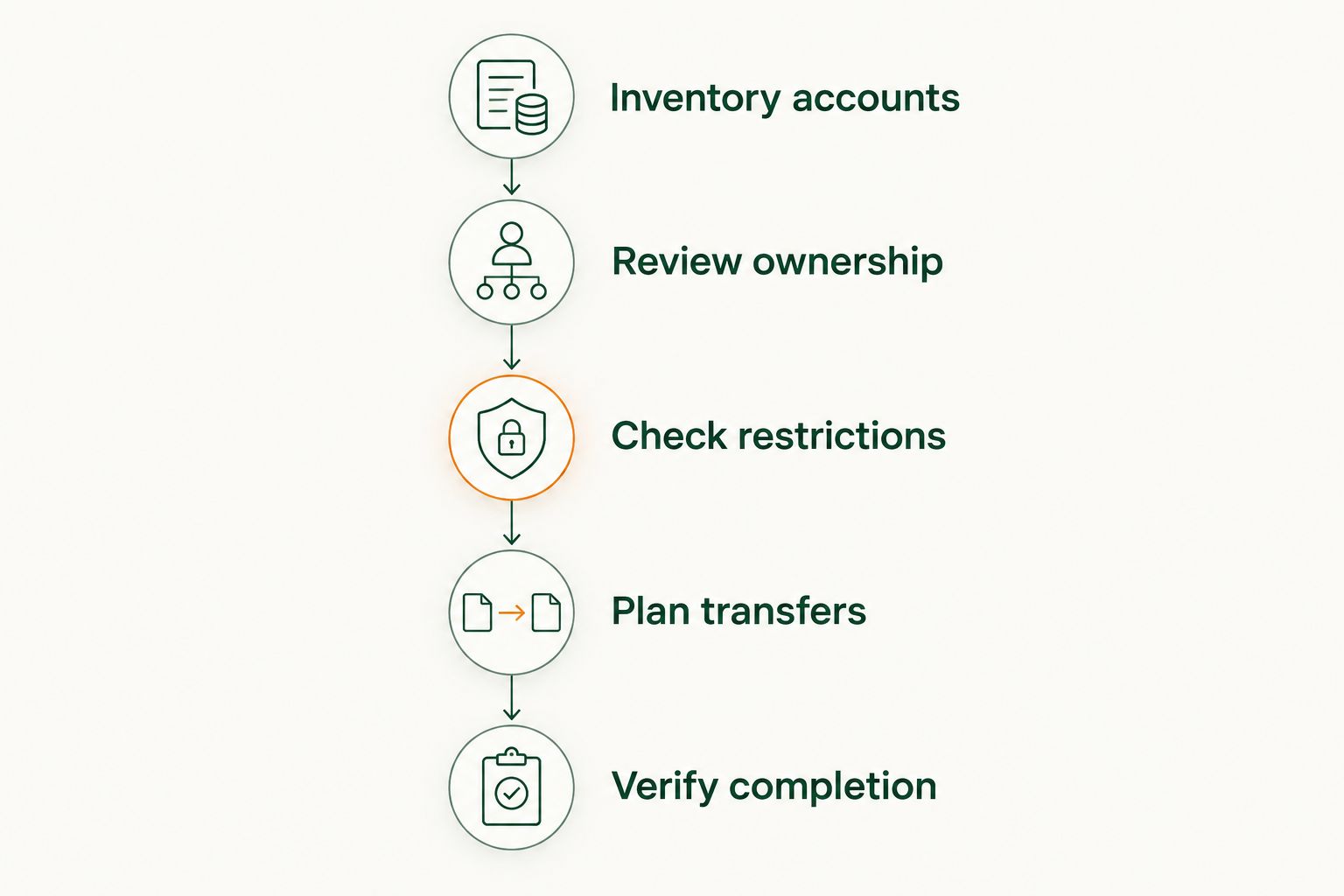
Use this sequence for a 2026 consolidation review. Agree on the destination and the transfer method before authorizing account closures or sales.
1. Inventory accounts
Gather current statements and identify each account's purpose. Include ownership, beneficiaries, holdings, cash needs, and the person currently responsible for investment decisions.
Separate assets available for management from assets that need planning attention only. An employer plan or a business interest can matter to the household plan without being transferable to the advisor.
2. Review ownership
Confirm the registration of each receiving account before moving assets. Individual, joint, trust, and retirement registrations carry different implications.
Review beneficiary instructions alongside ownership. Do not assume a transfer automatically recreates every instruction exactly as intended; verify the receiving account's records.
3. Check restrictions
Identify holdings that cannot transfer as they are, along with account features you want to retain. Ask whether a transfer would require selling investments or changing how you access money.
For retirement accounts, review the proposed transaction with the relevant tax and plan considerations in view. A rollover, a conversion, and an ordinary taxable-account transfer are different transactions.
4. Plan transfers
Ask for a written explanation of what moves, what stays, and why. Include how scheduled withdrawals, deposits, and investment activity will be handled during the transition.
Clarify who authorizes trades and who resolves transfer problems. Keeping responsibility explicit prevents an account from falling between the outgoing and incoming arrangements.
5. Verify completion
Compare the receiving records with the transfer plan. Check holdings, cash balances, ownership, beneficiary designations, and available tax-lot information.
Confirm recurring instructions separately. A transfer is complete only when the account works as intended, not merely when the assets appear on a statement.
What should you ask a fiduciary advisor before moving accounts?
Ask the advisor to explain the recommendation in terms of your interests, including alternatives to transferring. A fiduciary relationship still requires clarity about conflicts, authority, and the services covered by the agreement.
Useful questions include:
- Will you act as a fiduciary throughout this advisory relationship?
- Which accounts will you manage, and which will you consider only for planning?
- Why is transferring preferable to leaving this account in place?
- Does your compensation change if I transfer more assets?
- Which existing features or protections would I lose?
- How will you coordinate with my accountant and estate attorney?
- Who holds my assets, and how will I receive independent account statements?
- What happens to the accounts if I end the advisory relationship?
Choose the relationship based on responsibilities you can verify, not reassurance alone. Fee-only describes compensation; it does not, by itself, tell you how broad the planning service is or how a transfer recommendation was evaluated.
VIMNewEngland is a fee-only, SEC-registered RIA offering financial planning and investment management. Registration does not establish investment performance or guarantee outcomes. Evaluate the written scope and the fit with your household's needs.
Explore an integrated advisory relationship
Consider financial planning and investment management together before deciding which accounts to move.
Can one fiduciary advisor oversee accounts without moving them?
Yes, one fiduciary advisor can incorporate accounts held elsewhere into a financial plan when the arrangement supports it. Direct trading authority and ongoing monitoring depend on the account and advisory agreement, so distinguish planning visibility from investment management.
Does moving investments to one advisor create a tax bill?
Moving investments does not automatically create a tax bill; selling appreciated investments or changing an account's tax treatment can. For a 2026 transfer, confirm the transaction type and any required sales before approving the move.
Is one advisor better than keeping separate financial specialists?
One advisor is better for coordinating a household plan when that advisor has clear responsibility and access to relevant information. Separate accountants, attorneys, and investment specialists still have a role; central coordination should connect their work, not pretend to replace it.
FAQ
Is it worth consolidating accounts with one advisor if my investments are already diversified?
Yes, if consolidation improves planning or administration, but diversification alone is not a reason to transfer. Ask what changes in your household decisions, not just your account count.
Do I have to move every account to work with one fiduciary advisor?
No, one advisory relationship does not inherently require every account to move. Confirm which accounts the advisor will manage directly and which will remain part of planning only.
Can I combine my IRA and taxable brokerage account?
No, an IRA and a taxable brokerage account retain separate tax treatment and registrations. One advisor can coordinate them without merging them into a single account.
Should I roll over an old employer retirement plan just to simplify things?
No, convenience alone is not enough to justify a rollover. Compare the existing plan's features, investment choices, distribution rules, and applicable protections with the proposed IRA.
Does fee-only mean an advisor has no conflicts of interest?
No, fee-only compensation does not eliminate every conflict. Ask how recommendations to transfer assets affect compensation and how those conflicts are addressed.
Will consolidating accounts guarantee better investment returns?
No, consolidating accounts does not guarantee better returns. Its practical value is clearer oversight and coordinated decisions, subject to the quality and scope of the advice.
Can my financial advisor replace my accountant and estate attorney?
No, financial planning does not automatically include tax-return preparation or legal drafting. Confirm who performs each task and how the professionals coordinate.
What should I check after my accounts transfer?
Check holdings, ownership, beneficiaries, cash balances, available cost-basis records, and recurring instructions. Confirm that the receiving accounts match the agreed transfer plan.
One last thing
Fewer accounts can still mean the same unresolved decisions. Before signing a 2026 transfer authorization, ask for a short written explanation of what will improve, what will remain unchanged, and what deserves to stay separate.
VIMNewEngland's integrated financial planning and investment management is relevant to that coordination decision. The right next step is a discussion about your household's needs—not an assumption that every account must move.