
A straightforward account transfer to a new advisor takes several business days once the receiving firm accepts a complete request; transfers involving unsupported investments, retirement-plan distributions, or ownership changes take longer. Changing advisors without changing custodians is a different process, and the transfer is not finished until you confirm the holdings, account instructions, and any outstanding payments.
- FINRA transfer rules address firm-to-firm processing, not your new advisor’s entire onboarding process.
- How long does it take to transfer accounts to a new advisor? The transfer method and account details determine timing.
- An in-kind account transfer moves eligible investments without requiring you to sell them.
- Confirm retirement withdrawals, beneficiaries, and cost basis before treating an account transfer as complete.
How long does it take to transfer accounts to a new advisor?
Separate the time needed to move your investments from the time needed to establish your new advisory relationship. Signing an advisory agreement, opening receiving accounts, transferring assets, and putting a financial plan into practice are distinct milestones.
For your 2026 transfer, FINRA Rule 11870 provides the relevant processing framework for eligible transfers between member firms. The delivering firm generally must validate or take exception to the request within 1 business day of receiving it. Following validation, it generally must complete the transfer within 3 business days; exceptions and assets outside the standard process require separate handling.
Those deadlines do not start when you first speak with an advisor. They also do not promise that every holding, late dividend, or account record arrives together.
| Transfer route | Best for | Main advantage | Main limitation |
|---|---|---|---|
| Advisor change only | Keeping accounts at the same custodian | Assets need not move between institutions | Advisory authority and agreements still need updating |
| Automated account transfer | Eligible brokerage accounts moving between participating institutions | Standardized transfer processing | Unsupported holdings or incorrect details interrupt processing |
| Manual transfer | Assets outside the automated process | Accommodates transfers requiring separate instructions | Timing depends on the institutions and assets involved |
| Employer-plan rollover | Moving eligible workplace retirement savings | Connects retirement assets with the receiving account | Plan distribution procedures differ from brokerage transfers |
If you are considering keeping your existing institutions, start with connecting Schwab or Fidelity accounts to a fiduciary plan. Establish whether you actually need an asset transfer before planning around one.
Why this matters
A transfer affects more than where your statement comes from. You need to preserve access to spending money, maintain retirement distributions, and keep the information needed for tax reporting.
For New England families managing taxable investments, retirement accounts, and trust assets, the practical question is not simply when the balance appears. It is whether the receiving account can support the instructions attached to that money.
For a 2026 advisor change, plan around your next required payment rather than an estimated arrival date. Tell the receiving advisor about scheduled withdrawals, charitable gifts, and other transactions before submitting transfer paperwork.
Changing advisors without moving accounts
An advisor change does not always require a custodian change. If the new advisor can work with your existing custodian and account arrangement, the transition concerns advisory authority rather than the physical movement of assets.
Ask who will remove the former advisor’s access, establish the new advisor’s authority, and confirm when the change becomes effective. Do not assume signing an agreement completes those steps.
- Best for: You want a different advisory relationship while retaining an existing custodian.
- Advantage: You avoid an interinstitutional asset transfer.
- Limitation: Custodian approval, account permissions, and service arrangements still require attention.
Account access also matters. Confirm whether the new advisor will have trading authority, planning-only access, or another arrangement, and understand what you remain responsible for doing yourself.
Moving eligible brokerage accounts through ACATS
The Automated Customer Account Transfer Service, or ACATS, supports transfers of eligible accounts and assets between participating institutions. The receiving firm generally initiates the request using information you provide about the existing account.
A complete, matching request is essential. Your receiving account should have the appropriate ownership and account type, and the receiving institution must accept the investments being transferred.
An in-kind transfer moves eligible holdings without requiring a sale. That is useful when you want to preserve investments during the transition, especially in a taxable account where selling appreciated assets can create taxable gains.
- Best for: Eligible brokerage assets moving between participating institutions.
- Advantage: Standardized instructions and processing rules.
- Limitation: Transfer restrictions, unsupported holdings, and account mismatches require resolution.
FINRA Rule 11870’s 1 business day validation requirement and 3 business days completion requirement following validation describe firm processing obligations. They are not a guaranteed end-to-end onboarding schedule for your household.
Transferring assets that need manual handling
Some holdings require instructions outside the standard automated transfer process. Examples include assets the receiving institution does not support and investments with restrictions on transfer or redemption.
Ask the receiving institution to review the actual holdings before submitting a full-account request. If an investment cannot move, establish whether it will remain behind, require a different receiving arrangement, or need another action.
- Best for: Holdings that cannot follow the standard automated route.
- Advantage: Separate instructions address the particular asset’s requirements.
- Limitation: You cannot apply the standard brokerage-transfer timeline to every holding.
Do not authorize a sale merely to make the transition appear simpler. First review the investment’s restrictions, tax consequences, and role in your plan. A partial transfer can leave you with accounts at both institutions, which requires continued attention to statements and instructions.
Moving retirement accounts and employer-plan assets
An IRA transfer and an employer-plan rollover are not interchangeable procedures. Confirm the source account, the receiving account, and the applicable movement method before signing instructions.
For IRA assets, a properly arranged trustee-to-trustee transfer moves funds directly between institutions. For eligible employer-plan distributions, a direct rollover sends the distribution to the receiving retirement arrangement rather than making it payable to you personally.
An eligible distribution paid to you generally carries a 60-day rollover deadline under IRS rules. That is a tax deadline, not an estimate of how long the advisor transfer should take. Eligibility, withholding, and exceptions need separate review.
- Best for: Retirement assets that need an appropriate transfer or rollover arrangement.
- Advantage: Direct movement avoids making you the intermediary for the funds.
- Limitation: Plan procedures, distribution eligibility, and account type affect the instructions.
Inherited retirement accounts require particular care. Do not apply ordinary rollover instructions to an inherited IRA without confirming the beneficiary rules and receiving-account registration.
Why account-transfer timing varies
Your 2026 transfer schedule depends on the account details, not just the name of the new advisor. These factors determine whether a request can proceed as submitted:
- Account registration: Individual, joint, trust, and retirement accounts need appropriate receiving registrations.
- Transfer method: An advisor-authority change, ACATS request, manual transfer, and plan rollover follow different procedures.
- Investment eligibility: The receiving institution must accept the holdings you intend to move.
- Outstanding activity: Open orders, unsettled transactions, or other account activity require coordination.
- Documentation: Incomplete signatures, incorrect account details, or missing authorization require correction.
- Distribution instructions: Scheduled withdrawals and retirement payments need a separate continuity plan.
Ask for the specific cause of any delay. A rejected request needs corrected instructions; an unsupported holding needs a decision about that asset. Repeating the same request without addressing the cause does not solve either problem.
What should you do before submitting the transfer?
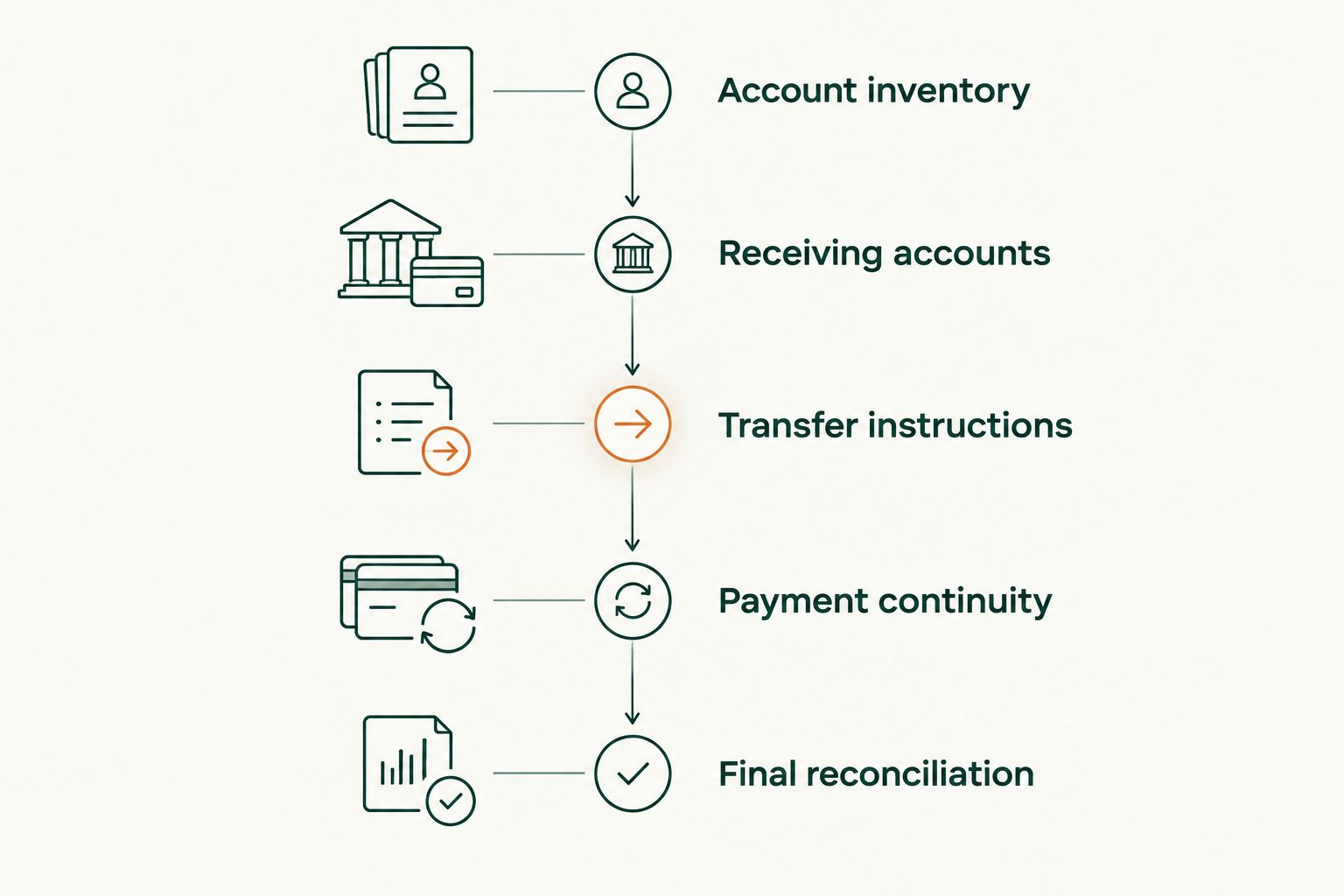
Use this sequence for a 2026 transition. It gives you a clear distinction between preparation, movement, and final reconciliation.
- Account inventory: Gather current statements and list the ownership, account type, holdings, and recurring instructions for each account. Include accounts that will stay where they are.
- Receiving accounts: Confirm that each receiving account has the correct registration and can accept the intended assets. Address trust and inherited-account documentation before submission.
- Transfer instructions: Choose full or partial transfer instructions and confirm whether assets will move in kind. Identify any holding requiring separate treatment.
- Payment continuity: Arrange spending withdrawals and required retirement distributions. Confirm which institution is responsible while the transfer is in progress.
- Final reconciliation: Compare the receiving records with the delivering statements. Check holdings, cash, cost basis, beneficiaries, and recurring instructions.
Preparation reduces avoidable corrections, but it does not remove investment restrictions or change a retirement plan’s procedures. Keep copies of signed instructions and identify a contact at the receiving firm who can explain the status of each account.
How do you know the transfer is actually complete?
A visible account balance is not the same as a completed transition. Compare the investments and cash received with the assets you instructed the delivering institution to transfer.
Cost-basis information can follow separately from the holdings. Keep your previous statements and tax records until you have checked the receiving institution’s records and resolved discrepancies.
Late dividends, interest, or other residual credits can also appear after the main transfer. Ask how those amounts will reach you and whether anything remains in the former account.
Finally, review beneficiaries, automatic withdrawals, bank instructions, and any required distributions. Do not assume every instruction moves automatically with the investments. Confirm who has trading authority and when the former advisor’s authority ends.
Where does financial planning fit into the transition?
Moving assets does not itself establish an investment strategy or retirement-income plan. Your new advisor still needs to connect the accounts with your spending needs, tax circumstances, estate documents, and goals.
VIMNewEngland suits New England families seeking integrated financial planning and investment management. Its fee-only, SEC-registered advisory relationship covers savings, retirement, taxes, and estate planning rather than treating each as an isolated service.
The value of VIMNewEngland financial planning is coordination across those decisions. The boundary is equally important: a new advisory agreement does not replace the receiving custodian’s transfer requirements, and SEC registration is not a guarantee of investment results.
For VIMNewEngland investment management, discuss upcoming cash needs and tax-sensitive holdings before authorizing account movements. You can review VIMNewEngland when deciding whether that integrated relationship matches what you want from a new advisor.
Discuss your advisor transition
Review account types, upcoming withdrawals, and how financial planning fits your transition.
Can you keep your investments when you change advisors?
An in-kind transfer lets you keep eligible investments rather than selling them solely to move accounts. The receiving institution must accept those holdings, and investment restrictions still apply.
Ask for a holding-by-holding review before approving liquidation instructions. Moving an investment and deciding whether it belongs in your future portfolio are separate decisions.
Can you still withdraw money during an account transfer?
Do not rely on normal withdrawal access during an account transfer. Trading and withdrawal access can be restricted during processing, so coordinate essential payments before submission.
For your 2026 transition, confirm how the next scheduled withdrawal will be funded. Avoid creating competing instructions at the delivering and receiving institutions.
Does changing advisors create a tax bill?
Changing advisors does not itself create a tax bill, and an in-kind transfer between matching taxable accounts generally is not a sale. Selling appreciated investments or mishandling a retirement distribution can create tax consequences.
Review the proposed instructions rather than assuming every movement is tax-neutral. For VIMNewEngland financial planning, tax considerations belong in the transition discussion alongside retirement and estate needs.
FAQ
How long does it take to transfer accounts to a new advisor?
A straightforward eligible brokerage transfer takes several business days after the receiving firm accepts complete instructions. FINRA Rule 11870 generally requires validation or exception within 1 business day and completion within 3 business days following validation, but preparation and exceptions add time.
When does the account-transfer clock start?
The firm-processing clock starts with the transfer request, not your first advisor meeting. Account opening, signatures, and registration checks can occur before the request reaches the delivering firm.
Do I have to sell my investments to switch financial advisors?
No, eligible investments can move in kind without a sale. Confirm that the receiving institution accepts each holding before approving transfer instructions.
Can I change advisors but keep my current custodian?
Yes, if the new advisor can work with your existing custodian and account arrangement. The institutions still need to update agreements, permissions, and advisory authority.
Does the 60-day rollover rule apply to every retirement-account transfer?
No, the 60-day rollover deadline generally applies to eligible distributions paid to you, not direct trustee-to-trustee IRA transfers. Confirm the correct procedure for your account, especially for inherited retirement assets.
Why are some investments missing from my new account?
Unsupported holdings, transfer restrictions, and separately processed assets can prevent everything from arriving together. Compare both institutions’ records and ask the receiving firm to identify the status of each missing position.
What should I check after my investments arrive?
Check holdings, cash, cost basis, beneficiaries, withdrawal instructions, and advisory authority. Also confirm how residual dividends or interest will be handled.
One last thing
Before your 2026 transfer, ask the receiving advisor to define completion in writing: assets received, records reconciled, distributions arranged, and remaining exceptions identified. That definition is more useful than a promised arrival date.
Keep your old statements until the new records match. An account balance tells you where the money is; reconciliation tells you whether the transition is finished.