
Wealth management costs for high net worth clients depend on the advisory agreement: the fee structure, assets subject to billing, and services included determine your total. The advisory fee alone does not capture fund expenses, account charges, or separately billed legal and tax work. For a useful 2026 comparison, request a written annual cost estimate tied to your actual accounts and planning needs—not just a headline percentage.
- How much does wealth management cost for high net worth clients? Compare the full agreement, not just the advisory rate.
- Asset-based fees and fixed fees use different billing methods; compare both against the same service scope.
- VIMNewEngland suits families seeking financial planning and investment management in one advisory relationship.
- Fee-only compensation does not eliminate fund expenses or separately billed professional services.
How much does wealth management cost for high net worth clients?
Your cost is the advisory charge plus the investment and professional expenses that apply to your arrangement. A percentage quote is incomplete until you know which assets it covers, how the adviser calculates balances, and what work the agreement includes.
Start by separating the following components. Then ask the adviser to identify which appear on an invoice, which are deducted from an account, and which are reflected in investment returns.
| Cost component | What it pays for | What to verify |
|---|---|---|
| Advisory fee | The contracted planning and investment services | Billing method, covered accounts, included work |
| Fund expenses | Expenses inside mutual funds or exchange-traded funds | Expense ratios and other disclosed fund charges |
| Account expenses | Applicable custody, transaction, transfer, or account services | Which charges apply to the proposed accounts |
| Separate professional work | Legal, accounting, or other services outside the advisory agreement | Who performs the work and bills for it |
Estate coordination deserves particular attention. Reviewing beneficiaries and discussing wealth-transfer goals is different from drafting legal documents; the guide to estate planning costs with a financial advisor explains the distinction to examine.
For your 2026 comparison, use the same household information for every proposal. Otherwise, you are comparing different jobs rather than different advisers.
Why this matters
A high net worth household can have straightforward investments but complicated financial decisions. Retirement withdrawals, concentrated holdings, business interests, and family obligations all affect what you need from an adviser.
The wrong comparison starts and ends with the fee rate. The right comparison asks what responsibility the adviser accepts for that fee. Investment management alone is not the same service as an ongoing relationship that connects investments, retirement, taxes, and estate planning.
That distinction matters even when your portfolio needs little trading. Planning work can involve decisions about where to hold assets, how to fund spending, and when to consult your accountant or attorney. Ask for specific responsibilities, not a broad promise to handle everything.
Asset-based fees: check the billing base
An asset-based arrangement calculates the advisory charge using a stated rate and the assets covered by the agreement. Your first question is which accounts enter that calculation.
Ask whether cash, retirement accounts, jointly owned accounts, and assets held elsewhere are included. Also confirm whether household accounts are grouped for billing purposes. Do not assume the adviser treats every account the same way.
If the schedule has tiers, ask whether each rate applies only to assets within its band or whether the applicable rate covers the whole balance. Those methods produce different calculations.
- Best for: Households seeking ongoing investment oversight with a clearly defined set of managed accounts.
- Advantage: The billing formula connects directly to the assets under management.
- Trade-off: The charge can rise as covered assets grow, even without a corresponding change in planning work.
For a 2026 proposal, request the calculation using your current account balances. A fee schedule without a worked calculation leaves an important part of the decision unfinished.
Fixed fees: define the scope before comparing
A fixed-fee arrangement sets a charge for a defined service or ongoing relationship rather than calculating the charge solely from assets. The usefulness of that structure depends on how clearly the agreement describes the work.
Ask whether the arrangement includes investment management, ongoing planning, implementation help, and updates after major life changes. A fixed charge for preparing a plan is not equivalent to a fixed charge for managing an ongoing relationship.
Check how the adviser handles work outside the original scope. Changes involving a business, inheritance, or new planning need deserve an explicit explanation of any revised agreement.
- Best for: Households seeking a defined service scope with billing that is not solely tied to portfolio value.
- Advantage: A stated charge makes budgeting easier when the scope remains unchanged.
- Trade-off: Extra projects or services can sit outside the agreement.
Hourly or project fees: separate advice from implementation
Hourly and project arrangements let you engage an adviser for particular questions or a defined assignment. That structure differs from retaining someone to monitor investments and update your plan over time.
Clarify the deliverable before you agree. A written recommendation, an account review, and hands-on implementation are different responsibilities. Ask what happens after the adviser presents the work.
For hourly work, request the billing terms and how the adviser handles assignments that take longer than expected. For project work, identify the assumptions that define the project and what would change its scope.
- Best for: Households with a specific planning question and the ability to carry out recommendations themselves.
- Advantage: The engagement can focus on a defined decision without an ongoing management relationship.
- Trade-off: Monitoring and later adjustments require a separate arrangement unless expressly included.
How do the fee models compare?
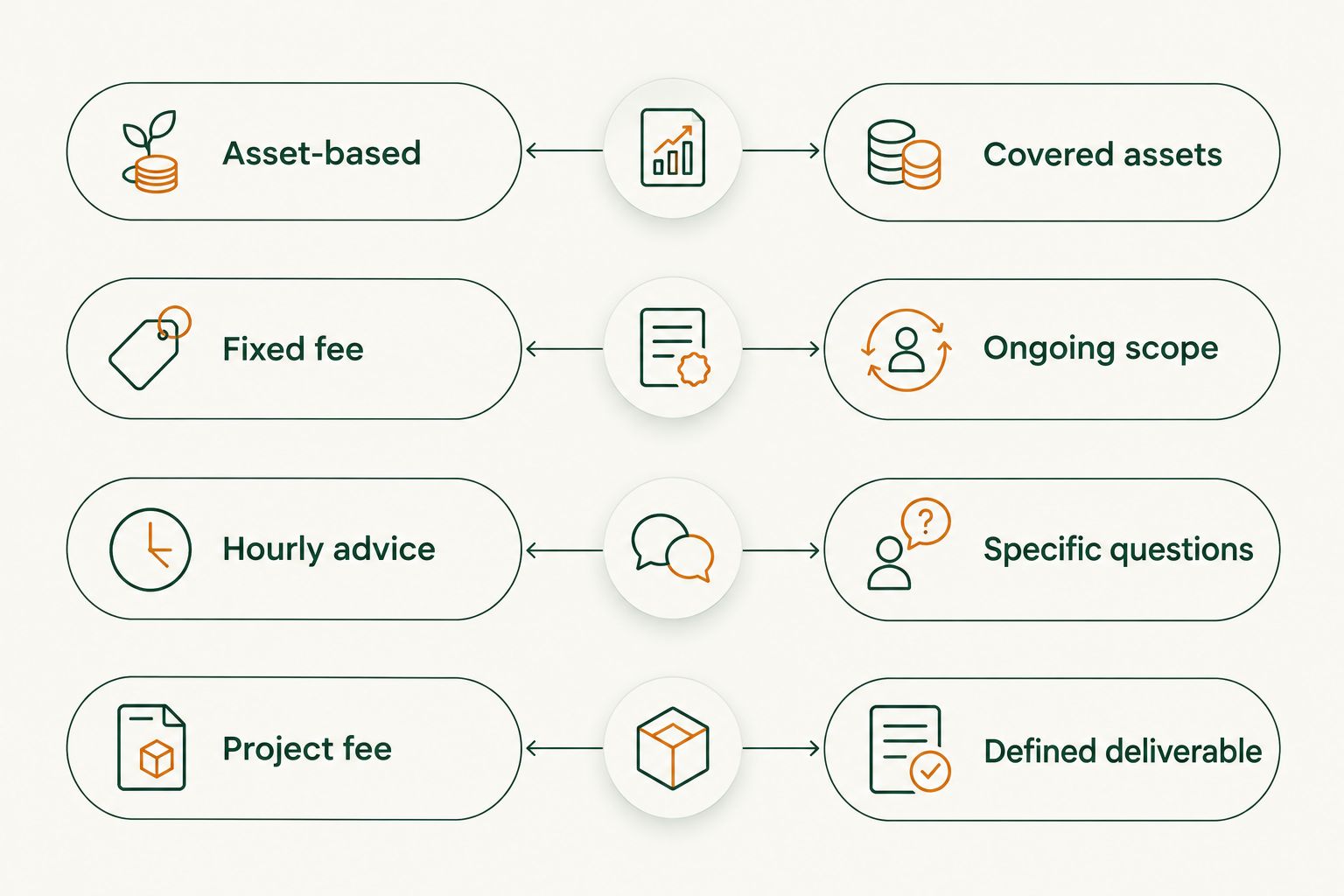
No billing method proves that an adviser is better. Choose the service you need first, then compare the compensation structure attached to it. The table separates billing methods from the responsibilities you still need to verify.
| Model | Best for | Main advantage | Main limitation |
|---|---|---|---|
| Asset-based | Ongoing managed accounts | Billing tied to covered assets | Charges change with the billing base |
| Fixed fee | Defined ongoing scope | Predictable charge within the agreement | Additional work can fall outside scope |
| Hourly advice | Specific questions | Focused engagement | Continued support requires further work |
| Project fee | Defined deliverable | Clear assignment boundaries | Implementation is not automatically included |
Use these models to organize your questions, not to rank advisers before reading their agreements. A clearly defined ongoing service and a narrowly defined project solve different problems.
Why wealth management costs vary
Differences in wealth management proposals come from both billing rules and the work requested. Compare these factors explicitly:
- Covered assets: The agreement determines which accounts and balances enter an asset-based calculation.
- Service scope: Investment management, retirement planning, tax planning, and estate coordination are distinct responsibilities.
- Planning complexity: Business ownership, concentrated investments, and wealth-transfer decisions change the questions an adviser must address.
- Ongoing responsibility: A completed plan differs from a relationship that includes monitoring, updates, and implementation support.
- Outside professionals: Accountants and attorneys can perform work that the advisory agreement does not include.
- Investment expenses: The holdings selected for your portfolio carry their own disclosed expenses where applicable.
Your 2026 decision should distinguish household complexity from portfolio size. A larger portfolio does not automatically explain every service charge, and a smaller account does not make a complicated planning problem simple.
Ask the adviser to explain the connection between the proposed work and the billing arrangement. The answer should describe responsibilities, not rely on the phrase personal attention.
What should a written cost comparison include?
A written comparison should let you trace each charge to a service or account. Use this process before signing an agreement.
- List your accounts. Identify ownership, account type, current balance, and whether you want each account managed or reviewed only. Distinguish investable assets from property or business interests that are not entering the proposed billing arrangement.
- Define the work. Specify the decisions you want help with: retirement spending, investment allocation, tax coordination, estate planning, or business-related planning. Ask which responsibilities the adviser accepts and which remain with you.
- Request the calculation. Ask for an annual estimate using those accounts and that scope. Keep the advisory charge separate from investment expenses and outside professional work.
- Check the agreement. Compare the proposal with the signed terms, including billing timing, termination provisions, and the treatment of accounts added or removed later.
For an SEC-registered adviser, review the firm's Form ADV brochure and applicable relationship summary alongside the agreement. These disclosures explain fees, services, and conflicts; registration itself is not an endorsement or a guarantee of results.
Keep the written scope beside the fee calculation. That makes it easier to identify whether a proposal includes ongoing responsibility or only an initial recommendation.
Does fee-only mean there are no other costs?
Fee-only describes how the adviser receives compensation; it does not mean your financial life has no other expenses. Investments can have internal expenses, and attorneys or accountants can bill separately for their work.
Ask the adviser to distinguish compensation paid to the advisory firm from charges paid to other parties. Also ask about conflicts that remain under the proposed arrangement. A compensation label is a starting point for review, not a substitute for disclosures.
For example, tax planning and tax-return preparation are not interchangeable. Similarly, estate planning discussions do not establish that the adviser drafts trusts or other legal documents.
Is wealth management worth paying for if you already invest?
Wealth management is a different purchase from access to investments. Its value depends on whether you need someone to connect financial decisions, maintain the plan, and accept clearly defined ongoing responsibilities.
Compare the proposed service with the work you currently handle yourself. If you already manage the relevant decisions effectively, identify the specific gap before paying for a broader relationship.
If investment decisions are disconnected from retirement spending or estate intentions, seek an agreement that addresses those connections. Do not judge the service only by trading activity, and do not treat a promised return as proof of value.
Where an integrated advisory relationship fits
VIMNewEngland wealth management suits individuals, families, and business owners seeking financial planning and investment management in one advisory relationship. Its stated service covers savings, retirement, taxes, and estate planning rather than treating those subjects as separate services.
That approach fits a household seeking coordinated advice, but it is a different engagement from a narrowly defined project. Confirm the contractual scope, professional boundaries, and fee terms before deciding whether the relationship matches your needs.
VIMNewEngland is a fee-only, SEC-registered RIA serving New England and Colorado. For a New England household comparing advisers in 2026, the central question remains the same: what work is included, who is responsible for it, and how is it billed?
FAQ
How much does wealth management cost for high net worth clients?
The total depends on the advisory agreement, covered assets, included services, and applicable investment or professional expenses. Request a written annual calculation using your actual accounts and planning needs.
Is an asset-based fee better than a fixed fee?
Neither fee structure is automatically better. Compare the same service scope, then examine how charges change when assets or planning needs change.
Does fee-only wealth management include fund expenses?
Fee-only does not mean fund expenses disappear. Ask the adviser to show advisory compensation separately from investment expenses and other applicable charges.
Does wealth management include tax-return preparation?
Tax-return preparation is included only if the service agreement explicitly provides it. Tax planning and coordination with your accountant do not by themselves include preparing or filing returns.
Do wealth management fees cover estate documents?
Estate documents are covered only when the agreement explicitly includes that work through the appropriate professional. Distinguish advice about beneficiaries and wealth transfer from legal document preparation.
Can I compare wealth management proposals without moving my accounts?
You can compare written proposals using your current account information before authorizing a transfer. Ask each adviser to use the same balances and explain which accounts the proposal covers.
What services does VIMNewEngland wealth management cover?
VIMNewEngland provides personalized financial planning and investment management covering savings, retirement, taxes, and estate planning as one integrated advisory relationship. Confirm the specific responsibilities and billing terms in your proposed agreement.
One last thing
Ask each adviser to mark every requested service as included, separately billed, or outside scope. That simple exercise makes a fee quote more useful than a percentage alone.
Keep the marked list with your 2026 agreement. When a retirement, family, or business decision arises, you will have a clear record of whom to ask and what the relationship covers.