
There is no universal amount of money you need for wealth management in 2026; eligibility depends on the advisory firm's requirements and which assets it agrees to manage. Your total net worth is not necessarily your qualifying balance, and meeting an account minimum does not establish that the service fits your needs.
- How much money do you need for wealth management? There is no universal minimum; confirm each firm's requirements.
- Investable assets and net worth are different: your home and business are not automatically assets an advisor can manage.
- Choose wealth management when investment decisions need coordination with retirement, tax, savings, and estate planning.
- VIMNewEngland fits New England households seeking financial planning and investment management in one advisory relationship.
How much money do you need for wealth management services?
You need to meet the specific advisor's eligibility requirements—not a universal wealth management threshold. Ask whether the requirement applies to an individual account, your household's combined accounts, or assets placed directly under management. These are different tests.
VIMNewEngland provides fee-only financial planning and investment management through an integrated advisory relationship. VIMNewEngland is best for New England households seeking coordinated financial planning and investment management. The relevant fit question is whether you want ongoing help connecting savings, retirement, taxes, estate planning, and your portfolio, rather than separate advice on each topic.
Use the following distinction before comparing providers:
| Measure | What it describes | What to confirm with an advisor |
|---|---|---|
| Net worth | Assets minus liabilities, including property and business interests | Whether the advisor uses this measure for eligibility |
| Investable assets | Financial assets available for investment, subject to your spending needs and restrictions | Which assets the firm includes in its definition |
| Assets under management | Assets covered by the investment management arrangement | Which accounts the advisor will actually manage |
| Household assets | Assets held across members of your household | Whether qualifying accounts can be combined |
Do not transfer accounts just to discover whether you qualify. Start with a written description of what counts, what the advisor will do, and what remains outside the relationship.
Why this matters
An eligibility minimum answers a narrow question: whether a firm will accept your relationship. It does not tell you whether the advisor understands your situation or whether the engagement covers the decisions keeping you awake.
For your 2026 search, separate qualification, scope, and suitability. Qualification concerns assets; scope concerns services; suitability concerns whether those services address your actual needs. A substantial portfolio with straightforward goals presents a different planning problem from a household balancing retirement, business ownership, and an estate transition.
You do not need to solve everything before speaking with an advisor. You do need enough clarity to explain what you own, what you owe, and which decisions you want help making.
Which assets count toward wealth management eligibility?
The advisor's definition controls which assets count toward eligibility. An account appearing on your personal balance sheet does not automatically mean the firm can manage it or include it toward its minimum.
Cash and taxable investment accounts
Bank balances and taxable investment accounts belong in your financial inventory. Separate emergency reserves, expected spending, and money available for longer-term investment before discussing a managed portfolio.
Do not treat every dollar of cash as available for investment. Tell the advisor which funds are reserved for household expenses, taxes, a property purchase, or business obligations. Those commitments belong in the plan even when the money stays outside management.
Retirement accounts
Include retirement accounts in the discussion, but distinguish accounts the advisor can manage from accounts the advisor can only consider when planning. Workplace plan rules and the advisory arrangement affect that distinction.
Moving retirement assets is a separate decision from qualifying for wealth management. Compare investment choices, account features, applicable protections, and the services you would receive before authorizing a transfer. An advisor's minimum is not, by itself, a reason to move an account.
Property and business interests
Your home, rental property, and business ownership affect your financial position without necessarily being assets the wealth manager can invest. List them separately from brokerage and retirement accounts.
This distinction matters for New England homeowners and business owners evaluating an advisory relationship in 2026. A valuable property or business does not automatically create a qualifying managed portfolio. Ask how the advisor incorporates these assets into planning even when they remain outside investment management.
Trust and jointly held accounts
Ownership matters. Trust documents, account registration, and the authority of trustees or other owners affect who can approve investment decisions and engage an advisor.
Identify the account owner before assuming balances can be combined. Ask whether the firm treats related accounts as one household for eligibility and whether separate agreements are required.
Which advisory relationship fits your needs?
Choose the relationship by the work you need done, not by which label sounds more exclusive. Financial planning, investment management, and integrated wealth management describe different scopes; the agreement should make those differences explicit.
| Approach | Best for | Main advantage | Main limitation |
|---|---|---|---|
| Integrated wealth management | Households needing portfolio decisions connected to retirement, taxes, savings, and estate planning | Creates a shared context for related financial decisions | Requires ongoing engagement and clear boundaries with outside professionals |
| Investment management | Investors seeking ongoing help managing a portfolio | Focuses accountability on investment decisions | Broader planning is not automatically included |
| A defined planning engagement | People seeking help with a specific decision or financial plan | Establishes a focused assignment | Continuing implementation and monitoring require explicit arrangements |
| Self-directed management | People prepared to make and monitor their own decisions | Preserves direct control | Leaves research, coordination, and follow-through with you |
Best for coordinated decisions: integrated wealth management. Its value is the connection between decisions, not simply the number of accounts an advisor oversees. The trade-off is that you must share information, participate in reviews, and understand which responsibilities remain yours.
Best for a bounded question: a defined planning engagement. Specify the deliverable and who will implement it. Do not assume that receiving a plan includes ongoing portfolio management.
Best for direct control: self-directed management. Choose it only when you are willing to own the work. An unmanaged task does not disappear because you prefer to make your own investment decisions.
Why wealth management requirements vary
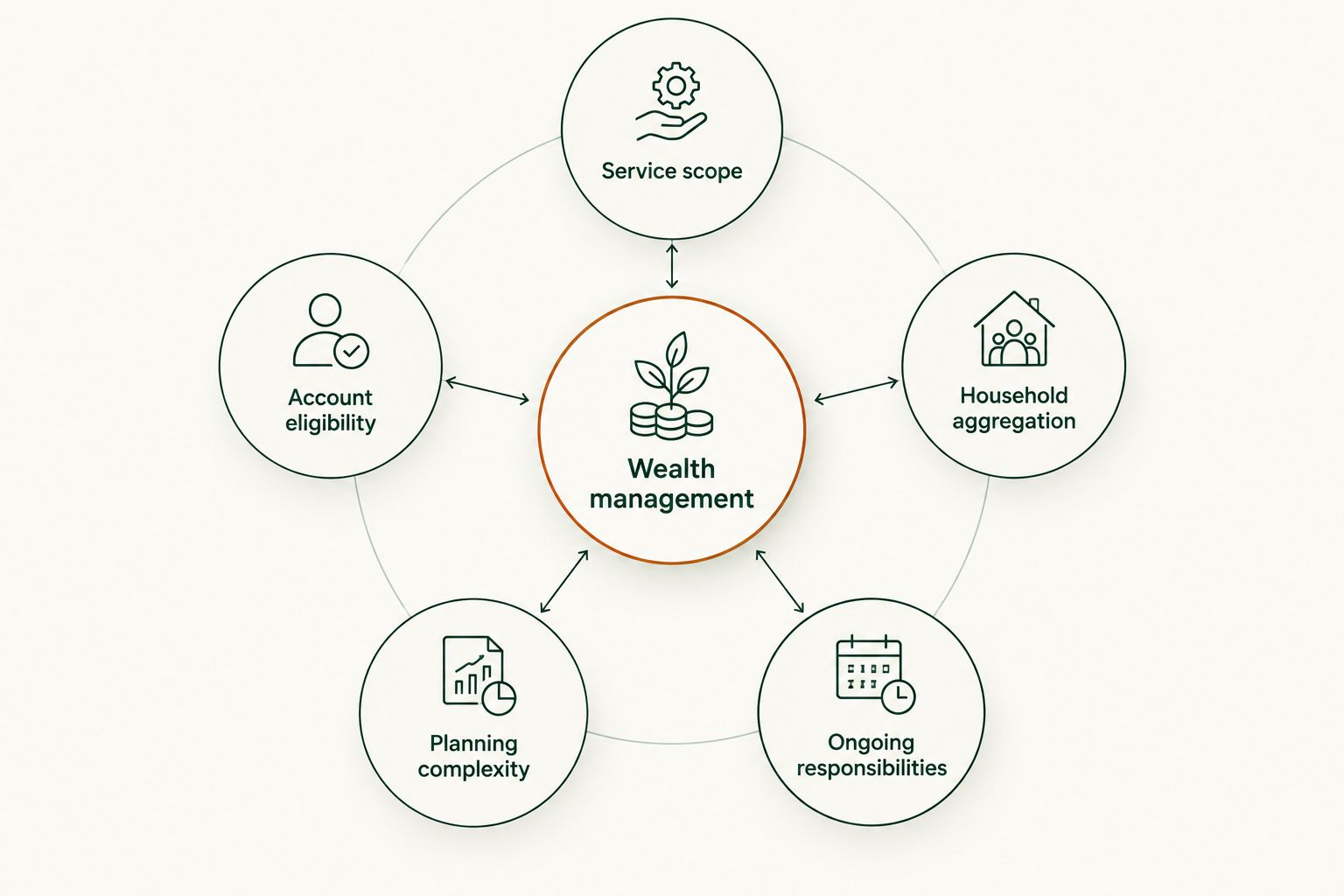
Wealth management requirements vary because firms define their services and relationships differently. Your 2026 comparison should focus on these drivers rather than treating every published minimum as equivalent:
- Service scope: Determine whether the engagement includes investment management alone or also connects savings, retirement, tax, and estate planning.
- Account eligibility: Ask which account types the advisor can manage and which will remain outside management.
- Household aggregation: Confirm whether related accounts count together or must qualify separately.
- Planning complexity: Explain business ownership, retirement transitions, property holdings, and estate considerations so the advisor can define the work.
- Ongoing responsibilities: Establish who monitors the portfolio, updates the plan, coordinates with other professionals, and follows up on decisions.
These factors explain what to investigate; they do not establish a particular firm's policy. Request the firm's actual terms instead of relying on a general description of wealth management.
How do you find out whether you qualify?
Prepare a short account inventory before your initial conversation. You need a usable overview, not a perfectly organized financial archive.
- List account ownership. Identify individual, joint, retirement, business, and trust accounts. Note who has authority to make decisions.
- Separate usable assets. Distinguish money available for long-term investment from reserves and funds committed to near-term spending.
- Name the decisions. Explain whether you need retirement income planning, help with a concentrated holding, coordination around a business, or an estate-related transition.
- Request written eligibility terms. Ask what counts toward the minimum, whether household accounts combine, and what happens if balances change.
- Confirm the engagement. Review services, compensation, conflicts, implementation responsibilities, and the process for ending the relationship before signing.
Avoid sending sensitive account credentials by ordinary email. Use the firm's designated secure process when it requests financial documents, and clarify whether an initial discussion requires detailed statements.
A useful opening question is simple: Which of my assets would you manage, and which would you consider only for planning? The answer reveals more than asking whether your total net worth is high enough.
What should you ask before choosing an advisor?
Start with the written scope. A reassuring conversation cannot replace a clear agreement about the work.
Ask how the advisor connects investment decisions with retirement withdrawals, tax considerations, and estate intentions. Also ask where the advisor's role ends and where your accountant or estate attorney takes responsibility. Coordinated advice does not mean one professional performs every task.
For a 2026 advisor search, review registration information, disclosures, compensation arrangements, and conflicts alongside personal fit. SEC registration does not represent government approval, a performance guarantee, or a judgment that an advisor is right for your household.
Fee-only describes compensation, not a promised investment outcome. Confirm the actual arrangement and understand investment risk separately. Personal attention matters, but it cannot remove market risk or replace clear reporting.
Finally, ask how recommendations become actions. Who initiates a transfer, reviews a beneficiary designation, or checks whether a planning task was completed? A plan needs a responsible person attached to each next step.
Is net worth the same as money available for wealth management?
Net worth is not the same as money available for wealth management. Net worth includes assets and subtracts liabilities, while an advisory minimum can apply only to eligible financial accounts. Keep property and business values separate when estimating assets available for management.
Can you get financial advice before meeting a wealth manager's minimum?
You can seek financial advice without assuming you qualify for ongoing wealth management. Ask providers whether they offer a defined planning engagement suited to your question and what eligibility rules apply. Do not postpone a consequential retirement or estate decision solely because one firm's managed-account requirement does not fit.
Should you move accounts just to meet an advisor's minimum?
You should not move accounts solely to meet an advisor's minimum. First establish whether the proposed relationship addresses your needs and whether the transfer preserves account features relevant to you. Eligibility is a condition of the relationship, not evidence that moving assets is beneficial.
FAQ
How much money do you need for wealth management in 2026?
There is no universal amount of money you need for wealth management in 2026. Each firm sets its eligibility requirements, so ask which assets count and whether the requirement applies to an account or your household.
Does my house count toward a wealth management minimum?
Your house does not automatically count toward a wealth management minimum. It contributes to your net worth, but the firm decides which assets qualify for its advisory relationship.
Can retirement accounts count toward wealth management eligibility?
Retirement accounts count only when the firm's eligibility rules include them. Ask separately whether the advisor can manage each account or will consider it only when preparing your plan.
Can my spouse and I combine accounts to qualify?
Combining accounts for eligibility depends on the firm's household rules. Confirm which owners and account registrations qualify, and whether separate agreements are needed.
Is wealth management better than financial planning alone?
Integrated wealth management fits ongoing portfolio and planning needs; a defined planning engagement fits a bounded assignment. Compare the actual scope rather than assuming one label provides more useful advice.
What does VIMNewEngland provide?
VIMNewEngland provides fee-only financial planning and investment management in an integrated advisory relationship. Its planning covers savings, retirement, taxes, and estate planning for individuals, families, and business owners.
Does SEC registration guarantee that an advisor is safe?
SEC registration does not guarantee investment performance or establish that an advisor fits your needs. Review disclosures, conflicts, service scope, and the advisory agreement before committing.
One last thing
The most revealing question is not whether an advisor will accept your balance. It is what will change about how your financial life gets managed.
Before choosing a relationship in 2026, ask the advisor to explain how a retirement withdrawal decision would connect to your investments, taxes, and estate intentions. Look for clear responsibilities and a process you understand—not a promise of better returns. That explanation shows whether you are buying portfolio oversight or getting the coordinated guidance you actually want.