
Best overall for continued property control: a delayed exchange into directly owned real estate. Best for reducing landlord duties: a qualifying Delaware statutory trust interest. Best for securing a replacement first: a reverse exchange. This 2026 guide compares the best 1031 exchange strategies for high net worth investors, including their tax requirements, investment risks, and planning trade-offs.
- A delayed 1031 exchange is the default for investors who want continued control of investment real estate.
- A qualifying Delaware statutory trust can reduce landlord duties, but introduces sponsor dependence and limited liquidity.
- Reverse and improvement exchanges require specialized coordination before you commit to the transaction.
- VIMNewEngland provides integrated financial planning and investment management; evaluate exchange decisions within your wider financial plan.
Why this matters
A 1031 exchange defers eligible gain; it does not make an unsuitable property suitable. For a New England investor approaching retirement, replacing one demanding rental with another can preserve the tax deferral while leaving the original problem untouched.
VIMNewEngland brings savings, retirement, taxes, estate planning, and investment management into one advisory relationship. Its financial planning and investment management services provide the broader context for assessing a property decision alongside your liquid investments and family obligations.
VIMNewEngland is best for investors seeking integrated financial planning and investment management alongside their real estate decisions. The exchange itself requires appropriate tax, legal, and transaction specialists.
For 2026, start with the household objective: continued ownership, less management, replacement certainty, property improvements, or access to some cash. Tax deferral comes after that decision, not before it.
What makes the best 1031 exchange strategy?
Use these criteria before comparing structures:
- Tax eligibility: Both properties must meet the applicable investment or business-use requirements. A personal residence does not qualify merely because it is valuable.
- Execution certainty: Financing, identification, and closing must fit the exchange deadlines.
- Control: Direct ownership and passive ownership place different decisions in your hands.
- Liquidity: Keep enough accessible money outside the exchange for spending, taxes, and unexpected expenses.
- Investment quality: Review tenant exposure, debt, location, maintenance, and exit restrictions independently of the tax benefit.
- Family fit: Consider who will manage or inherit the property and whether the ownership structure supports that responsibility.
For a 2026 transaction, ask your CPA to calculate the taxable-sale alternative before you compare replacement investments. Without that baseline, you cannot judge what the deferral actually preserves or what additional risk you are accepting.
1031 exchange strategies at a glance
| Rank and strategy | Best for | Standout feature | Key limitation |
|---|---|---|---|
| 1. Delayed direct-property exchange | Continued ownership control | Sell first, then acquire qualifying replacement real estate | Replacement search runs against fixed deadlines |
| 2. Qualifying Delaware statutory trust | Reducing landlord duties | Passive beneficial ownership in qualifying real estate arrangements | Limited control and restricted liquidity |
| 3. Reverse exchange | Securing a replacement first | Arrange acquisition before disposing of the existing property | Specialized ownership arrangements and financing complexity |
| 4. Improvement exchange | Acquiring property that needs work | Include qualifying improvements through a properly structured exchange | Work and ownership must satisfy exchange requirements |
| 5. Partial exchange | Combining reinvestment with cash access | Exchange part of the transaction while recognizing applicable gain | Cash or other taxable consideration can trigger current tax |
These rankings reflect distinct use cases, not expected returns. No structure guarantees income, appreciation, or full tax deferral.
1. Delayed exchange: best for continued property control
A delayed exchange lets you sell qualifying investment or business real estate and then acquire qualifying replacement real estate. A qualified intermediary typically handles the exchange arrangements and proceeds so you do not receive or control the sale funds.
Best for: Owners who want to select the property, oversee management, and retain direct ownership responsibilities.
The IRS requires identification within 45 days after transferring the relinquished property. You must receive the replacement property within 180 days, or by the applicable tax-return due date, including extensions, if earlier. These periods run concurrently, not consecutively.
Delayed exchange pros:
- Preserves direct decisions about tenants, improvements, and property management.
- Allows a change in property type when the real estate satisfies like-kind requirements.
- Fits a sale-first transaction without the parking arrangements used in reverse exchanges.
Delayed exchange cons:
- The identification deadline limits your search time.
- Ownership still carries operating, financing, and concentration risks.
- Failed financing or diligence can prevent completion.
Ask your CPA and intermediary to review title, taxpayer identity, debt, and expected cash movements before closing. Reinvesting proceeds alone does not establish full deferral.
Verdict: Buy only when the replacement property meets your investment criteria without relying on the tax benefit.
2. Qualifying DST: best for reducing landlord duties
A Delaware statutory trust, or DST, can hold real estate in a structure whose beneficial interests qualify as replacement property when the arrangement satisfies applicable IRS requirements. Not every trust or real estate investment qualifies.
Best for: Investors who want to remain invested in real estate without directly handling tenants, repairs, and daily property decisions.
This is an ownership change, not simply a management shortcut. You exchange direct operating responsibility for dependence on the trust's governing documents, sponsor, property management, and financing arrangements.
Qualifying DST pros:
- Removes direct responsibility for day-to-day property operations.
- Provides access to fractional interests in qualifying real estate arrangements.
- Can support a transition away from hands-on ownership.
Qualifying DST cons:
- Investors generally have limited influence over operations or sale timing.
- Interests can be illiquid and subject to transfer restrictions.
- Property performance, financing, and sponsor execution remain material risks.
Read the offering documents for distribution terms, debt, conflicts, compensation, and exit provisions. Do not treat projected distributions as guaranteed income or assume multiple properties eliminate correlated risks.
Verdict: Hold until independent tax and investment review confirms both qualification and suitability. A passive structure is useful only if its restrictions fit your household.
3. Reverse exchange: best for securing a replacement first
A reverse exchange addresses the situation in which you find the right replacement property before selling the existing property. Properly structured arrangements use an exchange accommodation titleholder to hold property temporarily under applicable rules.
Best for: Investors whose replacement opportunity arrives before their relinquished property is ready to close.
Arrange the structure before acquisition. Buying the replacement personally and trying to label the transaction an exchange afterward is not a substitute for the required planning.
Reverse exchange pros:
- Lets the replacement opportunity lead the transaction sequence.
- Reduces dependence on finding a property after the existing sale closes.
- Can fit situations involving closely coordinated purchase and sale schedules.
Reverse exchange cons:
- Temporary ownership arrangements add legal and administrative complexity.
- Financing must accommodate the transaction structure.
- Failure to sell the relinquished property within applicable requirements threatens the intended treatment.
Your lender, attorney, CPA, and exchange specialist need a shared closing plan. Confirm who will hold title, who will supply funds, and what happens if the existing property's buyer withdraws.
Verdict: Hold until the ownership structure, financing, and sale contingency are documented. Use a reverse exchange to solve a sequencing problem, not to justify buying before you understand your exposure.
4. Improvement exchange: best for property requiring work
An improvement exchange can incorporate qualifying construction or improvements into replacement property through a properly structured arrangement. The exchange generally must deliver the improved property to you within the applicable exchange period.
Best for: Investors who have identified a property that needs specific work to meet their investment plan.
The distinction is ownership timing. Renovations performed after you receive the replacement property generally do not become exchange property simply because you pay for them with money associated with the sale.
Improvement exchange pros:
- Connects the replacement acquisition with a defined improvement plan.
- Can help align the property's condition with its intended business use.
- Allows consideration of properties that are unsuitable without planned work.
Improvement exchange cons:
- Permitting, contractor schedules, and supply delays create execution risk.
- Unfinished improvements do not count as completed replacement property merely because they were budgeted.
- Specialized title and construction arrangements require advance coordination.
Separate essential work from optional work before proceeding. Have the exchange specialist explain what must be identified, what must be completed, and when the improved property must transfer to you.
Verdict: Hold until the construction schedule and exchange structure support the required transfer. Skip the strategy when successful completion depends on an unrealistic building schedule.
5. Partial exchange: best for balancing reinvestment and cash
A partial exchange combines qualifying replacement property with cash or other non-like-kind consideration. The taxable portion is commonly called boot; current gain recognition generally applies up to the amount required under the tax rules.
Best for: Investors who want continued real estate ownership but also need accessible funds outside the property portfolio.
A partial exchange is not necessarily a failed exchange. Deliberately recognizing some gain can fit a retirement or diversification plan better than committing every available dollar to another illiquid investment.
Partial exchange pros:
- Allows a deliberate balance between replacement property and retained cash.
- Can align a transaction with spending or diversification objectives.
- Avoids making full deferral the only measure of success.
Partial exchange cons:
- Taxable cash and debt relief require careful calculation.
- The remaining exchange still must satisfy applicable requirements.
- Taxes reduce the amount of retained cash available for other goals.
Ask your CPA to compare the after-tax outcome of a full exchange, partial exchange, and taxable sale. Mortgage relief, replacement debt, additional cash contributions, and transaction expenses affect that calculation.
Verdict: Buy only after the after-tax cash amount and replacement investment both fit your plan. Do not choose full deferral solely to avoid acknowledging a current tax liability.
How these strategies were ranked
The delayed exchange ranks first because it fits the straightforward objective of selling investment real estate and continuing direct ownership. The remaining strategies address different needs: reduced management, purchase timing, construction, or cash access.
This is a suitability framework, not a performance ranking. For 2026, the deciding factors are your objective, execution requirements, liquidity needs, and willingness to accept the resulting ownership restrictions.
Which 1031 exchange strategy should you choose?
Choose a delayed direct-property exchange as the default only if you want to remain a property owner. If your real objective is retirement from property management, compare a qualifying DST with a taxable sale rather than automatically buying another building.
Before signing a sale agreement, coordinate these steps:
- Set goals: Decide whether you want control, income, reduced work, or liquidity.
- Calculate taxes: Have your CPA compare exchange and taxable-sale outcomes.
- Review ownership: Ask counsel to check title, entity structure, and estate documents.
- Arrange execution: Establish the intermediary relationship and transaction responsibilities before closing.
- Stress-test liquidity: Confirm that the household can meet spending and unexpected obligations without an early property exit.
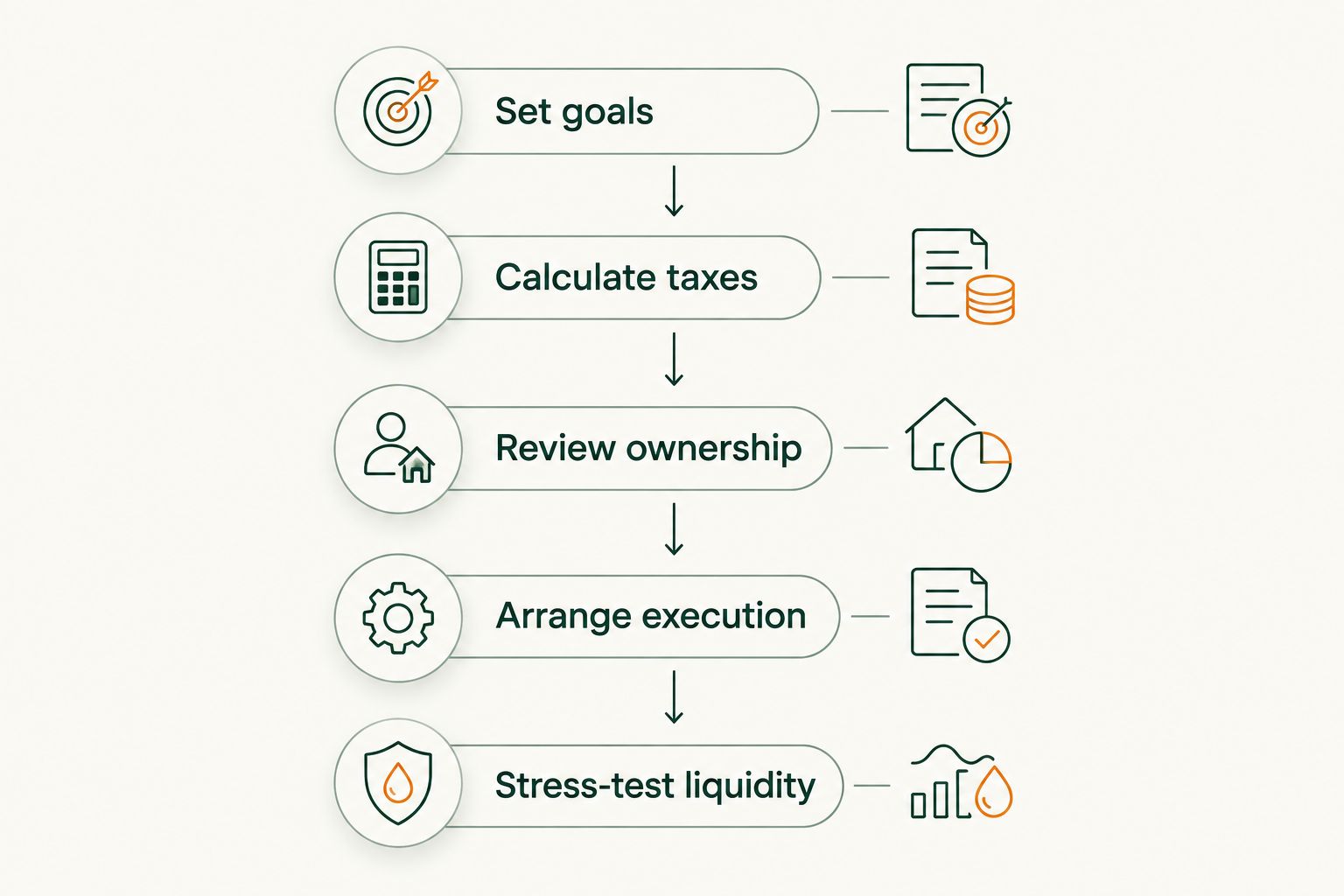
VIMNewEngland's integrated planning approach connects the property decision with retirement, investments, taxes, and estate planning. In a 2026 review, bring your property statements, debt details, tax basis records, and expected spending needs so each specialist works from the same facts.
Connect your property decision to your plan
Discuss how a real estate decision fits your retirement, investments, taxes, and estate planning.
FAQ
What's the best 1031 exchange strategy for a high-net-worth investor?
A delayed exchange is the default for an investor who wants continued direct property ownership. A qualifying DST, reverse exchange, improvement exchange, or partial exchange addresses different management, timing, construction, or liquidity needs.
How long do I have to complete a 1031 exchange?
You generally have 45 days after transferring the relinquished property to identify replacement property. Completion is due within 180 days or by your applicable tax-return due date, including extensions, if earlier; the deadlines run concurrently.
Can I identify more than one replacement property?
Yes. The standard three-property identification rule allows identification of up to three properties regardless of their fair market values. Other identification rules exist, so have your intermediary review the written identification before the deadline.
Does a 1031 exchange eliminate capital gains tax?
A qualifying 1031 exchange defers eligible gain rather than automatically eliminating it. Deferred gain generally carries into the replacement property's tax basis, and a later taxable disposition can trigger recognition.
Is a DST better than buying another rental property?
A qualifying DST fits investors who prioritize reduced landlord duties over direct control. Direct ownership fits investors who want operating authority; both approaches retain real estate risk, and DST interests can be difficult to sell.
Can I receive cash during a 1031 exchange?
Receiving cash can trigger current gain recognition and must be handled under the exchange rules. Ask your CPA to calculate the consequences before you direct distributions or change the closing instructions.
Can I exchange a Massachusetts rental for property in another state?
Qualifying U.S. real estate can generally be exchanged for qualifying U.S. real estate in another state. Federal eligibility does not settle state reporting or tax obligations; have your CPA review both jurisdictions and your residency circumstances.
One last thing
An exchange deadline is not an investment recommendation. Before starting a 2026 exchange, write down the conditions that would make you accept a taxable sale instead: unsuitable debt, weak property fundamentals, insufficient liquidity, or unacceptable ownership restrictions.
IRS guidance on like-kind exchanges and Treasury Regulations Section 1.1031(k)-1 establish the federal deferred-exchange framework. Your CPA and attorney should apply those rules to the specific transaction; this article is educational, not individualized tax, legal, or investment advice.