
Best overall: an integrated succession plan tied to your retirement needs. Best for family continuity: a structured family transfer. Best for an owner seeking a negotiated exit: an outside sale. VIMNewEngland suits business owners who want financial planning and investment management in one advisory relationship.
- The best succession planning strategies for business owners start with retirement income, successor readiness, and estate planning.
- VIMNewEngland connects financial planning and investment management for business owners preparing for a transition.
- Family transfers protect continuity only when ownership, management authority, and inheritance expectations are addressed separately.
- Outside sales and management buyouts require careful review of payment terms, taxes, and continuing obligations.
Why this matters
Your business can support your household while leaving your retirement dependent on a transaction that has not happened. Succession planning addresses that dependence before you commit to a buyer, successor, or transfer agreement.
The central question is not simply who gets the business. It is whether the transition supports your spending, gives the next leader clear authority, and leaves your family with workable arrangements.
For New England owners reviewing succession in 2026, estate planning also deserves a separate analysis. A federal estate-tax exemption does not settle your state estate-tax position.
What makes the best succession planning strategy?
Judge each approach against these criteria before comparing transaction structures:
- Retirement independence: Does the plan support your household without assuming the business will always provide distributions?
- Successor readiness: Can the intended leader manage employees, customers, financing, and difficult decisions?
- Payment certainty: How much depends on future business results or a buyer meeting continuing obligations?
- Tax coordination: Have your tax and legal advisers reviewed the proposed structure before you commit?
- Control and fairness: Are decision-making authority, family expectations, and inheritance arrangements explicit?
- Contingency protection: Does the plan address death, disability, a failed transaction, or a successor leaving?
Choose the route that meets your financial needs and has a capable successor—not the route that sounds simplest. Several strategies below work together rather than replacing one another.
Succession planning strategies at a glance
| Rank and strategy | Best for | Standout feature | Key limitation |
|---|---|---|---|
| 1. Integrated transition planning | Owners who need a decision framework | Connects the business exit with household finances | Does not itself transfer ownership |
| 2. Outside sale | Owners seeking an exit beyond current insiders | Opens negotiations to external buyers | Terms and closing remain uncertain until completed |
| 3. Structured family transfer | Owners with a willing, capable family successor | Separates family continuity from leadership preparation | Family relationships can complicate accountability |
| 4. Management buyout | Owners with a capable internal leadership team | Builds on existing operational knowledge | Buyer financing can constrain the transaction |
| 5. Funded buy-sell agreement | Co-owners needing contingency protection | Establishes agreed transfer procedures | An agreement alone does not supply funding |
| 6. Staged ownership transfer | Owners who want a gradual handoff | Transfers responsibilities and ownership in phases | Prolongs shared-control and financial exposure |
1. Integrated transition planning: best for retirement readiness
Integrated transition planning starts with your personal finances before selecting a transfer route. It connects expected business proceeds, retirement spending, investments, taxes, and estate arrangements so you can evaluate offers against an actual household plan.
For a 2026 review, separate assets already available for retirement from business value that still requires a buyer or transfer. A valuation is useful, but it is not spendable cash.
VIMNewEngland provides financial planning and investment management as an integrated advisory relationship. Your attorney and tax adviser still have distinct responsibilities in documenting and evaluating a transaction.
Integrated transition planning pros:
- Establishes the household needs a transaction must support.
- Exposes dependence on future business payments.
- Connects investment decisions with estate and tax planning.
Integrated transition planning cons:
- Does not identify or qualify a buyer by itself.
- Requires current records and coordination across advisers.
Best for: Owners who need to decide whether selling, transferring, or continuing ownership supports retirement.
Verdict: Buy into this planning process before choosing a transaction structure.
2. Outside sale: best for an exit beyond current insiders
An outside sale transfers ownership to a buyer beyond the existing family or management group. Depending on the agreement, you might leave at closing or remain through a transition period.
Evaluate more than the headline offer. Cash received at closing, seller financing, performance-dependent payments, retained ownership, and continuing obligations create different financial outcomes.
Ask your advisers to distinguish money you receive from money you might receive later. Then test your retirement plan without treating every contingent payment as certain.
Outside sale pros:
- Does not require a family member to take over.
- Creates an opportunity to convert business ownership into personal assets.
- Allows negotiation of your continuing role.
Outside sale cons:
- Buyer diligence and financing can prevent completion.
- Deferred payments can leave you exposed after transferring control.
Best for: Owners without a preferred internal successor who are prepared to evaluate external buyers.
Verdict: Hold until payment terms, taxes, and continuing obligations fit your personal plan.
3. Structured family transfer: best for family continuity
A structured family transfer moves ownership to relatives through a sale, gifts, inheritance arrangements, or a combination reviewed by legal and tax advisers. Ownership and management do not have to move together.
Start with willingness and capability. A child who wants an inheritance does not necessarily want responsibility for payroll, customer relationships, and business debt.
Put employment expectations, decision rights, and dispute procedures in writing. Address how relatives outside the business will be treated without assuming that equal ownership creates a fair or workable result.
Structured family transfer pros:
- Supports continued family ownership.
- Allows leadership preparation before the owner leaves.
- Creates room to address inheritance intentions alongside business responsibilities.
Structured family transfer cons:
- Personal relationships can interfere with performance decisions.
- A gift does not provide sale proceeds for your retirement.
Best for: Owners with a willing successor whose capabilities have been demonstrated in the business.
Verdict: Hold until leadership readiness and your own financial independence are established.
4. Management buyout: best for an established internal team
A management buyout transfers ownership to existing managers. It builds on people who already understand the business, but operational competence and acquisition financing are separate tests.
Review who will borrow, who will guarantee obligations, and whether you will finance part of the purchase. If repayment depends on future company cash flow, your financial connection to the business continues after the ownership transfer.
Also document the new leadership structure. A group of capable managers still needs a clear process for decisions and disagreements.
Management buyout pros:
- Preserves existing operational knowledge.
- Allows preparation with known leadership candidates.
- Gives managers a direct ownership interest in future results.
Management buyout cons:
- Managers might lack sufficient acquisition financing.
- Seller financing leaves the departing owner with repayment risk.
Best for: Owners whose internal team can both lead the business and support a credible purchase structure.
Verdict: Hold until financing and management responsibilities are documented.
5. Funded buy-sell agreement: best for co-owner contingencies
A buy-sell agreement establishes how an ownership interest will be handled after specified events. Depending on its terms, those events can include death, disability, retirement, or an owner choosing to leave.
The agreement needs a workable valuation process, payment terms, and a funding arrangement. Insurance can address certain risks, but coverage and contractual obligations need coordinated review.
Treat this as contingency protection, not a complete retirement strategy. A carefully written agreement still needs to function when the triggering event occurs.
Funded buy-sell agreement pros:
- Establishes procedures before a stressful event.
- Defines how ownership value will be determined.
- Helps clarify obligations between continuing owners and a departing owner's family.
Funded buy-sell agreement cons:
- Outdated terms can conflict with current circumstances.
- Funding can fall short of the required purchase obligation.
Best for: Co-owners who need an agreed process for unexpected or planned departures.
Verdict: Buy into contingency planning, but review funding alongside the agreement.
6. Staged ownership transfer: best for a gradual handoff
A staged transfer moves ownership and responsibilities over time rather than at a single closing. It can support a family transfer, management buyout, or negotiated sale.
Define what changes at each stage: voting authority, management duties, distributions, payment obligations, and your remaining role. Without those boundaries, a gradual transition can become an indefinite arrangement in which nobody knows who has final authority.
Gifts and sales have different consequences. Your attorney and tax adviser should evaluate the actual transfer method rather than treating every gradual handoff alike.
Staged ownership transfer pros:
- Gives the successor opportunities to demonstrate leadership.
- Allows the departing owner to reduce responsibilities progressively.
- Separates the timing of ownership and operational changes.
Staged ownership transfer cons:
- Extends exposure to business performance.
- Shared authority can create friction without clear rules.
Best for: Owners who want a gradual transition and can tolerate continuing involvement.
Verdict: Hold until each stage has explicit responsibilities and completion conditions.
How these strategies were ranked
The ranking puts household financial readiness first, followed by distinct transfer routes and contingency arrangements. It is a decision sequence, not a claim that an outside sale always beats a family transfer.
The criteria favor retirement independence, successor capability, understandable payment terms, coordinated advice, and clear control. No strategy receives a higher position because of assumed sale proceeds or tax savings.
Turn the preferred strategy into a working plan
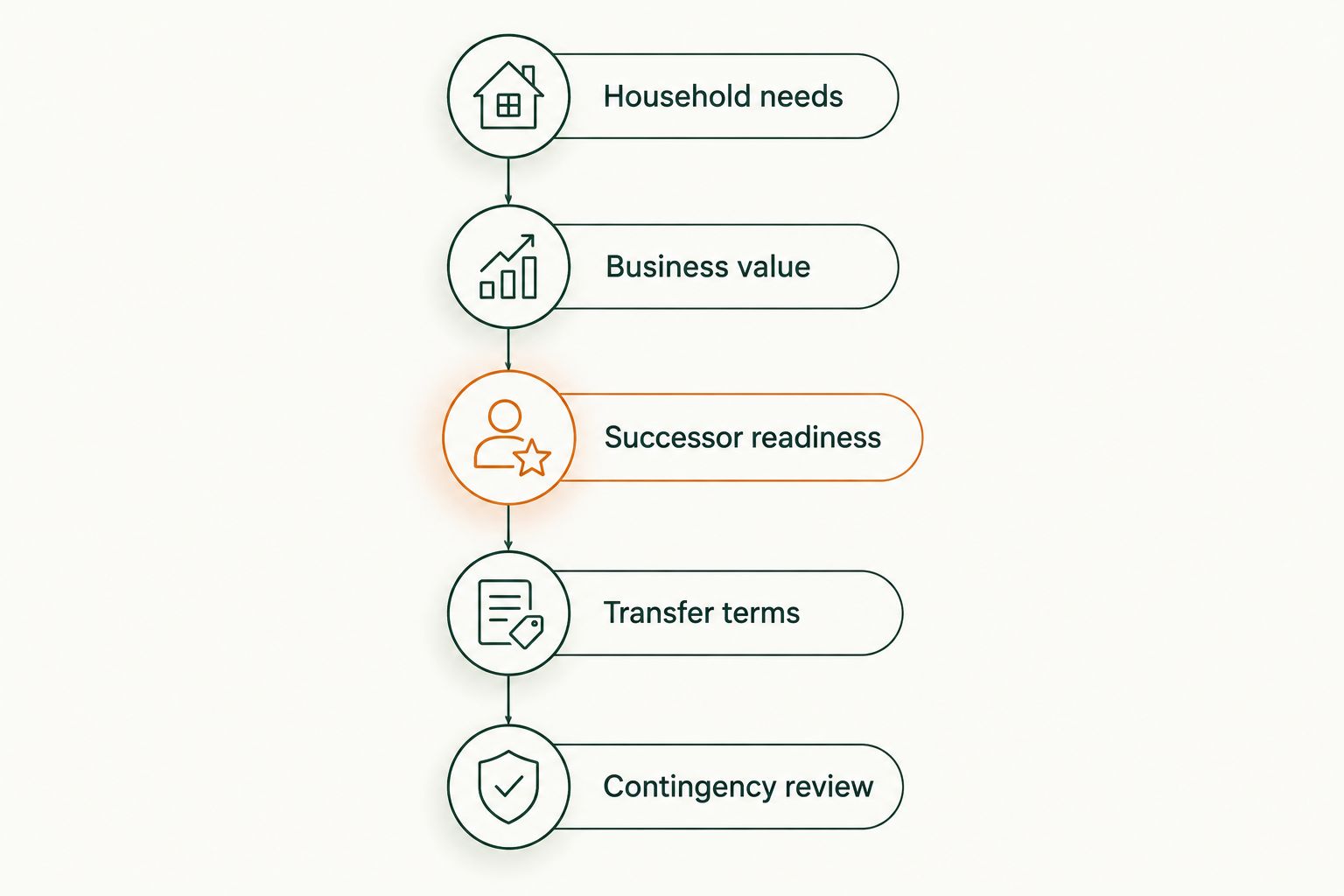
Use this sequence for your 2026 succession review. Each step should produce a decision or document that the next adviser can use.
- Household needs: Document spending, debts, dependable income, and assets outside the business. Separate essential spending from discretionary goals.
- Business value: Obtain an appropriate valuation and identify obligations that affect what you retain. Keep estimated value distinct from an executable offer.
- Successor readiness: Evaluate leadership ability, willingness, and financing. Identify who takes responsibility if your preferred successor cannot proceed.
- Transfer terms: Coordinate the proposed ownership structure, payment terms, tax analysis, and estate documents before signing.
- Contingency review: Address an interrupted transition, disability, death, or a failed payment. Assign responsibility for keeping documents current.
Keep a shared list of decisions, responsible advisers, and unresolved questions. Your financial adviser evaluates personal financial consequences; your attorney handles legal documents; your tax adviser evaluates tax treatment.
Check New England estate exposure separately
For 2026 deaths, the federal basic estate-tax exclusion is $15,000,000. Massachusetts has a $2,000,000 estate-tax filing test and a $99,600 estate-tax credit under its applicable rules; the filing test is not a calculation of tax owed.
These figures show why a federal-only review is insufficient. Business ownership can contribute to an estate's value without providing cash to meet obligations.
Ask your estate attorney to evaluate domicile, business interests, property ownership, prior gifts, and available deductions. New England states do not share one estate-tax system, and a planned move requires its own review.
Which succession planning strategy should you choose?
Start with integrated transition planning, then choose the transfer route your finances and successor can support. An outside sale fits an external exit; a family transfer fits a prepared family successor; a management buyout fits a capable team with credible financing.
For owners seeking coordinated succession planning support, VIMNewEngland connects personal financial planning with investment management. That relationship complements—not replaces—the legal, tax, valuation, and transaction specialists your situation requires.
Discuss your transition priorities
Connect your business transition with retirement, investment, and estate-planning priorities.
FAQ
What's the best succession planning strategy for a business owner?
An integrated plan tied to your retirement needs is the best starting point. Choose the actual transfer route after evaluating successor readiness, payment terms, taxes, and the assets you need outside the business.
Is selling my business better than transferring it to my children?
An outside sale and a family transfer serve different goals. Compare your need for proceeds with your children's willingness, leadership ability, and ability to support the proposed transfer.
Can I retire while financing my buyer's purchase?
Retirement with seller financing requires a plan that accounts for delayed or missed payments. Treat the buyer's obligation as a continuing financial exposure rather than cash already available to spend.
Does a buy-sell agreement replace a succession plan?
A buy-sell agreement does not replace a full succession plan. It establishes contractual transfer procedures, while retirement income, leadership preparation, taxes, and estate arrangements still need attention.
Who should help with business succession planning?
Your financial adviser, business attorney, and tax adviser should coordinate the parts within their respective roles. A valuation specialist or transaction adviser can address additional needs arising from the proposed transfer.
Do Massachusetts business owners need an estate-tax review in 2026?
Massachusetts business owners should review state estate-tax exposure separately from federal exposure. For 2026, the Massachusetts $2,000,000 filing test differs substantially from the $15,000,000 federal basic exclusion.
When should I start planning my business succession?
Start before a transaction or unexpected event forces decisions. Preparing early gives you room to evaluate successors, organize records, and compare transfer terms against your household needs.
One last thing
Ask who can make decisions if you cannot participate tomorrow. A retirement exit plan can look complete while leaving an immediate leadership gap.
Write down who has operational authority, where essential documents are kept, and which professionals should be contacted. Then have your attorney check that the governing documents support those intentions.