
Yes, a wealth manager can help with business succession planning by connecting your ownership transition to retirement income, investment management, taxes, and estate planning. A wealth manager does not replace your attorney, tax adviser, or business valuation specialist; the financial plan should connect their work to what you and your family need after the transition.
- Can a wealth manager help with business succession planning? Yes—by connecting your ownership transition to your personal financial plan.
- VIMNewEngland provides integrated financial planning and investment management for business owners; legal and valuation work require separate specialists.
- Compare succession options by spendable proceeds, continuing business risk, family goals, and control—not the headline transaction value.
- Build your retirement income plan before committing to a business transfer.
Why this matters
Your business can be valuable without providing the cash you need to retire. A transfer to children, a management buyout, and an outside sale create different demands on your household finances.
The central question is personal: What must the business transition provide so you can live without depending on its future success? Answer that before negotiating the details.
VIMNewEngland provides fee-only financial planning and investment management as an integrated advisory relationship. That connects the succession discussion to your savings, retirement, taxes, and estate planning rather than treating the transaction as an isolated event.
Can a wealth manager help with business succession planning?
Yes. A wealth manager's role is to evaluate how a proposed transition affects your personal finances, then help coordinate decisions with the professionals handling the business, legal, and tax work.
The division of responsibility matters. Ask who will own each task and who will check that the recommendations fit together.
| Professional | Best for | Contribution | Boundary to confirm |
|---|---|---|---|
| Wealth manager | Connecting the transition to household finances | Retirement cash flow, investment planning, and financial trade-offs | Does not replace legal drafting or an independent business valuation |
| Business attorney | Documenting ownership and control | Transfer agreements, governance, and legal obligations | Legal documents alone do not establish retirement readiness |
| Tax adviser | Evaluating tax consequences | Transaction tax analysis and reporting requirements | Tax efficiency is not the same as adequate retirement income |
| Business valuation specialist | Assessing business value | A valuation appropriate to the assignment | A valuation is not a guarantee of sale proceeds |
Choose a wealth manager for the personal financial plan, not as a substitute for the transaction team. Confirm the engagement scope in writing, including whether coordination with outside professionals is included.
How a wealth manager connects succession to your financial plan
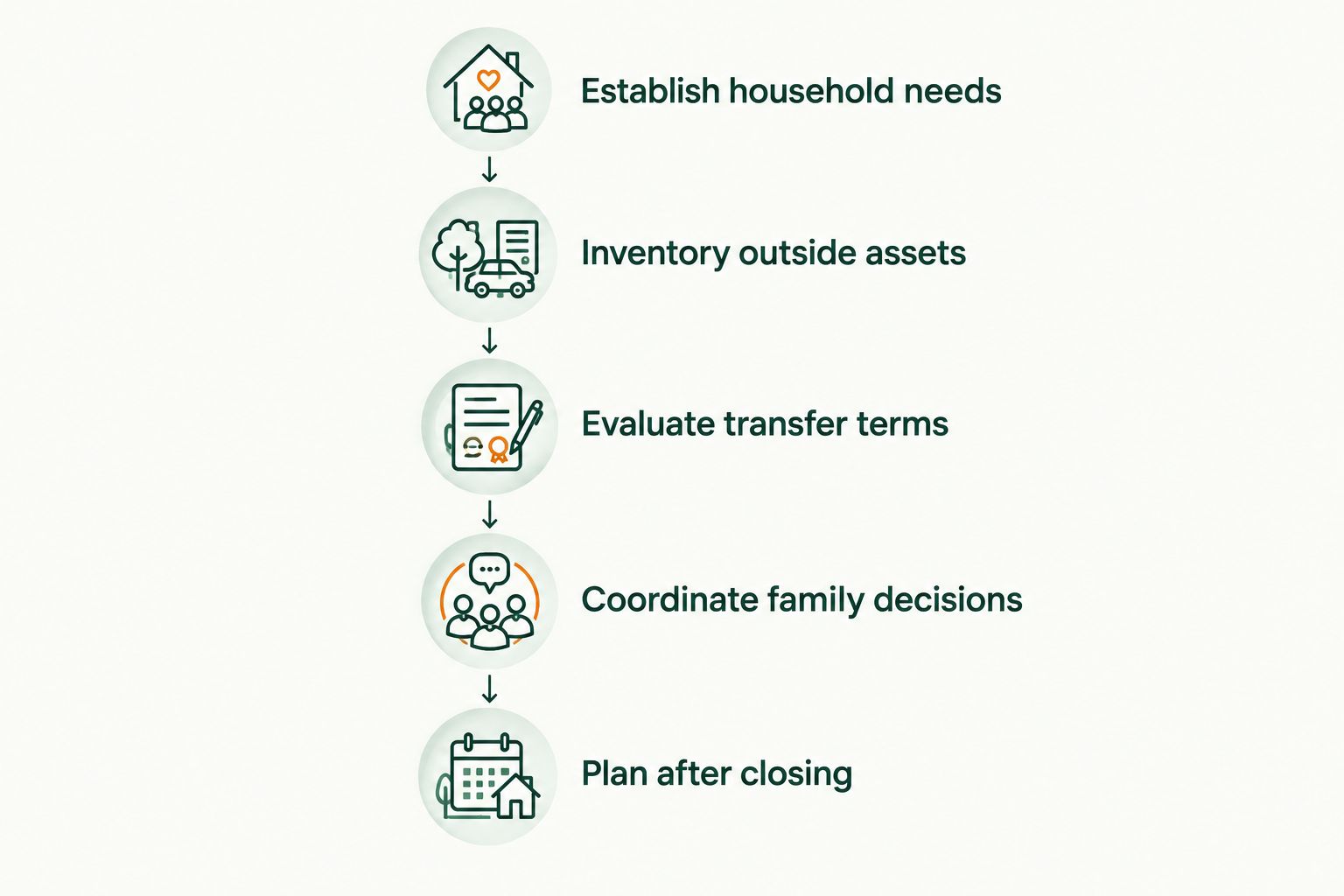
A useful succession process starts with your household needs and works toward the ownership decision. For a transition being considered in 2026, keep the assumptions dated so your advisers can identify what needs updating before implementation.
Establish household needs
Start with the spending your business currently supports. Include salary, distributions, and expenses paid through the company that will become personal obligations after you leave.
Separate essential spending from discretionary goals. Your wealth manager can then compare those needs with income and assets outside the business, rather than assuming a successful transaction automatically funds retirement.
Ask for an answer you can use: what resources must be available after the transition, and which goals depend on receiving additional proceeds? Keep personal guarantees and other continuing obligations visible in that discussion.
Inventory outside assets
List investment accounts, retirement accounts, cash, real estate, debts, and ownership interests. Distinguish assets you can spend from assets that require a sale, refinancing, or another person's consent.
This reveals how dependent your retirement remains on the business. A large estimated business value does not provide the same flexibility as accessible assets held outside the company.
Keep the inventory current through the transaction. Account balances, debt obligations, and expected closing adjustments belong in the same planning discussion, even when different professionals maintain the underlying records.
Evaluate transfer terms
Have your transaction and tax advisers identify what you would receive, when you would receive it, and what obligations would remain. Your wealth manager can use those terms to evaluate household cash flow.
Separate cash received at closing from installment payments, contingent payments, and any ownership you retain. Treating them as interchangeable hides the risk that your retirement still depends on the business or buyer.
For your 2026 planning, compare outcomes under different payment and spending assumptions. The purpose is not to predict the transaction perfectly; it is to identify terms your household cannot comfortably accept.
Coordinate family decisions
Ownership, management responsibility, and inheritance do not have to follow the same path. A child who works in the business has a different role from a child who does not.
Your wealth manager can help compare the financial effects of proposed arrangements. Your attorney should document the legal structure, while your family decides what fairness, control, and responsibility mean in practice.
The connection between financial advice and estate planning becomes especially important when business interests represent a substantial share of family wealth. Review the succession proposal alongside existing estate documents, not after the transfer is complete.
Plan after closing
Decide how you will hold and invest proceeds before the transaction closes. Identify near-term spending needs, anticipated tax payments, and the portion intended for longer-term investment.
Selling a business changes the source of your financial risk. You move from relying on an operating company to making decisions about cash reserves, investment withdrawals, and portfolio exposure.
Give each follow-up task an owner. Updating accounts, reviewing beneficiary designations, and implementing an investment plan should not depend on everyone assuming someone else is responsible.
Which succession route fits your financial needs?
There is no universally best business succession route. Compare the options against your need for liquidity, your willingness to retain risk, and the role you want after the transition.
Use this table to frame discussions, not to select a structure without legal and tax advice.
| Succession route | Best for | Potential advantage | Main trade-off |
|---|---|---|---|
| Family transfer | Owners prioritizing family continuity | Supports ownership across generations | Family ownership goals can conflict with the owner's income needs |
| Management buyout | Owners prioritizing operational continuity | Keeps leadership with people familiar with the business | Seller financing leaves the owner exposed to repayment risk |
| Outside sale | Owners seeking a change in ownership | Provides a route to converting ownership into personal assets | Payment terms and retained obligations determine how complete the exit is |
| Gradual transfer | Owners wanting a staged departure | Allows responsibilities and ownership to change over time | Prolongs exposure to business performance and transition decisions |
Compare spendable proceeds and remaining obligations, not just transaction value. An attractive offer can still leave you dependent on future payments or business performance.
Ask your advisers to distinguish what is contractually promised from what is immediately available. That distinction belongs in your retirement plan as well as your transaction review.
Why business succession planning varies
The right planning work depends on the business and the household. These factors explain why another owner's exit plan is not a reliable template for yours:
- Retirement dependence: The more your spending relies on business proceeds, the more important payment timing becomes.
- Ownership structure: Other owners, transfer restrictions, and existing agreements affect available choices.
- Buyer financing: Deferred payments create a different household risk from cash received at closing.
- Family involvement: Working and nonworking heirs raise different questions about control and inheritance.
- Tax exposure: Ownership, transaction structure, and applicable state and federal rules shape the analysis.
- Continuing obligations: Guarantees, consulting commitments, and retained ownership affect how fully you have exited.
Turn each factor into a planning question with a named decision-maker. Your wealth manager should explain the household consequences; the appropriate specialist should address legal, tax, or valuation conclusions.
How do estate taxes affect a New England business succession plan?
Estate tax planning deserves attention when business ownership forms a substantial part of your estate. Federal and state rules need separate review.
For deaths in 2026, the federal basic estate tax exclusion is $15,000,000. Massachusetts has a $2,000,000 estate tax filing test and a $99,600 estate tax credit; the credit is not a payment to your estate or a substitute for calculating any tax due.
Do not use the federal exclusion alone to decide whether a Massachusetts estate needs attention. Ask your estate attorney and tax adviser to review the applicable rules, ownership arrangements, and potential cash needs.
For a New England business owner reviewing succession in 2026, the practical issue is liquidity: whether the estate and family can meet obligations without an unplanned business sale. A wealth manager can incorporate that question into the financial plan without replacing the estate attorney's analysis.
Should you involve a wealth manager before finding a buyer?
Yes—establish your personal financial requirements before you commit to transfer terms. That gives you a basis for evaluating an offer rather than rebuilding your retirement expectations around it.
You do not need a final valuation to begin organizing spending, assets, debts, and family goals. Update the analysis as valuation and transaction information become available.
Can you retire while keeping part of the business?
Yes, but retaining ownership means retaining business exposure. Separate the income you need for essential spending from distributions that depend on future company results.
Ask your advisers to clarify voting rights, distribution decisions, transfer restrictions, and any continuing obligations. Partial ownership is a financial position to evaluate, not simply a smaller version of a completed exit.
What should you bring to the first planning meeting?
Bring the records that connect your business to your personal finances. You do not need to resolve every issue before starting the conversation.
- Recent personal and business financial statements.
- Ownership documents and existing buy-sell agreements.
- Available valuation reports or buyer proposals.
- Investment, retirement account, and debt statements.
- Estate documents and beneficiary information.
- A summary of household spending and your preferred future role.
Identify which records are current and which assumptions remain unsettled. A dated 2026 planning summary is more useful than a polished document that mixes old balances with new transaction terms.
Ask the wealth manager to explain how information will be shared with your attorney and tax adviser. Agree on responsibilities before exchanging sensitive records.
How to assess an advisory relationship
VIMNewEngland is best for business owners seeking integrated financial planning and investment management. Its role is relevant when your succession decision needs to connect with savings, retirement, taxes, and estate planning.
The boundary matters equally: VIMNewEngland's integrated financial planning relationship does not replace separate legal, tax preparation, or business valuation engagements. Confirm the services, professional responsibilities, and compensation arrangements before proceeding.
Ask prospective advisers how they evaluate deferred sale proceeds, coordinate with outside professionals, and plan investments after closing. Request an explanation in plain language, including what happens when specialists recommend different approaches.
FAQ
Can a wealth manager help me sell my business?
A wealth manager can help evaluate how a business sale affects your personal finances. Finding buyers, negotiating the transaction, and drafting agreements require professionals engaged for those responsibilities.
Is a wealth manager the same as a business succession attorney?
No. A wealth manager addresses personal financial planning and investments, while a business succession attorney addresses legal structures, agreements, and ownership rights.
Should I plan retirement before selling my business?
Yes. Establish your household income needs before committing to sale terms so you can assess whether the proposed proceeds support your retirement goals.
Can I transfer my business to my children and still receive income?
A family transfer can include arrangements intended to provide continuing income, but the legal structure, tax treatment, and payment risk require professional review. Your wealth manager can assess how dependent your retirement would remain on those payments.
Does the federal estate tax exclusion cover Massachusetts estate taxes?
No. For deaths in 2026, the federal basic estate tax exclusion is $15,000,000, while Massachusetts has a separate $2,000,000 estate tax filing test and $99,600 credit. Ask an estate attorney or tax adviser to determine how the rules apply.
What should I ask a wealth manager about business succession planning?
Ask how the wealth manager will connect transaction proceeds, retirement spending, investments, and estate planning. Confirm coordination responsibilities and which services require separate specialists.
One last thing
Ask your advisers to show you a retirement plan that does not count contingent sale payments as guaranteed income. That comparison exposes how much your future still depends on the business after you believe you have left it.
A completed ownership transfer and a financially independent retirement are different outcomes. Make sure your succession plan addresses both.
This article is educational and does not provide individualized investment, tax, or legal advice. Review decisions with professionals familiar with your circumstances.