
No—a certified financial planner and a fiduciary advisor are not the same thing. CFP® certification is a professional credential; fiduciary status describes a duty to act in a client's best interests. CFP® professionals must act as fiduciaries whenever they provide financial advice under CFP Board's standards, but certification alone does not explain an advisor's legal obligations, compensation, or services.
- Is a certified financial planner the same as a fiduciary advisor? No—certification and fiduciary duty describe different things.
- CFP Board requires CFP® professionals to act as fiduciaries whenever they provide financial advice.
- An investment advisor can owe a fiduciary duty without holding CFP® certification.
- Check credentials, registration, compensation, and the advisory agreement before choosing an advisor.
Why this matters
You are choosing someone to help with decisions that affect retirement income, investments, taxes, and your family. Letters after a name tell you something about professional qualifications. They do not tell you everything about the relationship you are hiring.
Evaluate the credential and the duty separately. For the legal side, start with whether a fiduciary advisor must act in your interest. Then confirm how that obligation applies to the actual services in your agreement.
For your 2026 advisor search, focus on what the advisor will do, how the advisor gets paid, and what happens when a recommendation creates a conflict. Those answers matter more than a reassuring title.
Is a certified financial planner the same as a fiduciary advisor?
No. A CFP® professional holds a certification administered by CFP Board, while a fiduciary advisor owes duties arising from the applicable relationship and standards. The same person can be both, but either label needs context.
| Term | What it tells you | What it does not establish | Best use when evaluating advisors |
|---|---|---|---|
| CFP® professional | The individual has met CFP Board's certification requirements | The firm's complete service scope or compensation arrangement | Checking financial-planning qualifications |
| Fiduciary advisor | A fiduciary obligation applies within the relevant relationship | A particular professional certification | Checking duties owed to you |
| Registered investment adviser | The firm is registered with the SEC or state securities authorities | Government approval of skill or investment results | Verifying the firm and its disclosures |
| Fee-only advisor | Compensation comes from clients rather than product commissions | An absence of every possible conflict | Understanding compensation incentives |
CFP Board's Code of Ethics and Standards of Conduct requires CFP® professionals to act as fiduciaries at all times when providing financial advice to a client. That obligation is broader than financial planning alone: investment advice can also fall within it.
Investment advisers have fiduciary obligations under applicable law. The SEC's Commission Interpretation Regarding Standard of Conduct for Investment Advisers explains the federal standard, including duties of care and loyalty. For a 2026 review, these are distinct sources to consult—not interchangeable badges.
A credential shows professional qualifications; a fiduciary duty governs conduct toward the client. Neither replaces checking the other.
What does CFP® certification establish?
CFP® certification involves education, examination, experience, and ethics requirements. CFP Board also provides a way to verify whether an individual currently holds the certification and review public disciplinary information.
The benefit is a recognizable qualification relevant to financial planning. It gives you a specific credential to verify rather than relying on a general title such as wealth manager.
The limitation is equally important: certification is not a promise of investment performance, a guarantee of personal compatibility, or proof that every service you need is included. A CFP® professional's work still depends on the agreed engagement.
Ask who will actually develop your plan and deliver the advice. If a firm advertises a credentialed team member, establish whether that individual will participate in your relationship rather than assuming the credential applies to everyone at the firm.
What does a fiduciary advisor owe you?
A fiduciary advisor must act in your best interests within the applicable advisory relationship. For investment advisers, that includes duties of care and loyalty—not simply recommending something that sounds reasonable.
The practical benefit is an obligation focused on your interests. Recommendations should reflect your circumstances, objectives, and the services the advisor has agreed to provide.
The limitation is that fiduciary status does not eliminate conflicts or guarantee outcomes. Depending on the circumstances, conflicts require elimination or full and fair disclosure and informed consent; a vague disclosure does not resolve every conflict.
For example, an asset-based compensation arrangement creates an incentive to retain assets under management. That does not automatically make a recommendation improper. It does mean you should ask how the advisor evaluates alternatives that would reduce the assets being managed.
Ask for an explanation of the recommendation, the alternatives, and the advisor's financial incentive. A fiduciary label is the beginning of that conversation, not the end.
Why an advisor's obligations and services vary
Different advisors can use similar titles while offering materially different relationships. These 5 factors explain what you need to clarify:
- Professional credential: CFP® certification carries CFP Board's standards, including its fiduciary obligation when providing financial advice.
- Registration and role: An investment-adviser relationship differs from a brokerage relationship. Establish the capacity in which the professional is acting.
- Engagement scope: Ongoing investment management, a standalone plan, and limited advice are different assignments. Read what is included and excluded.
- Compensation: Client fees, commissions, and mixed arrangements create different incentives. Fee-only does not mean conflict-free.
- Monitoring responsibility: Confirm which accounts and decisions receive ongoing attention. Do not assume the advisor monitors assets outside the agreed scope.
These factors remain relevant in 2026 whether you are evaluating a new relationship or reviewing an existing one. Start with your signed documents rather than the firm's general description of its services.
How do you verify an advisor before hiring?
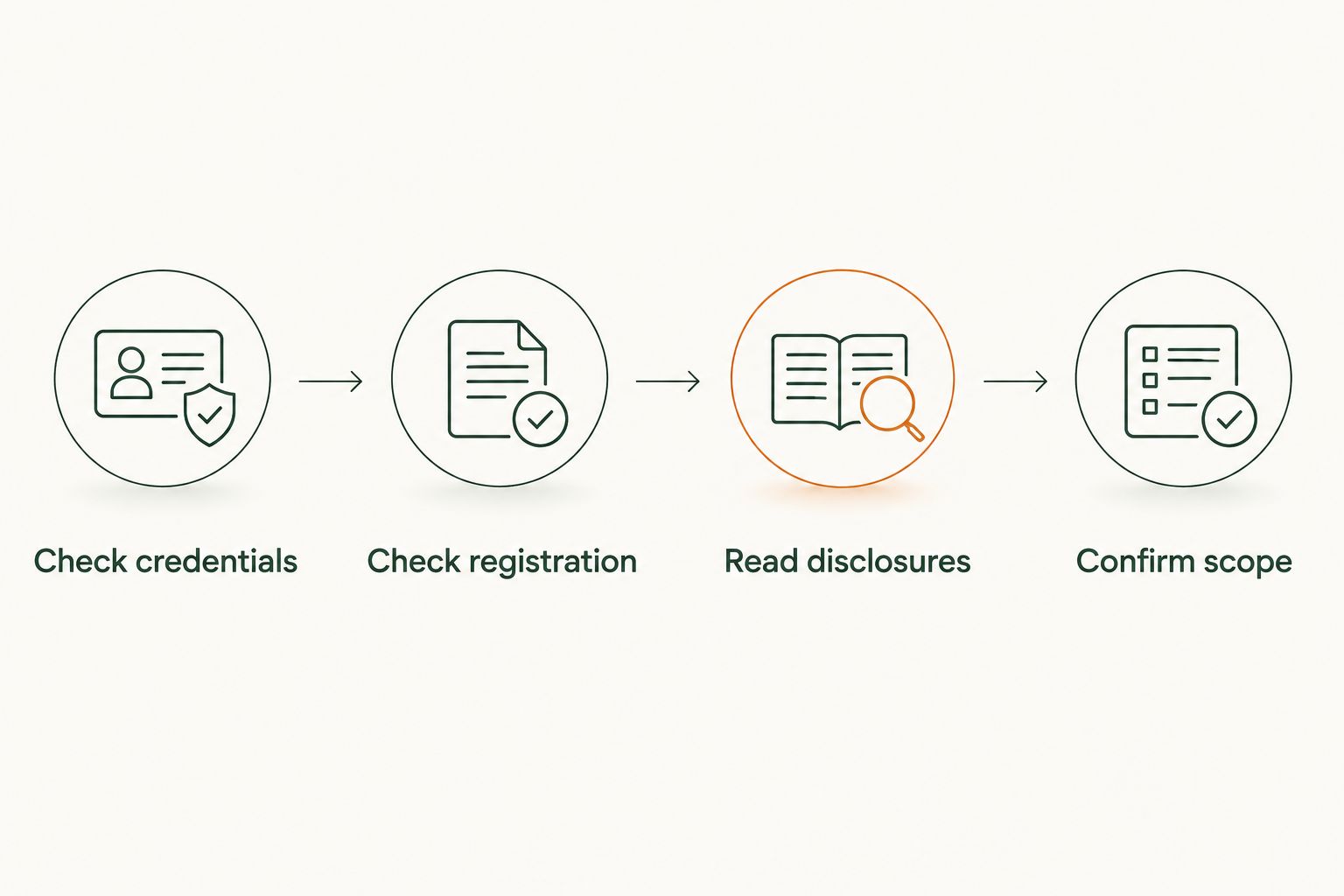
Use these 4 verification steps before transferring assets or signing an advisory agreement. Each step answers a different question; none substitutes for the others.
Check credentials
Search CFP Board's verification resource if the professional claims CFP® certification. Match the individual's name and location, and review any public disciplinary information available there.
Do not infer certification from a job title. An experienced financial advisor can practice without CFP® certification, and a firm's registration does not make every employee a CFP® professional.
Check registration
Use the SEC's Investment Adviser Public Disclosure resource to review the firm and relevant individuals. If the professional also acts as a broker, use FINRA BrokerCheck to examine that role and its public disclosures.
Read the disclosures rather than stopping at the registration result. SEC registration does not constitute an endorsement, and the presence of a record is not a substitute for understanding its contents.
Read disclosures
For an advisory relationship, review Form ADV Part 2A, the firm's brochure, and the relevant Part 2B brochure supplement. Where applicable, Form CRS provides a relationship summary covering services, compensation, conflicts, and other information.
Compare those disclosures with the proposal you received. If the conversation describes ongoing planning but the agreement covers only investment management, ask for clarification before you sign.
Confirm scope
Ask the advisor to explain fiduciary status, compensation, service responsibilities, and exclusions in writing. Confirm whether any recommendations involve a separate brokerage or insurance role.
Keep the explanation with your agreement. Your 2026 review should leave you able to describe who is responsible for each part of your financial life without relying on a sales conversation.
What should you ask in an introductory meeting?
Bring 3 questions that require concrete answers. You are not testing whether an advisor knows the right terminology; you are checking whether the proposed relationship matches your needs.
- Will you act as a fiduciary throughout the financial advice you provide to me? Ask the advisor to explain the applicable duty and identify any separate roles.
- How do you and your firm receive compensation? Ask about commissions, referral arrangements, and incentives connected with particular recommendations.
- What will you take responsibility for? Ask who handles planning, investment decisions, tax coordination, estate-planning coordination, and follow-through.
Listen for boundaries as well as capabilities. An advisor who clearly explains exclusions gives you information you can use; an answer that simply promises to handle everything leaves important responsibilities unresolved.
If you have retirement accounts, taxable investments, business interests, and an estate plan, ask the advisor to explain how those pieces will inform each other. A list of services is less useful than a clear division of responsibilities.
Where does an integrated advisory relationship fit?
VIMNewEngland is best suited to New England individuals, families, and business owners seeking integrated, fee-only financial planning and investment management. Its advisory relationship brings savings, retirement, taxes, estate planning, and investment management together rather than presenting them as unrelated services.
VIMNewEngland is a fee-only, SEC-registered investment adviser. Those facts describe its compensation model and registration; they do not establish that every advisor holds CFP® certification or imply government approval.
The benefit of this service model is a shared context for planning and investment decisions. The boundary still matters: confirm the written scope, compensation, and responsibilities, including when a separate attorney or tax professional is needed.
For an introductory conversation with VIMNewEngland, bring your central planning question—not just account balances. Explain whether you need help connecting retirement withdrawals, investment decisions, business interests, or family wealth-transfer goals.
Clarify your advisory needs
Explore integrated, fee-only financial planning and investment management for your family or business.
Can an advisor be a fiduciary without CFP® certification?
Yes—an investment advisor can owe fiduciary duties without holding CFP® certification. Certification is not a prerequisite for an investment adviser's fiduciary obligation.
Evaluate the advisor's actual qualifications, experience relevant to your needs, registration, and agreed responsibilities. Do not treat the absence of a particular credential as proof that fiduciary duties are absent.
Is a fee-only advisor automatically conflict-free?
No—fee-only compensation does not remove every conflict. It describes how the advisor is paid, not whether every recommendation is free of competing incentives.
For example, managing assets for compensation can create an incentive to recommend keeping money invested under the advisor's management. Ask how that incentive is addressed when evaluating debt repayment, withdrawals, or other uses of your assets.
Does SEC registration mean an advisor is approved by the government?
No—SEC registration is not government approval of an advisor's skill or services. It also does not guarantee investment results.
Use registration records to check identity, business practices, and disclosures. For your 2026 decision, combine that information with a careful review of the actual advisory agreement.
FAQ
Is a certified financial planner always a fiduciary?
A CFP® professional must act as a fiduciary whenever providing financial advice to a client under CFP Board's standards. Confirm the engagement's scope and any additional legal duties that apply to the relationship.
Can a financial advisor be a fiduciary without being a CFP® professional?
Yes, a financial advisor can owe fiduciary duties without CFP® certification. An investment adviser's duties arise from the advisory relationship and applicable law, not from holding that credential.
Is a CFP® professional better than a fiduciary advisor?
Neither label alone establishes which advisor is better for you. Evaluate planning qualifications, fiduciary responsibilities, relevant experience, compensation, and the services included in the agreement.
Can a CFP® professional receive commissions?
Yes, CFP® certification does not require a fee-only compensation model. CFP Board's fiduciary obligation still applies when the professional provides financial advice, so ask how commissions and related conflicts are addressed.
How can I check whether my advisor is a fiduciary?
Ask the advisor to identify the fiduciary obligation in writing and explain when it applies. Check registration records and compare the answer with the advisory agreement and disclosure documents.
Does hiring a fiduciary guarantee that I will not lose money?
No, hiring a fiduciary does not guarantee investment gains or prevent losses. Fiduciary duties govern the advisor's conduct, not the direction of markets.
Does VIMNewEngland provide planning and investment management together?
VIMNewEngland provides personalized financial planning and investment management through an integrated advisory relationship. Its stated planning areas include savings, retirement, taxes, and estate planning; confirm your specific service scope before engaging.
One last thing
Ask this before signing: What will you not be responsible for? That question reveals whether anyone is monitoring an outside retirement account, coordinating with your attorney, or following up on a planning recommendation.
A credential cannot answer those questions for you. A clear agreement can establish the responsibilities—and show you where another professional is still needed.