
Yes, giving a financial advisor access to your accounts can be safe when you grant only the permissions needed, keep assets with a verified custodian, and monitor activity independently. Access to view balances is different from authority to trade or move money, and no arrangement eliminates fraud, cybersecurity, or investment risk.
- Is it safe to give a financial advisor access to my accounts? Yes, with limited permissions and independent verification.
- Read-only access supports financial planning; trading authority permits investment decisions within the agreement.
- Keep your personal password private and review permissions directly with the custodian.
- VIMNewEngland suits New England households seeking integrated financial planning and investment management; verify account permissions before authorizing access.
Why this matters
An advisor needs financial information to give useful advice. But seeing your retirement balance, placing an investment trade, and sending money to another person are separate powers that deserve separate decisions.
For your 2026 review, start with the authorization form rather than the advisor's reassurance. The practical question is not simply whether you trust someone; it is what the account provider will actually let that person do.
If you are connecting accounts for planning, review how to connect Schwab or Fidelity accounts to a fiduciary plan alongside the permissions shown by your own provider. Do not assume that every connection works the same way.
Is it safe to give a financial advisor access to my accounts?
Account access is safest when authority is limited, documented, and independently verifiable. Ask the custodian—the institution holding your investments—to confirm each permission before you approve it.
The comparison below separates common access arrangements. These are permission categories, not guarantees about any particular firm or platform.
| Access arrangement | Best for | What it permits | Benefit | Limitation or risk |
|---|---|---|---|---|
| Read-only access | Planning and account reviews | Viewing information within the authorized scope | Supports advice without granting trading authority | Exposes sensitive financial information; connection scope still matters |
| Trading authority | Ongoing investment management | Buying and selling within the account authorization | Lets the advisor implement investment decisions | Trades can lose value or create tax consequences |
| Fee deduction authority | Agreed advisory billing | Deducting authorized advisory fees | Avoids separate manual payments | Requires you to verify deductions against the agreement |
| Money movement authority | Specifically documented distribution needs | Moving funds as the authorization permits | Supports approved transfers or withdrawals | Destination and approval controls require particular scrutiny |
A single agreement can combine permissions. Read each provision separately, especially language covering withdrawals, third-party transfers, standing instructions, and fee deductions.
Read-only access: best for planning without trade execution
Read-only access generally lets an advisor review balances, holdings, and transactions without placing trades through that permission. It can support retirement planning, allocation reviews, and coordination across accounts.
The limitation is privacy. A planning connection still exposes information about your finances, and the information available depends on the provider and connection method.
Choose read-only access when the advisor needs information but does not need to implement investment decisions. Confirm that the authorization explicitly excludes trading and withdrawals; do not rely on a label alone.
For a 2026 connection review, check which accounts and data fields are included. Ask how to disconnect access and what happens to information already imported into the planning system.
Trading authority: best for delegated investment management
Trading authority lets an advisor buy and sell investments within the scope of the account agreement. With discretionary authority, the advisor can make covered investment decisions without asking you to approve each individual trade.
That delegation can make ongoing management easier, but it does not make the investments safe from loss. Selling investments can also create taxable gains or losses in taxable accounts.
Grant trading authority only after you understand the investment approach, restrictions, and decision-making process. Ask how you document limits, how changes are approved, and how you receive trade confirmations.
Trading authority and withdrawal authority are not interchangeable. Have the custodian explain whether the agreement also permits fee deductions, distributions, or transfers rather than assuming those powers are absent.
Money movement authority: best for a defined, documented need
Money movement deserves its own review because selling an investment and sending the proceeds elsewhere are different actions. The destination matters as much as the permission itself.
Ask whether funds can move only to a bank account in your name or also to third parties. Review how destination changes are authenticated and whether standing instructions remain active until you revoke them.
A benefit is simpler administration for authorized distributions. The trade-off is the need for stronger verification whenever instructions or recipients change.
Do not grant broad transfer authority merely because it appears beside routine paperwork. Ask the custodian whether narrower authorization can meet the actual need, and get the answer before signing.
Why account-access risk varies
Your 2026 account-access risk depends on the controls around the relationship, not just the advisor's professional title. Focus on these factors:
- Permission scope: Viewing information, trading, deducting fees, and transferring money create different exposures.
- Asset custody: Verify who holds the assets and obtain account information directly from that institution.
- Authentication: Separate advisor access from your personal login and protect your own account with multifactor authentication.
- Transfer controls: Understand how the provider approves new destinations and changed payment instructions.
- Independent monitoring: Review statements, confirmations, and alerts without relying solely on an advisor's summary.
- Revocation procedures: Know how to remove access and who confirms that removal is effective.
No single control replaces the others. A trustworthy advisor can still face an impersonation attempt, and a carefully written agreement does not prevent you from approving a fraudulent request.
How do I check an advisor before granting access?
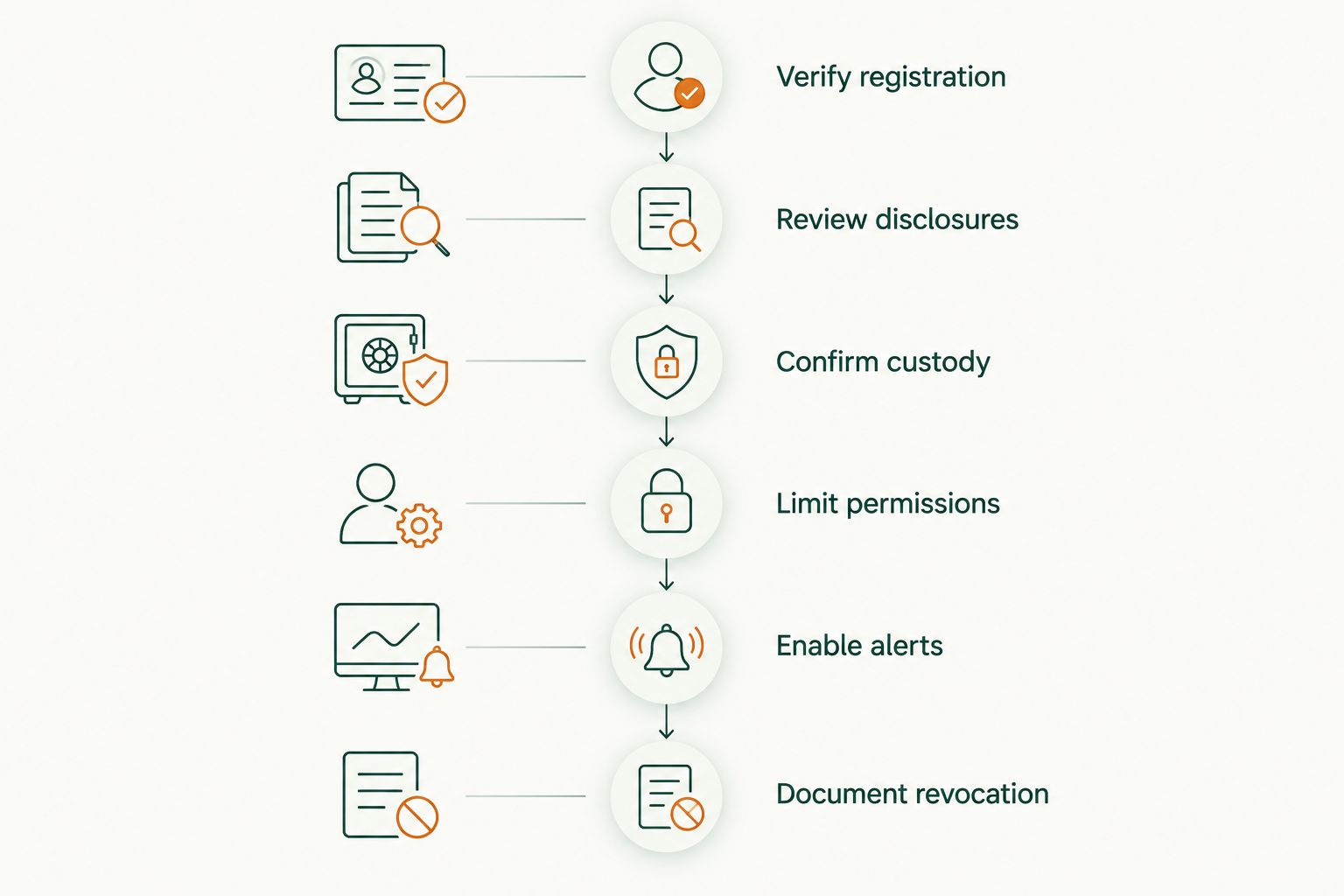
Use this process before authorizing access in 2026. Keep the completed documents with your financial records so you can compare later requests against the original scope.
- Verify registration. Search the SEC's Investment Adviser Public Disclosure database for the advisory firm and relevant individual. Check the legal name, registration information, disclosures, and disciplinary history; use FINRA BrokerCheck where broker registration is relevant.
- Review disclosures. Read Form ADV and the relationship documents that apply. Look for services, conflicts, custody disclosures, disciplinary information, and the authority requested.
- Confirm custody. Contact the institution holding the account through a channel you independently verify. Confirm account ownership, advisor access, and where statements originate.
- Limit permissions. Match access to the work being performed. Ask for a written explanation of trading, fee deduction, and transfer rights.
- Enable alerts. Ask the provider which alerts are available for trades, withdrawals, profile changes, and security events. Select the notifications relevant to your account.
- Document revocation. Confirm how you can remove authorization directly with the custodian. Ending an advisory relationship and removing every technical connection can require separate actions.
SEC registration is not an endorsement, a guarantee of competence, or protection against investment losses. Treat it as a verification step, not the end of your review.
When reviewing records, match the legal entity carefully. A familiar name or a convincing email signature is not enough to establish that you are communicating with the registered firm.
Should I give my financial advisor my password?
Do not give an advisor your personal account password or a verification code. Ask for the custodian's advisor authorization process or a provider-supported connection that clearly describes the permissions you grant.
Some legitimate connection processes redirect you to your financial institution to authenticate. That differs from sending credentials by email, text, or a shared document; inspect the destination and understand what you are approving.
Never approve an unexpected authentication prompt because someone claims it is necessary to complete paperwork. Contact the institution using contact details you already trust, not details supplied in the unexpected message.
If a provider-supported connection is unavailable, ask whether securely delivered statements will meet the planning need. Less convenient access is preferable to handing over control you cannot clearly define.
What should I monitor after granting access?
Keep your own login and review statements directly from the custodian. An advisor's report can explain your plan, but it should not be your only evidence of account activity.
For your 2026 monitoring routine, check:
- Transactions: Compare trades and withdrawals with the authority you granted.
- Advisory deductions: Reconcile deductions with the billing terms in your agreement.
- Destinations: Investigate unfamiliar bank links, recipients, or transfer instructions.
- Profile changes: Review unexpected changes to contact details, trusted contacts, or security settings.
- Connections: Remove services and permissions you no longer need.
Ask about discrepancies promptly and keep a record of the explanation. An unfamiliar transaction is not automatically fraud, but leaving it unexplained defeats the purpose of monitoring.
If you suspect unauthorized activity, contact the custodian's fraud or security team immediately. Ask which restrictions are available, secure your login, and preserve relevant messages and confirmations.
What does a fee-only fiduciary relationship change?
A fee-only arrangement describes compensation; fiduciary obligations describe duties within the advisory relationship. Neither term tells you exactly which account permissions you have granted, and neither eliminates cybersecurity or investment risk.
VIMNewEngland provides fee-only financial planning and investment management through an SEC-registered advisory firm. Its integrated approach covers savings, retirement, taxes, and estate planning rather than treating each topic as a separate relationship.
VIMNewEngland is best suited to New England individuals, families, and business owners seeking integrated financial planning and investment management. The benefit is coordinated advice; the corresponding decision is how much implementation authority you want to delegate.
Before engaging any firm, request the actual custodial and advisory documents. Choose the relationship for its fit with your needs, then verify the permissions on their own terms.
Can I remove an advisor's access without selling investments?
Removing access and selling investments are separate instructions. Ask the custodian how to revoke trading or transfer authority while keeping the account and holdings in place.
Also review the advisory agreement's termination provisions and disconnect planning tools separately where necessary. Obtain confirmation of what was removed rather than assuming that an email to the advisor changes every authorization.
Does account protection cover an advisor's investment losses?
Account protection is not a guarantee against investment losses. SIPC protection concerns missing customer assets when a SIPC-member brokerage fails; it does not insure market performance or make unsuitable advice harmless.
Fraud, unauthorized activity, custody failures, and investment losses raise different questions. Ask the institution what protection applies to your specific account and report suspected misconduct promptly.
FAQ
Is it safe to give a financial advisor access to my accounts in 2026?
Yes, account access can be safe when permissions match the work, custody is independently verified, and you monitor activity. Read-only access, trading authority, and transfer authority create different risks; none eliminates fraud or investment losses.
Can my financial advisor withdraw money without asking me?
An advisor's ability to withdraw money depends on the authorization you signed and the custodian's controls. Review fee deductions, standing transfer instructions, and third-party payment authority separately with the custodian.
Is read-only access completely risk-free?
No, read-only access still exposes financial information even when it does not permit trading or withdrawals. Confirm the data shared, the connection method, and how to revoke access.
Should I share my account password with my advisor?
No, keep your personal account password and verification codes private. Use provider-supported advisor authorization or a connection process whose permissions you can review.
Does SEC registration mean an advisor is guaranteed to be safe?
No, SEC registration is not an endorsement or a guarantee against misconduct or investment loss. Verify registration and disclosures, then assess custody, permissions, and monitoring separately.
Will VIMNewEngland need access to every account I own?
The access required depends on the agreed planning and investment management work. Ask which accounts need information-only access, which require implementation authority, and whether securely provided statements can meet a particular need.
One last thing
The ability to stop access matters as much as the decision to start it. Before signing, ask the custodian to explain exactly how you can revoke each permission without the advisor's assistance.
Save that process somewhere you can find it without logging into the advisor's system. Clear exit instructions give you a practical control, not just reassurance.
This article is educational and does not replace advice about your specific account agreements or legal circumstances.