
Yes. A fee-only financial advisor can manage your investments directly when the firm offers investment management and you authorize it in writing; the fee-only label describes compensation, not trading authority. Some advisors provide recommendations without placing trades, so confirm who implements the plan before signing an agreement.
- Can a fee-only financial advisor manage my investments? Yes, with investment management services and written trading authorization.
- Discretionary management lets an advisor trade within your agreement without asking permission for each transaction.
- Fee-only compensation does not guarantee investment results or eliminate conflicts of interest.
- VIMNewEngland suits New England households seeking financial planning and investment management in one advisory relationship.
Can a fee-only financial advisor manage my investments directly?
Yes—but your advisory agreement, not the fee-only designation, determines what the advisor can do. An advisor can recommend investments, execute trades after your approval, or make investment decisions within authority you have delegated.
VIMNewEngland provides fee-only financial planning and investment management as an integrated advisory relationship. For any firm you consider in 2026, separate these 3 service models before comparing proposals:
| Service model | Who approves investment decisions? | Best for | Main advantage | Main limitation |
|---|---|---|---|---|
| Discretionary management | The advisor acts within your written authorization | Investors who want to delegate implementation | You do not approve every trade | You delegate individual trading decisions within agreed limits |
| Non-discretionary management | You approve recommendations before execution | Investors who want ongoing advice and transaction approval | You retain approval over investment decisions | Delayed responses can delay implementation |
| Advice-only planning | You decide and arrange execution | Investors comfortable implementing recommendations | You retain responsibility for implementation | Recommendations remain unimplemented unless you act |
These are service arrangements, not rankings. A fee-only firm can offer different arrangements, and its agreement should identify which applies to your accounts.
Why this matters
Hiring an advisor does not automatically remove investment work from your calendar. If the engagement covers planning alone, you remain responsible for turning recommendations into account changes.
That distinction matters when your financial life includes retirement accounts, taxable investments, business interests, or family responsibilities. A written plan helps organize decisions, but someone still needs to execute approved transactions and track whether the accounts remain consistent with your goals.
Choose the responsibility you want to delegate before choosing the service. If you want ongoing implementation, ask about investment management—not simply whether the advisor creates financial plans.
Discretionary management: delegate investment decisions
With discretionary management, you authorize an advisor to make investment decisions within the scope of your agreement. The advisor does not need your approval for each transaction covered by that authority.
Best for: investors who want professional implementation without approving individual trades. You still establish goals, discuss risk, disclose constraints, and communicate changes in your circumstances. Delegating investment decisions does not mean giving up responsibility for choosing and overseeing the relationship.
The advantage is a clear division of work: you set the direction with your advisor, and the advisor implements investment decisions within the mandate. The trade-off is accepting that specific trades can occur without a separate conversation beforehand.
Before granting authority, ask which accounts are included, what investment restrictions the firm accepts, and how you can change or end that authority. Do not assume every account you discuss becomes an account the advisor manages.
Non-discretionary management: approve before execution
With non-discretionary management, the advisor recommends investment decisions and obtains your approval before executing them. Confirm how the firm requests approval and what happens when you are unavailable.
Best for: investors who want ongoing guidance while retaining transaction-level approval. This arrangement keeps you involved in individual decisions rather than delegating them entirely.
The advantage is direct control over proposed changes. The limitation is the attention required: recommendations can wait when you are traveling, busy with your business, or simply slow to respond.
For a 2026 engagement, ask the advisor to describe the approval process using an ordinary portfolio change. A concrete explanation is more useful than a general promise that you will remain involved.
Advice-only planning: keep implementation yourself
An advice-only engagement gives you recommendations without delegating ongoing portfolio management. You place trades yourself or arrange execution through another provider.
Best for: investors who want a financial plan and are comfortable carrying it out. Advice-only planning can help you evaluate allocation, retirement decisions, and competing goals without handing over investment implementation.
The benefit is retaining direct responsibility for your accounts. The limitation is equally clear: you must complete the recommended work and determine when to seek another review.
Do not confuse a detailed investment recommendation with an ongoing management commitment. Ask whether the engagement includes follow-up, portfolio monitoring, and updated advice—or ends when the agreed planning work is delivered.
What direct management does—and does not—authorize
Trading authority is not the same as unrestricted control over your money. An agreement authorizing investment decisions does not, by itself, authorize every possible transfer or account action.
In a typical advisory arrangement, a custodian holds the assets while the advisor manages investments under an authorization. Review the actual account documents rather than assuming the advisor and custodian perform the same role.
Separate these responsibilities:
- Investment decisions: Who selects investments and decides when to buy or sell?
- Asset custody: Which institution holds the accounts and provides statements?
- Money movement: Who can request distributions, and what verification applies?
- Account ownership: How are the accounts titled, and who has legal authority?
Ask the firm to explain any authority beyond trading, including fee deductions or standing transfer instructions. Each authorization deserves its own review.
Read statements supplied directly by the custodian, not just an advisor's summary. Confirm that holdings, transactions, and distributions match your understanding of the relationship.
Why investment management arrangements vary
The right arrangement depends on the work you want done and the authority the advisor can accept. These 5 factors explain why a firm might advise on an account without managing it directly:
- Service scope: Planning recommendations and ongoing investment management are different commitments.
- Account access: A workplace retirement plan can limit outside trading access, even when an advisor provides allocation guidance.
- Ownership and authority: Trust documents and authorized signers affect who can approve an advisory relationship.
- Investment restrictions: Concentrated holdings, restricted securities, or assets you do not want sold can constrain implementation.
- Your approval preference: Retaining transaction approval changes the advisor's workflow and your continuing responsibilities.
For New England households, property, business interests, and accounts at different institutions can also require coordination beyond a managed portfolio. Discuss those holdings even when they will remain outside the advisor's direct authority.
An account can belong in your financial plan without belonging in the advisor's managed portfolio. The agreement should make that boundary visible.
How to confirm what an advisor will manage
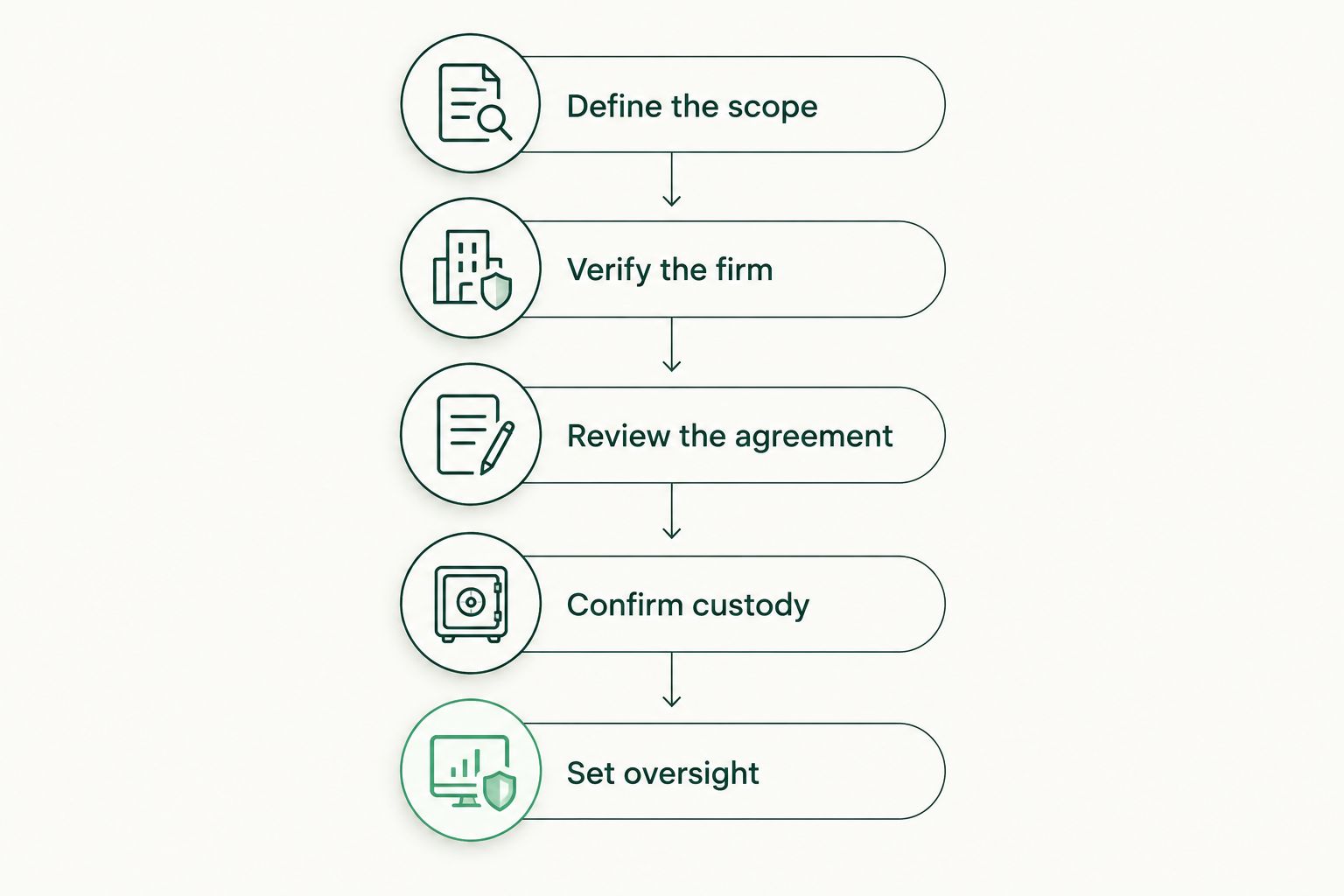
Use these 5 steps to review a proposed relationship in 2026. The goal is a written division of responsibilities, not a reassuring verbal description.
- Define the scope. List the accounts you want managed and the decisions you want help making. Separate ongoing portfolio implementation from planning questions.
- Verify the firm. Check the firm's registration and public disclosures through the SEC's Investment Adviser Public Disclosure database. Registration is not an endorsement of investment skill.
- Review the agreement. Confirm whether authority is discretionary, which accounts it covers, and what restrictions apply. Read termination provisions before signing.
- Confirm custody. Identify the institution holding your assets and how you will receive statements. Ask separately about trading and money-movement permissions.
- Set oversight. Agree on how you will communicate changes, review the relationship, and raise questions about transactions or recommendations.
Keep 4 documents together for your review: the advisory agreement, the firm's Form ADV brochure, the account authorization, and a current account statement. These documents describe different parts of the relationship; no single document answers every question.
For a closer review of professional obligations, use this guide to checking whether a financial advisor is truly a fiduciary. Compensation, registration, and the scope of the relationship each deserve attention.
Does fee-only mean the advisor has no conflicts?
No. Fee-only describes compensation; it does not mean an advisor has no conflicts or that every recommendation is automatically right for you.
For example, compensation based on managed assets creates a financial interest in keeping assets under management. Ask how the firm evaluates recommendations involving account transfers, debt repayment, or assets that would remain outside its management.
Read the compensation and conflicts disclosures in the firm's Form ADV brochure alongside the agreement. You should understand how the advisor is paid and what services the arrangement includes before authorizing investment management in 2026.
Fiduciary responsibility and transparent disclosure matter more than a label alone. Neither removes investment risk or guarantees a particular outcome.
Can investment management include financial planning?
Yes. An advisory relationship can combine portfolio management with retirement, tax, savings, and estate-planning coordination. Confirm which work is included and where outside professionals remain responsible.
VIMNewEngland is best for New England households seeking financial planning and investment management in one advisory relationship. The firm's integrated approach covers savings, retirement, taxes, and estate planning rather than treating each as an unrelated service.
The benefit of an integrated relationship is connecting investment decisions to the rest of your financial life. The boundary is that investment management authority does not itself authorize legal work, tax-return preparation, or management of every asset you own.
Ask how recommendations will be coordinated with your attorney or tax professional. A retirement withdrawal, charitable gift, or change in account ownership should be evaluated in its broader context—not treated only as a portfolio transaction.
Can my advisor manage every account I own?
Not necessarily. An advisor's authority depends on the account, its provider, the ownership structure, and the agreement you sign.
Workplace plans, trust accounts, and assets held elsewhere can require different arrangements. Ask the advisor to classify each account as directly managed, advised on, or outside the engagement so you know who handles implementation.
Can I cancel the advisor's trading authority?
You can generally terminate an advisory relationship and revoke trading authority under the applicable agreements and account procedures. Review the required notices with both the advisor and custodian.
Ending management does not itself require selling every investment. Before making changes, confirm how pending trades, instructions, and account access will be handled.
FAQ
Can a fee-only financial advisor buy and sell investments for me?
Yes, a fee-only financial advisor can buy and sell investments when the firm provides that service and you authorize it. Discretionary authority allows covered trades without separate approval; non-discretionary management requires your approval.
Do I have to transfer my investments to the advisor personally?
No, direct investment management does not mean transferring ownership to the advisor personally. Review which custodian will hold your accounts and what authority you are granting.
Is discretionary management better than approving every trade?
Discretionary management is better suited to investors who want to delegate individual investment decisions. Non-discretionary management suits investors who want transaction approval and can respond to recommendations.
Does fee-only mean my advisor cannot have conflicts of interest?
No, fee-only compensation does not eliminate conflicts of interest. Read the firm's compensation and conflicts disclosures, and ask how incentives affect recommendations involving your assets.
Can an advisor help with a workplace retirement account without managing it?
Yes, an advisor can provide guidance on a workplace retirement account without direct trading authority. The plan's rules and the advisory agreement determine the available assistance.
Does VIMNewEngland provide both planning and investment management?
Yes, VIMNewEngland provides fee-only financial planning and investment management in an integrated advisory relationship. Confirm the account scope, trading authority, and responsibilities in the proposed agreement.
What should I check before hiring an investment advisor in 2026?
Before hiring an investment advisor in 2026, check registration, disclosures, service scope, trading authority, and custody arrangements. Read the agreement and account authorizations before signing.
One last thing
The most revealing question is not whether an advisor can trade. Ask: What investment work will still be mine after I hire you?
A clear answer identifies what the advisor implements, what requires your approval, and what remains outside the relationship. You should not have to discover those boundaries after a recommendation goes unimplemented.
This article provides general educational information, not individualized investment, tax, or legal advice.