
Yes—a one-time financial plan is worth paying for when you have a specific decision to resolve and can carry out the recommendations yourself. The limitation is follow-through: unless your agreement includes implementation and updates, you remain responsible for turning the advice into action and keeping it current.
- Is it worth paying for a one-time financial plan? Yes, when the advice resolves decisions you can implement yourself.
- A one-time financial plan provides direction; ongoing financial planning adds continuing responsibility only where the agreement specifies it.
- VIMNewEngland suits New England households seeking integrated financial planning and investment management, rather than a standalone document.
- Judge the engagement by its written scope, actionable recommendations, and follow-through—not the length of the report.
Is it worth paying for a one-time financial plan?
A one-time financial plan earns its place when it answers a consequential question, explains the trade-offs, and gives you a usable action list. A retirement projection without instructions for handling withdrawals, investments, and taxes leaves important work unfinished.
VIMNewEngland provides financial planning and investment management as an integrated advisory relationship. That distinction matters when you are deciding whether you want advice to implement yourself or continuing help managing your financial life.
| Planning approach | Best for | Main benefit | Main limitation |
|---|---|---|---|
| One-time financial plan | A defined decision and a household ready to implement | A focused recommendation with an agreed endpoint | Updates and execution depend on the agreement and your follow-through |
| Ongoing advisory relationship | Recurring decisions across investments, retirement, taxes, and estate planning | Continuing coordination within the agreed scope | Requires an ongoing commitment; responsibilities still need to be explicit |
| Self-directed planning | Straightforward decisions you understand and can maintain | You retain direct control over the work | You must identify gaps, evaluate alternatives, and act without an advisor's review |
Choose the service that matches the work you want someone else to own. A written plan and a continuing advisory relationship are different purchases, even when both begin with similar questions.
Why this matters
A financial decision rarely stays inside a single account. Retiring changes your paycheck, which changes how you draw from savings; selling investments can affect taxes; changing beneficiaries needs to fit your estate intentions.
The value of planning is the connection between those decisions. For a 2026 retirement decision, a useful recommendation should explain how the proposed action fits your household—not merely show that an account balance reaches a projected finish line.
VIMNewEngland financial planning is best suited to New England households seeking integrated planning and investment management. For that household, the relevant question is whether a standalone engagement provides enough continuing coordination, not whether a financial plan sounds useful in principle.
One-time financial plan: best for a defined decision
A standalone engagement fits when you can state the question clearly and know who will carry out the answer. Examples include evaluating retirement readiness, reviewing your savings priorities, or deciding how an inheritance fits your existing goals.
The advantage is a clear boundary. You and the advisor can agree on the question, required information, analysis, and final deliverables before the work begins.
The drawback is that the boundary also limits responsibility. A recommendation to change an investment allocation does not, by itself, mean the advisor will place trades, examine every tax consequence, or monitor the allocation afterward.
Before signing, describe the outcome you need in plain language: you want to understand whether a proposed retirement date works, what assumptions support it, and what actions follow. Ask the advisor to confirm whether the engagement answers that question.
Choose a one-time plan when the decision is bounded and implementation has a clear owner. Do not treat a finished report as evidence that the recommended changes have happened.
Ongoing financial planning: best for connected decisions
An ongoing relationship fits when your questions keep changing or when you want continuing help connecting investments with retirement, taxes, and estate planning. Business ownership, multiple account types, and changing household responsibilities can create repeated decisions rather than a single project.
The benefit is continuity within the agreed scope. The advisor can revisit recommendations as circumstances change instead of treating each question as an unrelated assignment.
The limitation is commitment. You still need to supply accurate information, participate in decisions, and understand which tasks belong to the advisor, your accountant, your attorney, and you.
If your 2026 priorities include both a retirement transition and changes to how you manage investments, ask whether separating those projects creates extra coordination work. A standalone plan is not automatically simpler when several people must carry it out.
Choose ongoing advice when you want continuing responsibility, not just an initial recommendation. Confirm what that responsibility actually includes before comparing engagements.
What determines whether a one-time plan is worthwhile?
The value depends on the work the engagement covers and your ability to use it. These factors help you distinguish a useful planning project from a report that leaves your central question unanswered:
- Decision scope. A focused retirement-readiness question differs from coordinating savings, investment management, taxes, and estate intentions. Match the engagement to the actual problem.
- Household complexity. Business interests, multiple account types, property, and family obligations add information that the advisor must consider where relevant.
- Implementation responsibility. Identify who changes accounts, adjusts contributions, contacts other professionals, and checks that instructions were completed.
- Update terms. Establish whether corrections, follow-up questions, and changes in circumstances fall within the original engagement or require a new agreement.
- Professional coordination. Clarify whether the advisor will communicate with your accountant or estate attorney and what authorization that requires.
None of these factors makes a standalone plan inherently better or worse. They determine whether its boundaries match your needs.
How to evaluate a one-time planning engagement
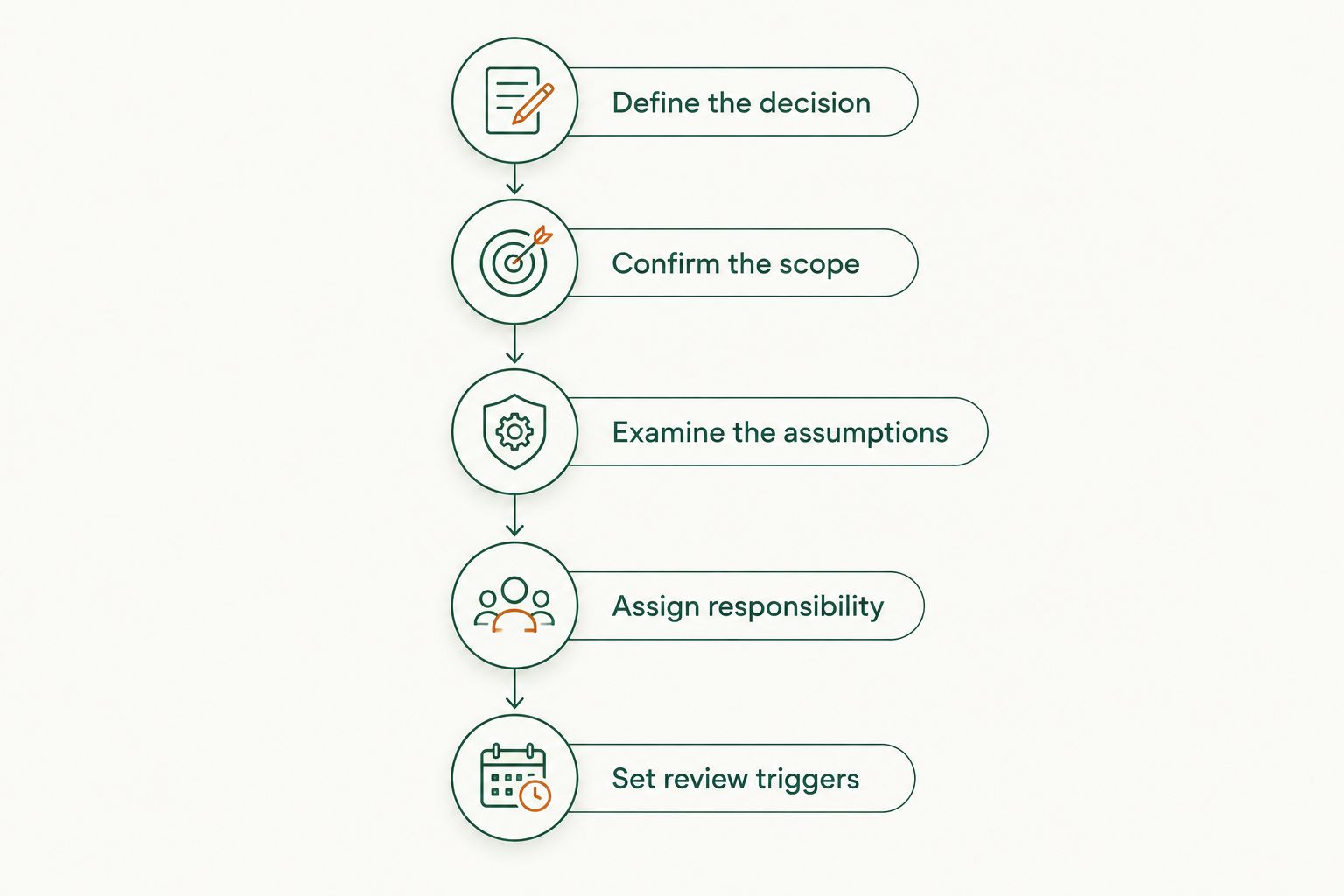
Use this sequence before you commit. It turns a broad promise of financial clarity into specific work you can evaluate.
1. Define the decision
Write down 3 decisions you want the engagement to resolve. Keep each specific enough that you will recognize an answer: whether you can retire, how to fund near-term spending, or which savings priorities should come first.
Then separate urgent decisions from background questions. If every part of your financial life needs attention at once, ask the advisor how the engagement will set priorities rather than assume everything receives equal treatment.
2. Confirm the scope
Request a written description of the analysis, deliverables, meetings, and exclusions. Ask what information the advisor needs from you and how incomplete information affects the recommendations.
A useful scope distinguishes financial planning from investment implementation, tax preparation, and legal document drafting. Do not assume that discussing an issue means the advisor is engaged to complete every related task.
3. Examine the assumptions
Ask how the plan treats spending, inflation, investment returns, taxes, and major changes in circumstances. These are assumptions to examine, not promises about what will happen.
For a plan prepared in 2026, make sure the starting balances and household information reflect your current situation. Request a plain-language explanation of what would cause the recommendation to change.
4. Assign responsibility
Give each action 1 owner. That owner might be you, the advisor, your accountant, or your attorney—but the assignment should be explicit and accepted.
Use an action list with a task, responsible person, dependency, and completion check. A recommendation that depends on another professional's review should say so before you act.
5. Set review triggers
Agree on what happens after delivery. Ask how you should handle a job change, inheritance, retirement-date change, or major shift in spending.
Put your action list on a 12-month calendar so ongoing tasks remain visible. This is an organizational recommendation, not a rule that every household should wait a year to revisit advice.
What should you receive at the end?
The deliverable should let you act without guessing what the advisor meant. The format matters less than whether it connects your question to a recommendation, explains the reasoning, and identifies the next task.
Ask whether the engagement will provide:
- A clear summary of your goals and the information used.
- An explanation of the assumptions behind the analysis.
- Recommendations tied to the decisions you agreed to address.
- Alternatives and their relevant trade-offs.
- A prioritized action list with responsibilities.
- Instructions for follow-up questions and future changes.
A report that says you are on track still needs context. On track for which spending level, retirement date, and household circumstances? You should be able to explain the recommendation back to the advisor in your own words.
For a 2026 plan, keep a dated copy of the information and assumptions used. That makes a later review more useful because you can identify what changed rather than compare unexplained conclusions.
How do you choose the advisor?
Start with the engagement, not a title. Ask what the advisor will do, how the advisor is compensated, which conflicts apply, and whether the advisor will act as a fiduciary throughout the relationship.
Fee-only describes compensation; it does not define the planning scope or promise a particular result. Ask for the relevant disclosures and compare them with the written agreement.
Use the same questions when speaking with each candidate. The guide to fee-only financial advisor qualities provides another way to organize that evaluation.
You should also understand who you will work with and how questions reach that person. Personal attention is difficult to evaluate from a sample report alone; ask how communication works during the engagement and after delivery.
Can I implement a one-time financial plan myself?
Yes, if you understand the recommendations, have authority to act, and can complete the required tasks. Ask the advisor to identify actions that need tax or legal review before you make changes.
Be candid about your time and interest. If you repeatedly postpone financial tasks, assigning yourself responsibility does not solve the follow-through problem; a service that includes implementation deserves consideration.
Will a one-time financial plan become outdated?
Yes, a one-time financial plan needs reconsideration when its underlying facts or assumptions change. A job loss, retirement, inheritance, change in family circumstances, or different spending needs can change the relevance of earlier advice.
Treat the 2026 plan as a dated decision framework, not a permanent instruction sheet. Ask which changes call for a new analysis and how you can obtain that review.
Discuss your planning priorities
Explore integrated financial planning and investment management for your household.
FAQ
Is it worth paying for a one-time financial plan if I manage my own investments?
Yes, when you want professional analysis of a defined decision and will implement the recommendations yourself. Confirm whether the engagement evaluates your investments alongside spending, retirement, and relevant tax considerations.
What's the biggest drawback of a one-time financial plan?
The biggest drawback is the gap between receiving advice and carrying it out. Unless the agreement includes implementation and updates, you remain responsible for those tasks.
Is ongoing financial planning better than a one-time plan?
Ongoing financial planning fits recurring, connected decisions; a one-time plan fits a defined project you can implement. Neither arrangement is better without reference to your needs and the written scope.
Does a financial plan include investment management?
Investment management is included only when the agreement specifies it. A recommendation about your portfolio does not automatically authorize the advisor to trade or monitor your accounts.
Can a financial advisor replace my estate attorney?
Financial planning does not replace legal advice or estate-document drafting. Ask how the advisor's recommendations will connect with work performed by your estate attorney.
What does VIMNewEngland offer for financial planning?
VIMNewEngland provides fee-only financial planning and investment management as an integrated advisory relationship. Its planning covers savings, retirement, taxes, and estate planning.
What should I ask before signing a financial planning agreement?
Ask what decisions the engagement will address, what you will receive, and who will implement each recommendation. Also confirm compensation, conflicts, exclusions, follow-up terms, and responsibility for future updates.
One last thing
Ask the advisor to walk you through the first action you would take after receiving the plan. If the explanation still leaves you unsure who does what, clarify the engagement before signing.
The useful test is not whether the report looks complete. It is whether you know what to do next—and who is responsible for doing it.