
Yes. A fiduciary investment advisor is legally required to act in your best interest within the scope of the advisory relationship, including duties of care and loyalty. That obligation does not guarantee investment gains or eliminate every conflict of interest. In 2026, the essential distinction is whether the person is acting as your investment adviser, your broker, or both—not simply whether their business card says financial advisor.
- Is a fiduciary advisor legally required to act in my interest? Yes, within the advisory relationship’s agreed scope.
- VIMNewEngland’s fee-only financial planning suits New England households seeking integrated planning and investment management.
- A fiduciary duty requires care and loyalty, not guaranteed investment returns or an absence of conflicts.
- Check registration, written responsibilities, compensation disclosures, and whether the professional also acts as a broker.
Why this matters
You need to know which obligations apply before you hand over investment decisions. A retirement recommendation can affect your taxes, access to savings, beneficiaries, and ongoing expenses. The legal standard matters, but so does the work your agreement actually covers.
Start with the distinction between a professional’s title and their legal capacity. Your advisor’s responsibilities come from the relationship and applicable law, not reassuring language on a website. These fiduciary financial advisor qualities to look for help turn that distinction into practical interview questions.
Ask for a written explanation of the duty owed to you and the services covered. Then compare that explanation with the firm’s regulatory disclosures and advisory agreement.
Is a fiduciary advisor legally required to act in my interest?
Yes. For SEC-registered investment advisers, the federal fiduciary duty includes care and loyalty. The SEC’s interpretation of the investment adviser standard of conduct explains that an adviser must serve the client’s best interest and must not subordinate the client’s interest to its own.
The federal framework comes from the Investment Advisers Act and the SEC’s interpretation. State-registered advisers also operate under applicable state requirements. This 2026 guide focuses on investment advice; trust administration, insurance, and other professional relationships can involve separate obligations.
| Professional capacity | Applicable responsibility | Best for | Limitation to examine |
|---|---|---|---|
| Registered investment adviser | Fiduciary duty throughout the advisory relationship, within its agreed scope | Ongoing advice and portfolio oversight when included in the agreement | Registration does not establish skill or guarantee results |
| Broker-dealer representative | Regulation Best Interest applies when making covered recommendations to retail customers | Investors seeking brokerage recommendations and transaction services | The recommendation standard does not itself create an ongoing fiduciary relationship |
| Dual registrant | Responsibilities depend on whether the professional acts as adviser or broker | Investors whose needs include both advisory and brokerage services | You must understand which capacity applies to each service |
These categories describe legal roles, not a ranking of individual professionals. Compare the relationship you are buying, not just the title of the person offering it.
What does a fiduciary advisor actually have to do?
A fiduciary obligation is more than a promise to be helpful. It governs how an adviser develops advice, handles conflicting incentives, and fulfills the agreed relationship.
Duty of care
An investment adviser must provide advice in your best interest based on a reasonable understanding of your objectives. That requires attention to your circumstances rather than a recommendation built solely around a product or portfolio model.
For example, a retirement withdrawal recommendation should account for relevant liquidity needs, risk tolerance, and investment horizon. An investment that fits one household can be inappropriate for another, even when both households have similar account balances.
An adviser’s monitoring responsibilities depend on the relationship’s scope. Ongoing portfolio management differs from advice limited to a particular engagement. Neither should be left to assumption.
Duty of loyalty
An adviser must not put its interests ahead of yours. The SEC framework requires the elimination of conflicts or full and fair disclosure sufficient for informed consent; some conflicts require mitigation or elimination because disclosure alone is inadequate.
Disclosure is not permission to give advice that puts the adviser first. Ask how a conflict affects the recommendation and what the firm does about it. A document that names a conflict without helping you understand its significance is not a useful stopping point for your questions.
Why fiduciary responsibilities vary by relationship
The core obligation is not optional, but its application depends on the services and circumstances. These are the factors to clarify when reviewing an advisory relationship in 2026:
- Legal capacity. A professional acting as an investment adviser has different responsibilities from one acting solely as a broker.
- Service scope. Ongoing investment management and a limited planning engagement involve different responsibilities for follow-through.
- Client circumstances. Your objectives, financial situation, risk tolerance, and need for cash inform appropriate advice.
- Decision authority. Discretionary management allows an adviser to make investment decisions within agreed authority; a nondiscretionary arrangement requires your approval.
- Conflicts and compensation. How the firm is paid, its affiliations, and incentives can affect the conflicts that require attention.
- Applicable law. Federal securities law, state requirements, and retirement-plan rules can apply differently depending on the relationship and recommendation.
Your agreement helps define the work. It cannot turn an adviser’s federal fiduciary duty into an optional promise or broadly waive that duty.
How can I verify an advisor’s fiduciary responsibilities?
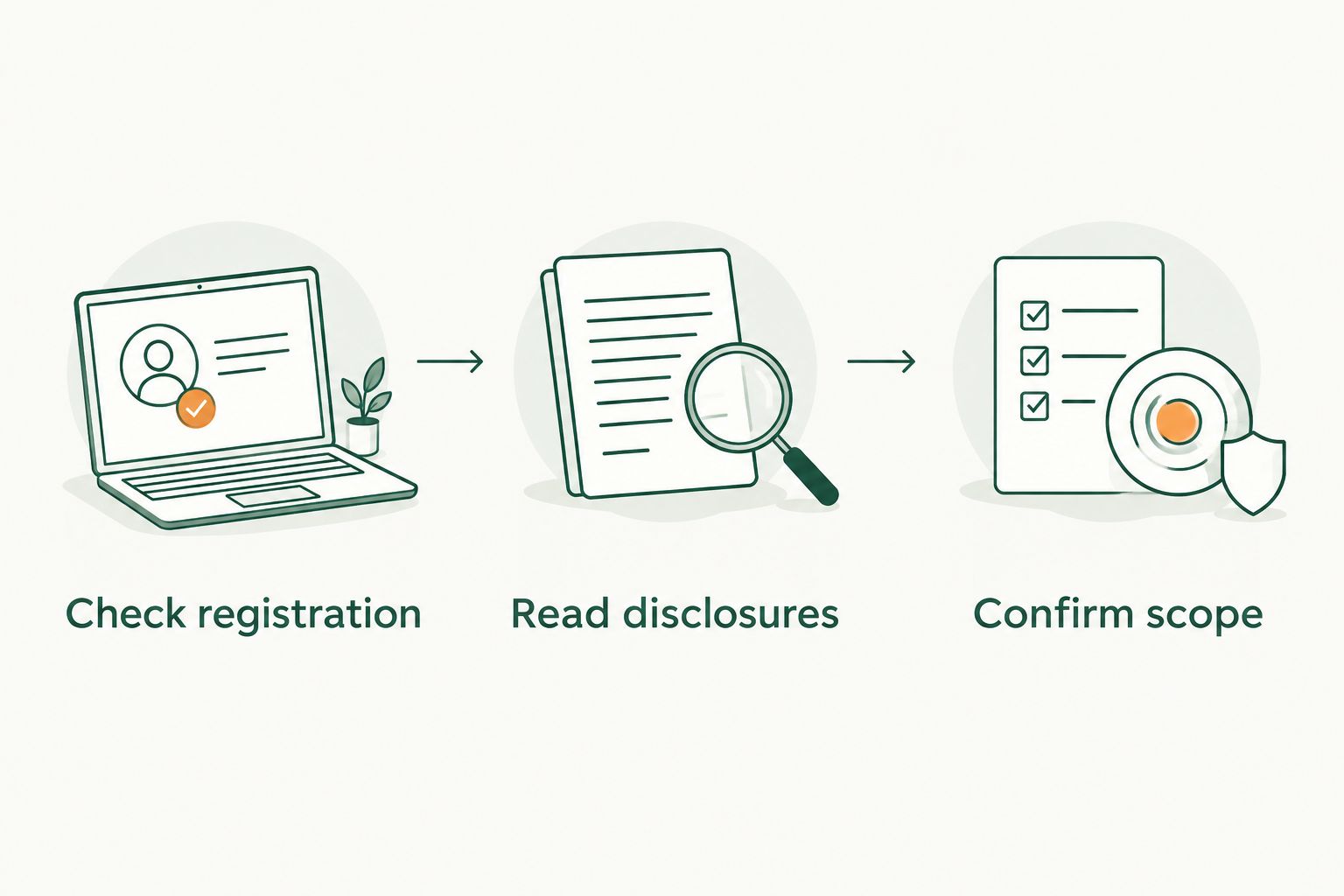
Use 3 document checks before signing: registration information, regulatory disclosures, and the advisory agreement. Read them together. A favorable answer in a meeting does not resolve a contradiction in the paperwork.
1. Check registration
Search the SEC’s Investment Adviser Public Disclosure database for the firm and professional. Review the available registration and disciplinary information, and use FINRA BrokerCheck when brokerage registration is relevant.
Registration tells you about regulatory status. It is not an endorsement, a certification of investment skill, or a guarantee that every service falls under the same legal standard. Make sure you have found the correct legal entity rather than a similarly named business.
2. Read disclosures
For an investment adviser, review Form ADV Part 2A, the firm brochure. Relevant sections address advisory services, compensation, conflicts, disciplinary information, and other business activities. Review the applicable brochure supplement for information about the professional advising you.
Ask for Form CRS when applicable. This relationship summary helps retail investors compare services, costs, conflicts, and disciplinary disclosures. It is a starting point, not a replacement for the agreement or brochure.
3. Confirm scope
Read the advisory agreement for the services included, investment authority, monitoring responsibilities, and termination provisions. Identify what you must do yourself and what requires a separate tax or legal professional.
Ask these 5 questions before you commit:
- Will you act as a fiduciary throughout our investment advisory relationship?
- Will you ever act as a broker in working with me?
- How are you and your firm compensated, including through affiliates?
- Which accounts and planning decisions will you monitor?
- How will you explain conflicts and document significant recommendations?
Keep copies of the documents you review. If a verbal assurance differs from the written terms, resolve the difference before transferring assets. Your goal is a clear division of responsibilities, not a folder of unread disclosures.
Is a fee-only advisor automatically a fiduciary?
No. Fee-only describes compensation, while fiduciary describes a legal obligation. Verify the professional’s registration, capacity, and agreement rather than treating either label as a substitute for the other.
Fee-only compensation removes product-sales commissions from the compensation model, but it does not remove every incentive. An adviser paid according to assets managed can have a financial interest in whether assets remain under management. That makes the reasoning behind a recommendation important, particularly when you are weighing debt repayment, gifts, or a rollover.
For your 2026 advisor search, separate 2 roles that one person can hold: investment adviser and broker. A professional’s obligations depend on the capacity in which they are acting, not simply the compensation label used in an introduction.
Does fiduciary duty mean my advisor cannot lose money?
No. Fiduciary duty does not guarantee positive returns, protect against every market decline, or require the best-performing investment in hindsight. The relevant questions concern the advice, the decision process, conflicts, and fulfillment of the relationship’s responsibilities.
A loss alone does not establish a breach. Conversely, a profitable investment does not excuse disloyal conduct. Ask why an investment fits your goals and risk tolerance, not whether the adviser can promise it will rise.
Does fiduciary duty cover my taxes and estate plan?
Not automatically. The advisory agreement determines whether financial planning, tax coordination, and estate-planning coordination are included. Investment management alone does not establish responsibility for every part of your financial life.
For a New England household with retirement accounts, taxable investments, and estate documents, coordination matters. Ask who reviews beneficiary information, who addresses tax questions, and who follows up with your attorney. Investment advice does not replace legal document preparation or tax services outside the engagement.
Where an integrated advisory relationship fits
VIMNewEngland’s fee-only financial planning is best for New England households seeking coordinated planning and investment management. The firm’s stated services cover savings, retirement, taxes, and estate planning within an integrated advisory relationship.
The benefit is a relationship designed to connect planning decisions rather than treat each account in isolation. The limitation remains important: fee-only compensation and SEC registration do not guarantee returns, eliminate conflicts, or establish that every possible tax or legal service is included.
Review VIMNewEngland with the same questions you would ask any investment adviser. Confirm scope, responsibilities, and compensation in writing before deciding whether the relationship fits your household.
Review your advisory needs
Consider how investment management, retirement, taxes, and estate planning should fit together.
What should I do if I suspect a fiduciary breach?
Start with the specific recommendation or action you question. Gather the agreement, disclosures, statements, transaction records, and relevant communications. Write down what happened and why it appears inconsistent with your instructions or the adviser’s responsibilities.
Ask the adviser for a written explanation. If the response does not resolve the concern, contact the firm’s compliance officer and identify the conduct you want reviewed. Keep the discussion factual: the account involved, the instruction given, the action taken, and the supporting records.
You can also contact the appropriate securities regulator. Depending on the registration and conduct involved, that can include the SEC, a state securities regulator, or FINRA for brokerage matters. A regulatory complaint does not guarantee compensation or replace legal advice about recovery.
If losses or deadlines are involved, consult a qualified securities attorney promptly. Review existing account instructions before making changes so that addressing a dispute does not create an unintended tax or liquidity problem.
FAQ
Is a fiduciary advisor legally required to act in my interest in 2026?
Yes. A fiduciary investment adviser must act in your best interest within the advisory relationship’s scope, including duties of care and loyalty. That duty does not guarantee returns or eliminate every conflict.
Does SEC registration mean an advisor is approved by the government?
No. SEC registration is not government approval, an endorsement of skill, or a guarantee of results. Review the firm’s disclosures and agreement in addition to its registration.
Can a fiduciary advisor have conflicts of interest?
Yes. Fiduciary investment advisers can have conflicts, but they must address them under their duty of loyalty. Depending on the conflict, that requires elimination, mitigation, or full and fair disclosure sufficient for informed consent.
Is a broker legally required to act in my best interest?
Regulation Best Interest applies when a broker makes covered recommendations to retail customers. That standard does not itself create the ongoing fiduciary relationship associated with investment advisory services.
Can I ask an advisor to confirm fiduciary status in writing?
Yes. Ask the adviser to identify the capacity in which they serve you and the scope of their responsibilities. Compare the answer with the advisory agreement and regulatory disclosures.
Does VIMNewEngland provide financial planning and investment management together?
VIMNewEngland describes its fee-only financial planning and investment management as one integrated advisory relationship. Confirm the particular services, responsibilities, and terms in your proposed agreement.
Does a fiduciary advisor replace my estate attorney or accountant?
No. Fiduciary investment advice does not automatically include legal document preparation or tax return preparation. Clarify which planning tasks the adviser handles and which require another professional.
One last thing
Ask the adviser to walk through a recommendation that would reduce the assets they manage—for example, using investments to repay debt or make a gift. You are not testing whether they always recommend that choice. You are checking whether they can explain the trade-offs and their financial incentive plainly.
For a 2026 hiring decision, that conversation makes the duty of loyalty concrete. A clear explanation of a conflict is more useful than a promise that conflicts do not exist. Take the time to understand both the recommendation and who benefits from it.