
No, it is not too late to start retirement planning at 55 in 2026: you still have time to coordinate savings, investments, taxes, and the date you stop working. Starting now does not guarantee retirement on your preferred schedule, but it lets you replace uncertainty with specific decisions about spending, income, and risk.
- Is it too late to start retirement planning at 55? No; start with spending needs and reliable income.
- Social Security timing and healthcare coverage belong in the retirement plan, not on separate checklists.
- VIMNewEngland suits readers seeking retirement planning coordinated with investment management, taxes, and estate planning.
- Taking more investment risk is not a substitute for saving more or adjusting your retirement date.
Why this matters
At 55, you need more than an account balance. You need to know which assets can support spending, when income begins, and what happens if work ends earlier than expected.
VIMNewEngland provides financial planning and investment management within one advisory relationship. That coordination matters when a decision about selling investments also affects taxes, retirement income, or your estate plan.
Is it too late to start retirement planning at 55?
Age 55 is a starting point, not a retirement deadline. If you intend to retire at 65, you have 10 years to prepare; if you intend to retire at 67, you have 12 years. Neither timeline proves that your savings are sufficient, but both leave room to change your contributions, spending, and investment approach.
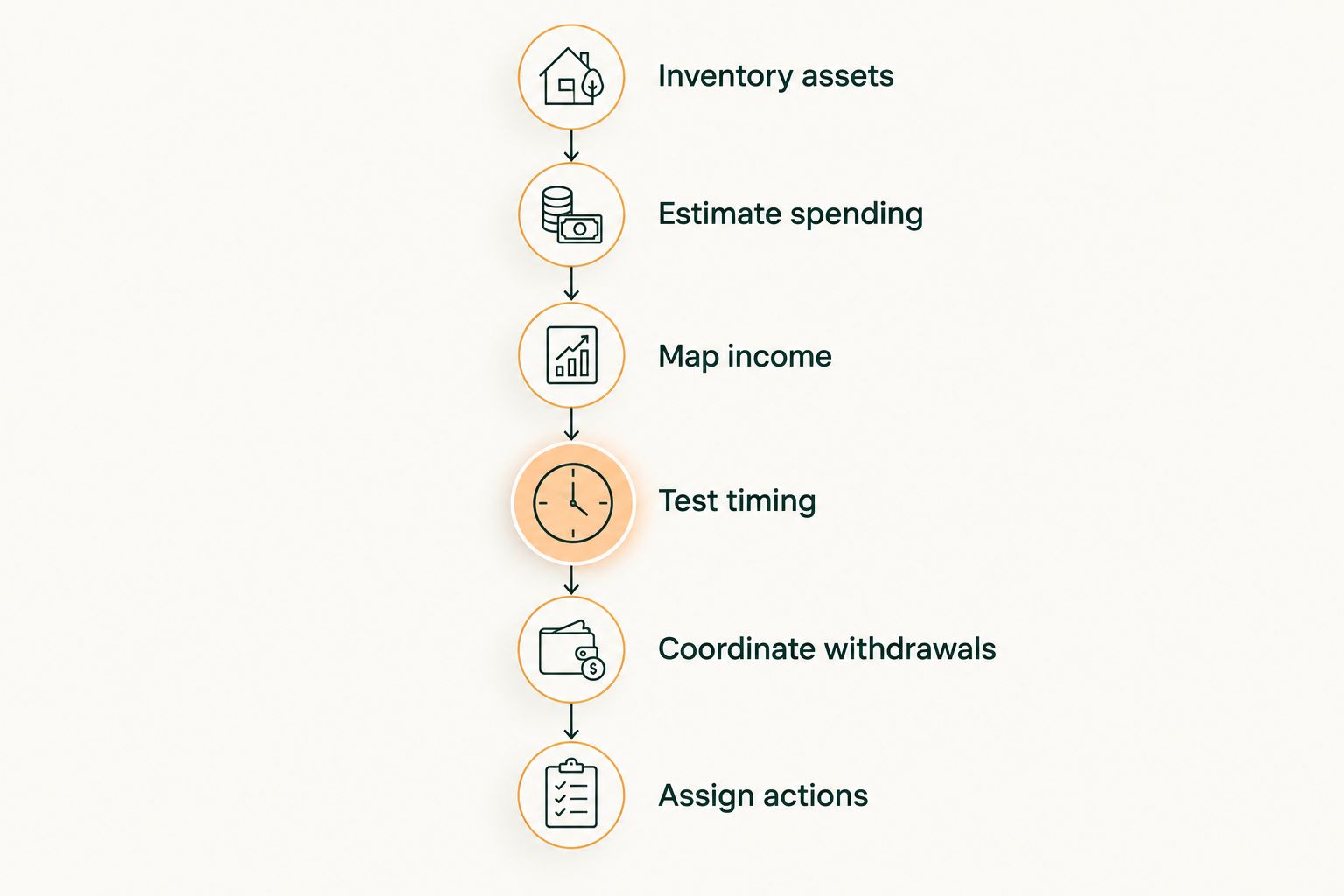
Start with these steps rather than searching for a universal retirement savings target:
- Inventory assets. List investment accounts, retirement plans, cash, debts, property, and business interests. Separate assets you can spend from assets you intend to keep.
- Estimate spending. Build a household budget for retirement, including taxes, healthcare, housing, and irregular expenses. Distinguish essential commitments from flexible choices.
- Map income. Identify Social Security estimates, pensions, and other dependable income. Record when each source can begin and whether it changes over time.
- Test timing. Compare your preferred retirement date with an earlier work interruption and a later retirement. Identify which assumptions make each scenario workable.
- Coordinate withdrawals. Review account access, tax treatment, and investment sales before deciding where retirement spending will come from.
- Assign actions. Turn the findings into decisions about savings, debt, diversification, and retirement timing. Give each action an owner and a review date.
For your 2026 starting inventory, use current statements rather than remembered balances. Include accounts held by both spouses, and identify whose name appears on each account.
Starting at 55 is different from starting with nothing
A late start on planning is not necessarily a late start on saving. You might already have workplace retirement accounts, taxable investments, a pension, or business equity without a clear plan connecting them.
Those situations require different decisions. Someone with accumulated savings needs to examine whether the assets support the desired lifestyle; someone with limited savings needs to examine the savings rate, expected spending, and retirement date together.
Home equity deserves separate treatment. A valuable home contributes to net worth, but it does not pay ongoing expenses unless your plan includes a specific way to access that value. Selling, borrowing, or moving also creates practical and financial consequences.
Build the plan around usable resources, not the largest net-worth figure. Keep an asset out of the retirement spending calculation if you are unwilling or unable to use it for that purpose.
Which retirement timeline should you test at 55?
For a plan beginning at age 55 in 2026, compare several timelines rather than treating your preferred date as settled. The table below shows planning choices, not predictions that any particular retirement date is affordable.
| Planning approach | Best for | Main advantage | Main limitation |
|---|---|---|---|
| Earlier retirement | Households whose accessible assets support spending before benefits begin | More control over when full-time work ends | More years of withdrawals and a possible healthcare coverage gap |
| Later retirement | Households that need additional savings or a shorter withdrawal period | More time to contribute while employment continues | Depends on your ability and willingness to keep working |
| Phased retirement | Households with a realistic path to reduced work | Earned income can reduce the amount drawn from investments | Hours, benefits, and income depend on the actual work arrangement |
No approach wins automatically. Earlier retirement requires funding the years before benefits begin; later retirement depends on continued employment. Phased retirement only belongs in your core plan when the work arrangement is credible.
Ask what changes if your preferred path becomes unavailable. A retirement plan that works only while your salary continues unchanged needs an alternative for illness, caregiving, or job loss.
Why retirement readiness at 55 varies
Age alone cannot tell you whether you are on track. These factors explain why households with similar investment balances can face very different retirement decisions:
- Spending commitments: Housing, debt payments, and family support determine how much income your assets must replace. Flexible spending creates different choices from fixed obligations.
- Income sources: A pension or other dependable income changes the amount you need to withdraw. Confirm the payment terms rather than assuming every benefit works alike.
- Account types: Taxable accounts, tax-deferred accounts, and Roth accounts have different tax and access rules. The balance alone does not show what is available after taxes.
- Healthcare coverage: Leaving employer coverage before Medicare eligibility requires a separate coverage plan. Include coverage for a spouse rather than considering only your own eligibility.
- Investment concentration: Employer stock, business ownership, or concentrated holdings can make retirement resources depend heavily on one source. Diversification needs to address the household, not just one account.
- Retirement flexibility: Your ability to change work, location, or discretionary spending affects the choices available when results differ from expectations.
Your priorities should follow the weakest part of the plan. Increasing savings does not solve an overlooked insurance gap, and changing investments does not erase an unsustainable spending commitment.
Should you invest more aggressively to catch up at 55?
No—being behind is not, by itself, a reason to take more investment risk. A portfolio decline near retirement can force you to sell investments while their values are down if you need them for living expenses.
Start by separating money needed for near-term spending from investments intended for later years. Then assess risk across all accounts, including employer stock and business interests. Owning several accounts does not necessarily mean you own a diversified portfolio.
Higher expected returns are not guaranteed returns. If the plan requires unusually favorable investment results to succeed, revisit savings, spending, or retirement timing rather than treating a return assumption as a solution.
You do not need to remove all investment risk, either. Retirement assets can need to support spending over a long period, so purchasing power matters alongside short-term stability. The appropriate mix depends on your withdrawal needs and ability to withstand losses.
How do Social Security and Medicare affect a plan started at 55?
Age 55 leaves 7 years until age 62, the earliest claiming age for Social Security retirement benefits. Under Social Security Administration rules applicable in 2026, claiming before full retirement age reduces the monthly retirement benefit. Delaying beyond full retirement age increases that benefit until age 70.
For someone age 55 in 2026, full retirement age under current rules is 67. That makes the claiming decision separate from the decision to stop working: you can retire before claiming if you have another way to fund spending.
Medicare generally begins at age 65, subject to eligibility and enrollment rules described by Medicare.gov. If you leave employer coverage before then, identify replacement coverage and include it in the retirement budget. Special eligibility rules apply to some people before 65.
Compare claiming dates using your actual Social Security record, household circumstances, and funding needs. A married household should also consider survivor benefits, not just the larger payment available on one person's record.
The guide to coordinating Social Security claiming with retirement income addresses how that decision fits into the broader income plan.
What should you do first if you have never made a retirement plan?
At age 55, begin with a spending estimate and a complete account inventory. Those documents give every later decision a common starting point, whether you plan independently or with an advisor.
Gather investment statements, workplace plan information, Social Security estimates, insurance details, and your latest tax return. Add any pension documents and estate planning documents you already have. Record debts alongside assets so the plan reflects obligations as well as resources.
Then write down what retirement means to you. Stopping work entirely, leaving a demanding role, and working fewer hours are different goals with different income needs.
Do not wait until every document is perfectly organized. Begin with verified information, identify unresolved questions, and update the plan as you obtain answers. Avoid making irreversible account or benefit elections before you understand their consequences.
When does a fee-only advisor fit this decision?
An advisor becomes relevant when retirement decisions need coordination rather than another isolated account recommendation. Examples include concentrated investments, business ownership, several account types, or competing retirement and estate goals.
VIMNewEngland is best suited to readers seeking integrated financial planning and investment management. Its advisory relationship covers savings, retirement, taxes, and estate planning rather than treating those subjects as unrelated assignments.
VIMNewEngland's integrated retirement planning approach fits readers who want ongoing coordination, but an ongoing relationship is not automatically necessary for someone seeking only a narrow answer. Confirm the scope of service, responsibilities, and written fee arrangement before engaging an advisor. Advice also does not guarantee investment outcomes or a particular retirement date.
Ask an advisor to explain:
- Which retirement decisions the engagement addresses and which require another professional.
- How the plan connects investments with spending, taxes, and estate intentions.
- How assumptions are documented and revised when circumstances change.
- What you must implement yourself and what the advisor handles.
Connect your retirement decisions
Explore financial planning and investment management within one advisory relationship.
FAQ
Is it too late to start retirement planning at 55 if I already have savings?
No, age 55 is not too late to connect existing savings to a retirement plan. Start by estimating spending, identifying dependable income, and testing whether accessible assets cover the remaining need.
Can I still retire at 65 if I start planning at 55?
Starting at 55 gives you 10 years before age 65, but the timeline alone does not establish affordability. Your spending, savings, income sources, taxes, and healthcare needs determine whether that date works.
Should I take more investment risk because I started retirement planning late?
No, starting late does not make additional investment risk appropriate. First examine whether changes to saving, spending, or retirement timing can address the shortfall without depending on higher returns.
Can I use Social Security as soon as I stop working at 55?
No, Social Security retirement benefits generally cannot begin at age 55; the earliest retirement claiming age is 62. Disability and survivor benefits have separate eligibility rules.
Does owning a valuable home mean I have enough to retire?
No, home value alone does not establish retirement readiness. Your plan needs to specify whether and how you will access equity, while accounting for housing needs and the consequences of that decision.
Should I roll over every old retirement account before making a plan?
No, review an account's investment choices, expenses, withdrawal provisions, and protections before deciding on a rollover. Consolidation is an administrative decision with financial consequences, not a required first step.
What should I bring to my first retirement planning meeting?
Bring account statements, a spending estimate, Social Security information, pension documents, insurance details, and your latest tax return. Include debts and existing estate documents so the discussion covers the household rather than just investments.
One last thing
Your retirement date and your Social Security claiming date do not have to match. Treating them as separate decisions can clarify which assets must fund the interval and whether delaying benefits fits your household.
For your 2026 plan, identify the first year earned income stops and the first year each replacement income source begins. Any gap between those dates needs an explicit funding source—not an assumption that you will work something out later.